Economics for Business 2 - Lecture 10 Flashcards
 Call Kai
 Learn
Learn Practice Test
 Spaced Repetition
 Match
Match Flashcards
 Knowt Play
1/31

Earn XP
Description and Tags
This set of flashcards covers key concepts from Lecture 10 of Economics for Business 2, including trade theories, globalisation waves, financial crises, and macroeconomic shift models.
Name | Mastery | Learn | Test | Matching | Spaced | Call with Kai |
|---|
No analytics yet
Send a link to your students to track their progress
32 Terms
Absolute advantage
When one nation is more productive than another, meaning it needs fewer inputs or less time to produce a good or perform a production task.
Comparative advantage
The principle that nations should specialise in production where they have the lowest opportunity cost and trade with others to maximise both nations' standards of living.
Autarky
A situation of no trade where a country produces everything it needs itself with no international exchange.
David Ricardo's 1817 theory
The theory stating that gains from trade exist even if one country is less efficient at producing all goods, provided each country specialises in goods where it has the lowest opportunity cost.
Globalisation
The free movement of goods, services, capital, labour, information, and intellectual property leading to a more integrated global economy.
Four waves of globalisation
(1) First Wave 1800−1914; (2) Collapse 1914−1945; (3) Second Wave 1945−1980s; (4) Hyper-globalisation 1980s−2008.
Benefits of globalisation
Economic growth, cheaper and more diverse goods, job creation in export sectors, innovation, knowledge flow, poverty reduction, and cultural exchange.
Costs of globalisation
Deindustrialisation in high-wage countries, rising inequality, a race to the bottom on wages and labour rights, vulnerability to global shocks, and environmental damage.
Dani Rodrik (1997) Argument
Argued in 'Has Globalisation Gone Too Far?' that competitiveness pressure strained the social fabric of developed economies and widened the wage gap for less-skilled workers.
Paul Krugman's counter-argument
The idea that benefits from free trade can be used to compensate the losers, though in practice benefits often flow to the already well-off.
MPC and Globalisation
Globalisation can weaken aggregate demand because income shifts to wealthy capital owners from lower-income workers who have a higher Marginal Propensity to Consume (MPC).
Deglobalisation
A process of decreasing interdependence between countries, especially regarding trade and financial flows.
Decoupling
Deliberate efforts by the US to reduce economic dependence, technological integration, and supply chain reliance on China to protect strategic autonomy.
Drivers of deglobalisation since 2008
The 2008 GFC, Brexit, COVID-19 supply chain disruptions, the Russian invasion of Ukraine, the global energy crisis, and US-China decoupling.
Potential costs of deglobalisation
Higher production costs, higher prices for consumers, supply chain disruptions, business uncertainty, and challenges from deep economic interdependence.
Five historical financial crises
Tulip Mania (1637), South Sea Bubble (1720), Wall Street Crash (1929), Latin American Debt Crisis (1980s), and the Global Financial Crisis (2007/09).
Elements preceding a financial crisis
New investment opportunities, excessive debt, credit booms, housing or asset price bubbles, and financial deregulation or innovation creating moral hazard.
Post-asset bubble burst symptoms
Crash in asset prices, collapse of financial institutions, credit crunch, bank runs, falling national income, and rising unemployment.
Credit crunch
A situation where financial institutions stop lending funds, even to profitable firms, often when banks are exposed to bad loans.
Moral hazard (Financial)
When institutions take on excessive risk because they believe they will not bear the full consequences of failure due to deregulation or innovation.
GFC shock (AD-AS model)
A dual shock where LRAS and SRAS fell due to financial system damage, and AD fell due to declines in consumption, investment, and exports.
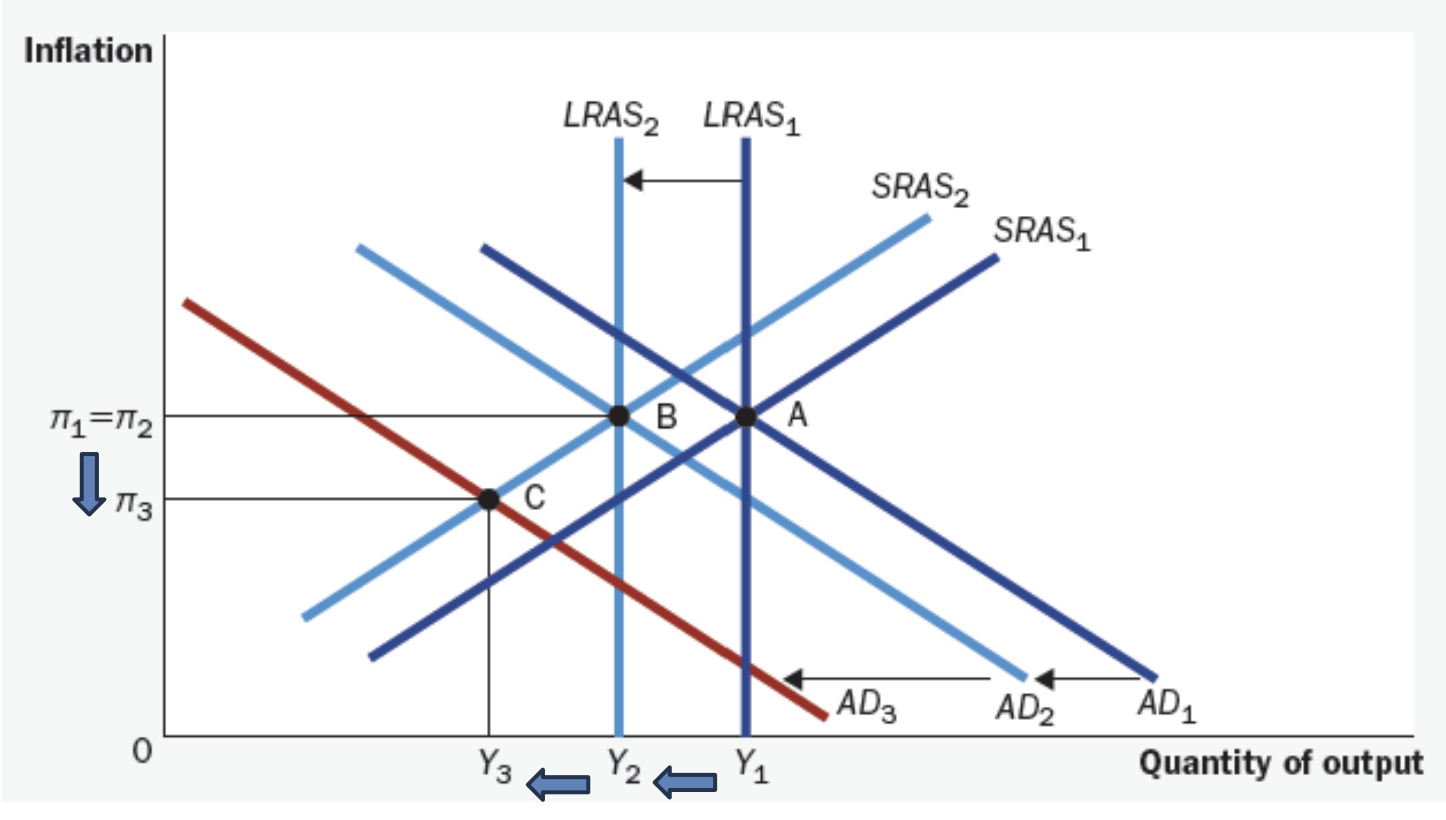
GFC AD-AS Model: Shift A to B
Represents the fall in Long-Run Aggregate Supply (LRAS) due to structural damage to the financial system and the housing sector.
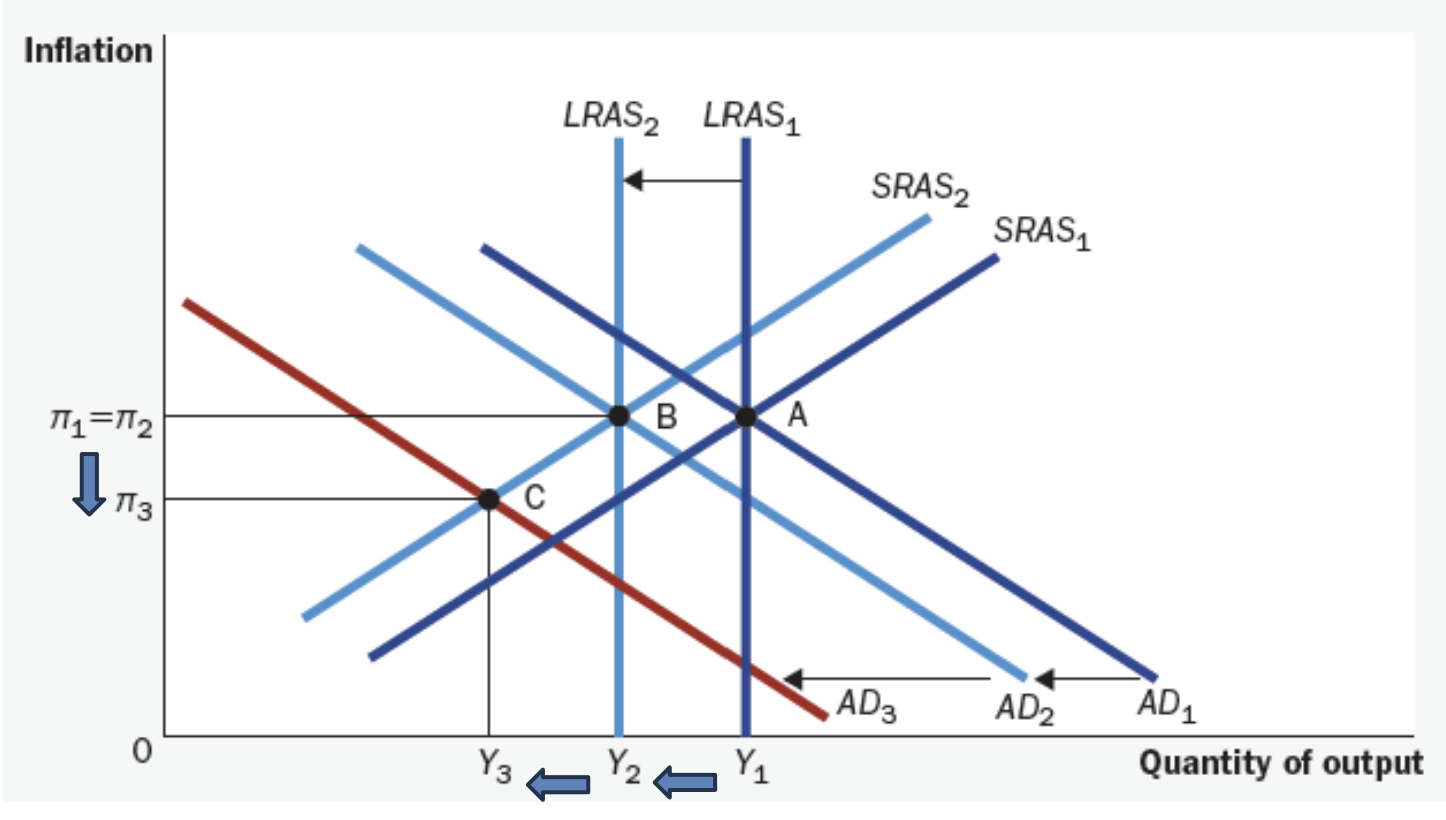
GFC AD-AS Model: Shift B to C
Represents the fall in Aggregate Demand (AD) triggered by declines in consumption, investment, and exports during the financial crisis.
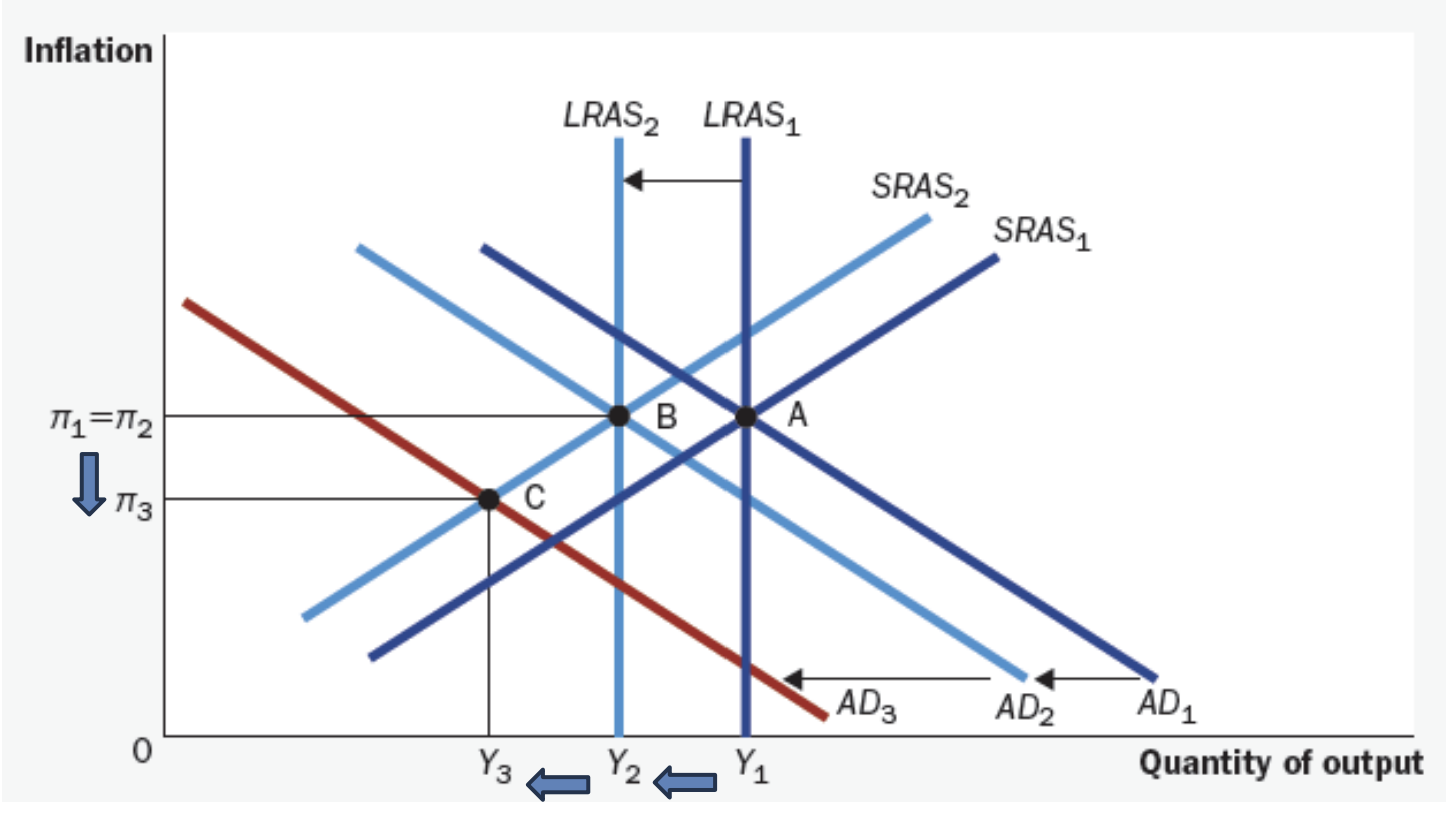
Self-correction mechanism post-GFC
Downward adjustments to wages and prices shifting SRAS right to reach a new equilibrium at LRAS2 with lower inflation and output (Y2).
Sticky wages and prices
The tendency for wages and prices to adjust slowly downward due to contracts, minimum wages, menu costs, and worker resistance.
Expansionary fiscal policy (GFC)
Increasing government expenditure or lowering taxes to boost aggregate demand and close the recessionary gap.
Expansionary monetary policy (GFC)
Lowering the real interest rate to stimulate borrowing, investment, and consumption to shift AD right.
Sacrifice Ratio
The amount of GDP growth that must be sacrificed to achieve a one percentage point reduction in inflation.
Phillips Curve
A relationship showing a short-run trade-off between inflation and unemployment.
Long-run Phillips Curve
A vertical line at the natural rate of unemployment, indicating no lasting trade-off between inflation and unemployment once expectations adjust.
Theory of rational expectations
The idea that firms and people use all available information to form expectations, potentially reducing the real effects of anticipated policy changes.
Recessionary gap
The difference between potential full-employment output and actual output when the economy operates below its long-run potential.