AP HUGE Unit 5: Agriculture and Rural Land Use
 Multiple Choice & FRQ
 Call Kai
1/137

Earn XP
Name | Mastery | Learn | Test | Matching | Spaced | Call with Kai | Chat |
|---|
No analytics yet
Send a link to your students to track their progress
138 Terms
Agriculture
The planting and harvesting of domesticated plants and the raising of domesticated animals for food.
Domesticated Plant
A plant that is deliberately planted, protected, cared for, and used by humans and is genetically distinct from its wild ancestors.
Domesticated Animal
An animal that depends on people for food and shelter and is different from its wild ancestors in looks and behavior as a result of close contact with humans.
Farmers
Raise crops and livestock to sell in the market at a profit rather than raising them for their own consumption
Physical Geography
The study of Earth’s physical characteristics and processes: how they work, how they affect humans, and how humans affect them.
Nutrients
Components of topsoil (such as nitrogen, phosphorus, and potassium) necessary for plants to survive, grow, and reproduce.
Topography
The arrangement of shapes on Earth’s surface
Climate
The average pattern of weather over a 30-year period for a particular region.
Weather
The day-to-day atmospheric conditions that affect daily decisions
Tropical Wet Climates
A climate located along the equator that experiences rain every day of the year
Tropical Wet and Dry Climates
A climate located along the equator that has a dry season with little to no rain, usually in the winter; is often subject to monsoons
Monsoon
Seasonal reversal of winds with a general onshore movement in summer and a general offshore movement in winter; onshore winds bring monsoon rains.
Monsoon Rains
Long periods of heavy rains every day at the end of a short dry season
Arid Climate
A climate that receives less than 10 inches of rain annually
Semiarid Climate
A climate that receives about 10 to 20 inches (25 to 50 centimeters) of rain annually that can support farming; also known as a steppe climate
Moderate Climates
A climate with an average year-round temperature of 75 degrees Fahrenheit (24 degrees Celsius); found north and south of the equator on the edges of tropical climates
Humid Subtropical Climates
A climate with long, hot summers and short, mild winters with variable precipitation; found on east coasts of continents
Marine West Coast Climates
A climate found a long western coasts of continents closer to the poles; characterized by moderate temperatures during long summers and cool winters
Mediterranean Climate
A climate with winter precipitation, unusually mild winters, and clear skies with abundant sunshine; found along the Mediterranean Sea and a few coastal regions
Continental Climates
A climate that has a larger range of temperatures and moderate precipitation; found in the interior of continents, north of the moderate climate zones.
Humid Continental Climates
A climate with a wide range of temperatures, moderate precipitation, and four distinct seasons; experiences warm to hot summers, moderate to abundant rainfall (20–50 inches [50–150 centimeters] annually), and cold winters with precipitation falling as snow
Humid Cold Climates
A climate with frigid temperatures nearly year-round, found in northern reaches of the continental climate zone and often described as subartic
Intensive Agriculture
Crop cultivation and livestock rearing systems that use high levels of labor and capital relative to the size of the landholding.
(Intensive) Subsistence Agriculture
Food production mainly for consumption by the farming family and local community, rather than principally for sale in the market (ex: planting a small garden).
Commercial Agriculture
Farming oriented exclusively toward the production of agricultural commodities for sale in the market.
Market Gardening
A small-scale farming system in which a farmer plants one to a few acres that produce a diverse mixture of vegetables and fruits, mostly for sale in local and regional markets.
Truck Farm
A scaled-up version of market gardening, with more acreage, less crop diversity, and a stronger orientation toward more distant markets
Plantation
Large landholding devoted to capital-intensive, specialized production of a single tropical or subtropical crop for the global marketplace
Mixed Crop / Livestock Agriculture
A diversified system of agriculture based on the cultivation of cereal grains and root crops (such as potatoes and yams) and the rearing of herd livestock
Cereal Grains
Seeds that come from a wide variety of grasses cultivated around the world, including wheat, barley, sorghum, millet, oats, and maize (corn).
Millet
A fast growing cereal plant that is widely grown in warm regions with poor soil.
Root Crops
Vegetables that form below ground and must be dug at maturity, such as cassava, potatoes, and yams.
Cash Crops
A crop raised to be sold for profit rather than to feed the farm family and the lifestock; common cash crops are cotton, flax, hemp, coffee, and tobacco.
Peasants
Small-scale farmers who own their fields, rely chiefly on family labor, and produce both for their own subsistence and for sale in the market.
Paddy Rice Farming
A system of wet rice cultivation on small level fields bordered by impermeable dikes; the fields (paddies) are flooded with 4-6 inches of water for about three-quarters of the growing season.

Grain Farming
A highly mechanized commercial farming system that specializes in the production of cereal grains; requires large farms and widespread use of machinery, synthetic fertilizer, pesticides, and genetically engineered seeds.
Livestock Fattening
An intensive system of animal feeding utilizing fenced enclosures to fatten livestock, mostly cattle and hogs, for slaughter and processing for the market
Feedlots
A fenced enclosure used for intensive livestock feeding that serves to limit livestock movement and associated weight loss.
Dairying (Dairy Farming)
A farming system that specializes in the breeding, rearing, and utilization of livestock (primarily cows) to produce milk and its various by-products, such as yogurt, butter, and cheese.
Extensive Agriculture
Crop cultivating and livestock rearing systems that require little hired labor or monetary investment to successfully raise crops and animals.
Shifting Cultivation
The cultivation of a plot of land until it becomes less productive, typically over a period of about three to five years; when productivity drops, the farmer shifts to a new plot of land that has been prepared by slash-and-burn agriculture
Slash-and-burn Agriculture
Agriculture that involves cutting small plots in forests or woodlands, burning the cuttings to clear the round and release nutrients, and planting in the ash of the cleared plot; also known as swidden agriculture
Intercropping
The farming practice of planting multiple crops together in the same clearing.
Nomadic Herding
A system of breeding and rearing herd livestock, such as cattle, sheep, or goats, by following the seasonal movement of rainfall to areas of open pasturelands; also known as [nomadic] pastoralism.
Tundra
The vast, flat, treeless arctic region of Europe, Asia, and North America in which the subsoil is permanently frozen
Livestock Ranching
The practice of using extensive tracts of land to rear herds of livestock to sell as meat, hides, or wool
Rural Area
Area located outside of towns and cities; all the space, population, and housing not included in an urban area.
Rural Settlement
A small group of people living outside of an urban area.
Agricultural Landscape
The visible imprint of agricultural practices.
Grain Elevator
A large storage facility for grain.
Suitcase Farm
In U.S. commercial grain agriculture regions, a farm on which on one lives; planting and harvesting are done by hired migratory crews.
Settlement Patterns
The ways in which people organize themselves on the land.
Clustered Settlement or Farm Village
A tightly bunched farm settlement that has anywhere from a few dozen to several hundred inhabitants.
Farmstead
A center of farm operations, which includes the farmhouse, barn, shed, livestock pens, and family garden.
Dispersed Settlement or Isolated Settlement Pattern
A settlement pattern in which families live relatively distant from one another.
Linear Settlement Pattern
A settlement pattern in which buildings are arranged in a line, often along a road or river, limited to areas where legal systems dictated that property lines must be rectangular.
Survey Methods
The methods used by surveyors to lay out property lines.
Cadastral Survey
Systematic documentation of property ownership, shape, use, and boundaries.
Metes & Bounds
Survey systems that use natural features such as trees, borders, and streams to delineate property boundaries.
Township & Range
Land survey system conducted by the U.S. Land Ordinance of 1785, which divides most of the country’s territory into a grid of square-shaped townships with 6-mile sides.
Long-lot Survey System
A unit-block surveying system whose basic unit is a rectangle that is typically 10 times longer than it is wide.
Domestication
The long-term process through which humans selectively breed, protect, and care for individuals taken from populations of wild plant and animal species to create genetically distinct species, known as domesticates.
First Agricultural Revolution
The period during which the early domestication and diffusion of plants and animals and the cultivation of seed crops led to the development of agriculture.
Teosinte
Large wild grass native to Mexico that produced the small ears of maize (corn) that were favored food among early groups in Mesoamerica.
Mesoamerica
The cultural region in the Americas that includes the diverse civilizations in the modern-day countries of Mexico, Guatemala, Honduras, Belize, El Salvador, Nicaragua, and Costa Rica.
Biodiversity
The variety and variability among species and ecosystems.
Hearth
A center where innovations or new practices develop and from which the innovations or new practices spread or diffuse.
Fertile Crescent
Areas in Southwest Asia that includes the river valleys of the Tigris and Euphrates; the earliest center for domestication of seed plants.
Indus River Valley
Area along the Indus River that flows from the highlands of Tibet and continues down along the border between present-day Pakistan and India; a site of the earliest domestication of plants and herd animals.
Columbian Exchange
The interaction and widespread transfer of plants, animals, culture, human populations, technology, disease and ideas between the Americas, West Africa, and the Old World in the fifteenth and sixteenth centuries.
Second Agricultural Revolution
The period that brought improved methods of cultivation, harvesting, and storage of farm produce that began in the late 1600s and continued through the 1930s.
Seed Drill
A machine for planting seeds in a row.
Mechanical Repair
A machine used to harvest grain crops mechanically; patented by Cyrus McComick in 1831.
Scythe
An agricultural hand tool with a curved blade used for cutting grain in the fields.
Agrichemicals
Chemical compounds obtained from petroleum and natural gas for use in agriculture; includes fertilizers, pesticides, and herbicides.
Synthetic Fertilizer
Industrially manufactured nitrogen, phosphorus, and potassium, made from petroleum by-products; contains higher concentrations of nutrients for plants than natural fertilizers.
Pesticide
Material used to kill or repel animals or insects that can damage, destroy, or inhibit crop growth.
Herbicide
Pesticide designed to kill or inhibit the growth of unwanted plants (weeds) that compete with crops.
Nutrient Pollution
Consequence of overuse of fertilizer; occurs when excess nutrients seep down into groundwater or are carried into nearby waterways as runoff.
Runoff
The flow of rain or irrigation water over land.
Green Revolution
The U.S.-supported development of high-yield seed varieties that increased the productivity of cereal crops and accompanying agricultural technologies for transfer to less developed countries.
Cross Breeding
The act of mixing different species or varieties of plants or animals to produce hybrids.
Hybrids
The offspring of two plants or animals of different species or varieties.
Double-Cropping
Planting another crop on the same plot of land as soon as the first crop has been harvested.
Multicropping
Planting two or three crops per year on the same land.
Cassava
A root vegetable native to South America.
Sorghum
A grain plant native to northeast Asia.
Endemic
Native to or characteristic of a certain environment.
Environmental Contamination
Chemical residue that builds up with each application of synthetic fertilizers and pesticides.
Soil Salinization
The concentration of dissolved salts in the soil.
Soil Salinity
A measure of the concentration of dissolved salts in the soil; a high measure results from poor irrigation practices
Capital Expenditures
Assets that cost money, such as land, machinery, synthetic fertilizers and pesticides, seeds, and livestock feed.
Bid-Rent Theory
Explains how the demand for and price of land decrease as its distance from the central business district increases.
Central Business District (CBD)
A dense cluster of offices and shops located at a city’s most accessible point, usually its center.
Large-Scale Commercial Operation
A large-scale farm oriented exclusively toward the production of agricultural commodities for sale in the market.
Monocropping (Monoculture)
The cultivation of a single commercial crop on extensive tracts of land.
Agricultural Cooperative
An organization where farmers pool their resources in certain areas of activity such as services or production; services or production resources are provided to individual farm members.
Family Farm
A farming operation wholly owned by a family or a family corporation that sells its products to some defined market, either directly or through a cooperative.
Commodity
In agriculture, a primary product that can be bought and sold, such as coffee, rice, or milk.
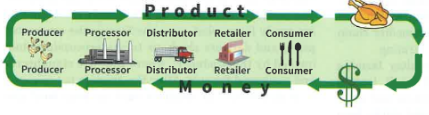
Commodity Chain
A series of links connecting a commodity’s many places of production, distribution, and consumption.