Physics Honors: Circuits and Induction
 Call Kai
 Learn
Learn Practice Test
 Spaced Repetition
 Match
Match Flashcards
 Knowt Play
1/19

There's no tags or description
Looks like no tags are added yet.
Name | Mastery | Learn | Test | Matching | Spaced | Call with Kai |
|---|
No analytics yet
Send a link to your students to track their progress
20 Terms
What is the direction of the electric field of a positive source charge?
is always directed away from the positive source
What is the direction of the electric field of a negative source charge?
is always directed toward the negative source
What happens during a fall of an object?
During a fall of an object, at the high location the object’s total amount of mechanical energy is conserved, but once it falls there is a loss of potential energy and a gain for kinetic energy. (work done by gravity)
What happens during the rise of an object?
When gravity does work upon an object to move it in the direction of the gravitational field, then the object loses potential energy. The potential energy originally stored within the object as a result of its vertical position is lost as the object moves under the influence of the gravitational field
What needs to be done to move an object?
Work must be done by an external force to move an object against nature - from low potential energy to high potential energy.
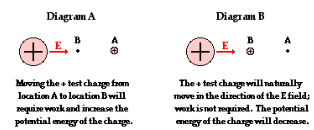
What happens when objects move through positive potential source charge ?
In Diagram A, a positive test charge moves against the electric field from A to B, so work is required and the charge gains potential energy. In Diagram B, the charge moves with the field from B to A naturally, losing potential energy. Therefore, a positive test charge has the highest potential energy closest to the positive source charge and the lowest energy farther away.
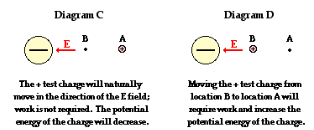
What happens when objects move through negative source charge?
In Diagram C, a positive test charge moves with the electric field from A to B naturally, so no work is needed and the charge loses potential energy. In Diagram D, the charge moves against the field from B to A, requiring work and causing the charge to gain potential energy. Therefore, a positive test charge has the lowest potential energy near a negative source charge and the highest energy farther away.
What is gravitational potential energy dependent on?
The amount of gravitational potential energy stored in an object depended upon the amount of mass the object possessed and the amount of height to which it was raised.
Ex: An object with twice the mass would have twice the potential energy and an object with twice the height would have twice the potential energy.
The greater the charge on the test charge…
the greater the repulsive force and the more work that would have to be done on it to move it the same distance.
What happens when two objects are the same charge?
with one being twice the charge of the other - are moved the same distance into the electric field, then the object with twice the charge would require twice the force and thus twice the amount of work
What is electric potential energy dependent on?
upon the amount of charge on the object experiencing the field and upon the location within the field
What happens with energy in a battery?
A battery creates high and low electric potential. Inside the battery, moving a positive charge from the negative terminal to the positive terminal goes against the electric field, so work is needed and the charge gains potential energy. This makes the positive terminal the high potential terminal. As charge moves through the wires from the positive to the negative terminal, it moves naturally with the electric field, loses potential energy, and requires no work. Therefore, the negative terminal is the low potential terminal.
What is electric potential difference?
is the difference in electric potential (V) between the final and the initial location when work is done upon a charge to change its potential energy.
What is current?
rate at which charge flows past a point on a circuit.
The equation for current is I= Q/t
What is resistance?
is the hindrance to the flow of charge. The variables that affect resistance are the total length of the wires, cross sectional area of the wires, and the material the wire is made of.
What is Ohlm’s Law?
The electric potential difference between two points on a circuit (ΔV) is equivalent to the product of the current between those two points (I) and the total resistance of all electrical devices present between those two points R.
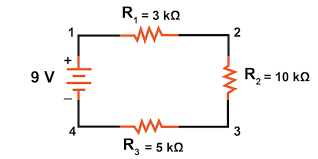
What is a series circuit?
each device is connected in a manner such that there is only one pathway by which charge can traverse the external circuit. Each charge passing through the loop of the external circuit will pass through each resistor in consecutive fashion.
Equations for Series circuits: Req = R1 + R2 + R3 + …
I = I1 = I2 = I3 = … + Ohlms Law
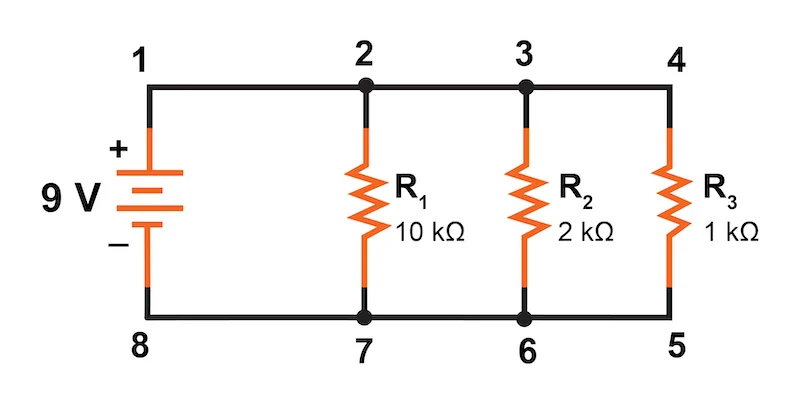
What is a parallel circuit?
, each device is placed in its own separate branch. The presence of branch lines means that there are multiple pathways by which charge can traverse the external circuit. Each charge passing through the loop of the external circuit will pass through a single resistor present in a single branch.
Itotal = I1 + I2 + I3 + … 1 / Req = 1 / R1 + 1 / R2 + 1 / R3 + … + Ohlms Law
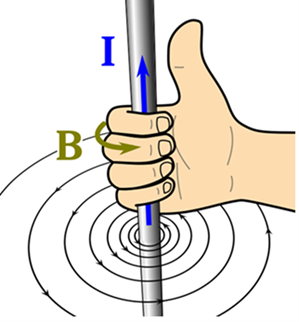
What is the “Field-Finding” right hand rule?
This rule allows us to determine the direction of the magnetic field around a current-carrying wire. Here’s how it works:
Step 1: Using your right hand, point your thumb in the direction of the current
Step 2: The fingers of your right hand will automatically curl around the wire in the direction of the B-field
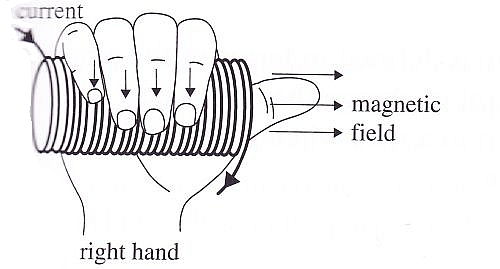
What is the solenoid right hand rule?
curl the fingers of your right hand around the coil in the direction of the conventional current (from positive to negative). Your extended thumb will point in the direction of the magnetic field lines inside the solenoid, which designates the North Pole