MKTG 3310 Exam 3 Wolter
 Call Kai
 Learn
Learn Practice Test
 Spaced Repetition
 Match
Match Flashcards
 Knowt Play
1/189

There's no tags or description
Looks like no tags are added yet.
Name | Mastery | Learn | Test | Matching | Spaced | Call with Kai | Chat |
|---|
No analytics yet
Send a link to your students to track their progress
190 Terms
What is a product?
Anything that can be offered to a market for attention, acquisition, use, or consumption
What are the products that fit under the broadened definition of product?
- Convenience products
- Shopping Products
- Ideas
- Places
- People/persons
- Organizations
- Goods, services
Convenience products
consumer product that customers usually buy frequently, immediately, and with minimal comparison and buying effort
Shopping products
a consumer product that the customer, in the process of selecting and purchasing, usually compares on such attributes as suitability, quality, price, and style
Ideas (as products)
- In a sense, all marketing is the marketing of an idea, whether it is the general idea of brushing your teeth or the specific idea of crest toothpaste
- Social marketing is a subset of this
Social marketing
a more narrow focus of the idea of idea marketing, social marketing consists of using traditional business marketing concepts and tools to encourage behaviors that will create individual and societal well being
Places (as products)
activities undertaken to create, maintain, or change attitudes or behavior towards particular places
People/persons (as products)
Consists of activities undertaken to create, maintain, or change attitudes or behavior toward particular people
Organizations (as products)
carry out activities to sell the organization itself. Create, maintain, or change the attitudes and behavior of target customers toward an organization
What are the product levels?
Core Customer Value, Actual Product, Augmented Product
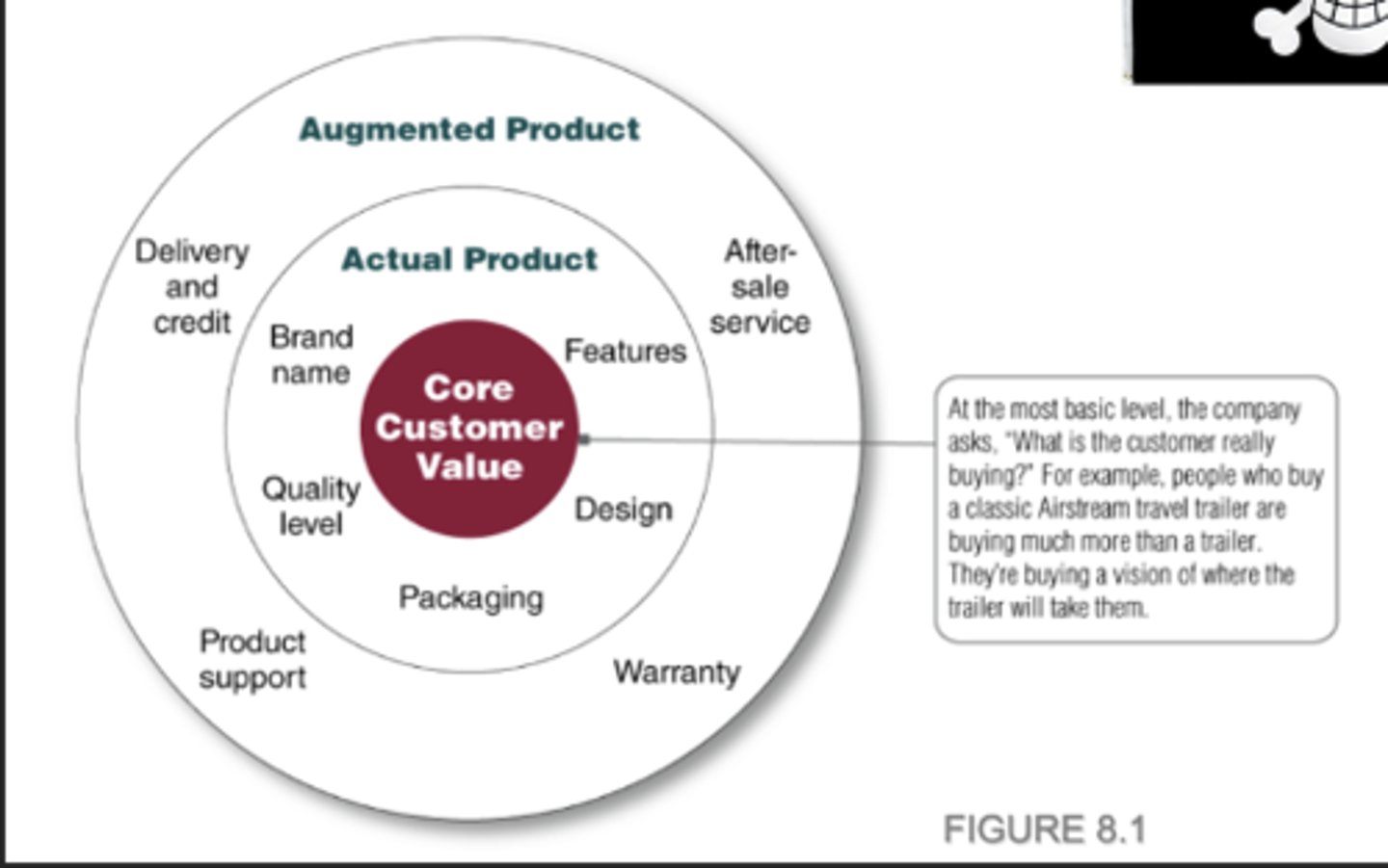
Product Levels: Core Customer Value
Why you buy, the main thing that you actually get from the product
Product Levels: Actual Product
- Manifestation that the product takes
- Includes Brand Name, Quality Level, Packaging, Design, and Features
Product Levels: Augmented Product
- Service Elements
- Includes Delivery and Credit, Product Support, Warranty, After Sale Service
How do consumers see products?
Complex bundles that satisfy their needs.
Where does someone start when designing a product?
When developing products, marketers must first identify the core customer value that consumers seek from the product. Then they must design the actual product and find ways to augment it to create customer value and a full and satisfying brand experience
Which level does product differentiation occur?
- Over time, you tend to build from the inside out. Other companies may copy the core, but then must differentiate in the outer rings
- Differentiation happens at all levels
What is product quality?
The characteristics of a product or service that bear on its ability to consistently and reliably satisfy stated or implied customer needs. Consistency is in which you hit that level of quality
Product quality
Strong potential point of differentiation both in terms of performance (level of quality) and conformance (stability of quality)
What are performance and conformance quality?
- Performance quality: the level of quality you intend to provide
- Conformance quality: the consistency at which you hit that level
Why may performance be mid but conformance be high?
Performance may be mediocre, but your conformance may be higher because you are always meeting that mediocre or "mid" level of performance and meeting the customer's expectations
Which type of quality is a determinant of satisfaction?
Conformance is the determinant of satisfaction because it can be disconfirmed and make a customer less satisfied
What are services?
Products that consist of activities, benefits, or satisfactions offered for sale that are essentially intangible and do not result in a customer's ownership of anything
What kind of products are most prevalent in the US economy?
US is a service based economy
Why is the US a service based economy?
- Manufacturing occurs in other countries
- Automation of production of goods
- Innovations
US as a service-based economy: Manufacturing occurs in other countries
Offshoring, import most of our goods
US as a service-based economy: Automation of production of goods
Companies automate processes during recessions, then never return to the traditional human-led approach to these processes (General idea: we automate production)
US as a service-based economy: Innovations
We often make new services more than we do new goods, such as OpenAI, Grubhub, etc.
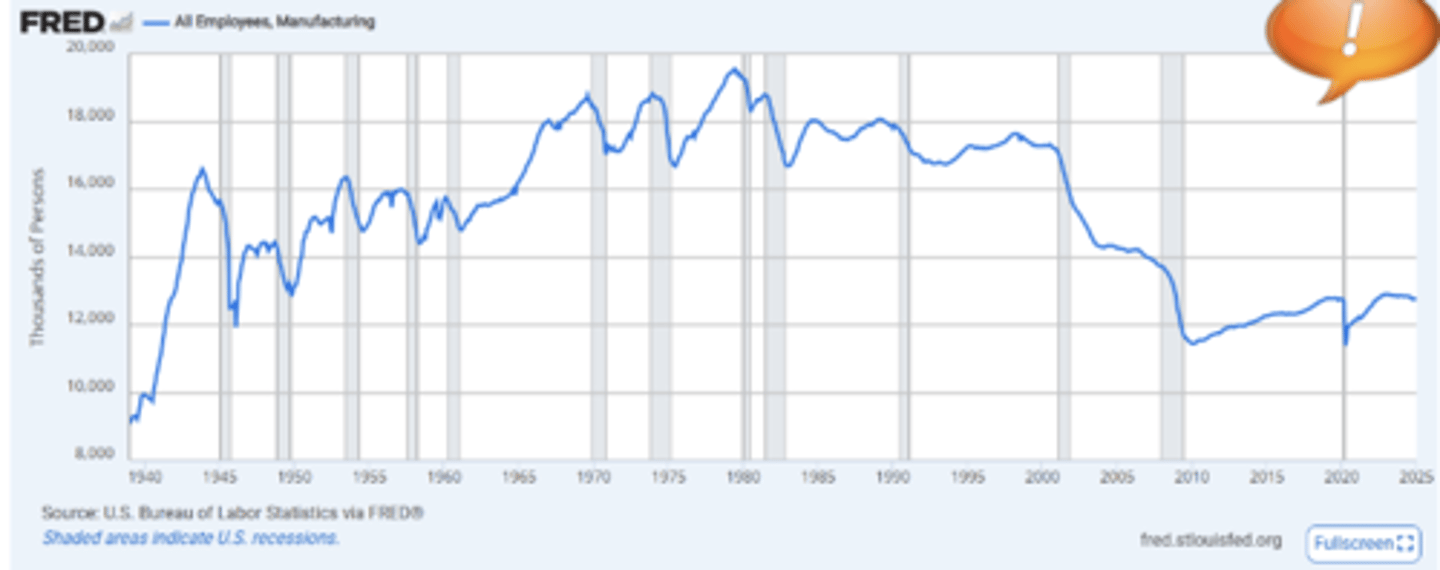
How do we determine that the US is a service based economy?
- We look at the percent and quantities of workers in the manufacturing industry, and notice it is low, but also declining.
- We can also look at the percent of value added industries to out GDP, and that is also trending downwards
How are services different from goods?
Intangibility, Variability, Inseparability, Perishability
How services differ from goods: Intangibility
Services cannot be seen, tasted, felt, or heard before purchase
How services differ from goods: Variability
Quality depends on who provides them, and when, where, and how they are provided
How services differ from goods: Inseparability
Services cannot be separated from their providers
How services differ from goods: Perishability
Services cannot be stored for later use
How intangibility of services affects marketing
Intangible products are harder to assess. The benefits of intangible products must be made tangible, meaning you have to find a way to sell what they cannot see through the intangible benefits. Tangible products often push intangible benefits to take advantage of the lasting power of abstract concepts in memory
How variability of services affects marketing
- A heterogenous product has greater employee and customer input, therefore quality becomes harder to control.
- Quality is determined by employees. Greater customization = greater variability = difficult quality control. Therefore, you must provide less options to improve and control quality
How inseparability of services affects marketing
An inseparable product must be produced in front of and along with customers. Quality is hard to achieve and assess for the organization. Also the customer must be accommodated within the serviscape, creating capacity issues. Customers impact each other
How perishability affects marketing
A perishable product cannot be produced ahead of time, so demand must be forecasted. A perishable product cannot be returned for a comparable product, therefore, additional remedies must be offered (make amends for a mistake)
Does employee satisfaction relate to customer satisfaction for all products?
- Happy employees work better and make customers happier
- However, this only happens when products are highly separable and variable
- Does not work when you have high quality (
Which customers perceive changes in employee satisfaction?
- Customers who are physically with employees when receiving the service (highly inseparable)
- Those who patronize OFTEN
Do manufacturing or service organizations have higher or lower satisfaction?
Due to the fact that services provide more interaction with customers, the employee attitude has more impact on customer satisfaction, resulting in lower satisfaction rates for service organizations.
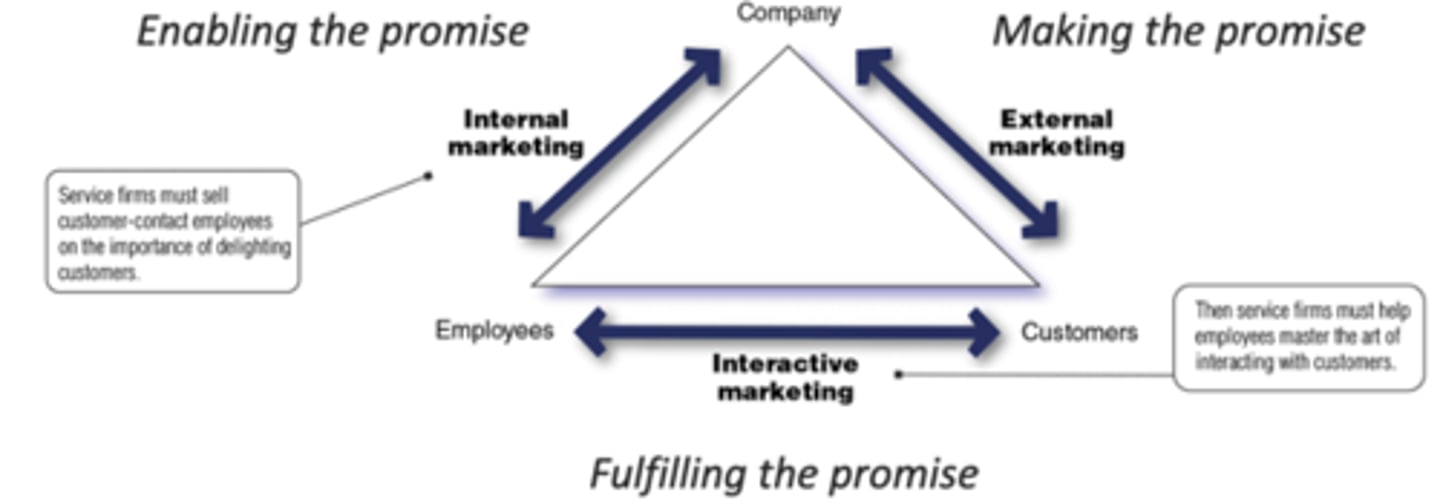
Services marketing triangle (I recommend drawing this a few times over and understanding the concepts)
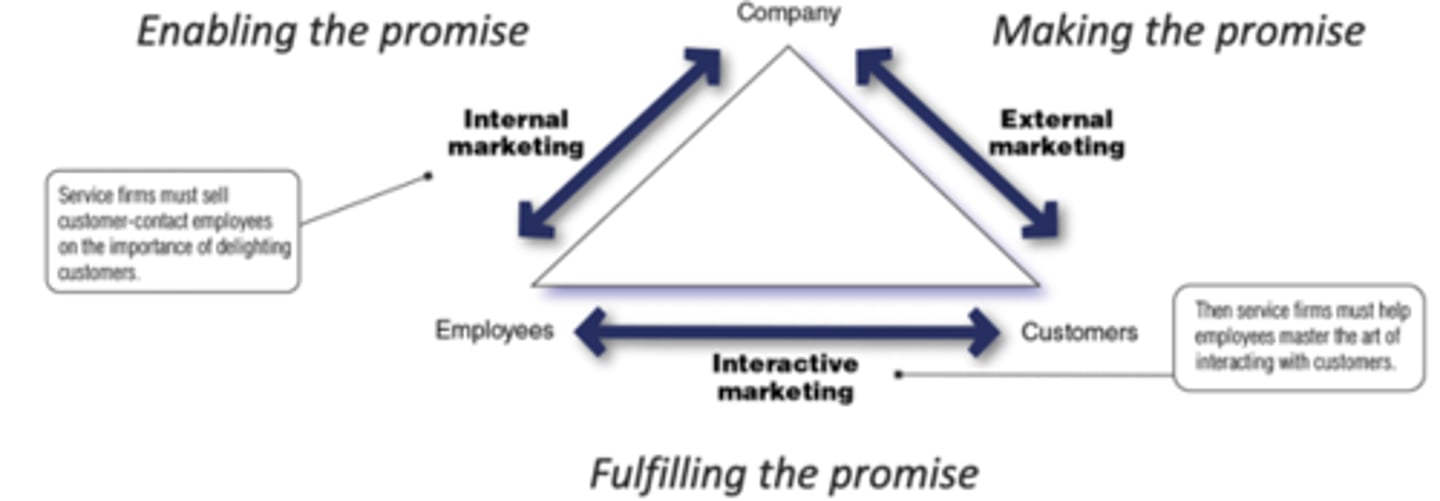
What are the concepts captured by the left side of the Services Marketing Triangle?
- Enable the promise, Internal Marketing
- Company to employees: do something for the employees that will provide the actual service. Give them the means to provide the service.
What are the concepts captured by the right side of the Services Marketing Triangle?
- Making the promise, External Marketing
- Company to customer: what you are saying to your customers and are promising
What are the concepts captured by the bottom side of the Services Marketing Triangle?
- Fulfilling the promise, interactive marketing
- Employee to customers: Employee and customer meet. "Moment of truth"
(if you have done the left and right sides correctly, then this side should fulfill the promise as it was promised)
What are the four categories of benefits?
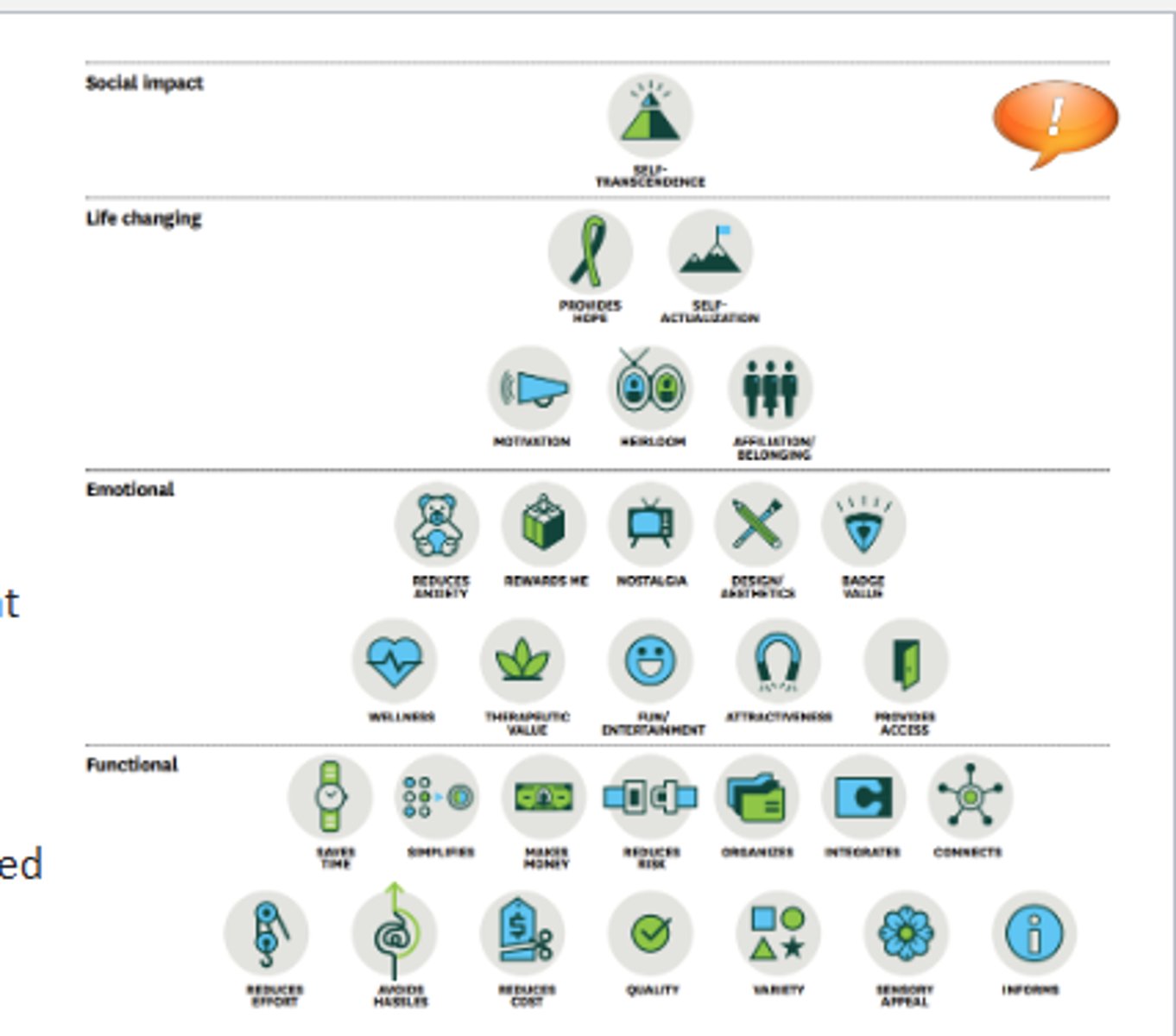
Products provide benefits that address four kinds of needs:
- Social impact
- Life Changing
- Emotional
- Functional
Categories of benefits: Social Impact
Self transcendence: above and beyond the needs
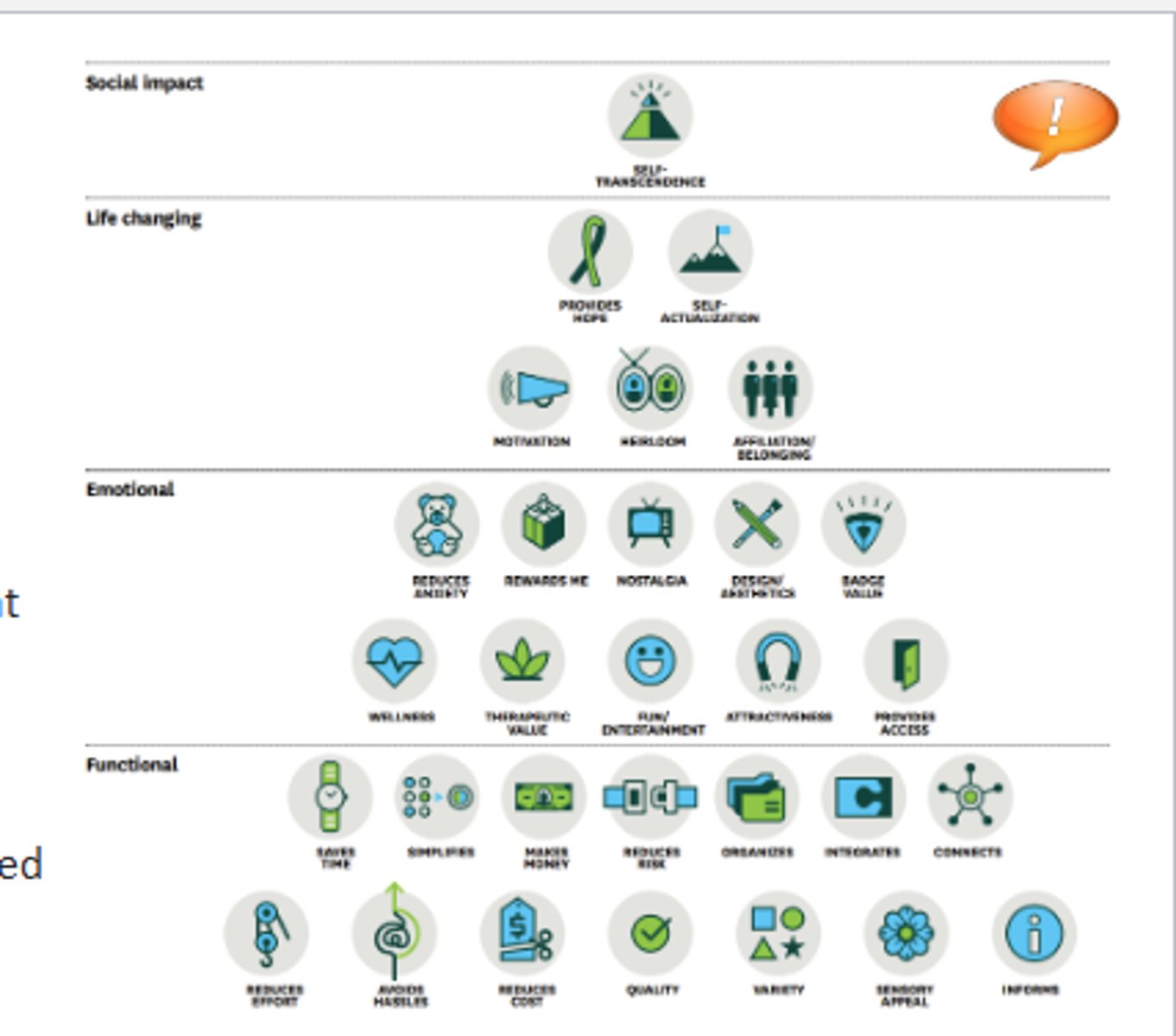
Categories of benefits: Life changing
Includes things like hope, self actualization, motivation, heirloom, affiliation and belonging
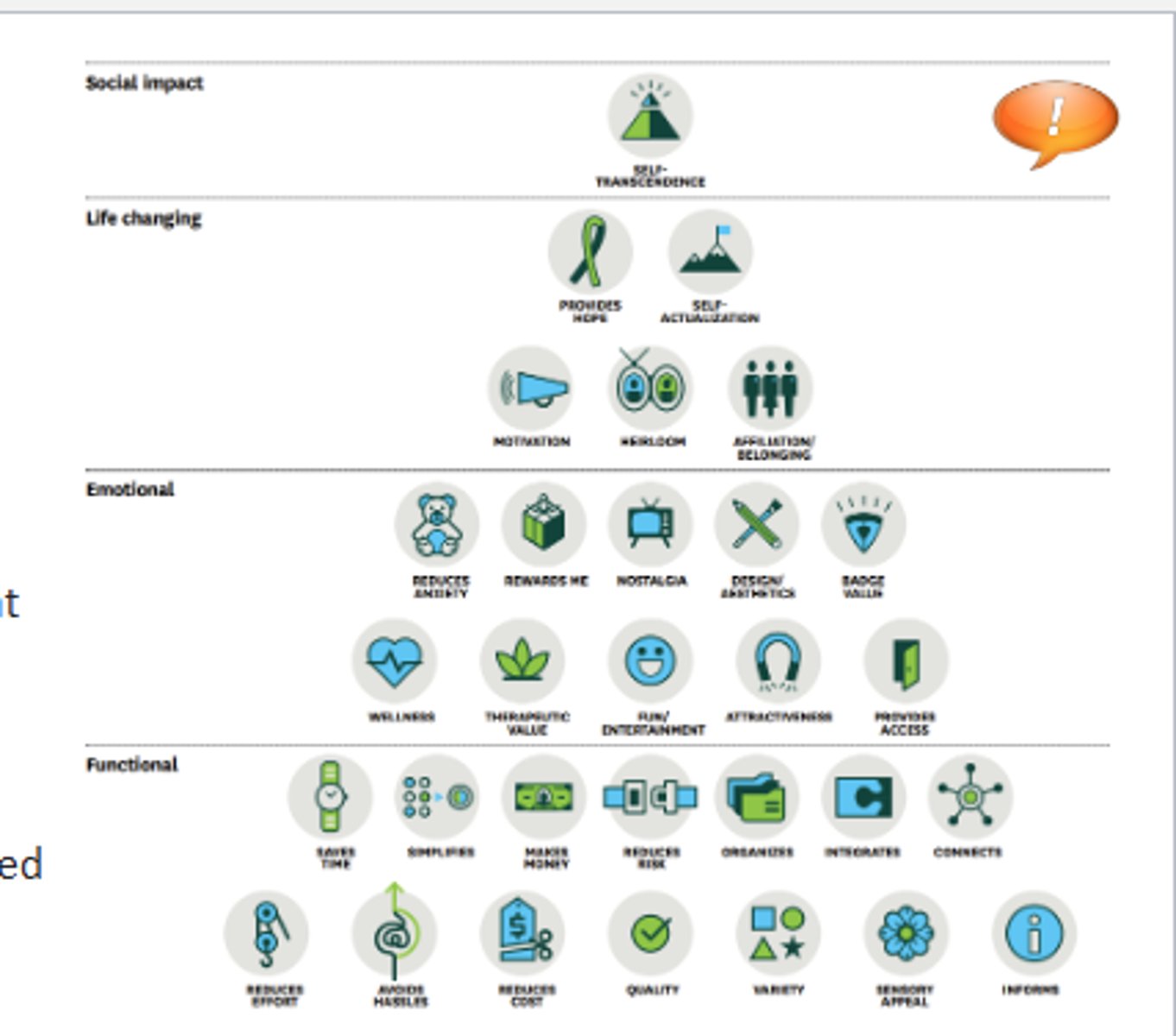
Categories of benefits: Emotional
Reduces anxiety, rewards me, nostalgia, design/aesthetics, badge value, wellness, etc.
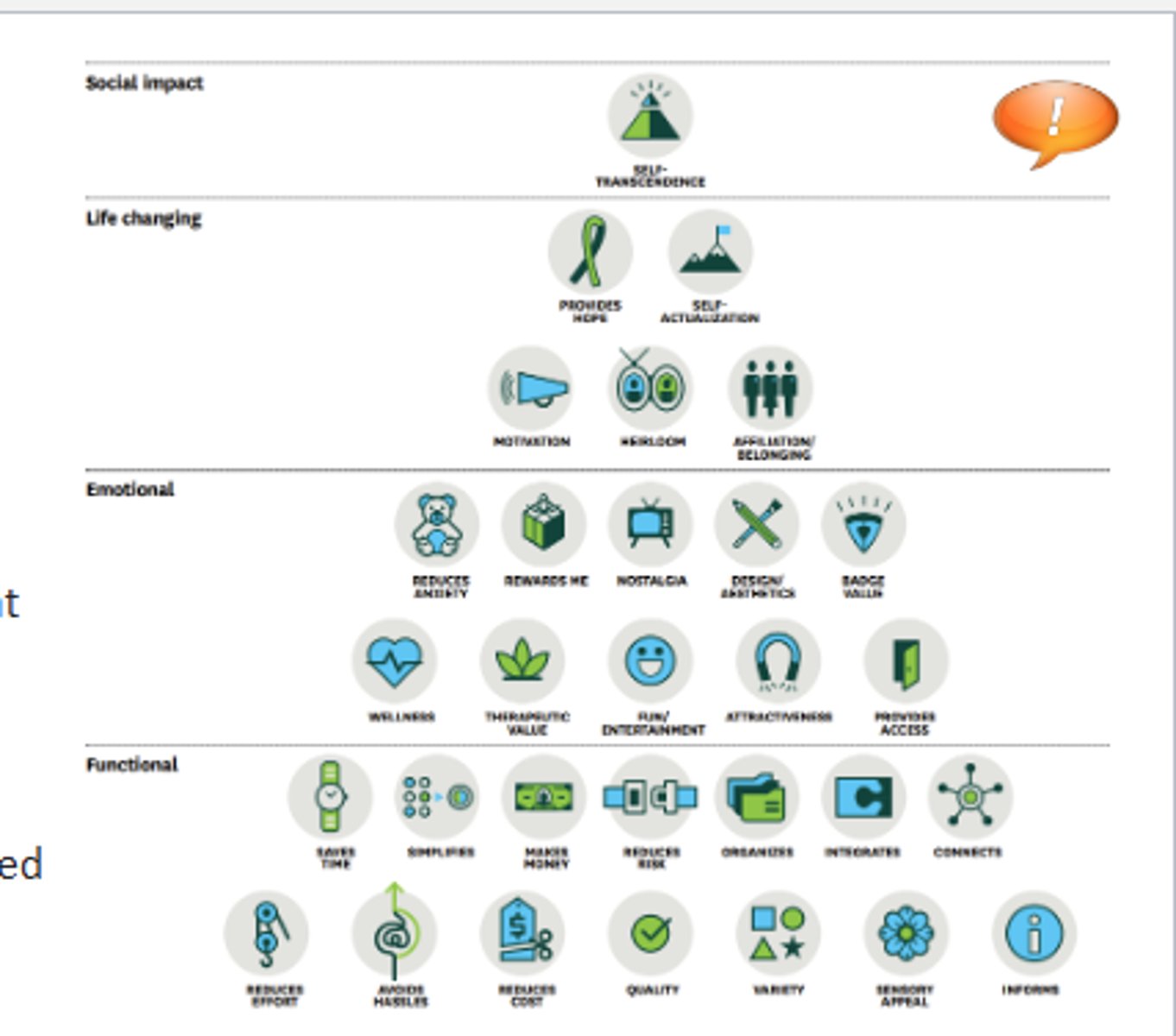
Categories of benefits: Functional
Reduce effort, avoids hassle, makes money, etc
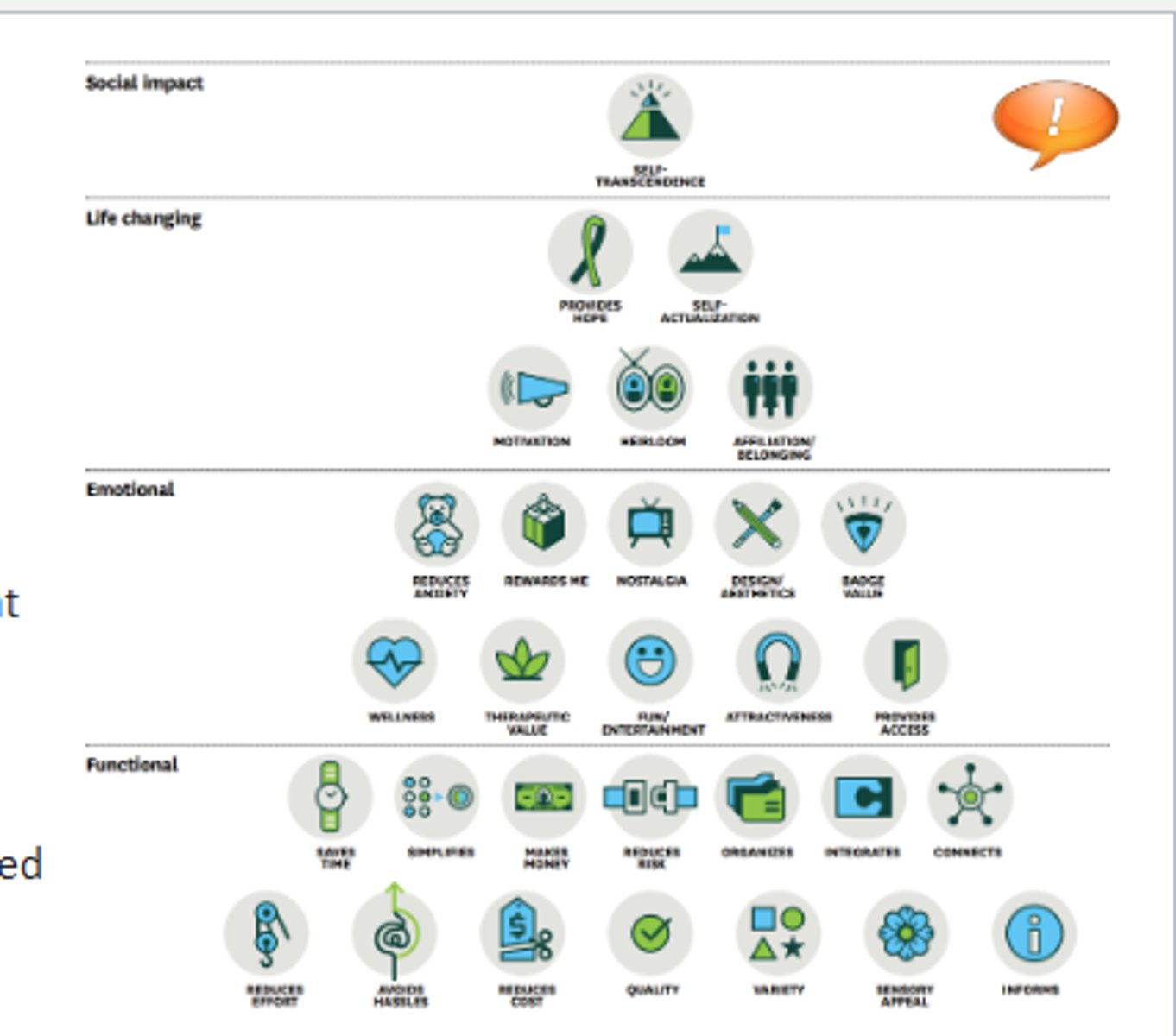
How does the Elements of Value Pyramid relate to Maslow's hierarchy?
1. Fulfill lower order ideas to have the higher order ideas to have the higher order needs
2. People will willingly give up the lower order needs to maintain the higher order needs
In general, which categories of the Value Pyramid must be fulfilled first?
The bottom must be fulfilled first, if you don't have any of the other categories. Once you get to the higher categories, then you become more willing to give up the bottom level categories
In general, which category of the Value Pyramid is most easily copied?
The functional elements at the bottom of the pyramid
What is the range of benefits for companies with highly loyal customers?
- 4-11 benefits
- Greater customer loyalty and satisfaction
- Research suggests that just providing four benefits well can create loyal customers, and the most provided by top brands is 11 out of the 30 in the Value Pyramid
What does bad customer service (over phones) do to the benefits?
- Good service can create an edge
- Bad service, however, can hamper the benefits
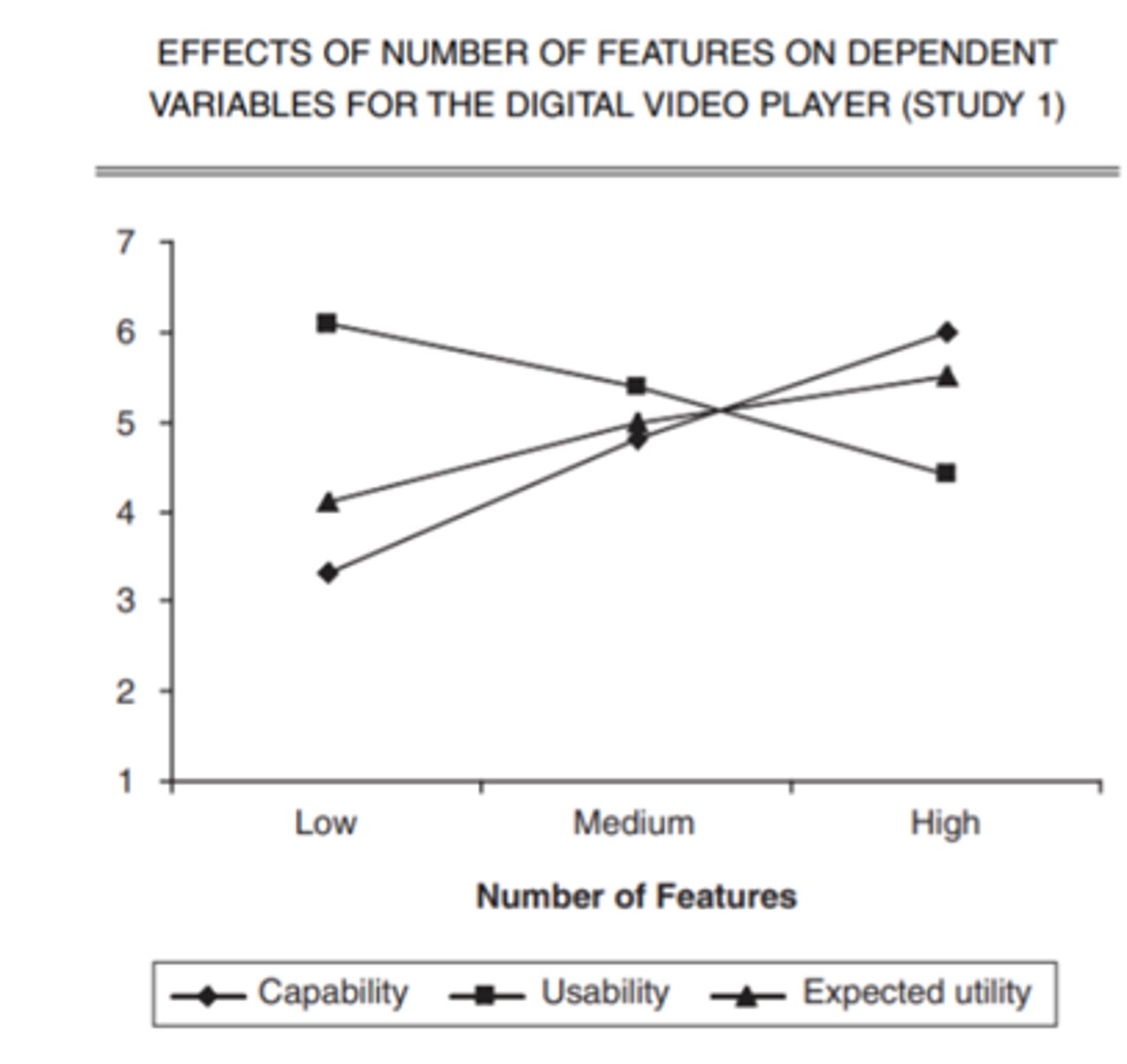
What is feature fatigue?
- A persistent challenge with asking customers what attributes they want is that customers typically want a lot of everything, all at a low price.
- Features of a product are easily copied. When you have more features, satisfaction rates can decrease because customers don't use all the features and they feel they didn't get all of the value out of it and decreases their satisfaction.
- Need to find a balance between having enough features to be attractive, but not too much that drives satisfaction down.
What is a brand?
A name, term, sign, symbol, or design or combination of these that identifies the products or services of one seller or group of sellers and differentiates them from competitors
What is branding?
the process of endowing products with the power of a brand. (Ex. branding a cow signifies who a company is, where it came from, and product quality)
Where does the idea of branding stem from and what is the point of branding? (i.e. what does it do for a company?)
- Tells people that it is their brand
- Who the company is
- Create connotations of quality/benefits of the product
- Get a customer to think of certain things when they see the brand
- Don't have to repeat what the company is about because consumers know based on the brand. Simplifies communication
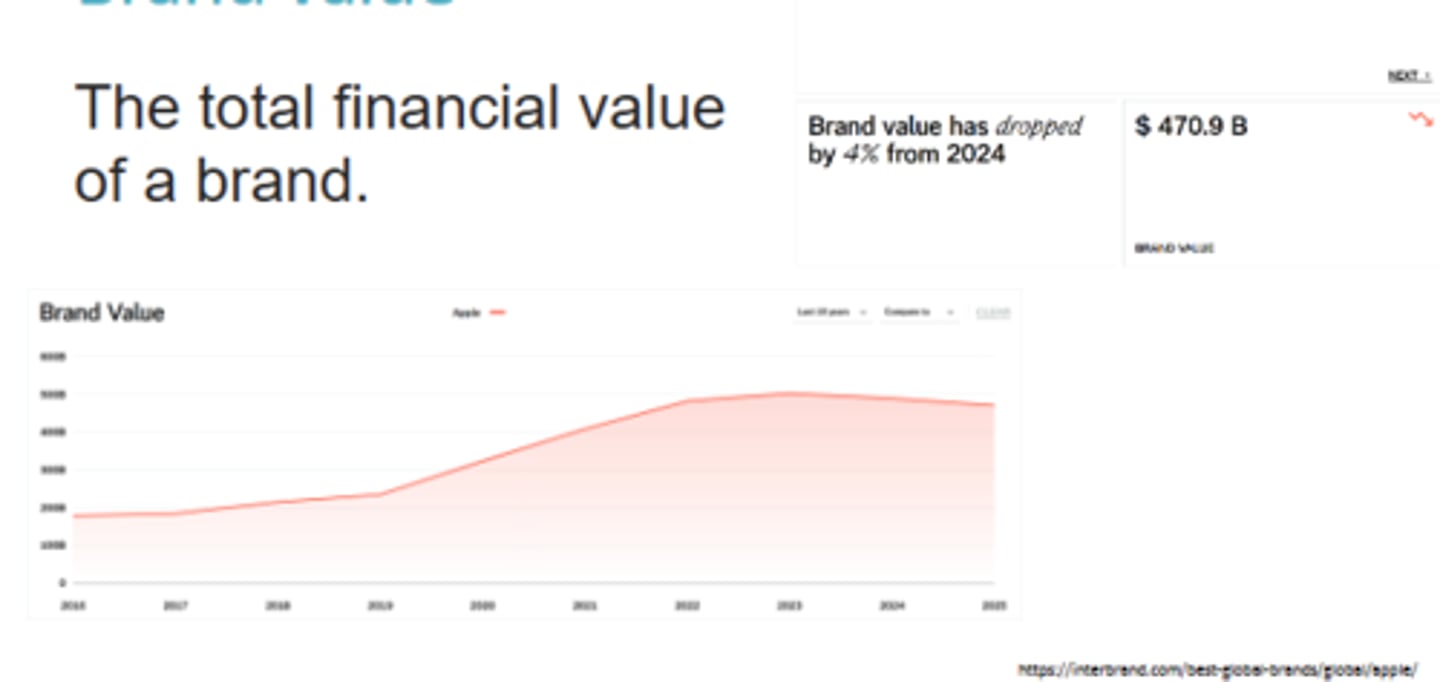
What is brand value?
Total financial value of a brand (Apple is #1 in brand value)
What is brand equity?
- The differential effect of a brand on consumer responses to marketing
- "If I put my brand on something, people react differently as compared to something else"
- Can charge more for the brand name (Ex. blue Apple t-shirt can increase cost by $25 as compared to plain blue t-shirt, which is their brand equity)
What are the four outcomes of brand equity?
- Increases willingness to pay
- Attracts new customers
- Increases customer loyalty
- Stabilizes cash flow
Four outcomes of brand equity: Willingness to pay
Plain blue t-shirt may cost 15 dollars vs. one with an Apple logo may cost 40 dollars
Four outcomes of brand equity: Attracts new customers
Strong brand is more enticing, inspires curiosity
Four outcomes of brand equity: Customer loyalty
Strong brand makes consumers feel bad for leaving it. Also makes people feel esteemed
Four outcomes of brand equity: stabilizes cash flows
Don't suffer as much when problems are present, can weather the storm (stemming from loyalty)
What is a private brand?
- Typically a retailer's own brand that they do on own products. Usually a cheaper knockoff. (ex. Target branded bleach vs. clorox)
What does the Pepsi Taste Challenge tell us about the positive effects of the power of branding?
- Pepsi taste challenge: blind tasting scenario between drinks. When people did not know whether they were drinking Pepsi or Coke, they would often say Pepsi is better. But when they knew which drink was Pepsi and which was Coke, they would more commonly say Coke.
- Made a campaign saying that if customers didn't know which drink they were drinking, they would like Pepsi better
- Branding can rewire how people respond, showing how difficult it can be to fight against high brand equity
How do we create a powerful brand?
- First comes awareness
- Then comes brand image
- Need to have both of the above
What is brand awareness?
The extent a market knows or recognizes a brand
Why does brand awareness matter?
- Can create brand equity. If we recognize a thing, we are more likely to buy something. "Familiarity breeds liking"
- Very do-able to create brand awareness
Why did downloads of Twitter drop 30% once rebranded to X?
- Had no brand awareness upon the change. People did not know of "X" when it was created initially
- People also began to search for Twitter, and people did not see Twitter show up and they would not download X
What is brand image?
The collection of associations, thoughts, and feelings that are evoked when exposed to a brand. Can be both positive and negative connotations
How does brand image work?
- Can be anything you want it to be, but you have to have a common and consistent theme
- Also is not always controlled by you (Ex. Corona beer took a bad hit when coronavirus came along)
What can brand image focus on?
- Can be whatever you want it to be.
- "Can be your product, McDonald's fries, feelings, things you do". THERE JUST HAS TO BE CONSISTENCY, just has to come back to one larger idea
Does brand image have to only focus on the brand?
- No, it just has to come back to one common theme. Find different ways to get your message across
- Crossfit brand equity increased when they fought with soda companies, conveying it in a consistent manner
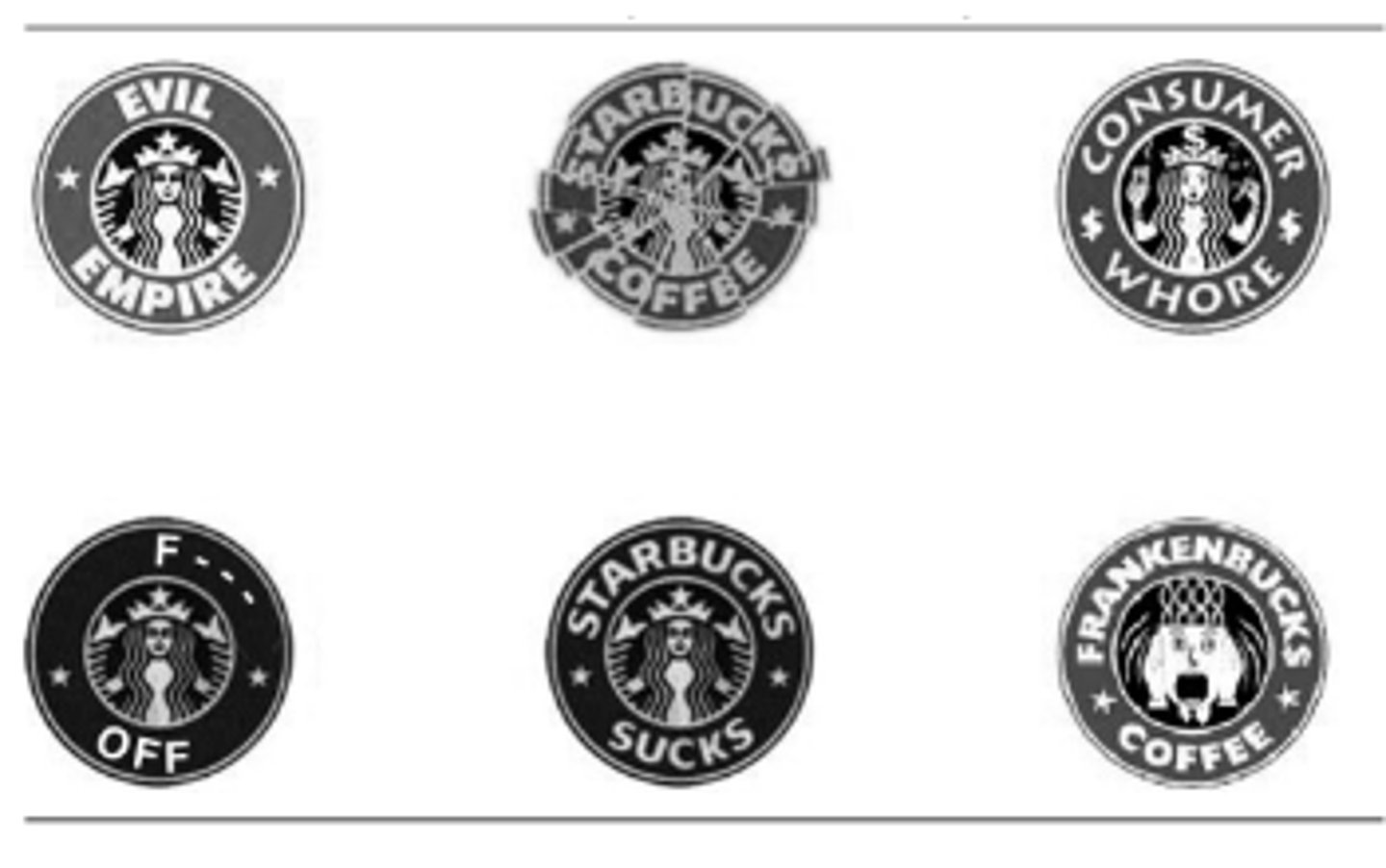
What is a doppelganger brand image?
A family of disparaging images and stories about a brand that are circulated in popular culture by a loosely organized network of consumers, antibrand activists, bloggers, and opinion leaders in the news and entertainment media.
What does Barnes & Noble tell us about branding?
- Sometimes good branding breaks the rules
- Not using overall corporate branding, each store can do it's own branding so that they can have a small time bookstore feel.
What are brand extensions?
Extending an existing brand name to new product categories (Ex. Reese's selling peanut butter "from their candies)
What is co-branding?
The practice of using the established brand names... on the same product (Ex. Reese's logo and flavor on Breyer's ice cream)
What determines if a brand extension works?
- The brand equity of the original brand
- The connection (or fit) between the brand and the product category being extended to (ex. Reese's scented markers is dumb vs. Reese's Puffs)
What are the different types of brand extensions?
- In-category: High similarities/connections between the original product and the extension (Reese's Puffs Cereal)
- Out-category: Low similarities/connections between the original product and the extension (Reese's scented markers)
What are the positive outcomes of brand extensions?
- Improves odds of new product success when things go well (Ex. Amsterdam food truck)
- Positive feedback effects when things go well(increase brand equity of original brand)
What are the potential negative outcomes of brand extensions?
- Negative feedback effects when things go poorly
- Ongoing link to the extended brand if something goes poorly
(Trump example)
What do companies do to avoid negative outcomes of brand extensions?
They brand things separately (Proctor and Gamble have Crest, Scope, Oral-B) so that the individual brands are isolated when something goes poorly.
(Ex. Oral B has a recall, that won't effect scope even though they are the same company, just a different brand)
What happened to Donald Trump's brand and brand extensions after he was president?
- They had varied success, likely due to his presidency
- When he became more controversial, the brand extensions began to fail
- At first, some brands were spared, then a negative feedback started and all of them suffered
- When his fortunes rose and fell(assassination attempt, felony charges), his brand extensions fluctuated wildly
Why did Donald Trump's brand and brand extensions change the way they did after he became president?
He began to change some of the brand extensions (i.e. their names) because he saw his value going down, and wanted to create a disconnect between himself as president and his brands
Product lifecycle
- Pattern of growing and declining sales in a product category
- Product lifecycles are affected by the competition that comes from multiple brands, which is why explaining them at the product category level is the preferred approach
What are the five stages of the Product Life Cycle?
- Product Development
- Product Introduction
- Product Growth
- Product Maturity
- Product Decline
Product Development
The company finds and develops a new product idea
Product Introduction
A period of slow sales growth as the product is introduce in the market. Profits are nonexistent in this stage because of the heavy expenses of product introduction
Product growth
A period of rapid market acceptance and increasing profits
Product maturity
A period of slowdown in sales growth because the product has achieved acceptance by most potential buyers. Profits level off or decline because of increased marketing outlays to defend the product against competition.
Product decline
The period when sales fall off and profits drop
Characteristics of product development (Sales, Profits, competitors, marketing)
- Sales: None
- Profits: Negative
- Competitors: None
- Marketing: None
Characteristics of product introduction (Sales, Profits, competitors, marketing)
- Sales: Low
- Profits: Negative
- Competitors: Few
- Marketing: Create product engagement and trial
Characteristics of product growth (Sales, Profits, competitors, marketing)
- Sales: Rapidly rising sales
- Profits: Rising profits
- Competitors: growing number
- Marketing: Maximize market share
Characteristics of product maturity (Sales, Profits, competitors, marketing)
- Sales: Peak Sales
- Profits: High Profits
- Competitors: Stable number beginning to decline
- Marketing: Maximize profit while defending market share
Characteristics of product decline (Sales, Profits, competitors, marketing)
- Sales: Declining
- Profits: Declining
- Competitors: Declining
- Marketing: Reduce expenditure and milk the brand
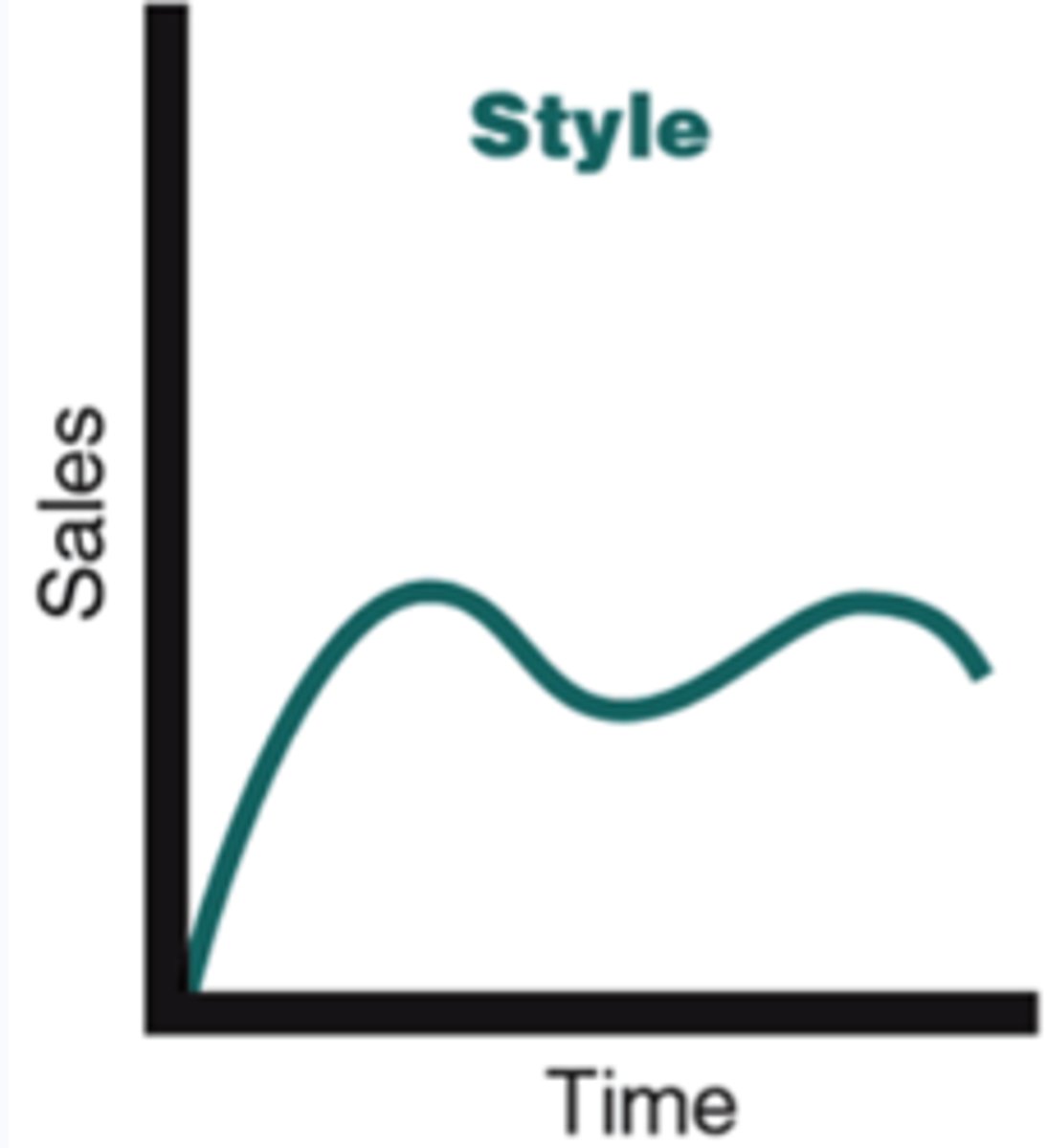
What's a style?
Basic and distinctive mode of expression.
Whats the product lifecycle of a style?
Has a cycle of showing several periods of renewed interest (Ex. flannels)