10SC3A1 - Chemistry
 Call Kai
 Learn
Learn Practice Test
 Spaced Repetition
 Match
Match Flashcards
 Knowt Play
1/59

There's no tags or description
Looks like no tags are added yet.
Name | Mastery | Learn | Test | Matching | Spaced | Call with Kai |
|---|
No analytics yet
Send a link to your students to track their progress
60 Terms
Structure of the atom
Charges:
Proton = positive
Neutral = no charge
Electron = negative
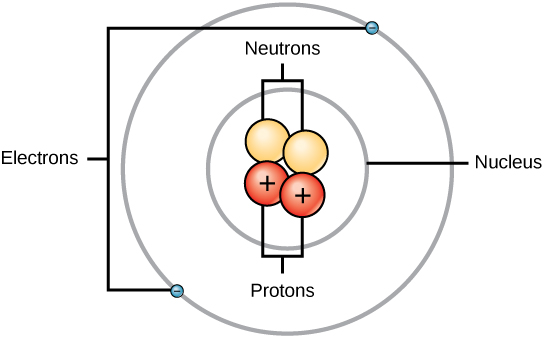
Subatomic Masses, Z, A.
Proton = 1
Neutron = 1
Electron = 1/1800
Z = number of protons
A = mass numbers
Metal form: anions or cations
Cations
Non metals form: anions or cations
Anions
Valence Electrons, Accepting and donating.
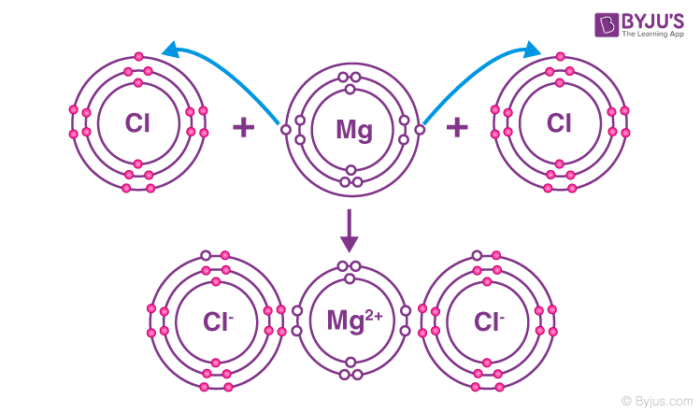
Valence electrons are transferred in ionic compounds through the donation of electrons from metals (forming positive cations) to non-metals (forming negative anions).
Ionic Compounds (+ Latice) (+Characteristics)
An ionic compound is a compound that is formed by ionic bonding. Ionic bonding occurs through a process called electron transfer, where one atom gives electrons to another. This causes one to be positive and the other to be negative, combining them together
Metal and Non metal bond together
Ionic compounds form giant 3D ionic lattice structures in their solid state. These structures consist of regular, repeating arrangements of alternating positive and negative ions, held together by strong electrostatic attractions that act in all directions. In the same ratio
-Charge cannot move about, → they are not good a conducting electricity
-They are hard but brittle
They have a neutral charge
Covalent Compounds
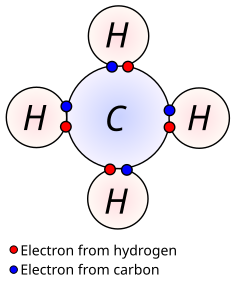
Octect Rule:
Tendency of atoms to prefer 8 electrons in their outershell
Covalent bond:
Forms when atoms share electrons in order to satisfy the octet rule.
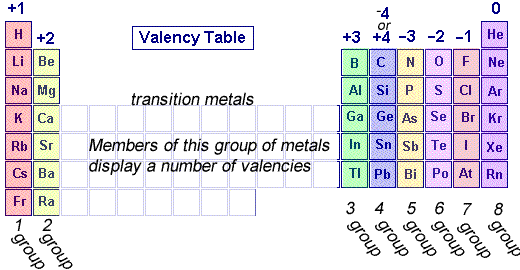
Valency charge of a period table
Valence electrons and electron stability
Atoms gain or lose electron to achieve a stable electron configuration, valence electrons are electrons located in the outermost shell, possessing the highest energy level
Metallic Bonding
The atoms of a metal arrange themselves so that they are abled to slide over one anothe.
Metallic bonding consists of a regular, three-dimensional lattice of positively charged metal ions (cations) surrounded by a "sea" of delocalized valence electrons. These free electrons are shared among all atoms, acting as electrostatic glue that holds the structure together.
Link properties of metals to their structure (5)
High electrical conductivity → delocalised (free) electrons move through the lattice
High thermal conductivity → free electrons transfer kinetic energy quickly
Malleable (can be hammered) → layers of metal ions can slide without breaking bonds
Ductile (can be drawn into wires) → same sliding layers allow stretching
High melting/boiling point → strong electrostatic attraction between positive ions and delocalised electrons (metallic bonding)
Strong/dense → closely packed lattice of positive ions
Shiny (lustrous) → free electrons reflect light
Naming Ionic Compounds
State the cation first (Metal)
State the anion second (Non - metals)
Different States of oxidation (Polyvalency)
Metals can have different oxidation states as they can have multiple valencies, we represent that with roman numbers in parenthesis, so balance out the formula.
Polyatomic Ions
Other ions consist of a group of atoms with a net charge. Since these ions are composed of multiple atoms held together by covalent bonds
, they are called polyatomic ions.
They also participate in forming ionic compounds just like monoatomic ions, but they are held together by covalent bonds.
Four Types of Solids
-Covalent Network Substances
-Molecular Covalent
-Metallic Solids
-Ionic Solids
Describe the bonding structure of a covalent compound
Covalent compounds form when two or more elements share pairs of electrons so that each has a full valency shell
Covalent bonds share two electrons, one from each atom.
Molecular Covalent
Structure: Atoms are covalently bonded within molecules, but the overall structure is held together by intermolecular forces
Forces between molecules: Weak dispersion forces (and sometimes dipole forces / hydrogen bonding)
Key idea: Strong bonds inside molecules, weak forces between molecules
Characteristics:
Low melting and boiling points (weak intermolecular forces)
Often gases or liquids (or soft solids)
Poor electrical conductivity (no free charged particles)
Covalent Network Substances
Structure: Atoms are covalently bonded in a continuous network (no separate molecules)
Bonding: Strong covalent bonds throughout the entire structure
Characteristics:
Very high melting and boiling points (strong bonds everywhere)
Very hard and strong
Low electrical conductivity (no free electrons or ions, except graphite)
Naming Covalent Molecular Compounds
State prefix only for the second element, unless required for the first element.
Identify whether the compound is a molecular compound first, this should be a non-metal with a metal.
List of prefixes
1 → mono-
2 → di-
3 → tri-
4 → tetra-
5 → penta-
6 → hexa-
7 → hepta-
8 → octa-
9 → nona-
10 → deca-
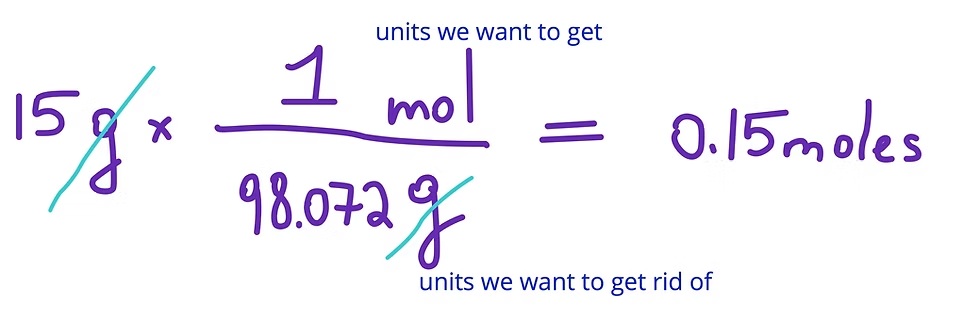
Grams to Mols
To convert grams to moles, divide the given mass of the substance (in grams) by its molar mass (in g/mol).
Concentration
How much substance is dissolved in a Solvent
Solute/Solvent
Solvent, Solute, Solution
Solvent: the substance that dissolves the solvent
Solute: the substance that gets dissolved
Solution:the mixture of solvent + solute
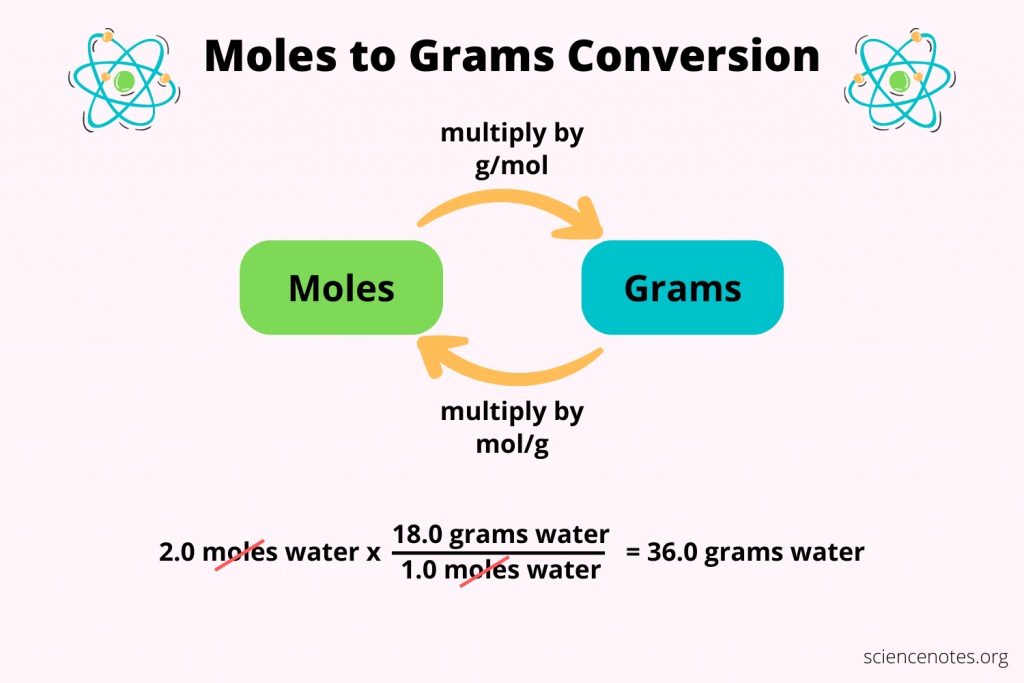
Molar Mass
Summing the average atomic masses, e.g H2o = 18.015
Molarity
Molarity = #Mols solute/ litres of solution.
Example 1.25M = 1.25 mol KCL/ 1 Litre KCL
Generalised formula for precipitation reaction
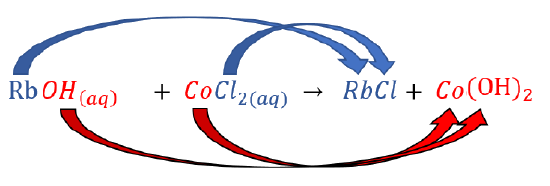
metal + non mentals, acids + bases
salt
How do you know if a product is soluble or insoluble?
What does aq? s? l? and g mean?
What do we do once the solubility has been checked?
Check the solubility table.
aq = aqueous, s = solid, l = liquid, g = gas
-Make sure to balance the equation by checking the charges
Acids vs Bases (Chemical Formula)
Acid has H+ and an Anion
Bases has a hydroxide (OH)- with a metal
Types of double displacement reactions:
Precipitation:
AB(aq) + CD(aq) → AD (aq) + CB (s)
Neutralisation:
Acid (aq) + Base (aq) → salt (aq) + water (l)
Precipitation
swap ions + check solubility
Acid–base
salt + water
Acid–metal
salt + hydrogen
Acid–carbonate
salt + water + CO₂
Electron Configuration - Elements properties
In which direction is it to be filled?
An elements chemical properties are controlled by its valence electrons
Elements in the same group have similar chemical properties because they have the same number of valence electrons.
It is to be filled clockwise, one at a time. Do not start pairing immediately.
Row Number
Column Number
How many shells it contains
Number of valence electrons.
The charge of an ion is called
Valency
Inert
Does not readily react with other substances
Valence Electrons in metals, strong or weak hold?
Metal atoms have a weak hold on their valence electrons, these electrons become free to move in the sea of electrons. This hold the metal atoms together.
Ionic Compounds in Water
•When the ionic substance is dissolved in water or in molten form, the ions are free to move and can conduct electricity.
Transition metas are typically seen with a charge of
+2
Exception to Graphite covalent bonding
Graphite is an example of a covalent network substance that can conduct electricity, due to 1 valence electron left unpaired in covalent bonding
Properties (Ionic Compounds dissolved in water)
•When the ionic substance is dissolved in water or in molten form, the ions are free to move and can conduct electricity.
Difference between Molecular Covalent and Covalent Network.
Why do they have different melting points?
Molecular covalent substances have weak intermolecular forces, while covalent network substances have strong covalent bonds throughout the entire structure.
Molecular covalent substances only require energy to break weak intermolecular forces, while covalent network substances requires breaking strong covalent bonds.
Covalent Substances = Charged or Neutral
Neutral
Intermolecular Forces
Forces neighbouring between molecules rather than within them
Electrostatic
Electro static force is a non-contact force acting between particles
(EXTRA: Tin has multiple charges, +2 and +4
Have no fear of ice cold beer!
Hydrogen H2
Nitrogen N2
Fluorine Fl2
Oxygen O2
Iodine I2
Chlorine Cl2
Bromine Br2
Signs of a chemical reaction
•After a chemical change (a.k.a. a chemical reaction), a new substance has been formed with different particles.
•
•Chemical changes might cause:
•A gas to be produced
(e.g. limestone ‘fizzing’ in acid)
•A permanent change in colour
(e.g. rust)
•Light or heat to be produced
(e.g. an explosion)
•A solid to be formed from two solutions
(this is called a precipitate)
Salts are not..
Salts are not hydroxide or oxides
Collision Theory
•For a chemical reaction to occur the reactants must collide with enough energy and in the correct orientation.
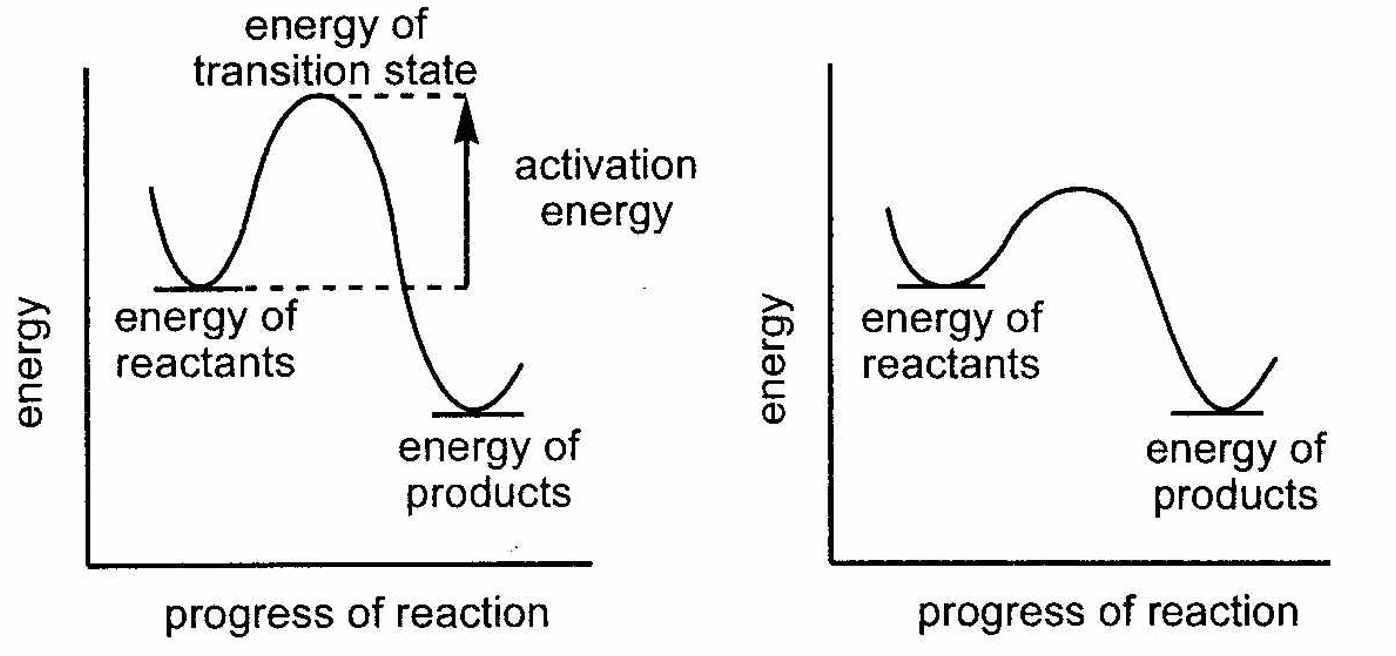
Activation Energy
The minimum kinetic energy required for a chemical reaction to occur is known as the activation energy
•The activation energy is unique to each chemical reaction – the amount of energy required for a chemical reaction to occur is different in every reaction.
Reaction Rate
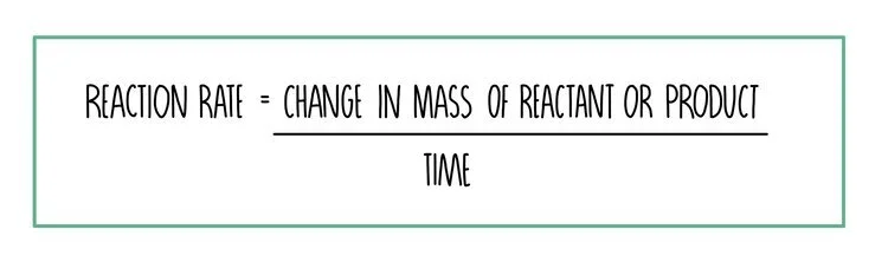
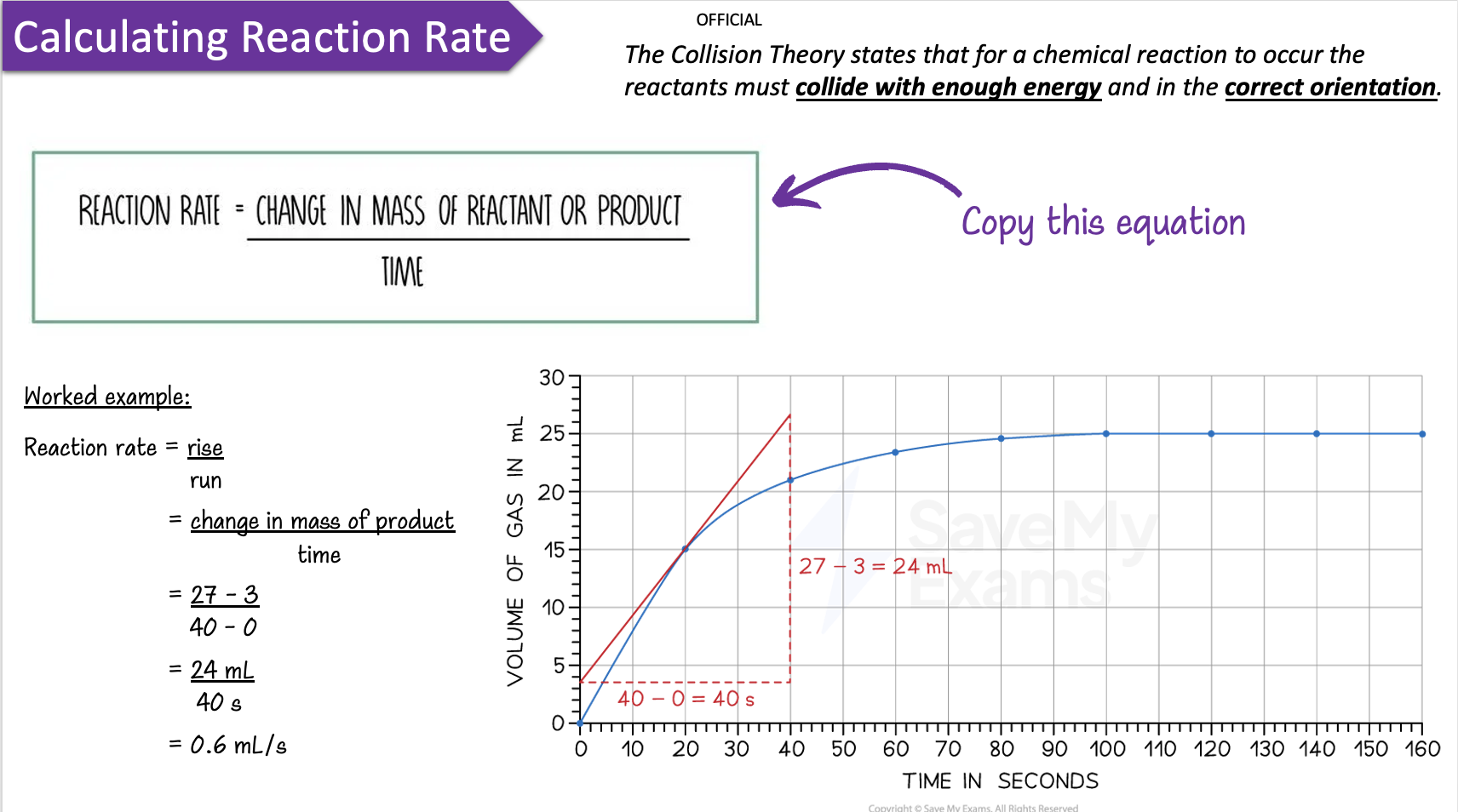
•The reaction rate is the speed at which reactants are converted into products in a chemical reaction, measured in the change in concentration of a substance per unit of time.
Reaction Rate Formula
Calculating Reaction Rate
Surface Area
•If a solid reactant is divided into smaller pieces, then more of the solid (larger surface area) is exposed to the liquid reactant and increasing the reaction rate.
•
Temperature
•Increasing the temperature will increase the reaction rate. This occurs due to:
• Increase in speed of particles in liquids and gases, resulting in more frequent collisions.
•Particles have more energy to collide with each other, making it more likely for the chemical bonds to break and rearrange to form products.
•
•Decreasing the temperature will decrease the reaction rate.
Reactant Concentration
•Increasing the reactant concentration increases the reaction rate as means the increase amount of particles are more likely to collide and react.
•
Catalysts
•Catalysts are chemicals that speed up reactions but are not used up in the reaction. They do this in two ways:
•They reduce the amount of activation energy required for reactants to convert to products.
•They make it easier for the reactant molecules to collide and form products.
Hence, the presence of catalysts increases the reaction rate
Agitation
•Agitating (stirring) the reactants will increase the rate of reaction.
•Agitation ensures that the reactants are kept in contact, by removing the build-up of products around the reactants.