EECS 3461 - Week 5A: Qualitative Analysis
 Call Kai
 Learn
Learn Practice Test
 Spaced Repetition
 Match
Match Flashcards
 Knowt Play
1/29

Earn XP
Description and Tags
Week 5A
Name | Mastery | Learn | Test | Matching | Spaced | Call with Kai |
|---|
No analytics yet
Send a link to your students to track their progress
30 Terms
What is the main objective of Qualitative Analysis?
To understand the meaning, context, process, and reasoning behind users’ actions and experiences
What are some types of qualitative data?
Written notes from interviews or observations
Audio/video recordings
Diary/journal entries
Written answers to questionnaires
Photographs
What insights does qualitative analysis give us?
Gives us insights into thoughts, priorities, processes, intended effects of actions, and feelings/experiences
The purpose of simple Qualitative Analysis:
Identify recurring patterns or themes in the data
Categorize data
Look for critical incidents or notable events
What are the tools used for Qualitative Analysis? (SAM)
Specialized Software, Automatic transcription, Manual transcription

Who said this quote?
Braun and Clarke
What does Thematic Analysis identify?
It identifies patterns or themes in the data
What are some potential Characteristics of Thematic Analysis
Can be inductive or deductive
It is an iterative process
The Steps in Thematic Analysis (FASRP)
Familiarize with data → assign preliminary codes → search for themes → review/refine themes → produce a report
How is coding defined in Thematic Analysis?
Assigning a brief label or description to part of the data or transcript
How are themes grouped in Thematic Analysis?
Organize codes into themes, interpret for meaning, draw diagrams to help visualize themes, and re-read transcripts/data
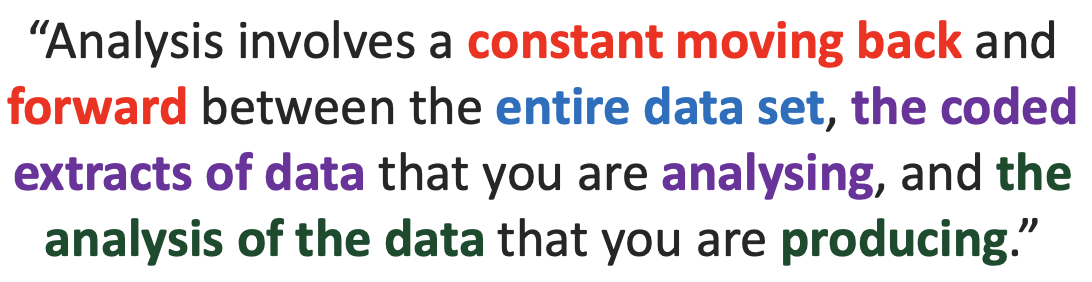
Who defined this statement on Analysis?
Virginia Braun and Victoria Clark

This is an example of
Thematic Analysis
What is Grounded Theory?
The process of collecting and analyzing data integrated into an iterative process, evolving as you go through the process
What is the main goal and focus of Grounded Theory?
Goal: Produce a theory that is grounded in the data
Focus: Understand and prioritize relationships between themes
The steps for Grounded Theory (CEB):
Collect Data - gather qualitative data from interviews, observations, other sources
Execute the coding process - assign codes and identify patterns and themes
Build theory - develop a theory grounded in the collected data based on the patterns and relationships observed
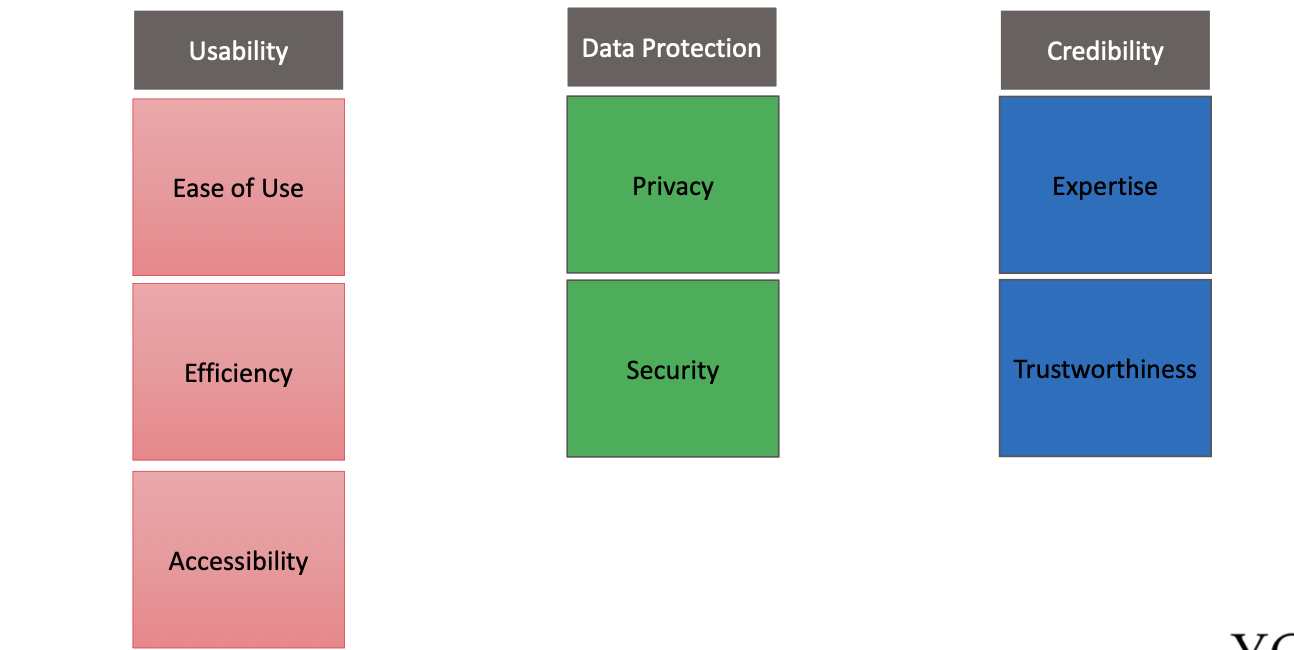
This is an example of a(n)
Affinity Diagram
What is an Affinity Diagram?
An organization tool used to group similar ideas or observations into themes to identify patterns in data
What is Open Coding in Grounded Theory?
Breaking data into smaller parts and assigning labels to identify concepts
What is Axial Coding in Grounded Theory?
Relating and organizing categories by identifying relationships between them
What is Selective Coding in Grounded Theory?
Integrates categories into a central core category/theme from the findings to form a coherent theory

This an example of
Open Coding
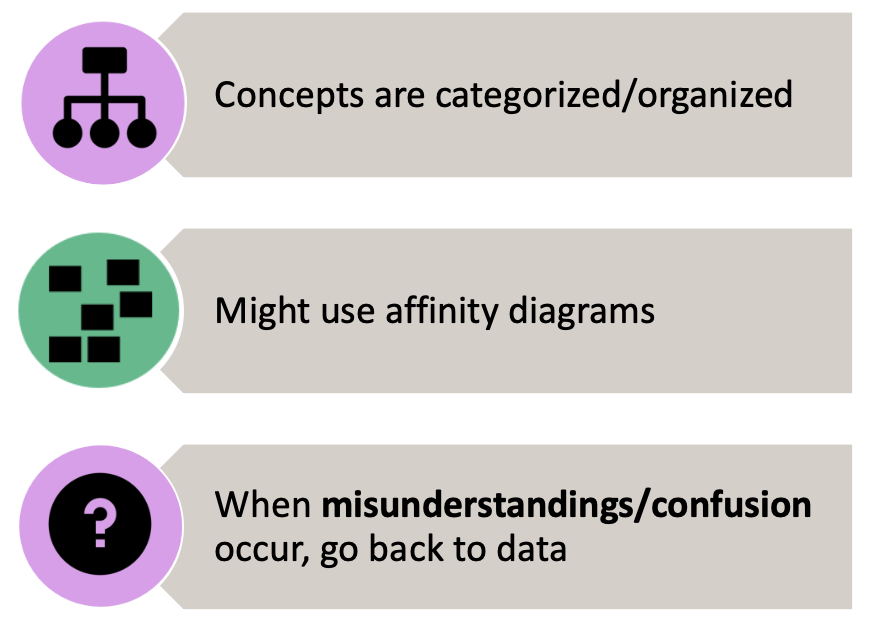
This is the process of
Axial Coding
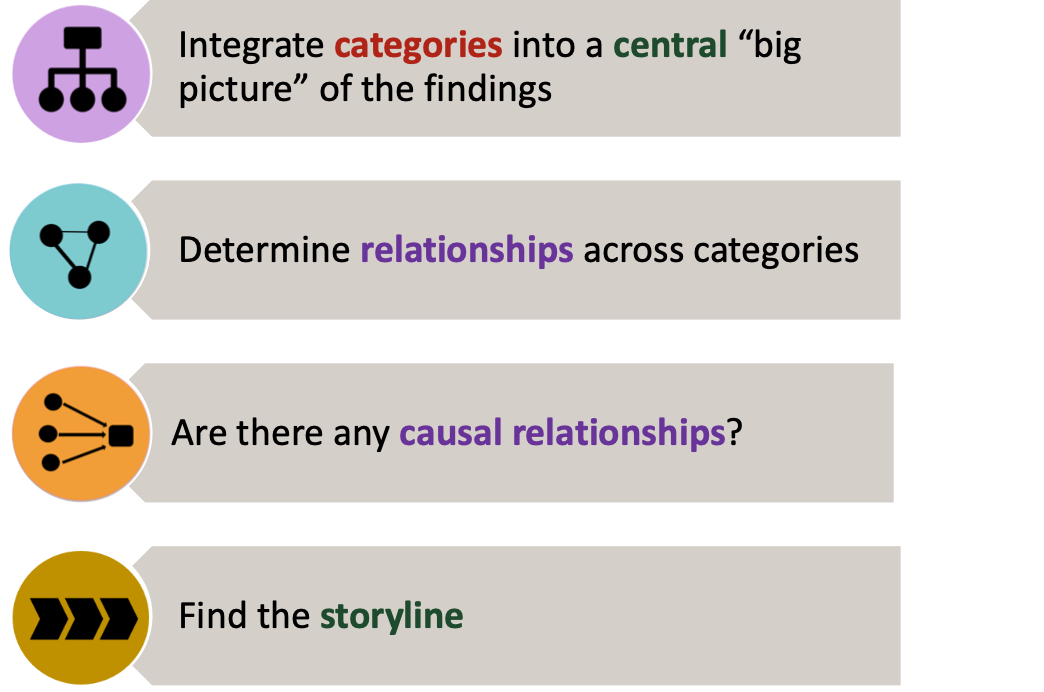
This is the process of
Selective Coding
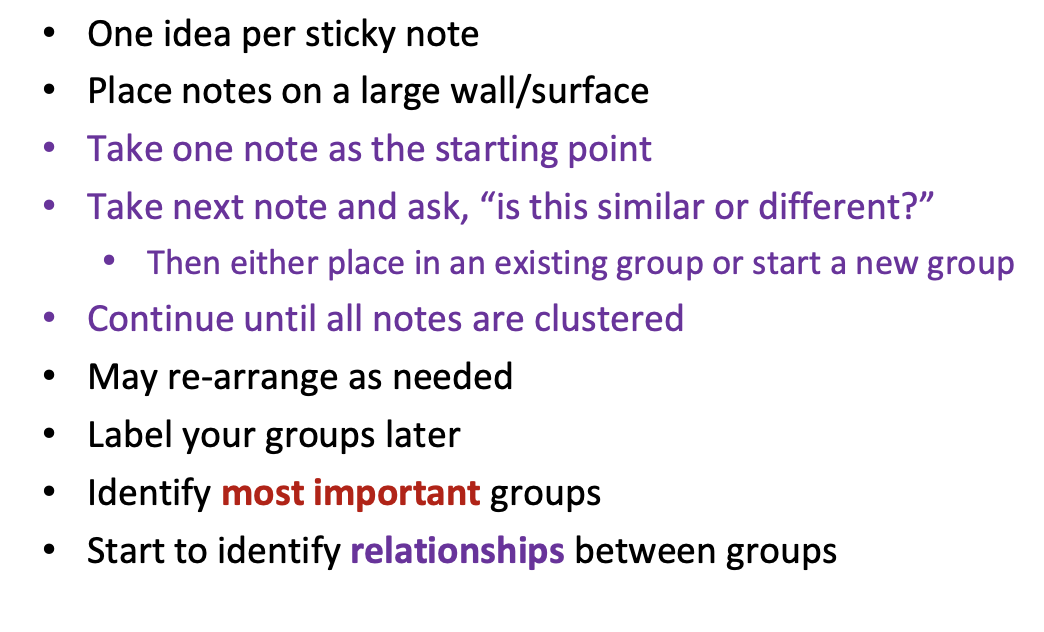
This is the process of creating an
Affinity Diagram
What is Theory Building in Grounded Theory?
Developing a theory based on the analysis from previous coding processes (open, axial, selective)
What are some limitations on Grounded Theory?
Analysis can be subjective or influenced by researcher’s prior knowledge, context may be lost, and not useful for hypothesis testing
What are the three categories of Interviews (USS)?
Unstructured - No pre-determined set of questions, conversation like, goes in-depth
Semi-structured - Some pre-determined questions, but flexible
Structured - Pre-determined set of questions, guided, standardized interview
What are the 2 most common categories of interviews in HCI (Human-Computer Interaction)?
Semi-structured and unstructured
What are the different types of interview questions? (BBSKFO)
Background, Behaviour, Sensory, Knowledge, Feeling, Opinion