BISC 101 Week 4 Reading
 Call Kai
 Learn
Learn Practice Test
 Spaced Repetition
 Match
Match Flashcards
 Knowt Play
1/17

There's no tags or description
Looks like no tags are added yet.
Name | Mastery | Learn | Test | Matching | Spaced | Call with Kai |
|---|
No analytics yet
Send a link to your students to track their progress
18 Terms
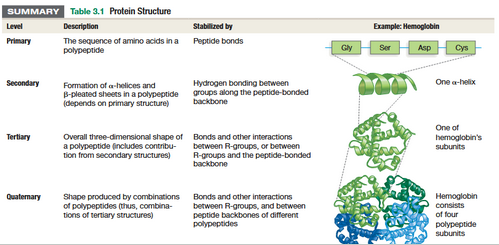
Primary structure of a protein
-The sequence of amino acids in a polypeptide
-Stabilized by peptide bonds only
-order of R groups affects molecule’s functions
e.g. Hemoglobin, has a valine instead of glumate at the 6th position, causing sickle cell.
Secondary structure of a protein
-Formation of a helices and B-pleated sheets in a polypeptide
a-helix (alpha-helix), coiled polypeptide backbone.
b-pleated sheet (beta-pleated sheet), 180° bent peptide chain that folds.
-Stabilized by hydrogen bonds
Tertiary Structure
A protein’s 3D shape
-has five types of interactions that support its structure
Hydrogen bonds
Hydrophobic interactions
Van der Waal interactions: electrical attractions
Covalent bonds
Ionic bonds
Quarternary Structure
-Combination of subunits
-Individual subunits are held by tertiary level of bonds
Dimers: consists of 2 identical subunits
Tetramers: consists of 4 subunits: 2 identical a units and 2 identical b units.
Macromolecular machines
groups of proteins that assemble to carry out a function
Table of protein structures at different levels
Protein fucntions
Catalysis
Defence
Movement
Signalling
Structure
Transport
Substrates
Catalysis
-speeds up reactions
-enzymes: proteins that functions as catalyst
-effective at catalysis due to variety of functional groups present in amino acids
Defence
antibodies
Movement
-moving the cell or large molecules and other types of cargo inside the cell.
e.g: actin and myosin
Signalling
carrying and receiving signals from cell to cell
Structure
Make up body components and form internal skeleton of individual cells
Transport
Allow molecules to enter ot exit cells
carries molecules throughout body
Substrates
-reactants in catalyzed reaction
-binds and reacts at an active site
How enzymes work
-Substrates fit into an enzyme and react (like a key and a lock)
-substrates undergo conformational change so reactants can bind to an active site
-substrates are held in place until transition state is reached
-Lowers activation energy
Transition state
high-energy, unstable state that molecules must reach for a chemical reaction to occur
Activation energy
Minimum energy required to proceed a reaction.
Present in all reactions even if its spontaneous
Free energy
-amt of energy in a system that is usable
-highest during transition state (old bonds broken, new bonds formed)