management exam!!!
 Call Kai
 Learn
Learn Practice Test
 Spaced Repetition
 Match
Match Flashcards
 Knowt Play
1/55

There's no tags or description
Looks like no tags are added yet.
Name | Mastery | Learn | Test | Matching | Spaced | Call with Kai |
|---|
No analytics yet
Send a link to your students to track their progress
56 Terms
equity theory
states that people will be motivated when they percieve that they are being treated fairly
equity components
inputs: contributions made to firm
outcomes: rewards recieved for contributions
referents: others with whom people compare themselves to ascertain if they have been treated fairly
outcome/input ratio: employee’s perception of how the outcomes (rewards) received from an organization compare with the employee’s input (contributions) to that organization
forms of inequity
underrewarded: refrent’s O/I ratio is better than that of an employee
overrewarded: referent’s O/I is worse than that of the employee
motivating with equity theory (mangers should make processess fair)
distributive justice: perceived degree to which outcomes and rewards are fairly distributed
procedural justice:the percieved fairness of the process used to make reward allocation decisions
expectancy theory
people will be motivated to the extent to which they believe that:
their effors will lead to good performance
good performance will be rewarded
they will be offered attractive rewards
components of expectancy theory
expectancy: effort vs. performance
instrumentality: performance vs. rewards
valence: desireablity of rewards
(all working together)
reinforcement theory
states that behavior is a function of its consequences
Behaviors followed by positive consequences will occur more frequently
Behaviors followed by negative consequences, or not followed by positive consequences, will occur less frequently
reinforcement
process of changing behavior by changing the consequences that follow behavior
positive reinforcement
strengthens behavior by following behaviors with desirable consequences
(player arrives early - praise)
negative reinforcement
strengthens behavior by withholding an unpleasant consequence when a specific behavior is performed
(player is on time - does not run)
punishment
weakens (decreases frequency) behavior by following behaviors with undesired consequences
(player is late - runs sprints)
extinction
weakens behavior by not allowing positive consequences to follow a previously reinforced behavior
(coach compliments early arrivals and then stops - player stops coming early)
goal-setting theory
people will be motivated to the extent to which they:
Accept specific, challenging (organizational) goals (target, objective, result) and
Receive feedback that indicates their progress toward goal achievement
components of goal setting
Communication and understanding of goal specificity, goal difficulty, goal acceptance, and performance feedback
communication
Process of transmitting information from one person or place to another
Basic management process cannot be performed effectively without effective communication
Planning
Organizing
Leading
Controlling
perception
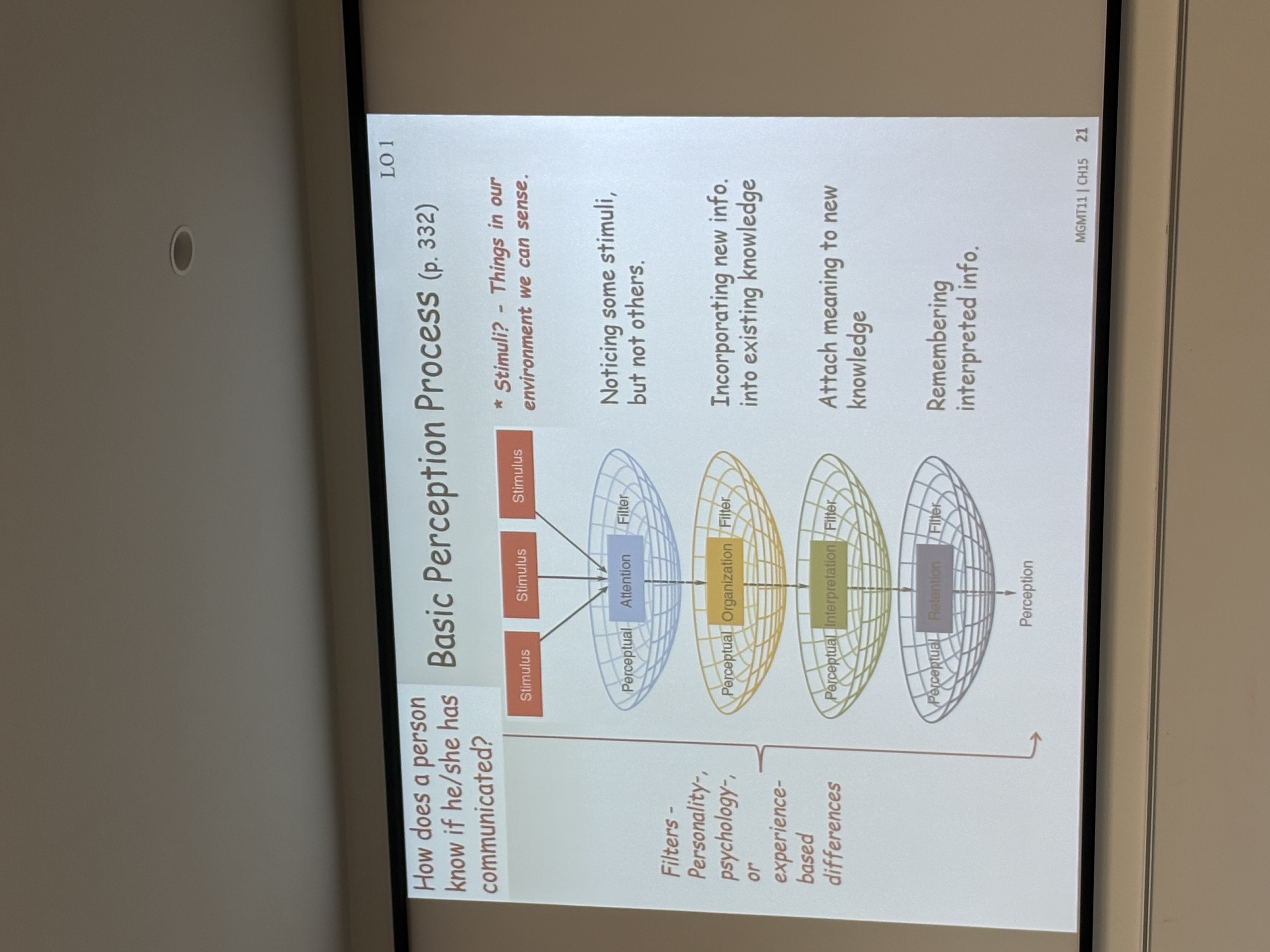
Process by which individuals attend to, organize, interpret, and retain information from their environments.
Perception is a key to communication… why? What is perception based on?
Expectations
World view
Preferences
Is it important to me
Past experiences
stimuli
People experience information stimuli through their perceptual filters - personality, psychology, or experience-based differences that influence people to ignore or pay attention to particular stimuli
basic perception process
perception problems- selective perception
tendency to notice and accept objects and information consistent with one’s values, beliefs, and expectations while ignoring or screening inconsistent behavior
perception problem - closure
tendency to fill in gaps of missing information by assuming that what one does not know is consistent with what one already knows… accurate/inaccurate?
perception problems - self-serving bias
tendency to overestimate one’s value by attributing successes to oneself and failures to others or the environment
Makes it difficult for managers to talk to employees about performance problems
interpersonal communication process
Process of transmitting information from one person or place to another
perception is littered throughout each stage
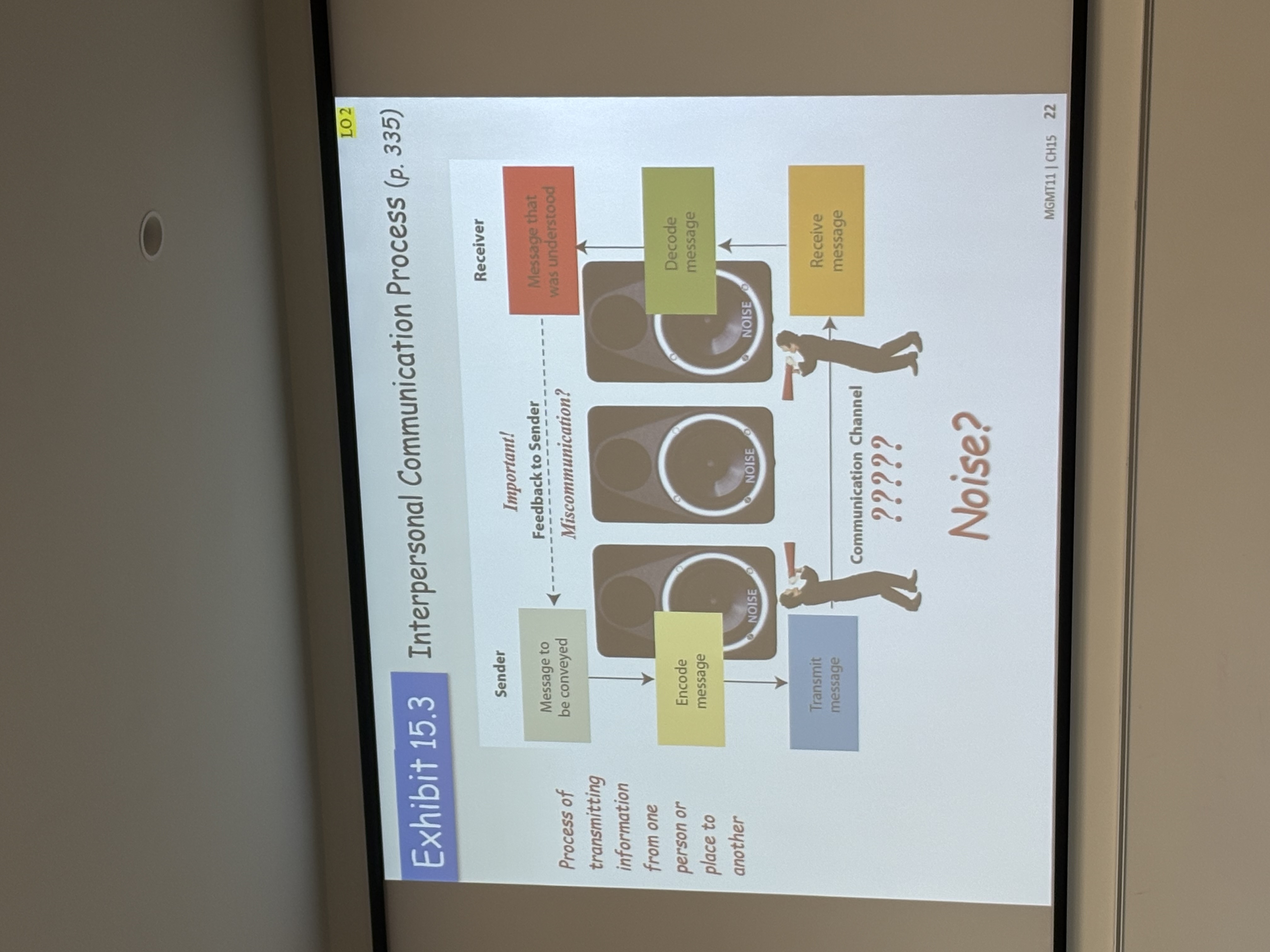
communication process
Noise (on arrow at bottom)
Anything that interferes with the transmission of the intended message
Nonverbal
Any communication that does not involve words
Jargon
Vocabulary particular to a profession or group that interferes with communication in the workplace
formal channels of communication
A system of official channels that carry organizationally approved messages and information
Downward communication: flows from higher to lower levels in an organization
Upward communication: flows from lower to higher levels in an organization
Horizontal communication: flows among managers and workers who are at the same organizational level - helps facilitate coordination and cooperation between different parts of the organization (shift nurses)
informal channels of communication
Often called the grapevine (gossip, rumer mill)
Transmission of messages from employee to employee outside of formal communication systems
Are they good sources of communication or an organization?
yes - builds relationships between employees
How can the grapevine or rumor mill be managed?
Give them an opportunity to communicate back to higher authority
Transparency from the top down (reduces made up things)
managing one-on-one communication - choosing the right medium
Medium: method used to deliver a message - 2 kinds
Oral communication (face to face / group)
Allows for questions and opportunities to receive and assess nonverbal communication. Better for delivering complex, ambiguous, or emotionally-laden messages
Written communication (letters, email, memos, social media)
Well-suited for delivering straightforward messages and information
hearing vs. listening
Hearing
Passive - the act or process of perceiving sounds - involuntary
Listening
active - making a conscious effort to to hear - voluntary
active vs. empathetic listening
Active listening
Put speaker at ease and make eye contact - listening carefully to what the speaker says
Assume half the responsibility for successful conversation
Actively give speaker nonjudgmental feedback that shows one has accurately heard what was said
Empathetic listening
Goes beyond active listening
Setting aside own attitudes/relationships to see through speaker’s eyes
Understanding the speaker’s perspective (emotion) and personal frame of reference
Give feedback that conveys this understanding to the speaker
giving feedback
Destructive feedback
Disapproves without any intention of being helpful
constructive feedback
Intended to be helpful, corrective, and/or encouraging
what is the best leadership style for all situations?
there is not one
management
Focus: order, consistency, efficiency
Asks: “how do we do this right?”
Responsibilities: planning, budgeting, organizing, controlling
Works within systems and processes
Goal: stability and predictability
leadership
Focus: vision, change, direction
Asks: “are we doing the right thing?”
Responsibilities: inspiring, motivating, influencing, setting direction
Challenges the status quo
Goal: movement and growth
leaders vs. managers
Leaders
Focus on vision, mission, goals and objectives
Encourage creativity and risk taking
Have a long-term perspective
Concerned with expanding choices
Managers
Shower term perspective
leadership traits (who leaders are)
Effective leaders possess a similar set of traits or characteristics
Traits: relatively stable characteristics such as abilities, psychological motives, or consistent patterns of behavior
Earlier version - taller, more stamina, “born, not made?”
Even now- a “precondition for success”
Recent evidence suggests leaders are generally different from nonleaders in the following traits:
Drive
Desire to lead
honesty/integrity
Self-confidence
Emotional stability
Cognitive ability - smart
Knowledge of the business
leadership behaviors (what leaders do)
Numerous studies - 2 basic leader behaviors central to successful leadership and forming the basis of upcoming leadership theories
Initiating structure: the degree to which a leader structures the roles of followers
Setting goals and deadlines, giving directions, and assigning tasks
Affects employee job performance
Consideration: extent to which a leader is friendly, approachable, supportive, and shows concern for employees
Affects employee job satisfaction
situational leadership theories - fiedler’s contingency theory
Performance can be maximized and leaders will be more effective when their leadership styles are matched to the proper situation
2 main assumptions
When their work groups perform well, leaders are considered effective
A difference from other situational theories - leadership styles are consistent and generally unable to change - match style to situational
(These aren’t necessarily correct - a leader needs to change)
Situational favorableness - the degree to which a particular situation either permits or denies a leader the chance to influence the behavior of a group
Factors that lead to situational favorableness
Leader-member relations - followers respect and trust leaders?
Task structure - tasks clearly specified?
Position power - leaders are able to hire, fire, reward and punish
situational leadership theories - hersey & blanchard’s
Leaders need to adjust their leadership styles to match followers readiness
Performance readiness: ability and willingness to take responsibility for directing one’s behavior at work
Components of readiness include
Job readiness - knowledge, skill
Psychological readiness - self-confidence, self-respect
situational leadership theories - path-goal
Leaders can increase subordinate satisfaction and performance by:
Clarifying and clearing the path to those goals
Increasing the number and kinds of rewards available for goal attainment
Leaders need to clarify how followers can achieve organizational goals, take care of problems that prevent followers from achieving goals, and then find more and varied rewards to motivate followers to achieve those goals
Leaders can change and adapt their leadership style!
situational leadership theories - normative decision theory
Leaders determine the appropriate amount of employee participation in decisions
Right degree of employee participation can improve:
Quality of decisions
Extent to which employees accept and are committed to decisions
The likelihood that employees will agree with a decision
Decision styles
Autocratic - leaders make decisions
Consultative - leaders share problems but still make decisions
Group - leaders share problems and have subordinates make decisions
visionary leadership theories
Creates a positive image of the future that:
Motivates organizational members
Provides direction for future planning and goal setting
2 types! - charismatic + transformational
visionary leadership theories - charismatic leadership
Strong, confident, dynamic personalities that attract followers, enable leaders to create strong bonds with followers, and articulate a clear vision for the future based on strongly held values or morals
Ethical charismatic leaders:
Provide developmental opportunities for followers and recognize their contributions
Are open to positive and negative feedback
Have moral standards that emphasize the large interests of the organization or society
Unethical charismatic leaders
Control and manipulate followers
Do what is best for themselves
Have moral standards that put their interests before everyone else’s
visionary leadership theories - transformational
A step further… able to make followers feel that they are a vital part of the organization and help them see how their jobs fit with organization’s vision
“Transforming” - generates awareness and acceptance of a group’s purpose and mission.
Enable employees to feel as though they are a vital part of the organization and see beyond their own needs and self-interests
Followers are inspired. Their values, attitudes, and motives are elevated, so they commit to the organization’s vision and go beyond their own self-interest for the good of the group.
Components
Idealized influence - role models
Inspirational motivation - provide meaning (energize + unite) & challenge. Clearly communicate vision
Intellectual stimulation - creative & innovative. Encourage critical thinking
Individualized consideration - pay special attention to followers’ individual needs
transformational vs. charismatic
Transformational leaders increase the confidence of followers in themselves + the mission of the organization, while charismatic leaders increase the followers confidence in the leader.
(5) transactional leadership
Based on traditional exchange process in which followers are rewarded for good performance and punished for poor performance
Problems:
May rely heavily on discipline or threats to bring performance up to standards
Exchange- rewards for performance or punishments for failure - often does not inspire long-term commitment or creativity. Followers do what’s required, but rarely go beyond that.
control
regulatory process of establishing standards to achieve organizational goals, comparing actual performance against standards, and taking corrective action when necessary
continuous - ongoing
dynmanic - constant change
cybernetic - constand attention to feedback is necessary to stay on course
control processes - standards
basis of comparison for measuring the extent to which various kinds of organizational performance are satisfactory or unsatisfactory
Standards should enable goal achievement and can be determined by:
Past performance related to goals
Listening to customer feedback
Observing competitors
control processes - benchmarking
Identifying other companies and collecting data against which to compare. Benchmarking focuses on identifying outstanding practices, processes, and standards in other companies and adapting them to your company
control processes - maintaining control
Control is achieved when behavior and work procedures conform to standards and company goals are accomplished
behavior/work procedures + standards = goals achieved
Control loss: occurs when behavior and work procedures do not conform to standards
basic control mechanisms - when
Feedback control (output) - reactive to learn and improve for next time. Gathering information about performance deficiencies after they occur and using it to correct or prevent performance deficiencies
Concurrent control - correct in the moment. Gathering information about performance deficiencies as they occur, thereby eliminating the delay between performance and feedback
Feedforward control (input) - proactive and preventative. Monitoring performance inputs to minimize performance deficiencies before they occur
control methods - how
Bureaucratic control
Top down. Use of hierarchical authority to influence employee behavior. Rewarding or punishing employees for compliance or noncompliance with organizational rules, policies, procedures
Objective control
Evolved from bureaucratic control - use of observable measures of worker behavior or outputs to assess performance and influence behavior
Normative control
Regulation of worker behavior by widely shared organizational values and beliefs
Concertive control
Regulation of workers’ behavior and decisions through work team/group values and beliefs. Work groups are typically given complete autonomy
Self-control (self-management)
Managers and workers control their own behavior by setting their own goals, and monitoring their own progress
emotional intelligence
Emotions impact our ability to choose the better option
Definition: the ability to choose correctly in an emotion-charged environment
self awareness (leading self - what i see)
Know strengths, limits
Know values, beliefs, emotions, moods
Aware in the moment
The most important part of emotional intelligence
What happens to those with low self-awareness?
Interrupting others, talking about themselves all the time, unwillingness to accept responsibility or accountability
Therefore they don’t learn or grow
Live in an emotional prison
Don’t trust yourself - seek & receive feedback!
self management (what i do - leading self)
Event -> moment of truth -> either you react (creates negative cycle) OR you respond (creates positive cycle)
What happens in the moment of truth?
Next steps - what do I do
The real you comes out - your character is revealed
Who is the real you?
Behaviors (above iceberg) - what I do
Personality - who i am
Values - who i am
Purpose - who i am
social awareness (what i see - leading others)
Listens with eyes
Cares for others
Lives “in moment”
Listen to understand instead of to respond
How to grow in empathy?
Be present
Dimmer switch + on/off switch
Be the on/off switch
Practice listening
relationship management (leading others - what i do)
Mutual benefit
Be authentic in how you deal with others
Influence
Inspiration
Transparency
can EQ be improved?
Yes but… it’s hard
You need
Serious commitment
Time & experience
Coaches & mentors!
IQ gets you hired, EQ helps you thrive + gives opportunity for success (helps protect relationships)