UNIT 3 lecture 10 from Biological Information Flow
 Call Kai
 Learn
Learn Practice Test
 Spaced Repetition
 Match
Match Flashcards
 Knowt Play
1/38

There's no tags or description
Looks like no tags are added yet.
Name | Mastery | Learn | Test | Matching | Spaced | Call with Kai |
|---|
No analytics yet
Send a link to your students to track their progress
39 Terms
A nucleotide consists of:
sugar + base + phosphate
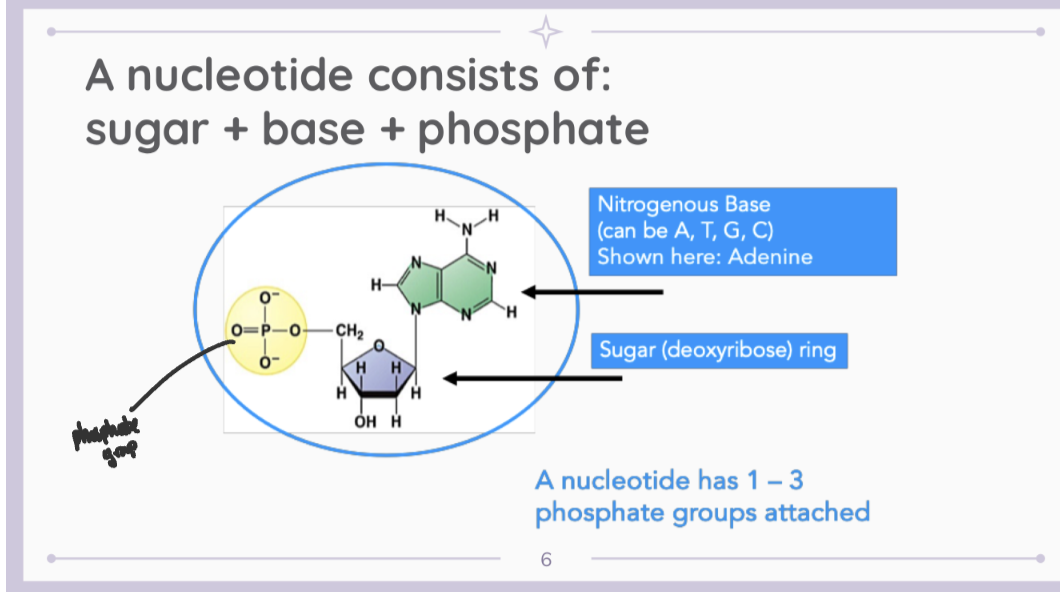
Sugar in nucleotide:
Sugar deoxyribose ring
Base in nucleotide
Nitrogenous base (can be A, T, G, C)
Phosphate in nucleotide
Phosphate group. A nucleotide has 1-3 phosphate groups attached.
DNA assembles into larger structures:
Monomers
Polymers
Functional Structures
DNA assembles into larger structures:
MONOMERS
Monomers consist of Nucleic Acid Monomers
DNA assembles into larger structures:
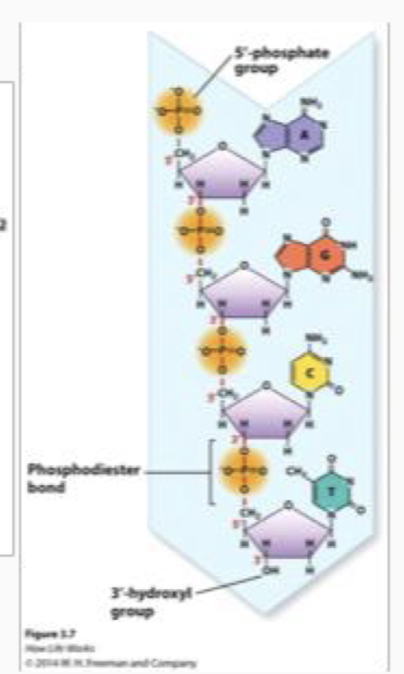
POLYMERS
Polymers consist of Linear nucleic acid polymer
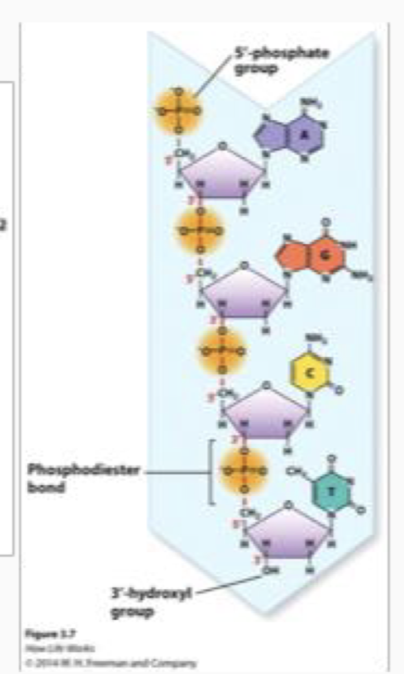
DNA assembles into larger structures:
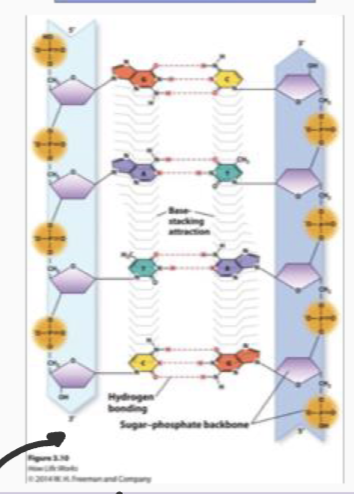
FUNCTIONAL STRUCTURES
Functional structures consist of double-stranded nucleic acids.
To form it, new nucleotides are added to 3’ end.
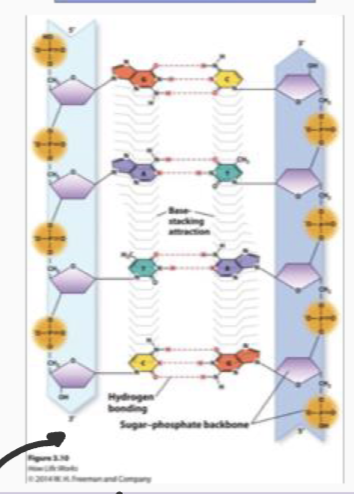
DNA has levels of structure (like proteins)
DNA LEVELS OF STRUCTURE
Primary
Secondary
Tertiary
DNA has levels of structure (like proteins)
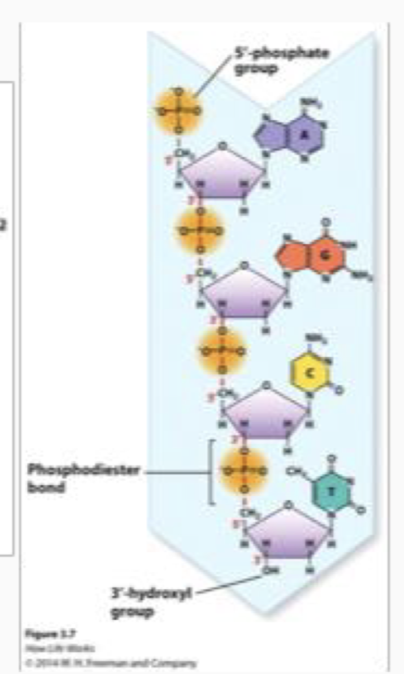
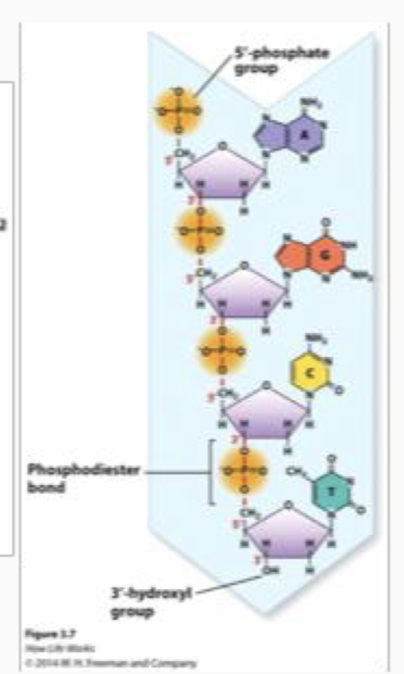
PRIMARY
Primary (sequence) 1 strand of DNA
DNA has levels of structure (like proteins)
SECONDARY
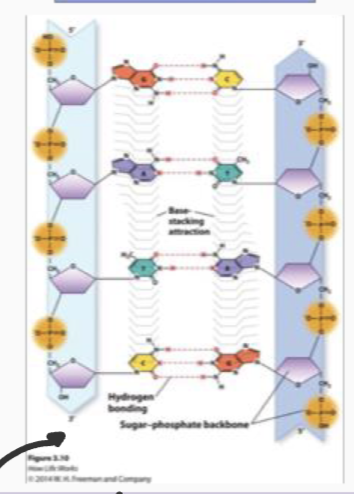
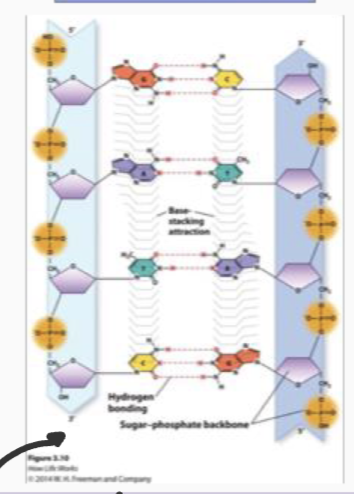
Secondary (helix) 2 strands coming together.
Double helix: 2 strands twisted into a helix
DNA has levels of structure (like proteins)
TERTIARY
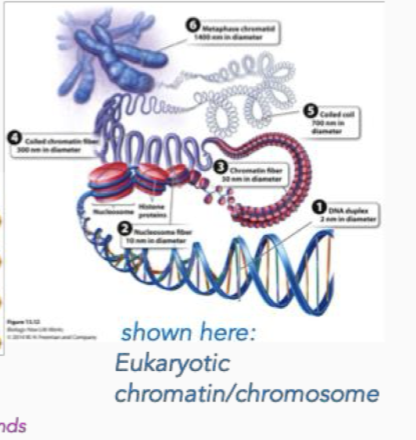
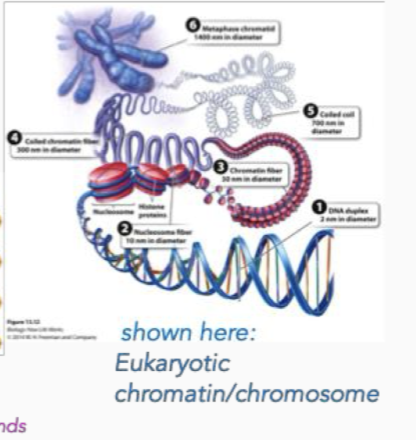
Tertiary (helix winds up to form chromatin, DNA that “wound up”)
Deoxyribose ring and # of C
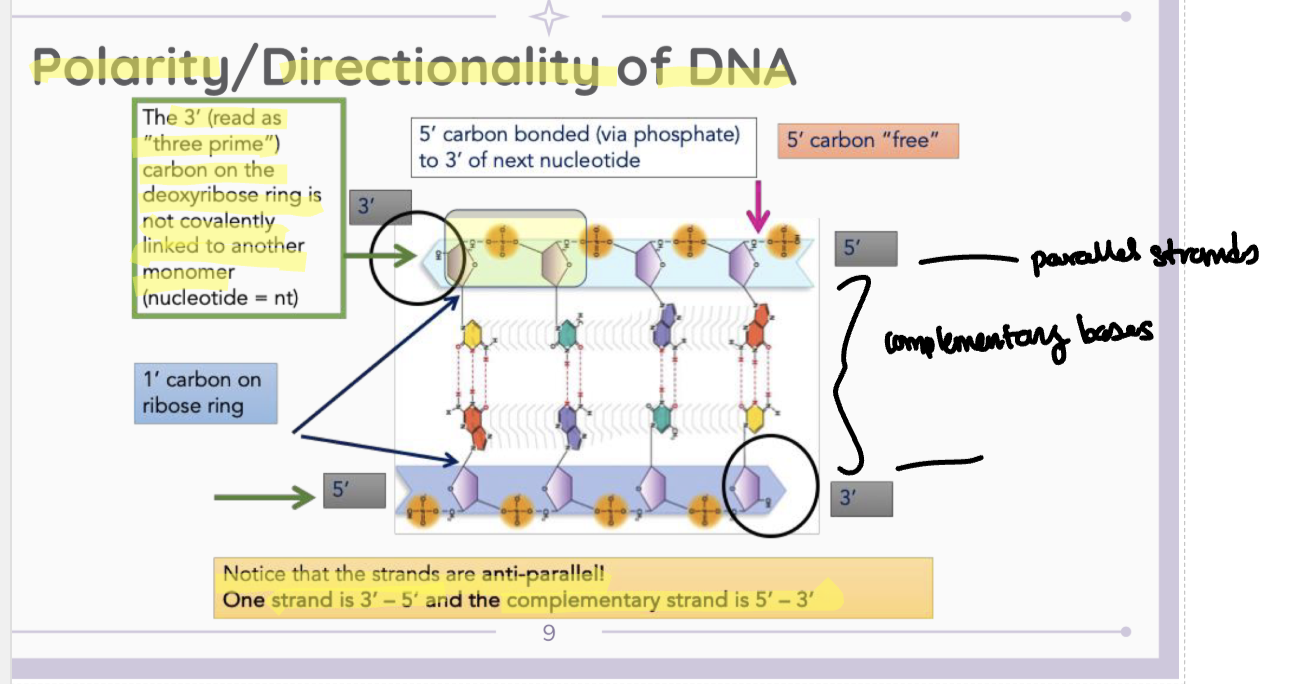
Polarity/Directionality of DNA
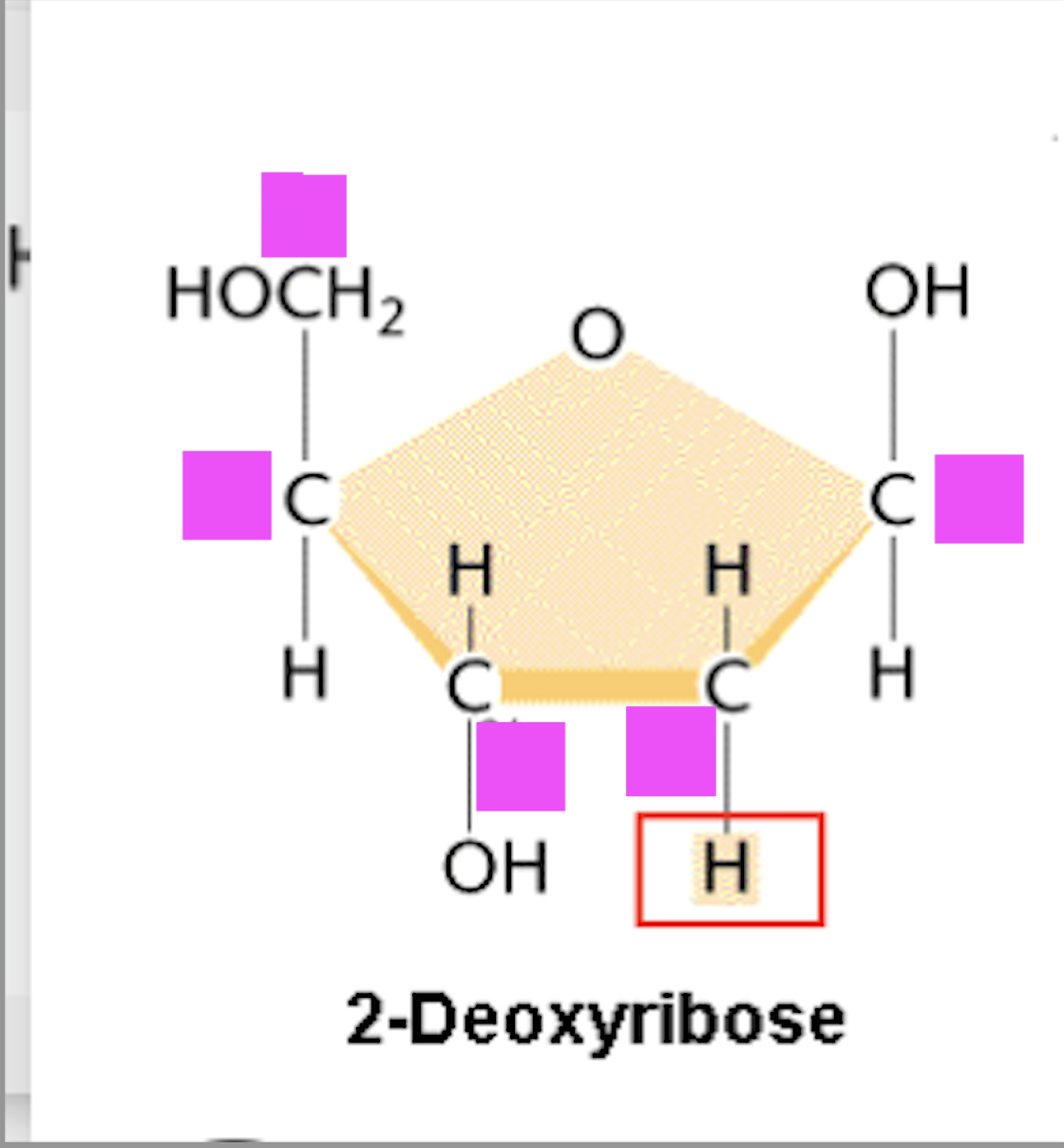
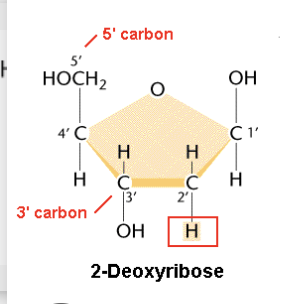
3’ carbon on the deoxyribose ring is not covalently linked to another monomer.
5’ carbon bonded (via phosphate) to 3’ of next nucleotide
1’ carbon on ribose ring
Strands are anti-parallel. 3’-5’ and complementary strand 5’-3’.
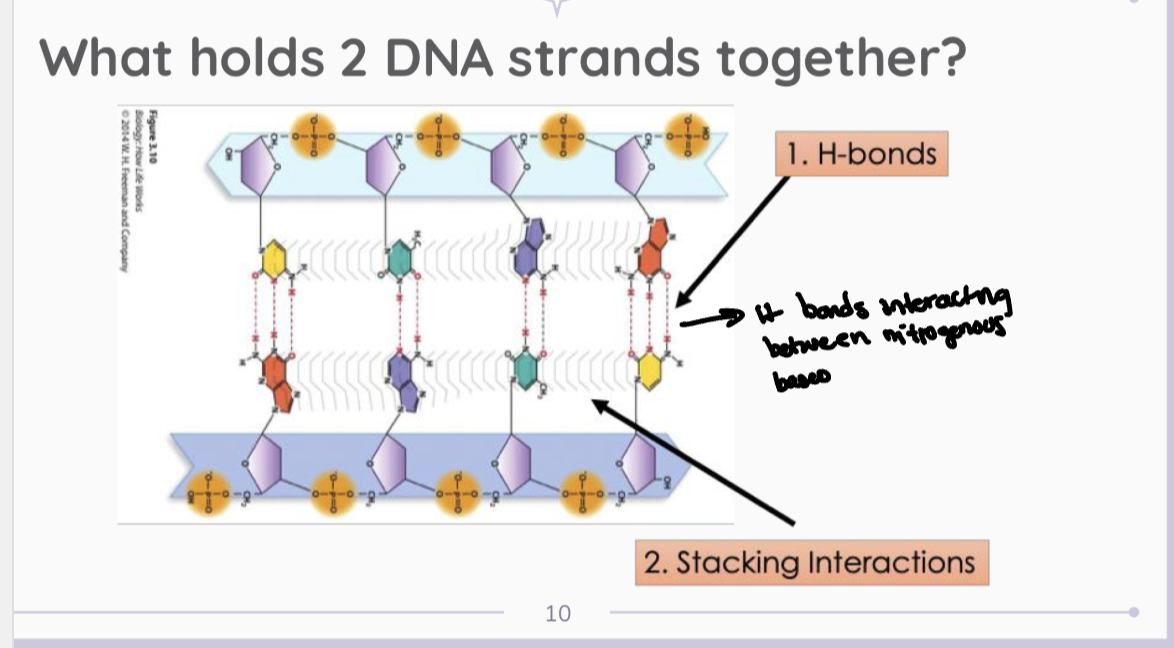
What holds 2 DNA strands together?
H-bonds → which are interacting between nitrogenous bases.
Stacking interactions
What effect drives the spontaneous formation of DNA double helix?
The hydrophobic effect.
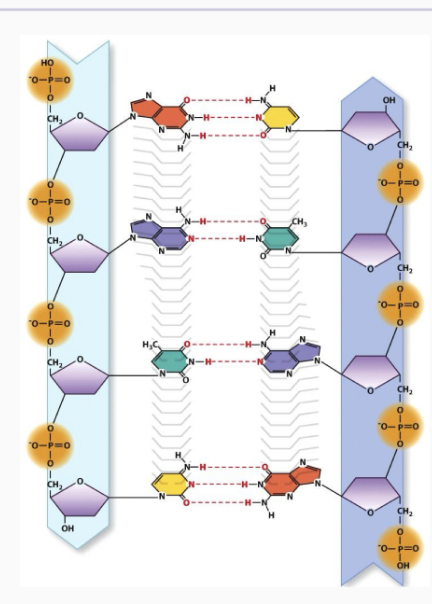
Hydrophobic effect and formation of DNA double helix
CHARACTERISTICS
Base Stacking Interactions in adouble helix
Purine and pyrimidine bases are essentially hydrophobic → non-polar
Some stacking interactions are ID-ID (non-polar) or ID-PD ID-PD (Induced Dipole-Permanent Dipole): Some parts of the DNA bases have permanent dipoles (fixed partial positive and negative charges) because of atoms like Nitrogen or Oxygen. When a permanent dipole on one base gets close to the electron cloud of a neighboring base, it "pushes" those electrons around to create an induced dipole, leading to an attraction between the two.
Help stabilize the strands and support the H-bonds between the bases.
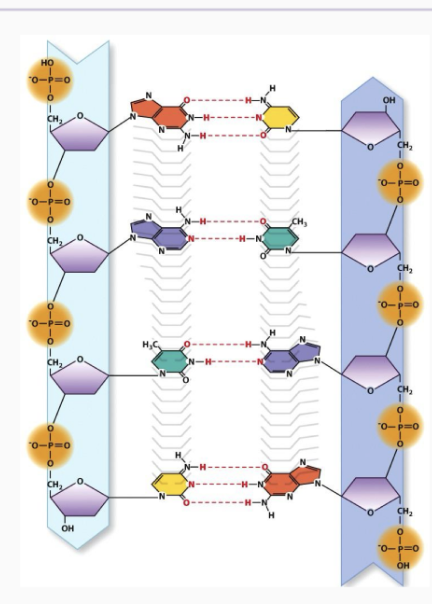
DNA Double Helix
Grooves
Major Groove “big turn”
Minor Groove “little turn”
Regions where proteins bind to the DNA
Different proteins recognize the different sequences of bases (A, T, G, C) i.e. bind to specific regions of the DNA
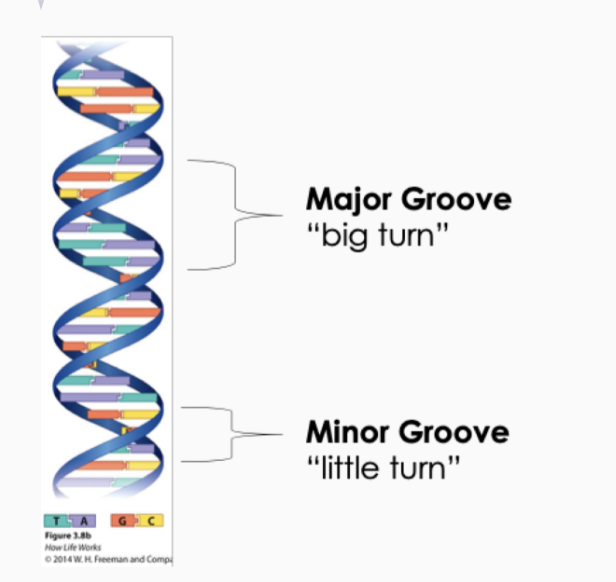
DNA Double Helix Binding
Chargaff’s (Watson-Crick) base pairs all have the same general geometry, this allows:
Chargaff’s (Watson-Crick) base pairs all have the same general geometry, this allows for a uniform structure:
Same distance between bases in the two strands
Same, regular hydrogen bonding pattern
Same stacking interactions between bases above and below.
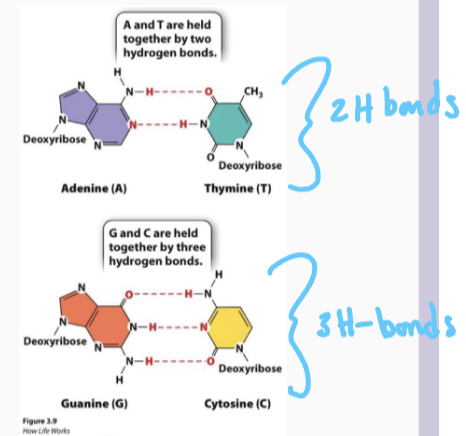
DNA Double Helix Binding
MISTMATCHED BASE PAIRS
If less H bonds interacting between 2 strands → less stability
More H bonds usually means greater stability
BUT
-purine: may cause bulging
-pyrimidine = too much distance, not close enough to interact strongly
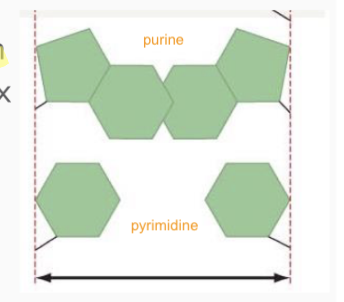
DNA Double Helix Binding → Chargaff’s Rules of Base Pairing
Purines (A & G) and based with Pyrimidines (T & C uracil in rna)
%Adenine = %Thymine → T base pairs = 2H bonds
%Guanine = %Cytosine → C base pairs = 3H bonds
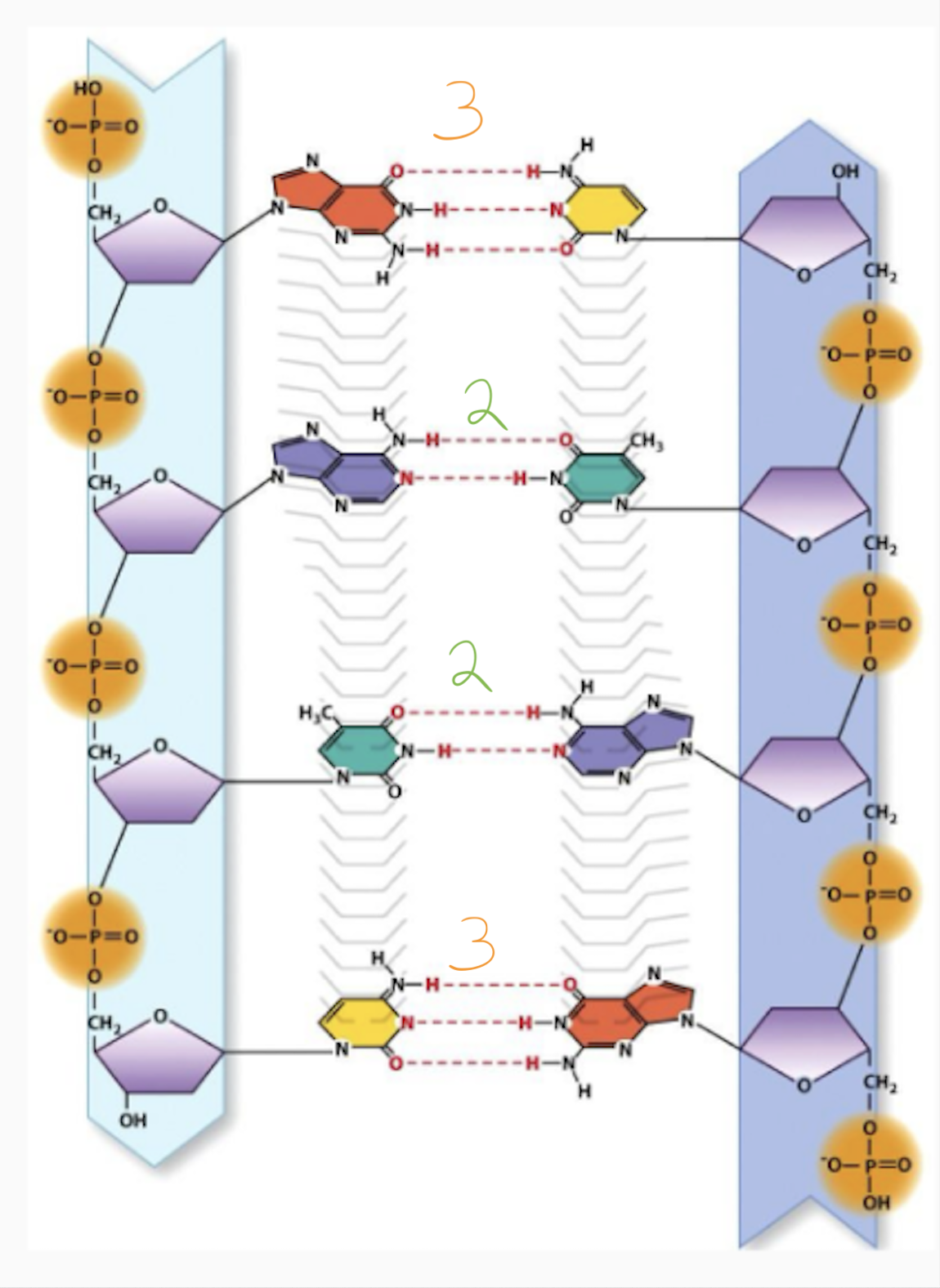
QUESTIONS: In a bacterial genome, 14% of the DNA nucleotides were found to beThymine. What proportions of the other bases would you expect to be present in this particular DNA?
T = 14%
A = 14%
So,
14 + 14 = 28
100-28= 72
72/2=36
So,
C = 36%
G = 36%
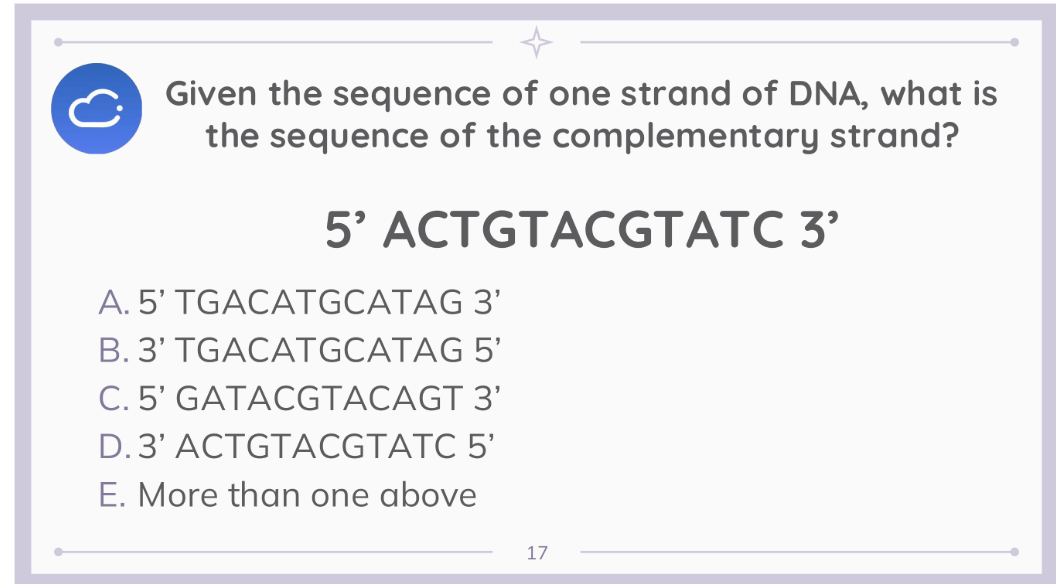
QUESTION
B & C
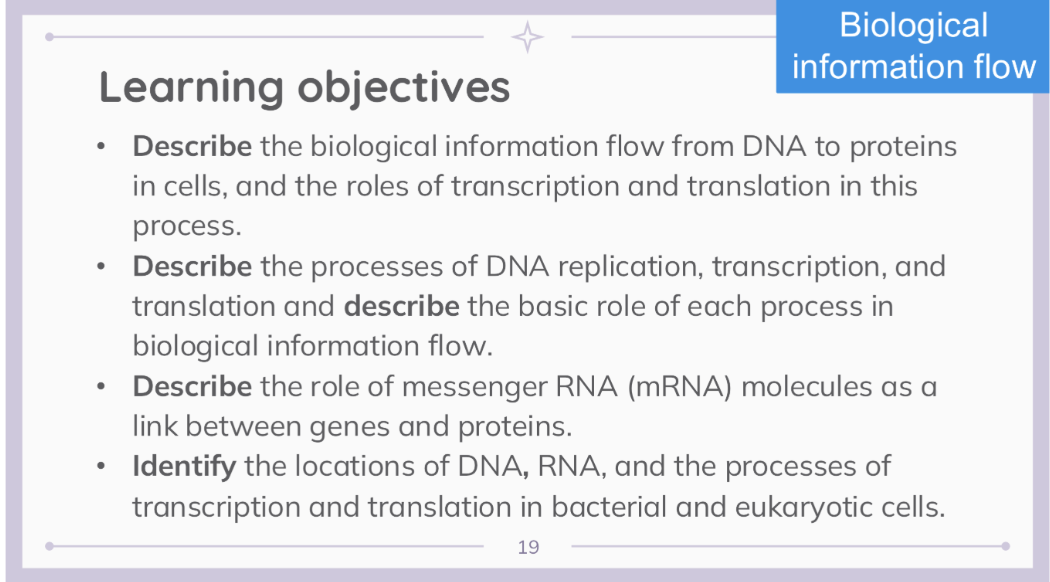
BIOLOGICAL INFORMATION FLOW
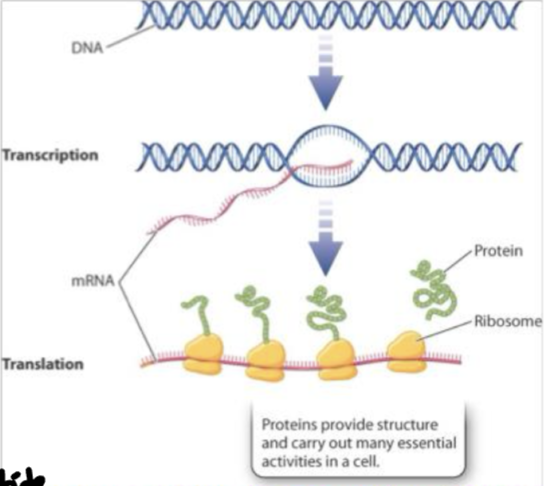
Genetic information is transferred from:
Genetic information is transferred from DNA to RNA
Genetic information
DNA is copied in…
… is translated into a…
Genetic information
DNA is copied in mRNA
mRNA is translated into a folded protein.
(some RNAs are not translated into proteins)
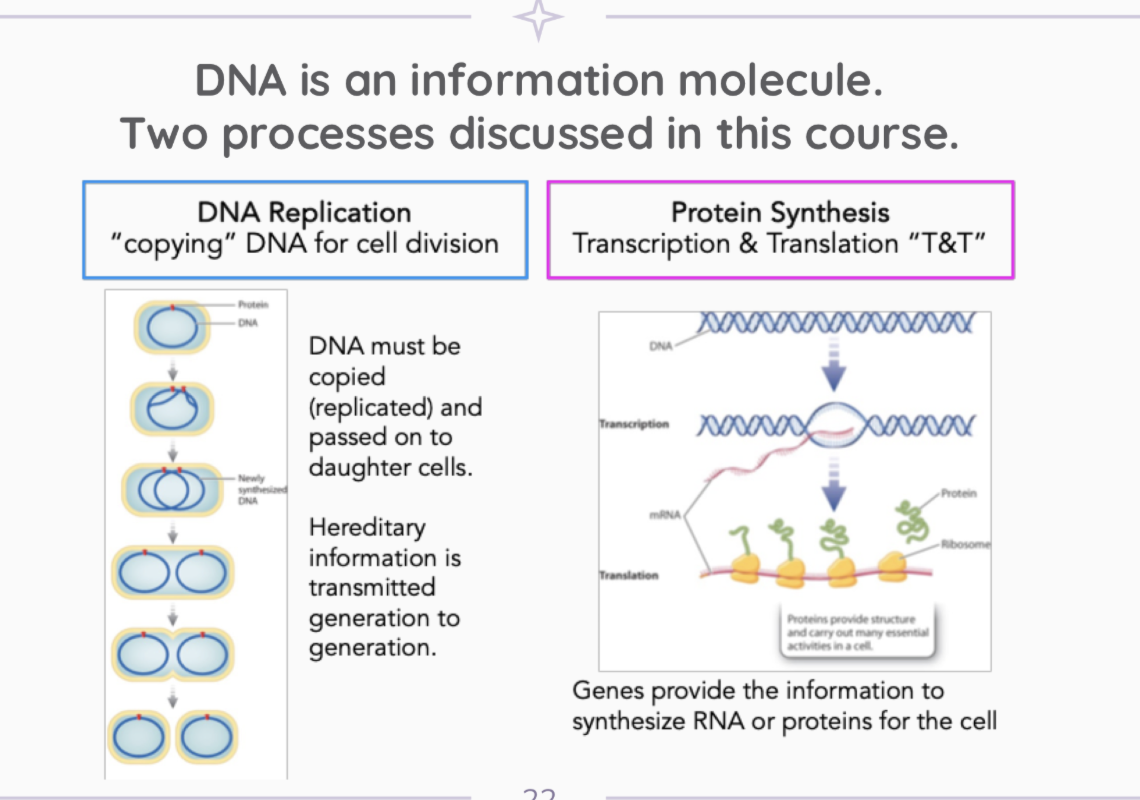
Processes in DNA
DNA Replication → copying DNA for cell division
Protein Synthesis → Transcription & Translation
Role of RNA molecules
Transcription of different RNAs in the cell.
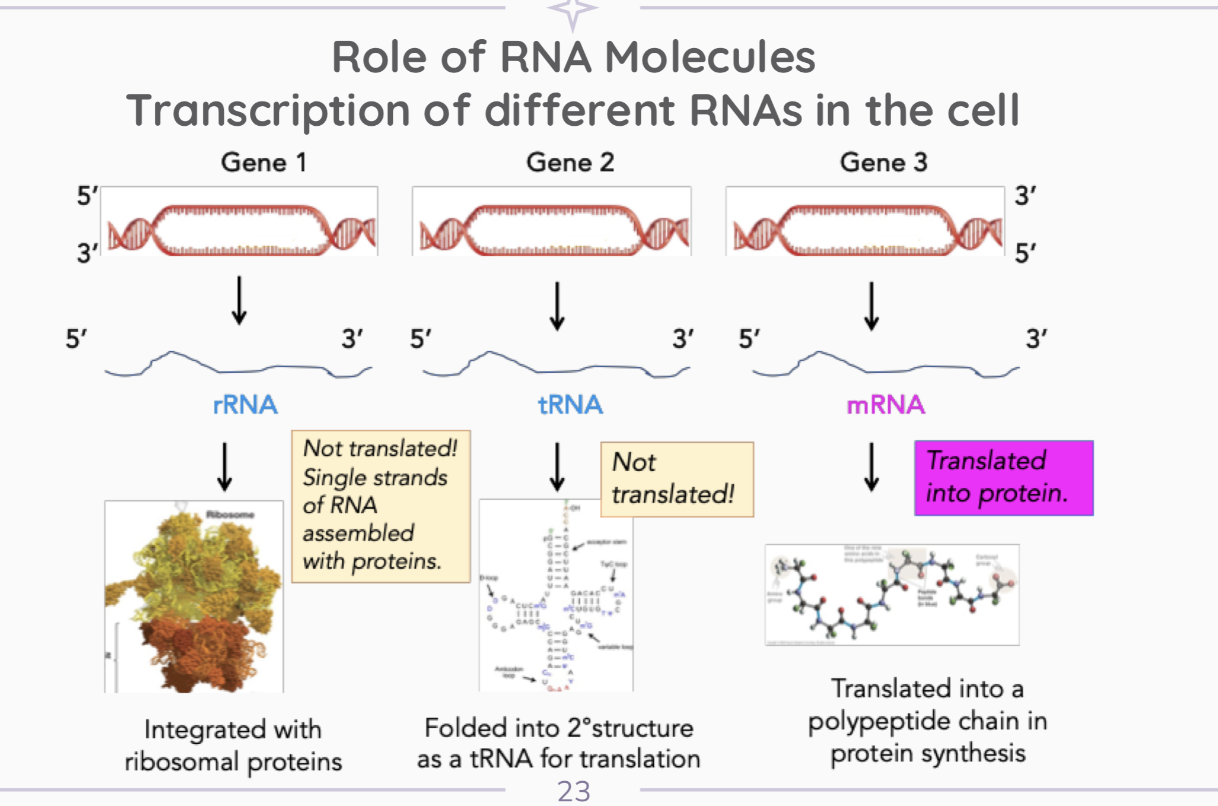
RNA molecules
rRNA & tRNA
rRNA and tRNA are considered to be “stable” RNA.
RNA strands are either bind with proteins (rRNA) or
fold to form secondary structures (tRNA) → protects RNA from degradation.
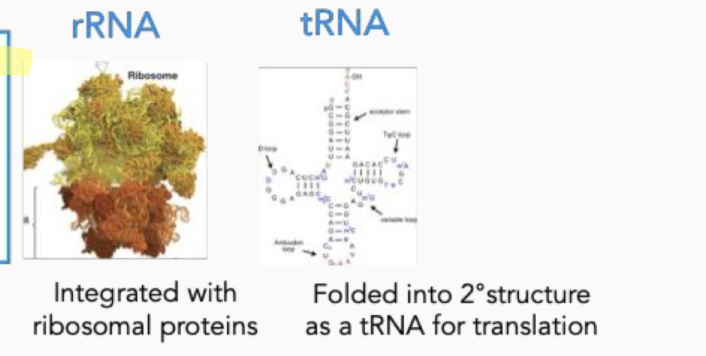
RNA molecules
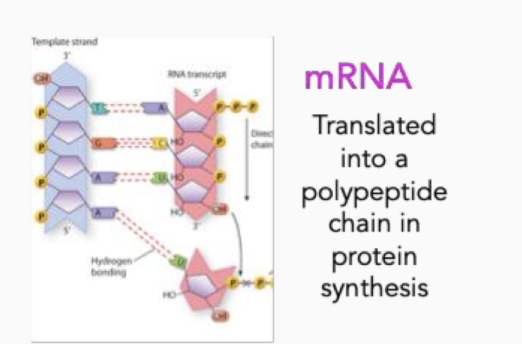
mRNA
unstable RNA
These enzymes in and out of the cell degrade RNA easily as it is single-stranded.
Short life
Translated into polypeptide chain in protein synthesis.
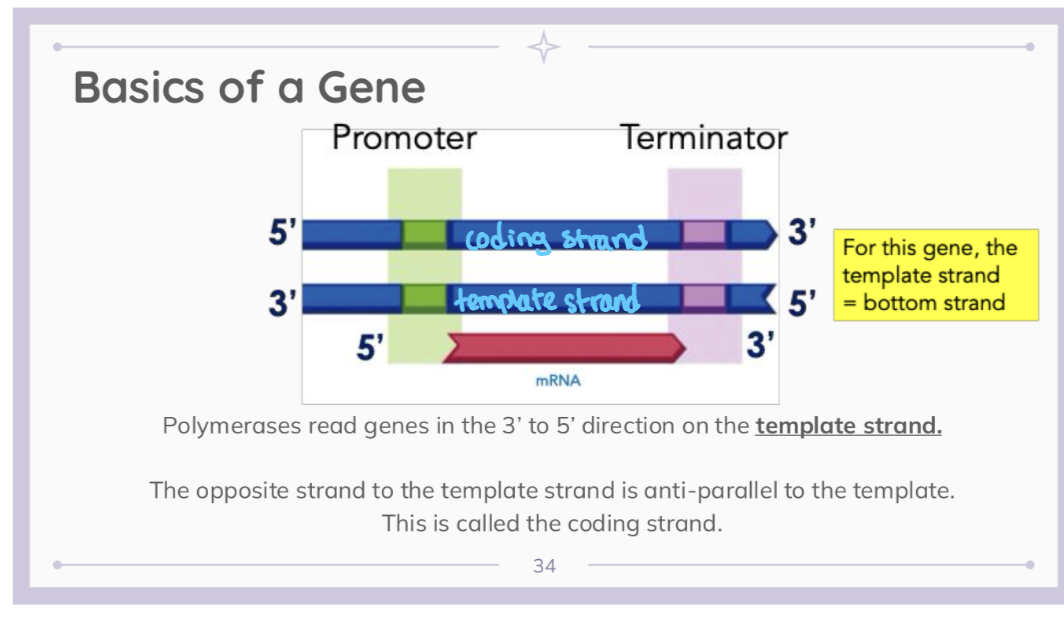
GENE STRUCTURE
What is a gene?
In molecular biology a gene is a transcription unit.
The sequence of DNA that produces an RNA transcript.
Sequence of nucleotides in DNA that codes for a single RNA molecules, along with sequences necessary for its transcription.
Elements of a gene
normally contains:
a promoter,
an RNA-coding sequence
terminator.
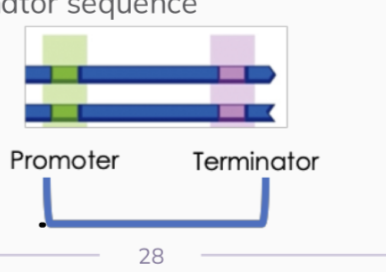
The coding region codes fro:
amino acids
RNA polymerases read genes in the … direction on the … strand.
RNA polymerases read genes in the 3’ to 5’ direction on the template strand.
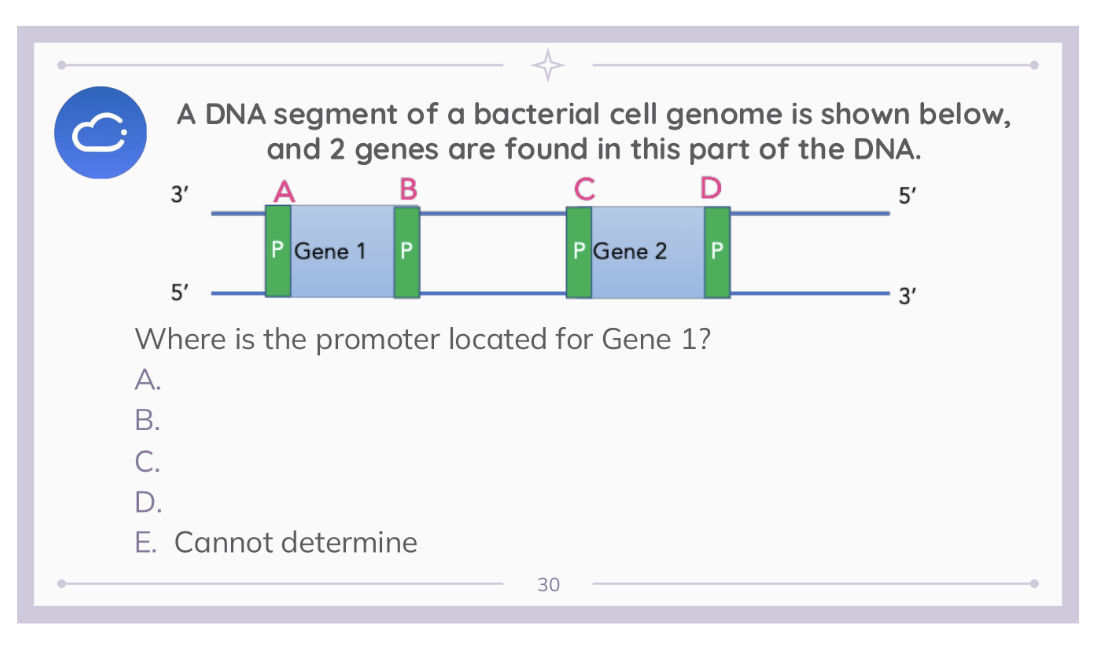
QUESTION
cannot determine → we are not given the direction.
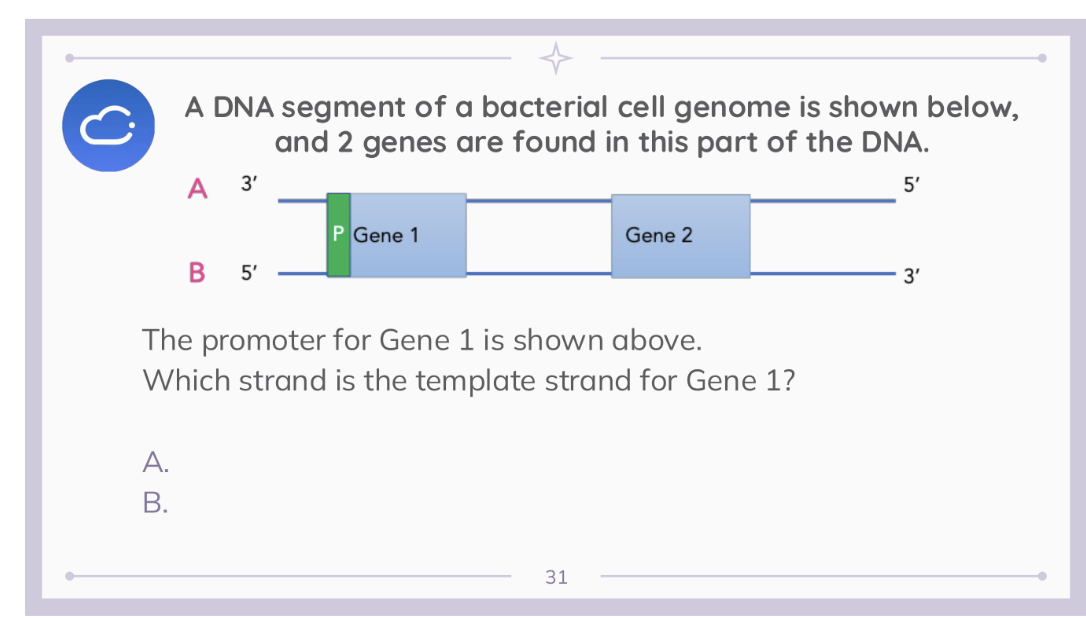
QUESTION
A
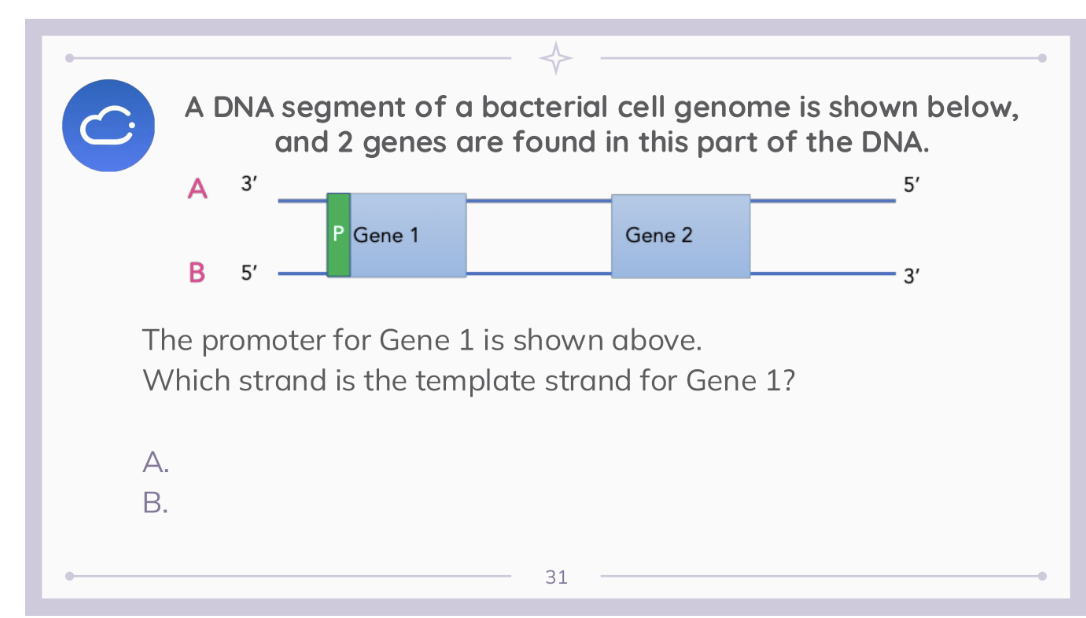
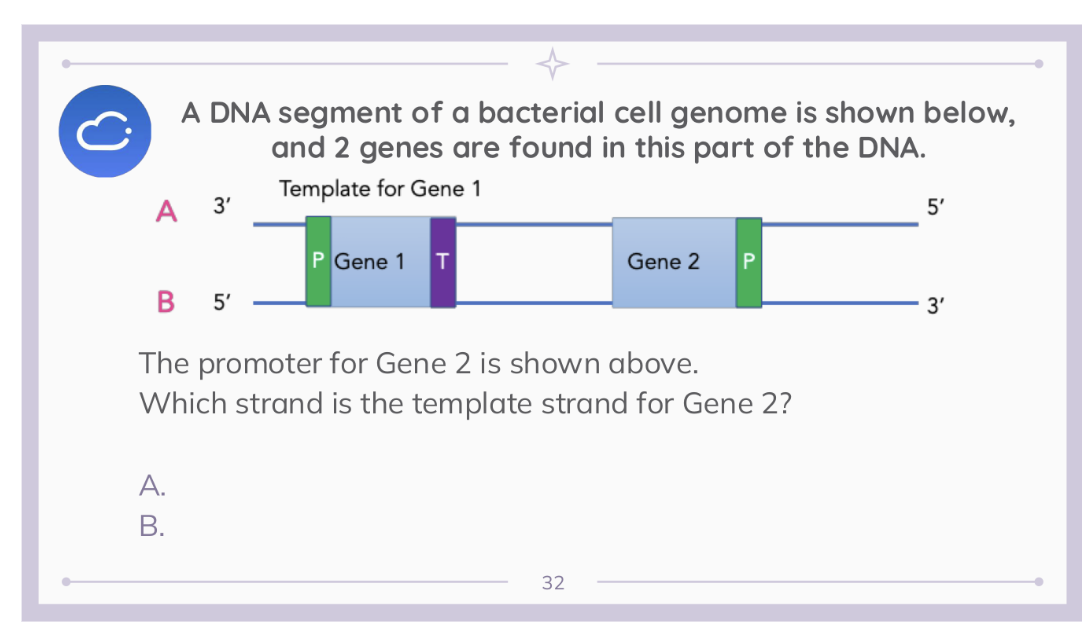
QUESTION
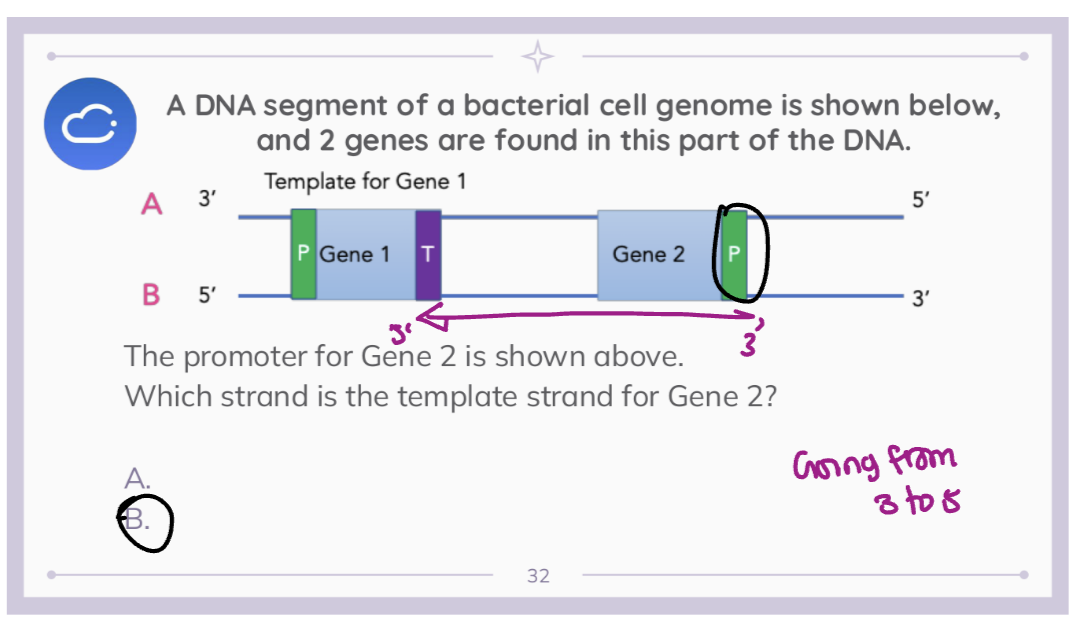
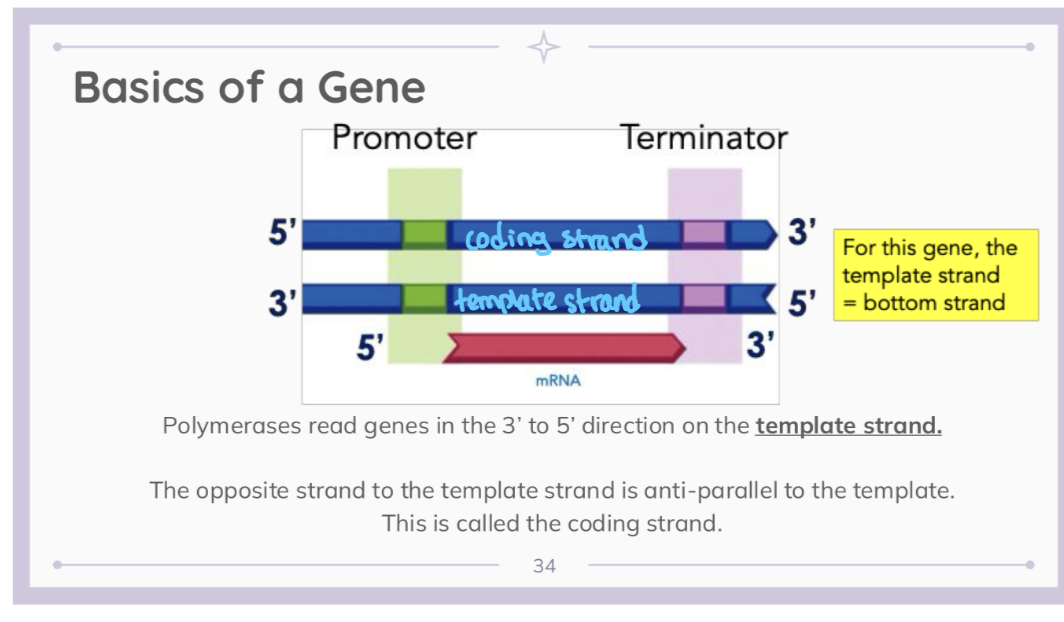
BASICS OF A GENE