7 - Metabolism and Pathways
 Call Kai
 Learn
Learn Practice Test
 Spaced Repetition
 Match
Match Flashcards
 Knowt Play
1/51

There's no tags or description
Looks like no tags are added yet.
Name | Mastery | Learn | Test | Matching | Spaced | Call with Kai |
|---|
No analytics yet
Send a link to your students to track their progress
52 Terms
c. Gluconeogenesis
Conversion of non-carbohydrate substrates into glucose
a. Glycolysis
b. Glycogenolysis
c. Gluconeogenesis
d. Glycogenesis
Pyruvate
Amino acids
Glycerol
Lactate
Non-carbohydrate substrates include _____ [4]
d. Lactate
This non-carbohydrate substrate, when undergoing gluconeogenesis, is normally communicated between muscle and liver
a. Pyruvate
b. Amino acids
c. Glycerol
d. Lactate
b. Cori cycle
The pathway in which lactate is communicated between muscle and liver during gluconeogenesis
a. Krebs cycle
b. Cori cycle
c. Calvin cycle
d. Urea cycle
c. Primarily cytosol (especially of the liver)
Cellular site of gluconeogenesis
a. Mitochondrial matrix
b. Nucleus
c. Primarily cytosol (especially of the liver)
d. Endoplasmic reticulum
c. Glucagon
Gluconeogenesis is stimulated by this ________ , indicating it happens in the fasted state
a. Insulin
b. Cortisol
c. Glucagon
d. Epinephrine
c. Glycolysis
Gluconeogenesis is described as the reverse of
a. Krebs cycle
b. Beta-oxidation
c. Glycolysis
d. Cori cycle
b. Hexokinase (HK)
[Gluconeogenesis - Diagram]
Glycolytic enzyme abbreviated as HK, reversed by glucose-6-phosphatase in gluconeogenesis
a. Pyruvate kinase
b. Hexokinase (HK)
c. Phosphofructokinase
d. Aldolase
c. Glucose-6-phosphatase
[Gluconeogenesis - Diagram]
Enzyme that converts G6P back to glucose, specifically a liver enzyme
a. Hexokinase
b. Phosphofructokinase
c. Glucose-6-phosphatase
d. Fructose-1,6-bisphosphatase
c. Phosphofructokinase (PFK)
[Gluconeogenesis - Diagram]
Glycolytic enzyme abbreviated as PFK, reversed by fructose-1,6-bisphosphatase in gluconeogenesis
a. Hexokinase
b. Pyruvate kinase
c. Phosphofructokinase (PFK)
d. Aldolase
c. Phosphofructokinase
[Gluconeogenesis - Diagram]
Enzyme that converts F6P back to FBP in glycolysis, bypassed in gluconeogenesis
a. Hexokinase
b. Fructose-1,6-bisphosphatase
c. Phosphofructokinase
d. Pyruvate carboxylase
d. Fructose-1,6-bisphosphatase
[Gluconeogenesis - Diagram]
Enzyme that converts FBP back to F6P in gluconeogenesis
a. Phosphofructokinase
b. Hexokinase
c. Aldolase
d. Fructose-1,6-bisphosphatase
Glycerol
3 fatty acids
[Gluconeogenesis - Diagram]
Triacylglycerol (TAG) breaks down into ______ [2]
b. Glycerol
[Gluconeogenesis - Diagram]
Component of TAG that feeds into gluconeogenesis at the level of DHAP
a. Fatty acids
b. Glycerol
c. Amino acids
d. Pyruvate
c. Amino acids
[Gluconeogenesis - Diagram]
These feed into gluconeogenesis through the TCA cycle via oxaloacetate
a. Fatty acids
b. Glycerol
c. Amino acids
d. Lactate
c. Pyruvate kinase (PK)
[Gluconeogenesis - Diagram]
Glycolytic enzyme abbreviated as PK, bypassed in gluconeogenesis
a. Hexokinase
b. Phosphofructokinase
c. Pyruvate kinase (PK)
d. PEP carboxykinase
d. Pyruvate carboxylase
[Gluconeogenesis - Diagram]
Enzyme that converts Pyruvate to Oxaloacetate in gluconeogenesis
a. PEP carboxykinase
b. Pyruvate kinase
c. Pyruvate dehydrogenase
d. Pyruvate carboxylase
d. PEP carboxykinase
[Gluconeogenesis - Diagram]
Enzyme that converts Oxaloacetate to PEP in gluconeogenesis
a. Pyruvate carboxylase
b. Pyruvate kinase
c. Citrate synthase
d. PEP carboxykinase
a. Glycogenesis
[Glycogen Metabolism]
Synthesis of glycogen
a. Glycogenesis
b. Glycogenolysis
b. Glycogenolysis
[Glycogen Metabolism]
Breakdown of glycogen
a. Glycogenesis
b. Glycogenolysis
a. Glycogenesis
[Glycogen Metabolism]
Requires formation of α1,4 and α1,6 bonds
a. Glycogenesis
b. Glycogenolysis
b. Glycogenolysis
[Glycogen Metabolism]
Requires breakdown of α1,4 and α1,6 bonds
a. Glycogenesis
b. Glycogenolysis
a. Glycogenesis
[Glycogen Metabolism]
Stores glucose from the blood to the liver and muscle
a. Glycogenesis
b. Glycogenolysis
b. Glycogenolysis
[Glycogen Metabolism]
Releases glucose from liver to the blood (muscles don’t release)
a. Glycogenesis
b. Glycogenolysis
a. Glycogenesis
[Glycogen Metabolism]
Stimulated by insulin , indicating it happens in the fed state
a. Glycogenesis
b. Glycogenolysis
b. Glycogenolysis
[Glycogen Metabolism]
Stimulated by glucagon , indicating it happens in the fasted state
a. Glycogenesis
b. Glycogenolysis
b. Glycogen synthase
[Glycogen Metabolism]
Rate-limiting enzyme of glycogenesis
a. Glycogen phosphorylase
b. Glycogen synthase
c. Phosphoglucomutase
d. Branching enzyme
c. Glycogen phosphorylase
[Glycogen Metabolism]
Rate-limiting enzyme of glycogenolysis
a. Glycogen synthase
b. Phosphoglucomutase
c. Glycogen phosphorylase
d. Debranching enzyme
b. Glucan
[Glycogen Metabolism]
Glycogen is composed of this type of polymer
a. Disaccharide
b. Glucan
c. Monosaccharide
d. Galactan
c. α1,4
[Glycogen Metabolism]
Bond responsible for the "length" of glycogen, and dominant in the structure
a. α1,6
b. β1,4
c. α1,4
d. β1,6
c. α1,6
[Glycogen Metabolism]
Bond responsible for the "branching" of glycogen
a. α1,4
b. β1,4
c. α1,6
d. β1,6
Liver
Muscle
[Glycogen Metabolism]
Glycogen is stored in the _______ [2]
c. Mutase
[Glycogen Metabolism]
Clue word indicating an enzyme acts as a positional isomer
a. Synthase
b. Phosphorylase
c. Mutase
d. Kinase
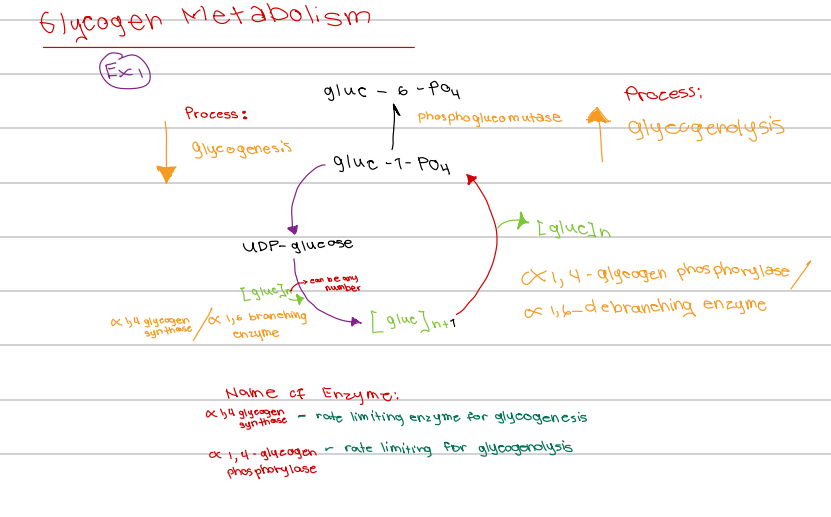
c. Phosphoglucomutase
[Glycogen Metabolism]
Enzyme that converts Gluc-6-PO4 to Gluc-1-PO4
a. Glycogen synthase
b. Glucose-6-phosphatase
c. Phosphoglucomutase
d. Glycogen phosphorylase
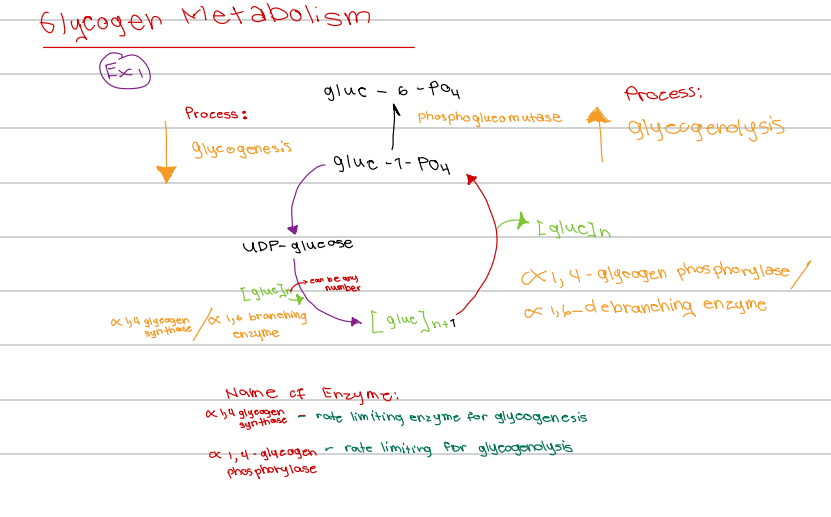
c. Glycogenesis
[Glycogen Metabolism]
Process in which Gluc-1-PO4 is converted to UDP-glucose
a. Glycogenolysis
b. Glycolysis
c. Glycogenesis
d. Gluconeogenesis
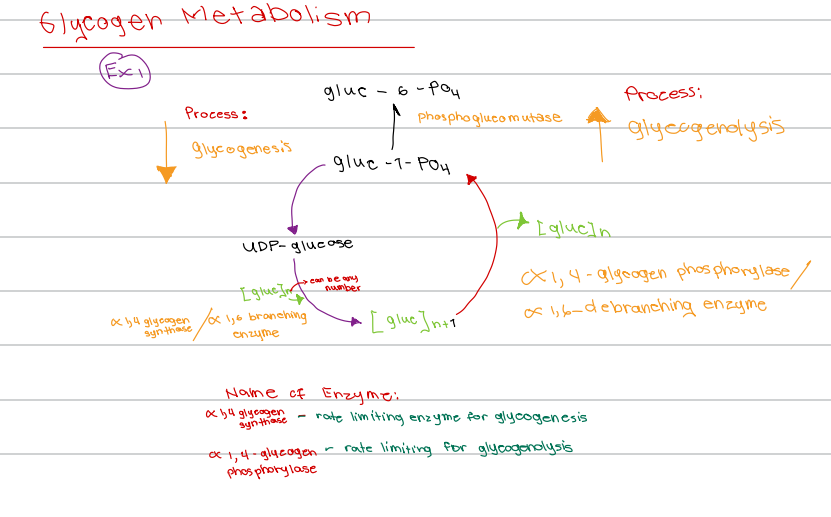
c. Any number
[Glycogen Metabolism]
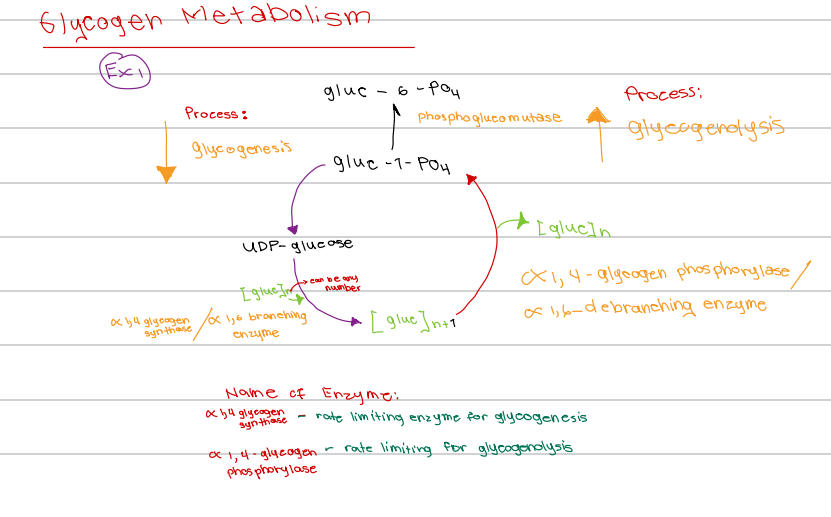
In [gluc]n, n represents
a. A fixed number
b. An even number
c. Any number
d. A prime number
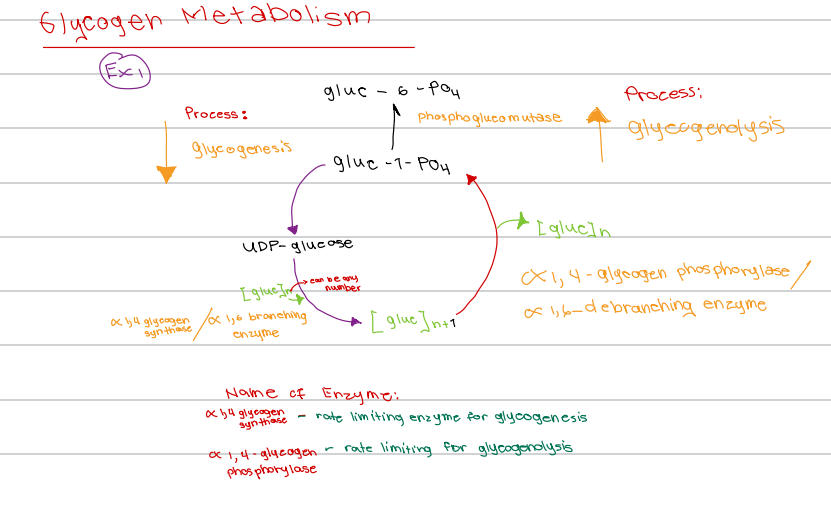
b. α1,6 branching enzyme
[Glycogen Metabolism]
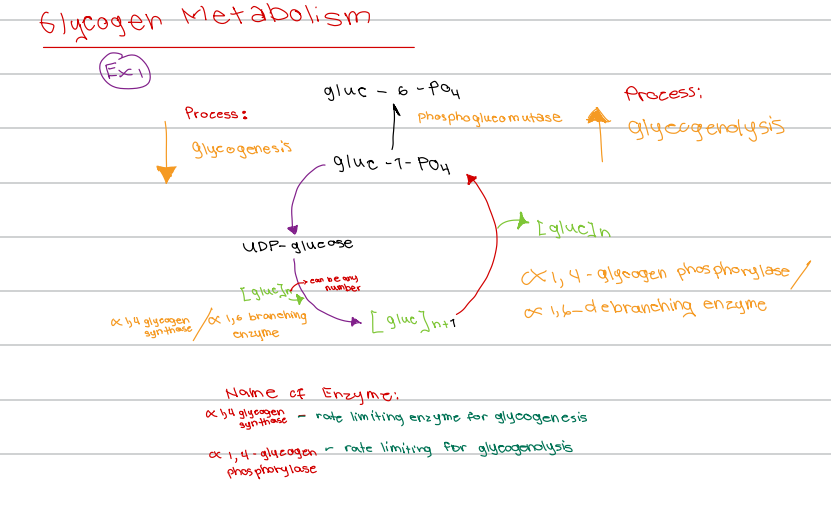
Enzyme responsible for adding glucose units via α1,6 bonds during glycogenesis
a. α1,4 glycogen synthase
b. α1,6 branching enzyme
c. α1,4 glycogen phosphorylase
d. α1,6 debranching enzyme
c. α1,6 debranching enzyme
[Glycogen Metabolism]
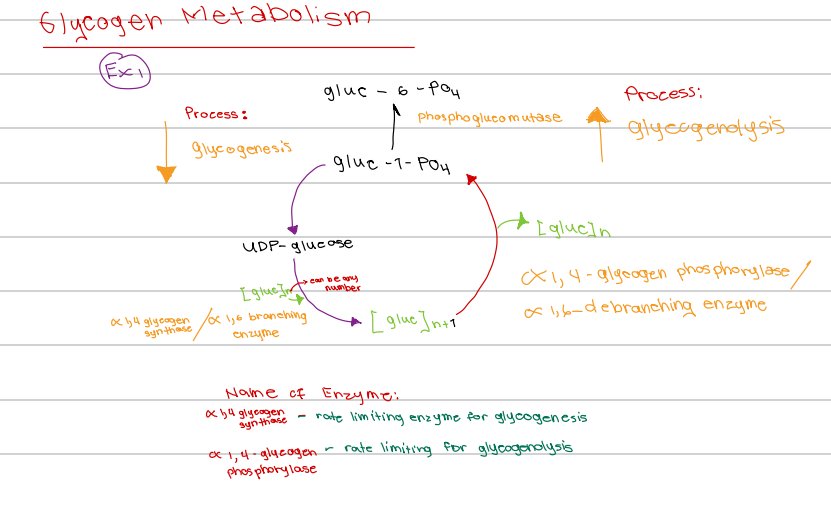
Enzyme responsible for removing glucose units via α1,6 bonds during glycogenolysis
a. α1,6 branching enzyme
b. α1,4 glycogen synthase
c. α1,6 debranching enzyme
d. α1,4 glycogen phosphorylase
b. α1,4 glycogen synthase
[Glycogen Metabolism]
Rate-limiting enzyme for glycogenesis
a. α1,6 branching enzyme
b. α1,4 glycogen synthase
c. α1,4 glycogen phosphorylase
d. α1,6 debranching enzyme
c. α1,4-glycogen phosphorylase
[Glycogen Metabolism]
Rate-limiting enzyme for glycogenolysis
a. α1,4 glycogen synthase
b. α1,6 branching enzyme
c. α1,4-glycogen phosphorylase
d. α1,6 debranching enzyme
c. Glycogenesis
[Glycogen Metabolism]
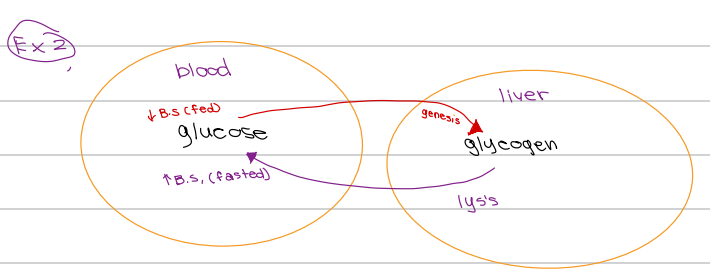
Process by which glucose from the blood is converted to liver glycogen, occurring in the fed state
a. Glycogenolysis
b. Gluconeogenesis
c. Glycogenesis
d. Glycolysis
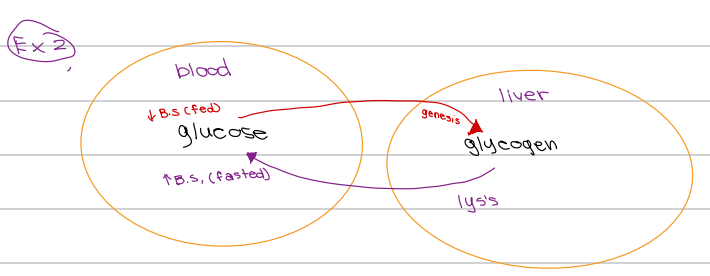
c. Decreased blood sugar
[Glycogen Metabolism]
Glycogenesis causes this effect on blood sugar
a. Increased blood sugar
b. No change in blood sugar
c. Decreased blood sugar
d. Stabilized blood sugar
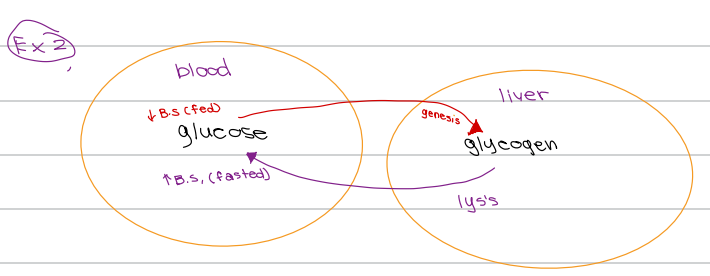
b. Glycogenolysis
[Glycogen Metabolism]
Process by which liver glycogen is converted back to glucose released into the blood, occurring in the fasted state
a. Glycogenesis
b. Glycogenolysis
c. Gluconeogenesis
d. Glycolysis
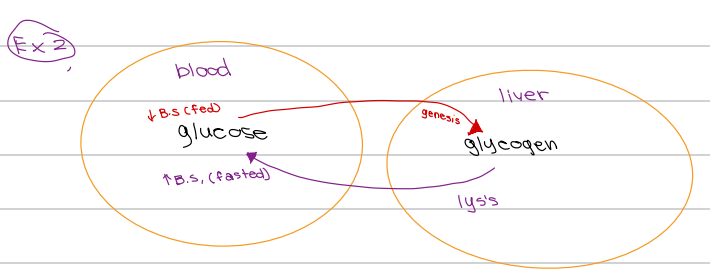
d. Increased blood sugar
[Glycogen Metabolism]
Glycogenolysis causes this effect on blood sugar
a. Decreased blood sugar
b. No change in blood sugar
c. Stabilized blood sugar
d. Increased blood sugar
c. No eponymous name (—)
[Glycogen Storage Diseases]
Glycogen synthase deficiency corresponds to GSD Type 0
a. Von Gierke's disease
b. Pompe's disease
c. No eponymous name (—)
d. Andersen's disease
c. Von Gierke's disease
[Glycogen Storage Diseases]
Glucose-6-phosphatase deficiency corresponds to
a. Pompe's disease
b. Cori's disease
c. Von Gierke's disease
d. Andersen's disease
b. Pompe's disease
[Glycogen Storage Diseases]
Lysosomal alpha-glucosidase deficiency corresponds to
a. Von Gierke's disease
b. Pompe's disease
c. McArdle's disease
d. Hers' disease
b. Cori's disease
[Glycogen Storage Diseases]
Debranching enzyme deficiency corresponds to
a. Andersen's disease
b. Cori's disease
c. Tarui's disease
d. Hers' disease
c. Andersen's disease
[Glycogen Storage Diseases]
Branching enzyme deficiency corresponds to
a. Cori's disease
b. McArdle's disease
c. Andersen's disease
d. Pompe's disease
b. McArdle's disease
[Glycogen Storage Diseases]
Muscle phosphorylase deficiency corresponds to
a. Hers' disease
b. McArdle's disease
c. Andersen's disease
d. Tarui's disease
c. Hers' disease
[Glycogen Storage Diseases]
Liver phosphorylase deficiency corresponds to
a. McArdle's disease
b. Tarui's disease
c. Hers' disease
d. Von Gierke's disease
d. Tarui's disease
[Glycogen Storage Diseases]
PFK deficiency corresponds to
a. McArdle's disease
b. Hers' disease
c. Cori's disease
d. Tarui's disease