homolytic and heterolytic fission
 Call Kai
 Learn
Learn Practice Test
 Spaced Repetition
 Match
Match Flashcards
 Knowt Play
1/16

There's no tags or description
Looks like no tags are added yet.
Name | Mastery | Learn | Test | Matching | Spaced | Call with Kai | Chat |
|---|
No analytics yet
Send a link to your students to track their progress
17 Terms
reaction mechanisms
series of steps that take place in the course of the overall reaction
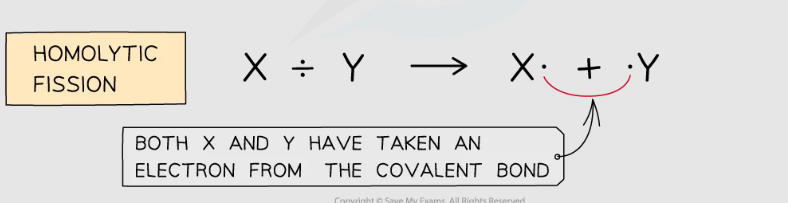
homolytic fission
both atoms at each end of the bond leave with one electron from the pair forming the covalent bond
free radicals
formed post homolytic fission…have an unpaired electron represented by a dot
initiation step
energy is input which results in the breaking of a covalent bond to form 2 free radicals
propagation step
formed free radicals can then attack reactant molecules to form more free radicals
termination step
two free radicals react with each other to form a molecule with no free radicals
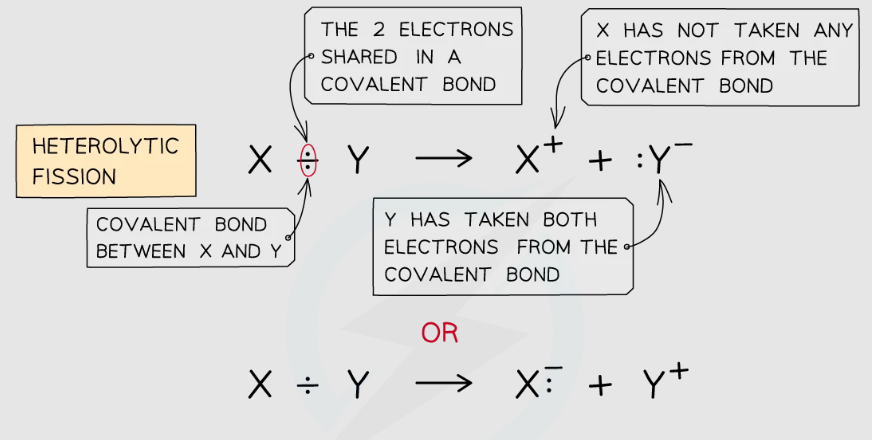
heterolytic fission
the more electronegative atom takes both the electrons in the covalent bond
C-X bonds
small curly arrow shows electron movement…X is more electronegative than carbon
carbocation
alkyl group with a single positive charge on one of its carbon atoms…formed during reaction mechanisms
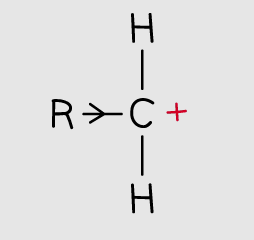
primary carbocation
least stable with one alkyl group
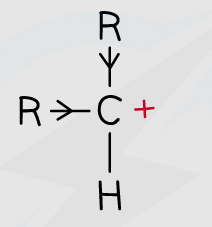
secondary carbocation
partially stable with two alkyl groups
tertiary carbocation
most stable with 3 alkyl groups
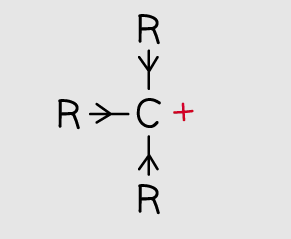
inductive effect
uneven sharing of electrons from a covalent bond…electron donors like alkyl groups are positive inductive and electron takers like oxygen are negative inductive
alkyl groups
push electrons away from themselves and reduce charge density of positive charge on carbocation
stability
the more alkyl groups there are, the more stable the carbocation is
electrophile
species that can act as an electron pair acceptor like carbocations…forms a new covalent bond
nucleophiles
species that can act as a donor of an electron pair…forms a new covalent bond with the electron deficient atom under-attack