BIO 260 - Genetics Exam 1 Material
 Call Kai
 Learn
Learn Practice Test
 Spaced Repetition
 Match
Match Flashcards
 Knowt Play
1/131

There's no tags or description
Looks like no tags are added yet.
Name | Mastery | Learn | Test | Matching | Spaced | Call with Kai |
|---|
No analytics yet
Send a link to your students to track their progress
132 Terms
What are the characteristics that make an organism ideal for genetic studies?
Short generation time (short life cycle)
Production of numerous progeny (able to produce lots of babies for quantifiable results)
The ability to carry out controlled genetic crosses (you want to know the genetics that you’re working with)
The ability to be reared in a laboratory environment (low maintenance organism, low contamination risk)
The availability of numerous genetic variants (Availability of many known mutants and natural variants for comparison)
An accumulated body of knowledge about their genetic systems (lots of genetic data that is open)
What are the major divisions of genetics
Transmission Genetics
Molecular Genetics
Population Genetics
Transmission Genetics (Mendelian/classical)
Examines principles of heredity
Molecular Genetics
deals with processes underlying gene expression
Population Genetics
studies genetic composition of groups of organisms
Who is the father of modern genetics and why are they considered that?
Gregor Mendel
He was not the first to think about inheritance, but he was the first to carry out quantifiable experiments and apply the scientific method to the question “how are traits passed down?”
The principle of segregation came from Mendel’s ______
Independent assortment came from Mendel’s ______
monohybrid crosses
dihybrid crosses
Gregor Mendel Findings:
Deduced fundamental laws of genetics using garden peas
Parents pass on ‘heritable factors’ (genes) to their offspring responsible for inherited traits
Dominant and Recessive labels
Why did Mendel’s Experiments work so well
Controlled his matings
Pea plant was a model organism
Studied 7 characteristics that occurred in two forms, making him get clear numbers (either one or the other)
Characteristic
Feature you can measure or describe (e.g. color of flower)
Gene
An inherited factor that helps determine a characteristic
Allele
A version of a gene
Locus
The specific place on a chromosome occupied by an allele
Genotype
Set of alleles in an individual
Phenotype
Set of traits in an individual
Heterozygote
Individual with two different alleles at a specific locus
Homozygote
Individual with two identical alleles at a specific locus
Homologous Chromosomes
Pairs of matching chromosomes in diploid organisms, with one inherited from each parent
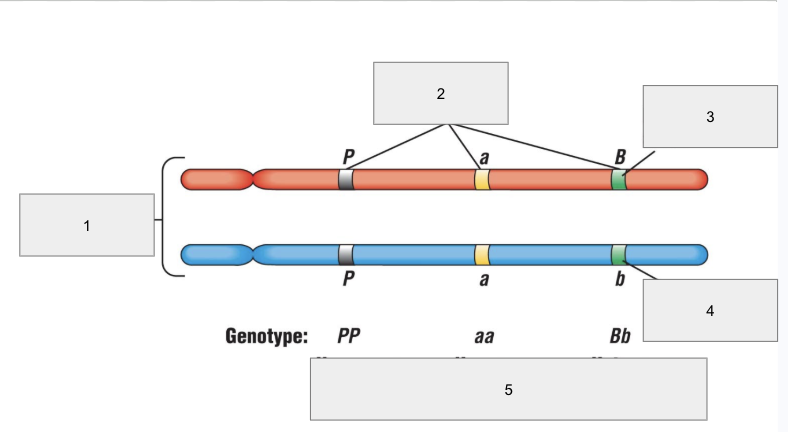
Homologous Chromosomes
Gene Loci
Dominant Allele
Recessive Allele
PP - homozygous for dominant allele, aa - homozygous for recessive allele, Bb - heterozygous
What question did Mendel want to answer?
if offspring of parents with distinct traits display either of the parental phenotypes or a blended phenotype
Monohybrid Crosses
A cross between two true-breeding parents that differ for one characteristic
3 generations (P, F1, F2)
2 crosses (PxP, F1xF1)
True Breeding
Parents are homozygous for specific traits, leading to offspring that do not show trait variation across generations
Intercross
Genotypes of the parents are different (RR x rr)
P Generation
These are the true-breeding parents used for the initial cross (RR x rr)
F1 Generation
The first set of offspring from the P generation cross. These are typically hybrids (heterozygous) and show only the dominant trait
F2 Generation
Offspring produced by the self-pollination or crossing of two individuals from the F1 generations (siblings omg)
What do you do to get to an F2 Generation when given parents genes?
Cross Parents to get F1 generation, cross F1 to get F2
What did Mendel Conclude?
The traits of the parents do not blend
F1 must have information from both parents, it is the only way in which both traits can re-emerge in the F2
Concept of Dominance - one version of a gene can mask a different version of the same gene
Individuals must carry two copies of each ‘factor’ which separate with equal probability when gametes are formed to explain the 3:1 in F2
Principle of Segregation
Diploid organisms possess two alleles for any particular trait, which separate (segregate) during meiosis, ensuring each gamete carries only one allele for each gene
Backcross
Take an F1 and cross it with one of the parents to produce offspring with genetic characteristics closer to that parent
Self Cross
Crossing two F1s, crossing it with the same genotype basically (Rr x Rr)
Genotypic Ratio
Look at all possible genotypes (1 RR:2Rr :1 rr)
Phenotypic Ratio
Look at all possible phenotypes (3 round:1 wrinkled)
Test Cross
used to determine if an individual with a dominant phenotype (and unknown genotype) is homozygous dominant or heterozygous
Reciprocal Cross
Switch the phenotypes of the parents to determine if the inheritance pattern is influenced by the parent's gender
so if in the first cross the female phenotype is PP, the reciprocal cross will be pp (same for male)
What cross would you set up if you want to find out the genotype of an organism displaying a dominant phenotype?
test-cross
The Multiplication Rule
The probability of two or more independent events occurring together is calculated by multiplying their independent probabilities
Language to look out for in questions: “and“
Independent Event
when the outcome of one event does not affect the probability of another
The Addition Rule
The probability of any one of two or more mutually exclusive event is calculated by adding the probabilities of these events
language to look out for: “or“
Mutually exclusive events
events that can’t happen at the same time
Probability
Odds/chances something will happen
expressed as a value from 0-1, with 0 meaning it is impossible and 1 meaning it is certain
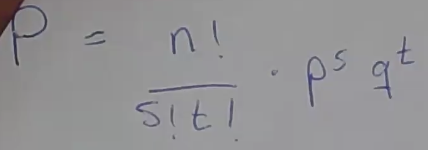
n = # trials
s = number in one class
t = number of other class
p = probability of outcome s
q = probability of outcome t
Dihybrid Crosses
Analyzing the inheritance patterns of two distinct genes simultaneously (RRYY x rryy)
Law of independent Assortment
Alleles at different loci separate independently of one another
When does the law of independent assortment occurr
During meiosis I, metaphase I when homologous chromosomes line up RANDOMLY
The Law of independent Assortment was derived by Mendel’s ____
Dihybrid Crosses
Dihybrid Crosses give you ____ combinations
16
Observing a phenotypic ratio of 9:3:3:1 is indicative of what type of cross?
Double heterozygote x double heterozygote
When given a dihybrid problem, use a ___
branch diagram
Mendel’s principles of inheritance
Law of segregation (1st law)
Law of independent assortment (2nd law)
Genetics
The science of heredity, dealing with resemblances and differences of related organisms resulting from the interaction of their genes and the environment
Branch Diagrams
Used to determine the phenotypic ratio of a dihybrid cross
Observing a phenotypic ratio of 1:1:1:1 is indicative of what type of cross?
double heterozygous x double homozygous for recessive allele
The Goodness of fit Chi-Square Test
A test that measures how a hypothesis/model compares to actual data
Indicates the probability that the observed deviation is due to chance
P < 0.05 (5%)
reject the null
P > 0.05 (5%)
fail to reject the null
Duplicated Chromosomes
Consist of two sister chromatids
Homologous Pair
Consist of two chromosomes, a maternal and a paternal
Diploid cells (2n)
Carry two sets of genetic information (pairs of homologous chromosomes/allele pairs)
Haploid cells (n)
Carry one set of genetic information (one chromosome/one allele from the pair)
We have 22 ___ and one pair of___
autosomes
sex chromosomes
Karyotype
An arrangement of chromosomes, allow to see chromosomes (usually done during pregnancy to see if something needs investigating)
Trisomy 21
extra copy of chromosome 21 (three instead of 2) resulting in down syndrome and other symptoms
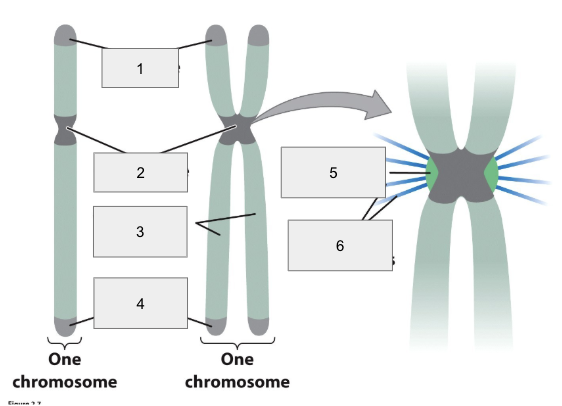
Telomere
Centromere
Sister chromatids
telomere
kinetochore
spindle microtubules
Centromere
DNA region on chromosome area where kinetochores assemble and allow attachment of spindle microtubules
When counting chromosomes, count the __
centromeres
Telomeres
Tips of a linear chromosome, protect from genetic data loss and deterioration during cell division (they shorten every time, once too short, they go through cell death)
Chromosomes are made up of ___
chromatin
Chromatin
DNA wrapped around histone proteins
What does the wrapping of histones allow?
It allows huge amounts of DNA to fit into a very small space (nucleous)
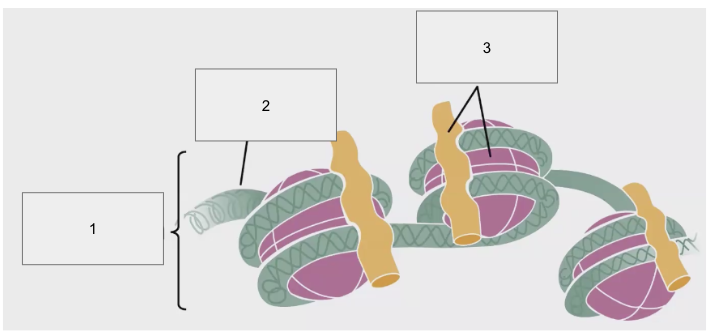
Chromatin
DNA
Histone Proteins
Meiosis
The first part of sexual reproduction, the second is fertilization
one of two types of cell division (mitosis)
Meiosis produces genetic _______
variation in sexually reproducing animals
A cell that’s gonna divide by meiosis will go through ___
interphase
Interphase (S-Phase)
Chromosomes and DNA duplicates
Meiosis I gives you _____
2 Haploid cells
Meiosis II gives you ____
4 Haploid cells
To count number of chromosomes in meiosis, count the ___
centromeres
Amount of DNA refers to the amount of ___
chromatids
Crossing over occurs in ___
Prophase I
Meiosis Consists of
Interphase (S-Phase)
Prophase I
Metaphase I
Anaphase I
Telophase I
Prophase II
Metaphase II
Anaphase II
Telophase II
What are the sources of genetic variation that occur in meiosis, and in what phase do they occur
Crossing over, happens in prophase I
Random alignment of homologs, happens in metaphase I
2^n calculates what
The number of possible gametes arising from independent assortment alone
where n is the number of homologous pairs in cell
Sex
refers to sexual phenotype. Most organisms have two sexual phenotypes, male & female, in which one of the fundamental differences is the size of their gametes
Male gametes contribute
nuclear DNA
which gamete is bigger, male or female?
female #swag
XX Male Syndrome
human with genotype XX (with translocated SRY gene), displaying male anatomy, is referred to as being male
sterile male
Androgen Insensitivity Syndrome
XY individual develops female phenotype, but no uterus + underdeveloped gonads (no testosterone receptor expressed)
SRY is what and where is it located
Sex determining region Y-protein
very top of the Y chromosome
Swyer Syndrome
Mutation in SRY that results in a phenotypic female
What are the main Sex-Deterrmining Mechanisms
Genic
Environmental
Chromosomal
Genic Sex Determination
Genetically determined but there are no sex chromosomes, sex is controlled by genes
No chromosomes that stand out as sex chromosomes
what are some organisms that follow genic sex determination
some plants, fungi, protozoans, and fishes
Environmental Sex Determination
Sex is determined fully or in part by environmental factors
what are some organisms that environmental sex determination
turtles - lower temp gives you male, high temp gives you female
limpet - first larva that attaches to a rock is a female, then others that attach is male
Chromosomal Sex-Determining Systems
utilize sex chromosomes to determine an organism's biological sex
what are the three chromosomal systems
XX-XO
XX-XY
ZZ-ZW
Heterogametic
organism that consists of sex chromosomes that differ
Homogametic
organism that consists of the same sex chromosomes
XX-XO: males are _____, females
____
heterogametic
homogametic