PHYS 1025Q Final Exam Prep - Conceptual Questions
 Call Kai
 Learn
Learn Practice Test
 Spaced Repetition
 Match
Match Flashcards
 Knowt Play
1/63

There's no tags or description
Looks like no tags are added yet.
Name | Mastery | Learn | Test | Matching | Spaced | Call with Kai |
|---|
No analytics yet
Send a link to your students to track their progress
64 Terms
Why do we have seasons?
The tilt of Earth's axis, at 23.5 degrees, as it revolves around the Sun, puts the southern hemisphere in winter when the northern hemisphere is in summer and vice versa.
Andromeda is our nearest large spiral galaxy. It is about 2.5 million light-years away. When we look at Andromeda, we see it:
A) As it is right now.
B.) As it will be in 5 million years.
C) As it will be in 2.5 million years.
D) As it was 5 million years ago.
E) As it was 2.5 million years ago.
E) As it was 2.5 million years ago.
True or false: During the 3rd quarter Moon, 3/4 of the Moon's surface is illuminated
False.
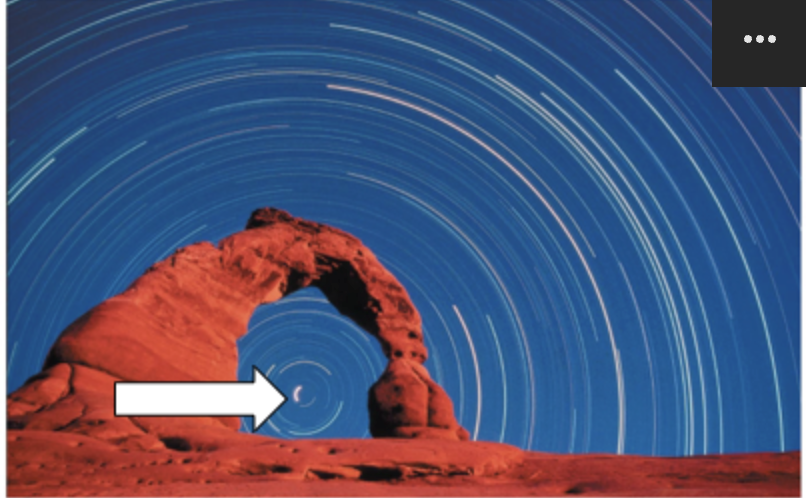
Stars rise in the ___ and set in the ___. The arrow in this time-lapse picture from Arches National Park in Utah is pointing in the direction of ___.
east; west; north
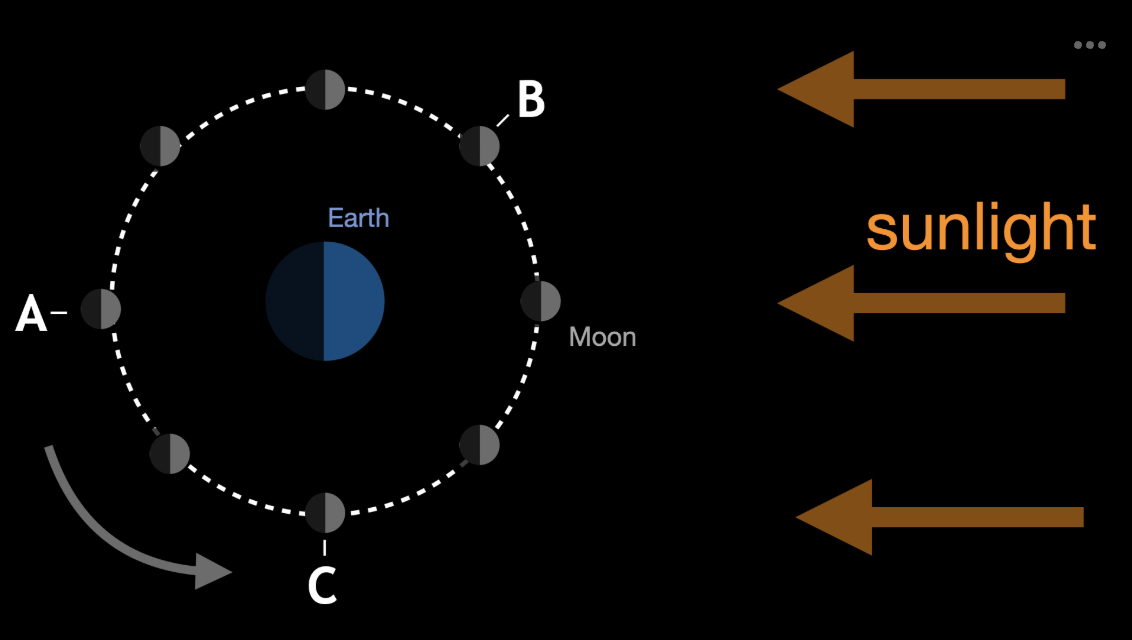
The figure shows a “top view” of the Sun, Earth and various positions of the Moon during its orbit around Earth. Find the correct image of the moon at each of the point A.
Full moon
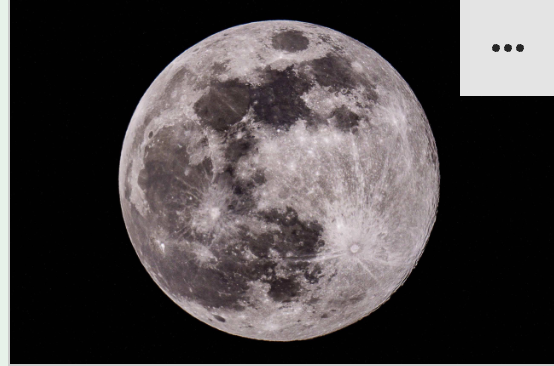
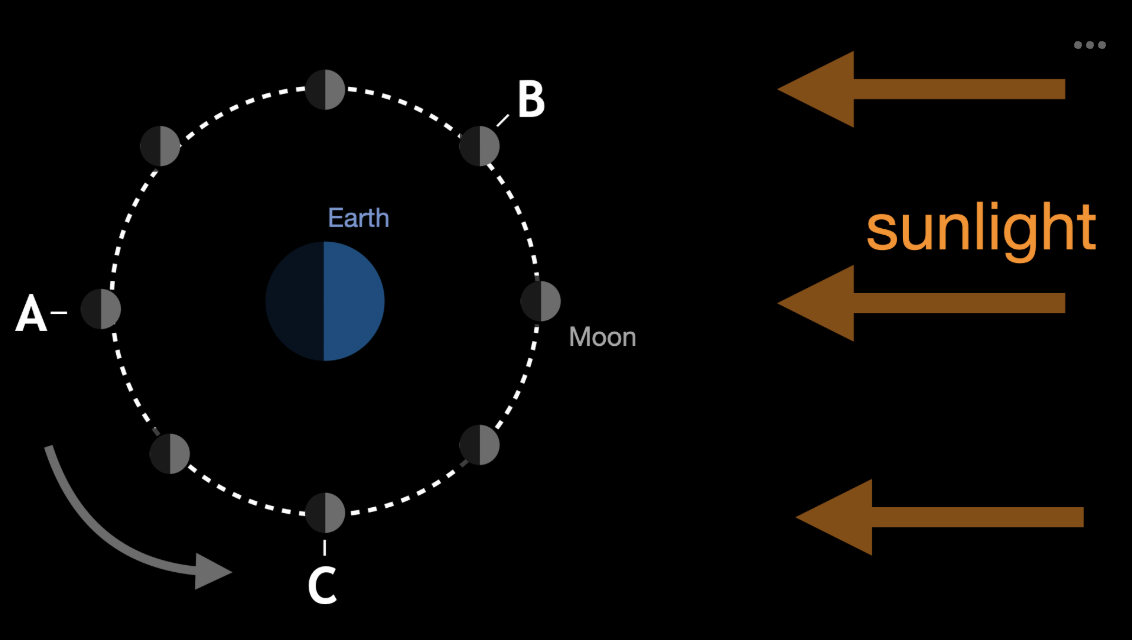
The figure shows a “top view” of the Sun, Earth and various positions of the Moon during its orbit around Earth. Find the correct image of the moon at each of the point B.
Waxing crescent
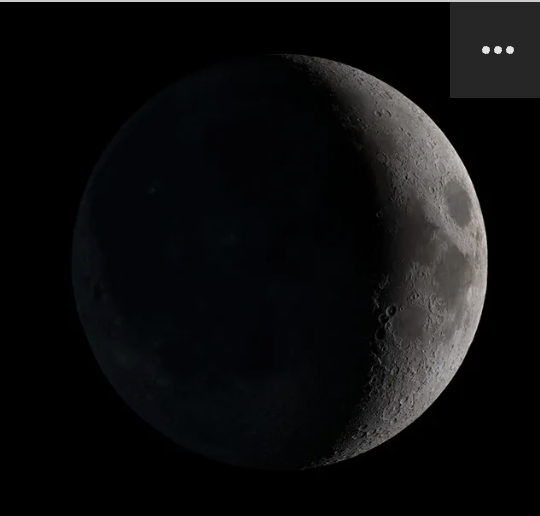
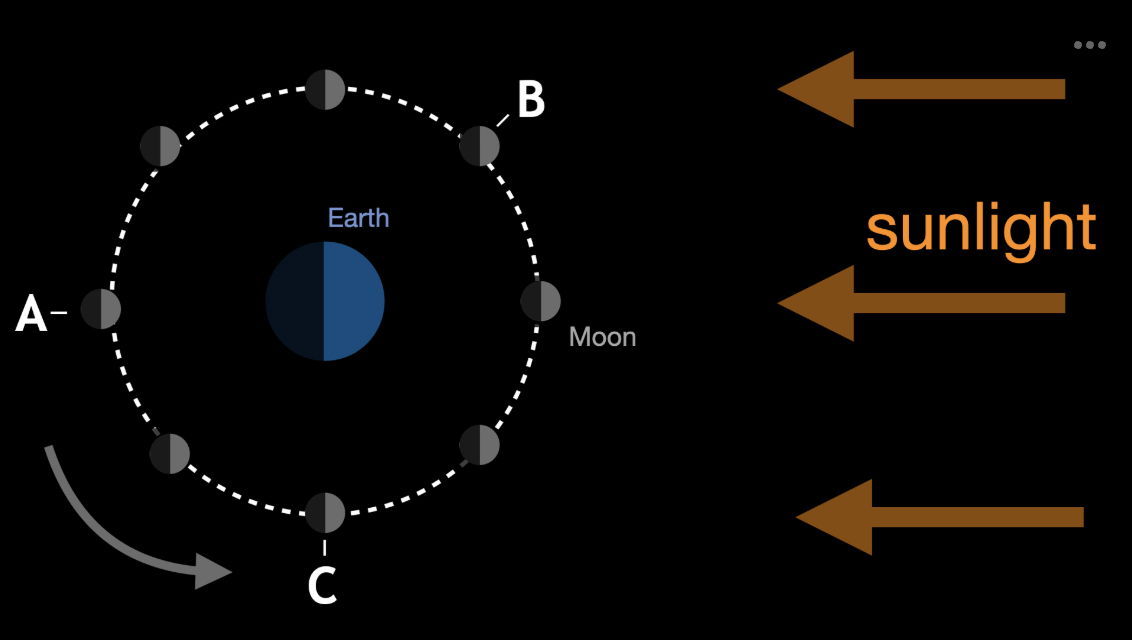
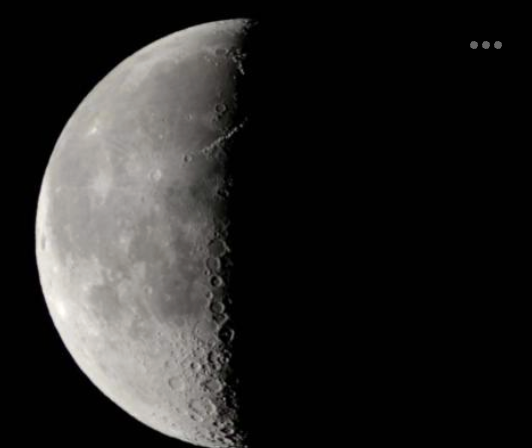
The figure shows a “top view” of the Sun, Earth and various positions of the Moon during its orbit around Earth. Find the correct image of the moon at each of the point C.
Third quarter
What is the phase of the moon immediately before entering, and just after exiting a lunar eclipse?
Full moon
True or false: A total solar eclipse is only seen from a location on Earth that is currently in the umbra of the Moon’s shadow.
True.
What is two of the observations that led astronomers to prefer the Sun-centered model instead of the old Earth-centered model of the solar system? (Hint: what did Galileo observe?)
The discovery of the phases of Venus and the discovery of the moons of Jupiter.
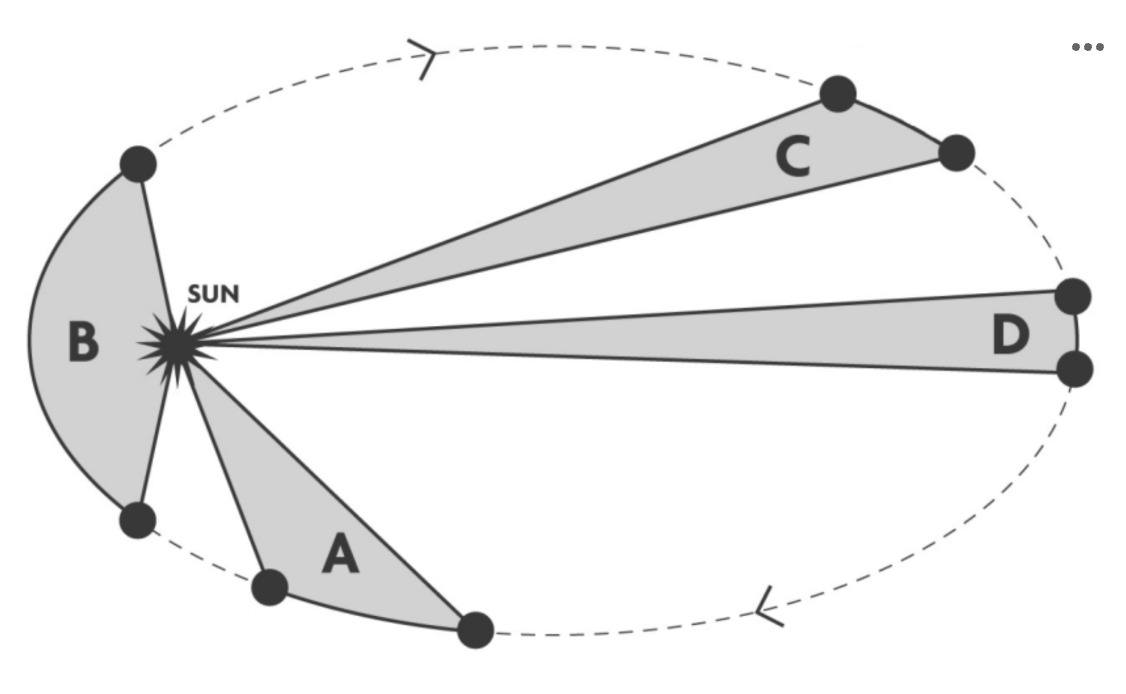
Rank the shaded parts of a planet’s orbit around the Sun by speed (slowest to fastest), distance (farthest to closest), and time (shortest to longest) according to Kepler’s Laws.
Speed: DCAB, Distance: DCAB, Time: DCAB
Which of the following is NOT one of Kepler’s Three Laws?
A) Most distance planets orbit the Sun at slower average speeds, P² = a³ (P = period of orbit, a = distance from Sun to planet)
B) The orbits of celestial bodies are controlled by the force of gravity.
C) The orbit of each planet around the Sun is an ellipse with the Sun at one focus.
D) As a planet moves around its orbit, it sweeps our equal areas in equal times; planets move faster at perihelion and slower at aphelion.
B
True or false: The orbits of the planets in the solar system are ellipses with low eccentricity. Since a circle is just an ellipse with zero eccentricity, that's why we often approximate these planetary orbits as circles.
True
Two stars are orbiting one another in a binary system. Star A has a mass of 5 times the mass of the Sun and Star B is 2 times the mass of the Sun. Which star experiences a larger gravitational force? Recall that F = G M1M2/R2
A) Star A
B) Star B
C) They experience the same gravitational force
D) More information is needed to answer this question
C
Two stars are orbiting one another in a binary system. Star A has a mass of 5 times the mass of the Sun and Star B is 2 times the mass of the Sun. Which star experiences a larger acceleration? Newton’s second law states that F = ma where m is the mass and a is the acceleration.
A) Star A
B) Star B
C) They experience the same gravitational force.
D) More information is needed to answer this question.
B
Fill in the blank: Red light has a ___ (higher/lower) frequency and a ____ (longer/shorter) wavelength than blue light. X-rays are _____ (higher/lower) energy than radio waves.
lower; longer; higher
True or false: Gamma rays travel at faster speeds than infrared light (both in a vacuum)
False
True or false: A solid object (i.e., a blackbody) at a higher temperature emits more power at all wavelengths than does a cooler one.
True —> A hotter blackbody emits more power at all wavelengths because higher temperature equals greater average atomic kinetic energy, leading to more frequent and more energetic collisions between atoms, which produce more intense, higher-frequency photons across the entire spectrum.
True or false: For a solid object emitting light, the higher the temperature, the longer the wavelength at which the maximum power is emitted
False
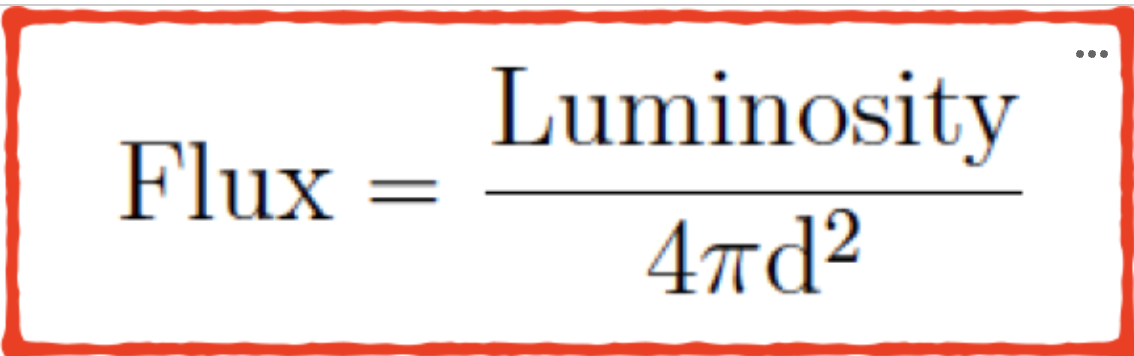
Star A and star B have the same luminosity, but star B is a factor 2 more distant than star A. What is the relationship between the fluxes (i.e., apparent brightness, or energy rate per area) we measure of these two stars?
A) The stars have the same flux
B) Star A’s flux is 2 times higher than Star B’s flux
C) Star A’s flux is 4 times higher than Star B’s flux
D) Star B’s flux is 2 times higher than Star A’s flux
E) Star B’s flux is 4 times higher than Star A’s flux
C
Select all the correct statements regarding the emission of a photon by a neutral hydrogen atom (hydrogen has one proton and one electron):
A) An atom with an electron in the ground state cannot emit a photon.
B) When the electron drops from a higher energy level to a lower one, the atom emits a photon having energy exactly equal to the energy difference between these two levels
C) Photons of any wavelength can be emitted
D) A gas cloud of hydrogen (consisting of many trillion individual atoms) will emit an emission spectrum.
A, B, and D
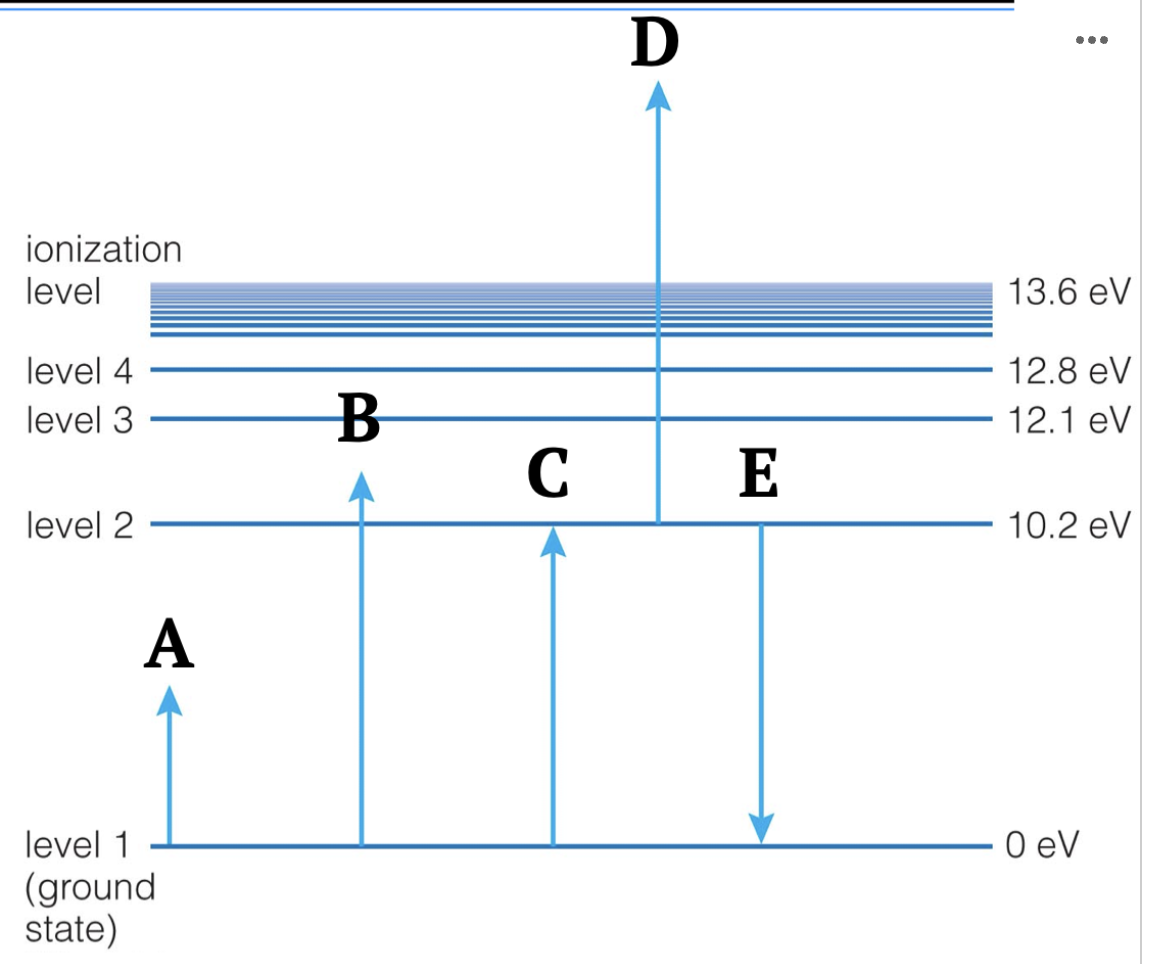
The energy levels of the Bohr Model of the Hydrogen atom are shown in the image. Indicate which transitions are not allowed.
A and B
True or false: The cool, low density atmosphere of the Sun creates absorption lines in the Solar spectrum. These lines arise from the transition of electrons from low to high energy levels in the atoms that comprise the atmosphere.
True
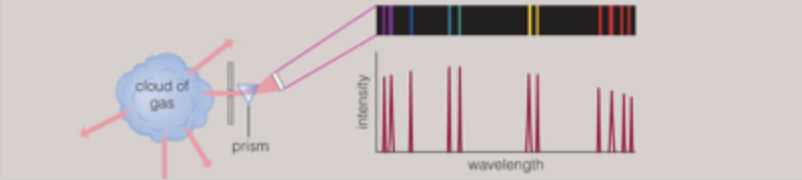
An electron in a cloud of gas moves from a discrete higher energy level to a discrete lower energy level, making the spectrum shown in the diagram an emission spectrum, an absorption spectrum, or a continuous spectrum?
Emission spectrum
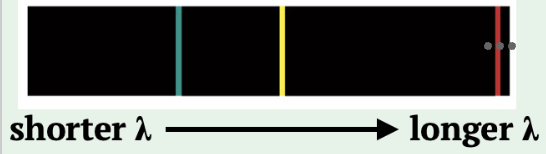
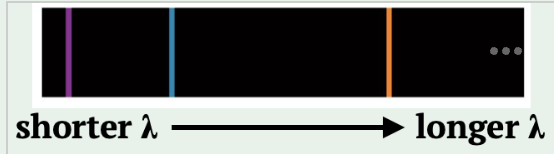
In this observed spectrum, how is the source moving?
The source is moving away from the observer
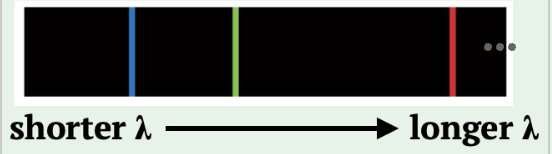
In this observed spectrum, how is the source moving?
The source is moving toward the observer
In this observed spectrum, how is the source moving?
The source is moving perpendicular to the observer’s line of sight.
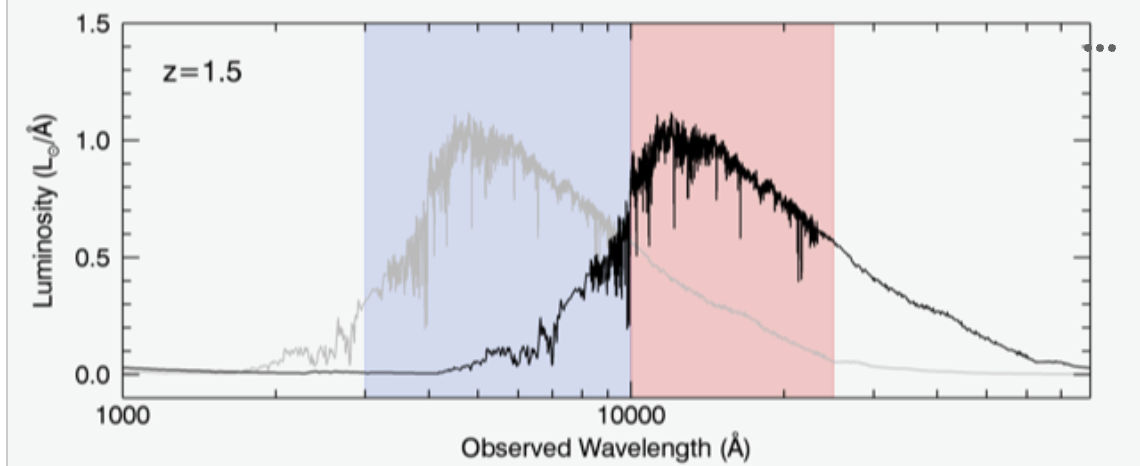
This bold line in this plot shows the spectrum of a galaxy at redshift z=1.5. This galaxy is so far away from us that the expansion of the universe makes it seem like it is moving away at a very high speed. The faint gray line shows what the galaxy's spectrum would look like if the galaxy were very nearby and not moving.
True or False: The spectrum shown in the bold line is blueshifted (i.e., shifted to shorter wavelengths).
False
What is the source of the Sun’s energy?
Nuclear fusion
Fill in the black using the following phrases: convection; gravity; nuclear fusion; electromagnetism.
Hydrostatic equilibrium describes the balance between the inward force of ___ and the outward pressure due to ___.
gravity; nuclear fusion
True or false: When hydrogen atoms fuse in the Sun’s core, the resulting helium atom has less mass than the sum of the hydrogen masses that combined together.
True
What will happen to our Sun at the end of its life?
It will undergo a Red Giant phase where its outer atmosphere will expand to engulf the Earth. At its core will be an ultra-dense White Dwarf star.
True or false: Measuring masses of stars can only reliably be done by observing eclipsing binary stars.
True
What are binary stars?
Two stars that are gravitationally bound and revolve about each other
What does an H-R Digram plot stars by?
Temperature and luminosity
Parallax: d= 1/p where d is the distance in pc and p is the parallax angle in arcseconds.
A star has a parallax of 1” (1 arcsecond). What is its distance?
1 parsec
Is radar a reliable technique to measure accurate distances to distant stars?
No
The position of a main-sequence star on the H-R diagram is uniquely determined by its mass. What are three properties that are correlated with its mass? (i.e., if you know the mass of a star, you know these properties as well).
A star’s surface temperature, luminosity, and lifetime.
The longest-lived stars on the main sequence are:
A) Low-mass and blue
B) Low-mass and red
C) High-mass and blue
D) High-mass and red
B
The most luminous red stars are:
A) Small and cool
B) Large and cool
C) Small and hot
D) Large and Hot
B
The dimmest blue stars are:
A) Small and cool
B) Large and cool
C) Small and hot
D) Large and Hot
C
The spectral classification scheme is ordered OBAFGKM.
True/False: O stars have the highest temperature
True
True/False: The space between the stars is purely a vacuum: it is completely empty of matter.
False
True/False: Molecular clouds comprise the coldest and densest phase of the interstellar medium.
True
What is the main physical force that causes interstellar gas to contract and ultimately form stars?
Gravity
True/False: Most stars form in clusters from a giant cloud of gas rather than on their own.
True
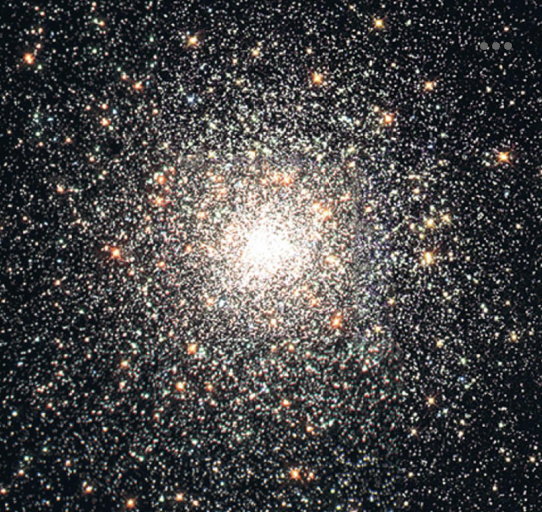
What type of object is this image?
Globular cluster
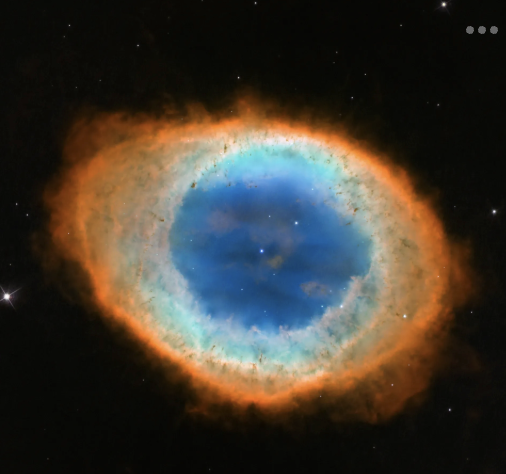
What type of object is this image?
Planetary Nebula
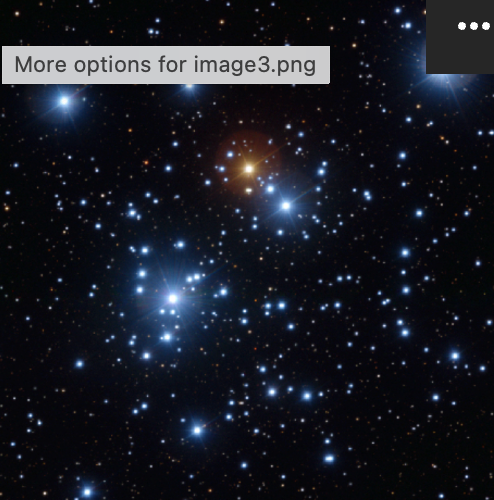
What type of object is this image?
Open cluster
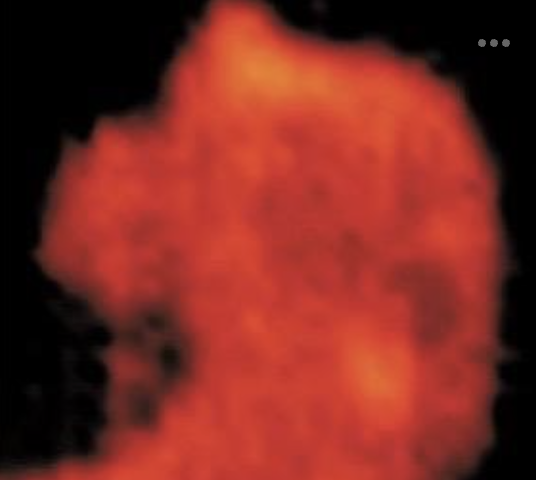
What type of object is this image?
Molecular cloud
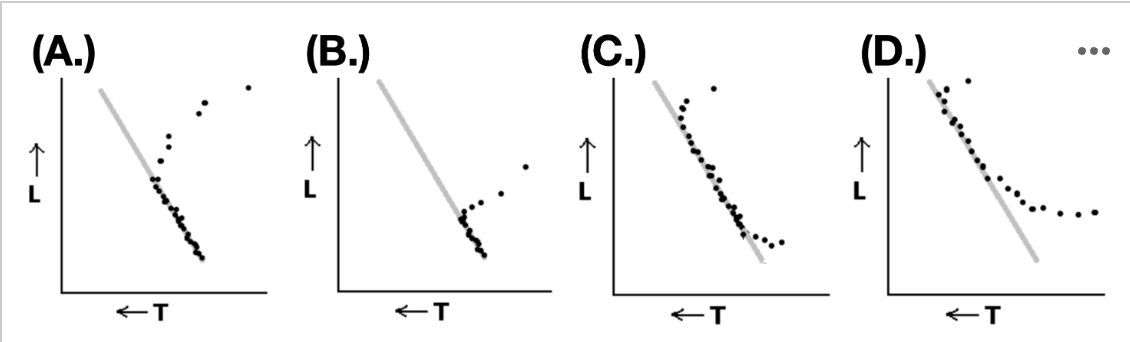
The HR diagrams of 4 stellar clusters are shown below. Rank them from youngest to oldest.
D, C, A, B
When does a star leave the main sequence?
When it exhausts its supply of hydrogen in its core.
Over its full lifetime, our Sun will be able to: (select all that apply)
A) Fuse hydrogen into helium
B) Fuse helium into carbon
C) Fuse iron into nickel
D) Fuse gold into uranium
A and B
What astrophysical mechanism created H (hydrogen), atomic number 1?
The Big Bang (beginning of the Universe)
What astrophysical mechanism created C (carbon), atomic number 6?
fusion in the core of a 1 MSun red giant
What astrophysical mechanism created Fe (iron), atomic number 26?
fusion in the core of a 20 MSun supergiant
What astrophysical mechanism created Au (gold), atomic number 79?
type II (core-collapse) supernova
How is a neutron star created?
It is the leftover core of a dead massive star.
Inside the event of a black hole…
A) …is a spinning pulsar, which beams radiation towards Earth with a regular cadence
B) …is a planetary nebula
C) …gravity is so strong that not even light can escape
D) …gravity is so weak that not even light can escape
C
How have we detected black holes?
We can watch the orbits of stars slingshot around them, we captured them in photos, and have accurate predictions from general relativity.
True/False: A pulsar is a type of neutron star from which we see regular, periodic pulses of light.
True
White dwarf exceeds 1.4 MSun —> If a white dwarf is part of a binary system, where the other star is much more massive, and the white dwarf peels off the outer layers of the star… Mergers, two white dwarfs orbiting each other, somehow collide and combine and create a white dwarf that's over the mass limit. Is this a…
A) Type Ia Superanova
B) Type II Supernova
Type Ia Supernova
Core-collapse at the end of the life of a massive star —> If a star is much more massive, it has nuclear fusion occurring in the core, which is creating more massive elements than iron… an extremely unstable process that causes a core collapse. Is this a…
A) Type Ia Superanova
B) Type II Supernova
Type II Supernova
What does the Fermi Paradox say?
Given all the time since the Big Bang and all the stars, why has some form of intelligent life in the Galaxy not established a network throughout the Galaxy and visited us?