5. Quality assurance in food industry
 Call Kai
 Learn
Learn Practice Test
 Spaced Repetition
 Match
Match Flashcards
 Knowt Play
1/32

There's no tags or description
Looks like no tags are added yet.
Name | Mastery | Learn | Test | Matching | Spaced | Call with Kai |
|---|
No analytics yet
Send a link to your students to track their progress
33 Terms
What is food quality control (QC)?
The core mechanism of quality control is to maintain desired quality in product and production process by:
Measuring product and process properties
Comparing measurement outcomes with the standard
Taking necessary corrective action(s)
What is food quality assurance (QA)?
The objective to quality assurance is to guarantee that quality requirements are realized
Quality assurance should provide confidence to government, customers, consumers
Quality assurance is especially important for the food industry to ensure that food is safely produced.
Critical product quality points and critical process quality points are regularly audited (internal and external)
The core mechanism of quality assurance
The translation of assurance requirements of stakeholders into the company-specific quality management system
Its implementation
Verifying if the system is executed well
What are key quality assurance activities?
Setting requirements on quality (and safety)
Implementation of the requirements
Validating the effectiveness (in advance)
Verify and audit whether the system works
Documenting and record-keeping of all steps above.
Interaction between quality control and quality assurance
Quality assurance depends on quality control
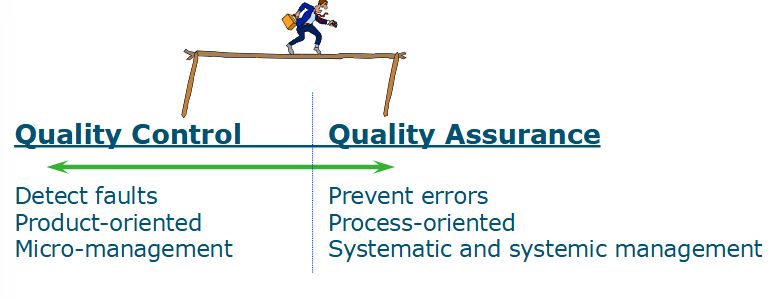
Is it possible to have quality assurance without quality control?
No, quality control focuses on specific points in the process
Quality assurance focuses on the whole process.
Quality management (QM)
Refers to all activities that companies use to direct, control, and coordinate the quality
Quality management system (QMS)
Quality management system (QMS) includes the organizational structure, responsibilities, processes, procedures, and resources that QM needs.
Food safety management system (FSMS)
Part of QMS
Is specifically aimed at realizing and ensuring product safety
How is a QMS or FSMS designed?
Designed by the use of quality assurance guidelines and standards
QA guidelines support in designing a companies’ own specific QMS/FSMS
QA standard has a similar function, but in addition a company can be certified against the predefined requirements of the standard (e.g. ISO)
QMS certification
Once a company decides for certification of its QMS (e.g. ISO certification) and independent certification agent is coming to check the QMS on its compliance with the procedures.
Typical QMS decisions
Critical product properties, critical parameters, critical points in the production process
Capability of processes, equipment and buildings
Critical decisions and action points of people
Responsibilities and procedures in quality systems and auditing
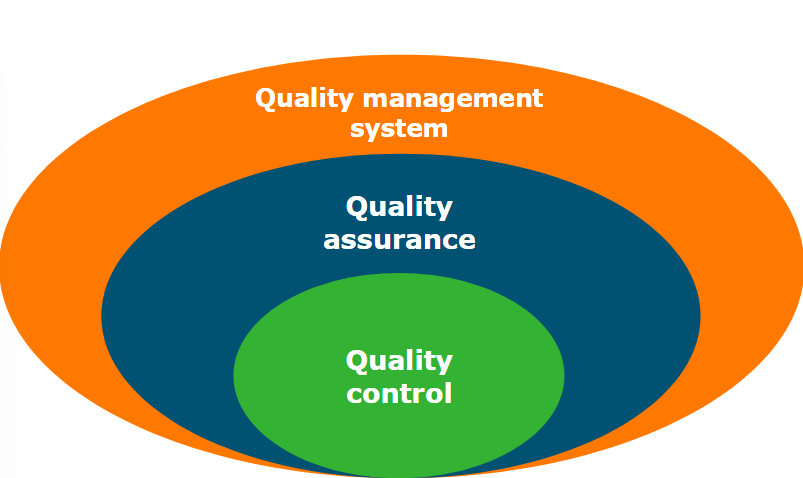
Order of QC, QA and QMS
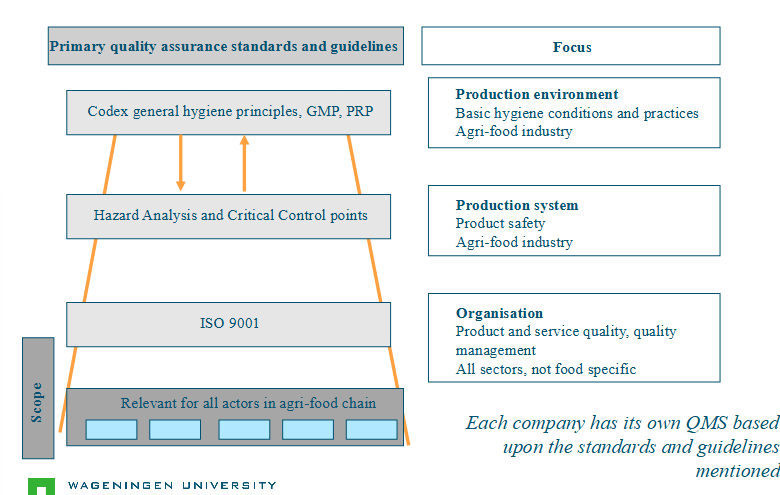
Primary QA standards and guidelines
Production environment
Production system
Organization
Remember not the different topics but what they entail and what their differences are.
Similarities of QA standards/guidelines:
Aims for safe and/or high-quality foods
Describe how to control, monitor, and document activities
Differences of QA/guidelines:
Regulated by law, retailer or company initiative
Focus on production environment, food production itself, and/or the complete organization
Degree of detail and way of structuring
Focus on one actor of the supply chain, part(s) of the supply chain, or the full supply chain
Principles of codex alimentarius
The purpose of codex alimentarius is to establish a set of international standards, guidelines and codes of practice for food quality and safety to protect the health of consumers and ensure fair pratices in the internation food trade
Designed to ensure international acceptance in terms of quality and economic interest of consumer and to ensure fair trade practices
Hygiene guidelines based on scientific principles such as HACCP
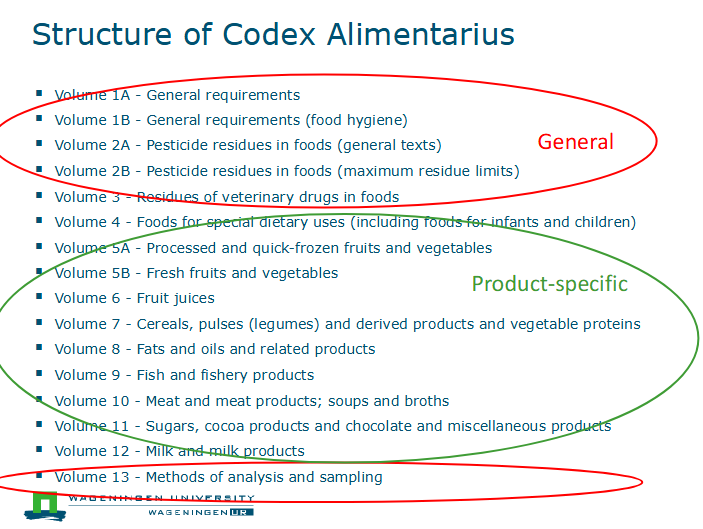
Structure of codex alimentarius
The general principle is an elementary document for production of safe food in agri-food chains, foundation for ensuring food hygiene
Must be combined with specific codes of hygiene practice and guidelines for microbiological criteria
Codex General principles of Food hygiene contains:
General practical principles of food hygiene
Guidelines HACCP application
Principles for establishment and guidelines of microbiological criteria for foods
Principles for establishment and guidelines to conduct microbial risk assessment
Food labelling requirements of codex
Name of the food
List of ingredients (in descending order)
Net content and drained weight
Name and address of manufacturer
Country of origin
Lot identification
Date marking and storage instructions
Instructions for use
Principles of Good manufacturing practice
Good manufacturing practice is a set of regulations, codes, and guidelines for the manufacture of drug substances and drug products, medical devices, in vivo and in vitro diagnostic products, and foods
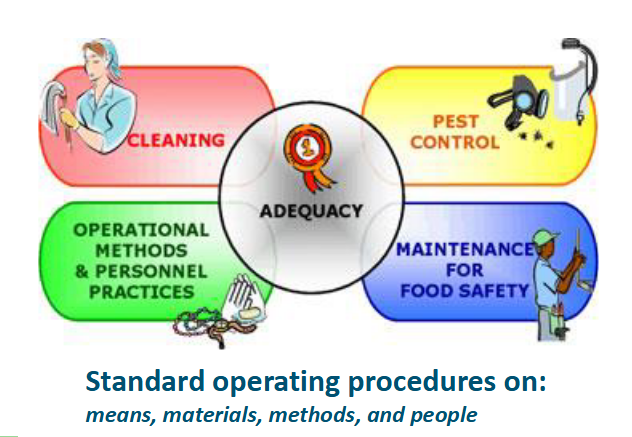
GMP for the food industry
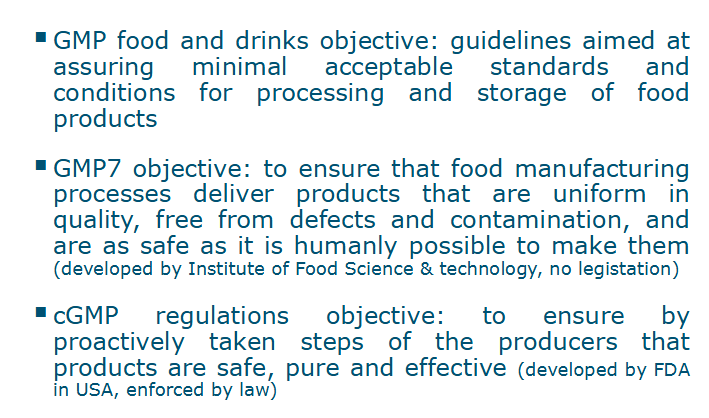
Prerequisite programmes (PRPs)
Objective: prevention of hazards that are not controllable as critical control point (CCP)
e.g. contamination by poor equipment design
Necessary foundation for functional HACCP
Focus: independent systems not specifically linked to process but applicable to whole company
Content of detailed description to achieve PRP goals:
What? How? When? Who? Where?
Comparison Codex, GMP and PRP
Codex: general principle of safe food production
Good manufacturing practices: guidelines of hygienic food production
Prerequisite programs: necessary foundation for a functional HACCP system (focus on control)
Principles of hazard analysis critical control points (HACCP)
A systematic approach to the identification, evaluation and control of those steps in food production that are critical to food safety
Basic aim is assuring production of safe food products by prevention instead of by quality inspection.
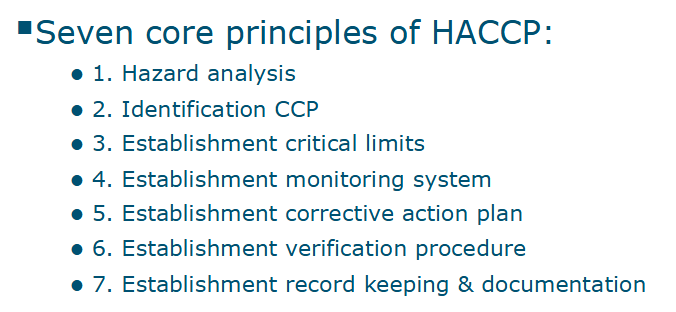
Seven core principles of HACCP
= Quality control
= Quality Assurance
Principles of well known ISO standards
ISO 9001 and ISO 22000 are among ISO’s most well-known standards in food industry
ISO 9001 helps organizations to implement quality management
ISO 22000 helps food productio nchains to ensure food safety
Principles of ISO 9001
It is generic:
For any organization, large or small, whatever its product or service, in any sector (private, public)
It is a quality management standard with focus on finding and preventing nonconformities during production and supply process and preventing their recurring appearance
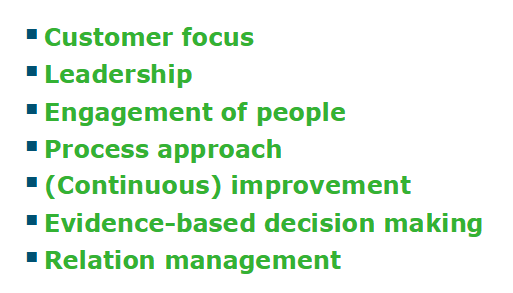
7 core principles of ISO
Structure ISO 9001:2015
ISO 9001:2015 deals with managing all processes with a company to research high product and/or service:
It is not a product/service standards
It is a process standard
It can be sued by product manufacturers and serivce providers
Processes affect final products or services
ISO 9001:2015 gives the requirements for what the organization must do to manage processes affecting quality of its products and services
Major change to ISO 9001:2008 is ‘risk based thinking’ in stead of ‘preventative thinking’
ISO certification
Certification means that an independent, external
body has audited an organization's management system and verified that it conforms to the requirements specified in the standardISO does not carry out certification and does not issue or approve certificates; national certification bodies do
Certification is not a requirement of ISO 9001, an
organization can implement and benefit without having it certified
ISO Certification as a business decision
Certification is a decision to be taken for business
reasonsif it is a contractual, regulatory, or market
requirementif it meets customer preferences
it is part of a risk management programme
if it will motivate staff by setting a clear goal
Principles of ISO 22000
Objective: integrity of food supply chain by minimzing hazards throughout the chain by ensuring there are no weak links
It specifies how:
To carry out the hazard analysis
To design the prerequisite programmes
to decide which are operational prerequisite programmes
to design the HACCP plan
Based on 9001 and includes HACCP
Mix of management and process approach rather than a product approach
QA trends in food supply chains
Complex international food production chains
When a product comes and goes to so many places, then who is responsible?: the company from which the product is bought.
Integrated food production chains
Shorter food production chains