Business Management Concepts IBDP
 Call Kai
 Learn
Learn Practice Test
 Spaced Repetition
 Match
Match Flashcards
 Knowt Play
1/76

There's no tags or description
Looks like no tags are added yet.
Name | Mastery | Learn | Test | Matching | Spaced | Call with Kai |
|---|
No analytics yet
Send a link to your students to track their progress
77 Terms
what is the primary sector?
the primary sector is all the businesses that extract raw materials
what is the secondary sector?
the secondary sector transforms raw materials extracted by primary sector businesses into goods (manufacturing).
what is the tertiary sector?
the tertiary sector is the provision of services (banking, education, retail stores etc)
what is the quatenary sector?
the quatenary sector includes services that relate to data, knowledge, and IT (e.g. videogame/app development)
reasons to start entrepreneurship include…
financial rewards
innovation
life-work balance
filling in the market gap
independence
responsibility
personal interest
what is the private sector?
the private sector encompasses organizations owned by private individuals who typically aim to make a profit
what is the public sector?
the public sector are organizations owned by the government that provide important services to citizens (e.g. healthcare, education)
what is a mission statement?
a statement of why the organization exists and helps guide how the firm acts and makes decisions
what is a vision statement?
a vision statement is a long term aspirational statement of who the firm wants to become in the future
what is CSR
Corporate social responsibility - focuses on how a company behaves from an ethical POV (its environment and social impact)
CSR can improve brand image and improve employee motivation, but may also lead to the increased conflict in a business due to the costs of acting in an ethical way.
what are stakeholders?
stakeholders are individuals or groups who are impacted by the actions of the business, wether directly or indirectly.
internal vs external stakeholders
internal stakeholders
Those who are part of a business
includes employees and managers
external stakeholders
those who are not part of a business
includes customers, suppliers, and the government
(its essential for a business to manage conflict between its stakeholders, as stakeholder objectives are often conflicting)
define internal growth
a company using its own resources to crow (cheaper + less risky)
define external growth
using a third party such as a partner to grow (faster + more risky and esxpensive)
internal growth strategies…
acquisition
joint venture
strategic alliance
franchising
external growth strategies…
increasing market share
developing new products
market penetration
growing as a business entails benefits such as…
earning more profits
better recognition from customers
greater access to financing
attract more talent
staying small as a business entails benefits such as…
better relationship building with customers
owners can maintain control and ownership of the firm
economies of scale definition
when average costs fall as a result of the business operating on a large scale
diseconomies of scale defenition
when average costs increase as a result of the business producing more
multinational corporations benefits
they can access a wider customer base abroad giving customers more choice and signifiant employment opportunities
factors that influence HR planning
demographic changes
labour mobility
immigration
flexitime
gig economy
4 main reasons why employees resist change…
Self interest
Misinformation
Low tolerance
Interpretation of circumstances
managing employee resistance to change can include:
clear communication
employee involvement
recognition and rewards
planned implementation
what is delegation?
when a manager entrusts a subordinate with a responsibility or task this often builds motivation and trust
what is the span of control?
the span of control is how many subordinates each manager is responsible for.
wide vs narrow span of control
a wide span of control means the manager is responsible for a few employees
a narrow span of control means the manager is only responsible for a few employees
what do levels of heirarchy show?
the various levels of formal authority within an organisation
what are chains of command
lines of authority for decisions/orders
long = many lines of hierarchy
short = few levels, faster communication
bureaucracy
administrative systems, rules, and procedures
ensures clarity and consistency
can reduce creativity and innovation
useful in contexts needing strict procedures (eg government)
centralized vs decentralized decision making
centralized: few (senior managers) make decisions → faster, more control
decentralized: decisions spread across organization → slower but empowers employees
neither approach is always the best — depends on business needs
delayering
removing levels of hierarchy → from tall to flat structure
saves costs
can improve communication and decision making
matrix structure
combines people from different departments (e.g marketing, finance, HR)
encourages collaboration across functions
flat structure (horizontal)
✅ Easier communication
✅ more informal relationships
❌ more authority/responsibility
❌ harder for close supervision
tall structure (vertical)
✅ clear expectations for rules and procedures
✅ more promotion opportunities
❌ slower, more complex decision making
❌ risk of departments not communicating with eachother
project based structure
temporary teams from different departments
mixes skills from different departments
❌ task prioritization, managing multiple projects
handys shamrock organization
organises workers into three categories/groups
professional core: full time, essential employees
contingent workforce: temporary/short-term staff
outsourced vendors: external specialists for specific tasks/projects
✅ flexibility and cost savings
❌ lower motivation for contingent workers
scientific decision making
based on data, facts, and objective analysis
informed but slower process, depending on accurate data
intuitive decision making
based on experience, insight, or ‘gut feel’
faster, useful in urgent situations
risk of personal bias
4 factors of production
land
labour
capital
enterprise
Features of an entrepreneur
Risk-taking
Innovation
Persistence
Advantages of converting from privately held to publicly held company
Capital influx (Advantage)
Brand visibility (Advantage)
Liquidity (Advantage)
Features of a cooperative
Democratic Control (Advantage)
Shared Profits
Limited Liability (Advantage)
Features of a privately held company
Limited liability (Advantage)
Shares cannot be sold on the public stock market
Separate Legal Entity (Advantage)
Features of a publicly held company
Limited liability (Advantage)
Shares can be bought on the public stock market (Advantage)
Seperate legal entity (Advantage)
Final accounts must be publicized
Disadvantages
Lack of privacy (Disadvantage)
Dilution of control (Disadvantage)
Features of a NGO
Social or Environmental Mission
Independent from government control
Heavy reliance on volunteers
What is a pressure group?
A pressure group is an organized group seeking to influence business or government actions to achieve change.
Franchising (advantages and disadvantages of franchisor)
Franchising is giving licensing rights to a firm to sell goods and services using your brand or trademark products.
Advantages:
Rapid Expansion
Regular Income
Challenges:
Loss of Control
Reputational Risk
Types of internal economies of scale
Financial economies
Marketing economies
Managerial economies
Technical economies
Purchasing economies
Risks bearing economies
Specialization economies
Takeover
A company controlling stake in another company (owning more than 50% of the shares)
Internal and external forms of growth
Internal: Using your own ability to grow.
Retained profit
Selling shares to the public
External: Using outside factors to grow.
Takeover
Franchising
Mergers and acquisitions
External economies of scale
Advantages that accrue to an industry as a result of growth of firms within the industry.
Advantages
Increased research and development
Increased raw materials and support service
Increased technical knowledge
gig economy defenition
The gig economy workers that are typically on short-term, flexible and temporary contracts.
Chain of command defenition
the chain of command is who delegates a task to who
it shows the reporting lines within a company
levels of hierarchy definition
number of layers of formal authority in an organization
autocratic leadership style
autocratic leadership is strict and rigid management where decision making is centralized
ADVANTAGES
Easier coordination
There is efficiency in the decision making process
DISADVANTAGES
Employees may not feel heard or seen
Employee motivation may decrease
The company may not be as successful or efficient in tasks
situational leadership style
situational leadership style is flexible leadership that responds to the present need
ADVANTAGES:
appropriate decision making based on the situation
high motivation for staff
DISADVANTAGES:
decision making will not be as fast
democratic leadership style
democratic leadership style means the decisions are made via voting
DISADVANTAGES:
popularity contest/decisions are made based on persuasive skills as opposed to facts and credentials.
slow decision making process.
laissez fair leadership style
laissez fair leadership style means there is minimal involvement of authority within day to day work of employees
ADVANTAGES:
high motivation for employees
the level of employee input increases
DISADVANTAGES:
inefficiency with employees (employees may not want to do something)
paternalistic leadership style
paternalistic leadership style is where actions are taken in the best interest of the employees
ADVANTAGES:
High employee motivation
Employees have a say in the management
Provides an inclusive workspace
DISADVANTAGES:
Slow decision making process
the output may not yield the same amount as competitors
fringe benefits
fringe benefits are financial benefits of a business in addition to the salary (e.g. transport allowances).
Induction training-features
induction training is training new people
knowledge shared to the employees is new knowledge
Vrooms expectancy theory
vrooms expectancy theory states that people would have no motivation to undertake a task without reward at the end (e.g. working with no pay)
maslows motivational theory
*see image*
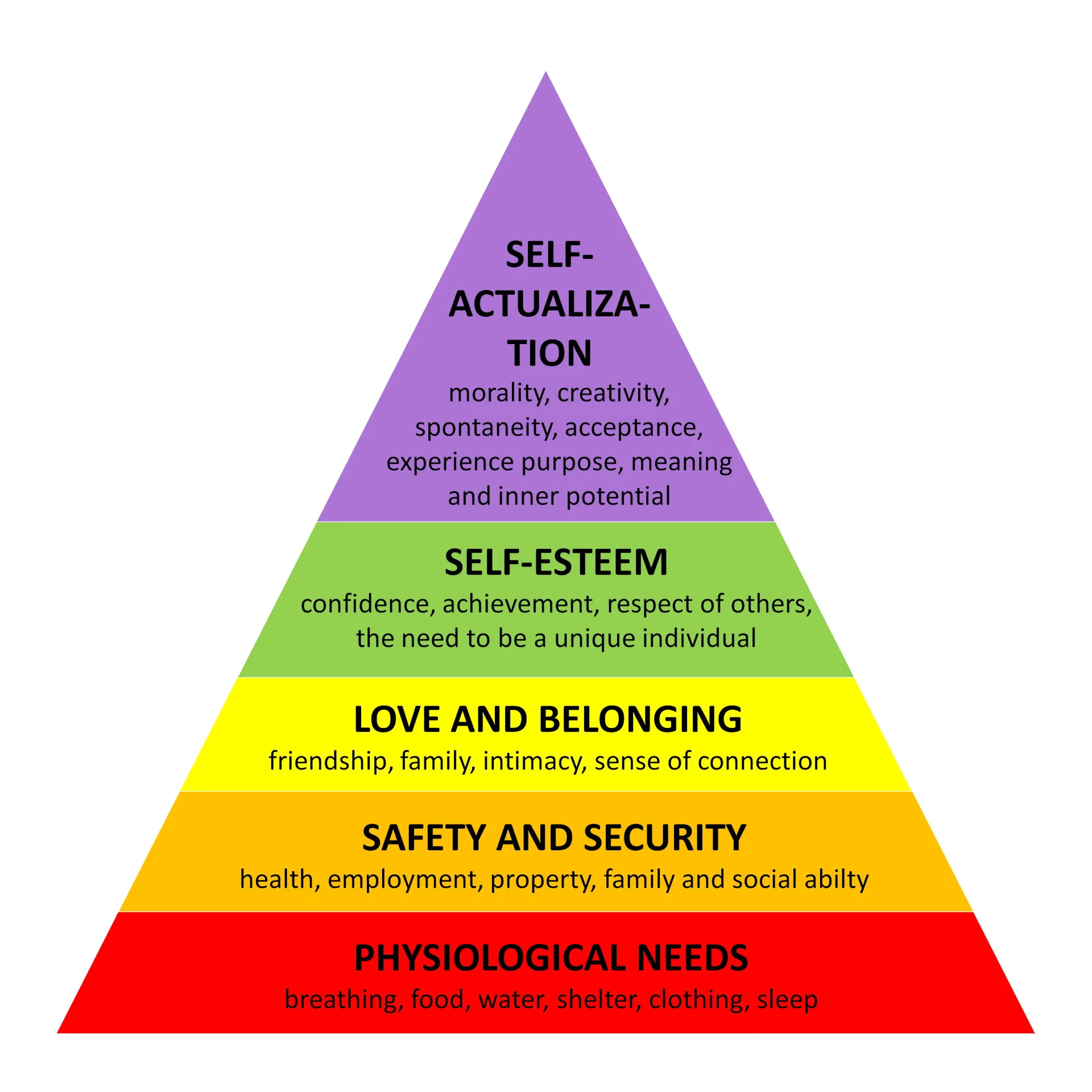
herzbergs two factor theory (motivation)
hygiene factors: clean environment, respect, company policy, status.
motivators: money, pay, salary, bonuses, promotion
taylors scientific theory (motivation)
taylors scientific theory states that you do work based on the input that youve been given (more money = more work)
mclellands aquired needs theory (motivation)
states that:
some people work because of the need to achieve,
others are motivation by power,
others are motivated by the need for affiliation
equity and expectancy theory (motivation)
input = output
deci and ryans theory (motivation)
deci and ryans theory states there are three things that motivate someone intrinsically (internally):
autonomy (controlling your own destiny/fulfillment)
competence
connection with others
Types of financial rewards
performance related pay
fringe benefits (anything paid in addition to salary)
employee share ownership
Types of training
induction training (training new people)
on the job training (training current staff while on the job)
off the job training (training current staff while away from the work station)
Non-financial reward
Non-financial rewards are non-monetary awards such as
job enrichment
enhancing someones role
job rotation
job enlargement
Appraisal methods
appraisal is performance review
four methods include:
formative (day-to-day reviewing of jobs)
summative appraisal (at the end of the year)
360º (two people appeasing each other)
self-appraisal (evaluating yourself)
power culture (zeus)
an organization that is based on power (e.g. military)
strict command
fast decision making
role culture (apollo)
an organization where formal structures and procedures facilitate the smooth running
task culture (athena)
an organization where the role of managers are supported by clear objectives
person culture (dionysus)
an organization where individuals interests take center stage (the interest of the employees)