BIO 39 Lecture Exam #3
 Call Kai
 Learn
Learn Practice Test
 Spaced Repetition
 Match
Match Flashcards
 Knowt Play
1/24

There's no tags or description
Looks like no tags are added yet.
Name | Mastery | Learn | Test | Matching | Spaced | Call with Kai |
|---|
No analytics yet
Send a link to your students to track their progress
25 Terms
Mechanism of gene transfer involving the transferring of plasmids between unrelated cells.
Conjugation
Bonus genes that are usually virulence and antibiotic resistance genes. Plasmids carry these.
Accessory genes
True or False: Plasmids are independent from the bacterial chromosomes in terms of replication and function.
True
Changes in the DNA nucleotide sequence.
Mutations
Name the four nucleotides present in the DNA of all life forms.
Adenine, guanine, cytosine, thymine
DNA polymerase or replication errors.
Spontaneous mutations
Mutation involving a singular nucleotide substitution/change.
Spontaneous point mutation
Gene transfer between unrelated cells.
Horizontal gene transfer
Gene transfer that is associated with replication during binary fission, Genes transfer from parents to offspring.
Vertical gene transfer
Cell that receives the plasmid.
Recipient cell
Cell that has and passes the plasmid.
Donor cell
Gene transfer mechanism that requires direct physical contact between two living cells.
Conjugation
The cell that produces the conjugation pilus for gene transfer.
Donor cell
An appendage of a cell that serves as a tunnel through which a plasmid is transferred from a donor into a recipient cell. Crucial for the conjugation process.
Conjugation pilus
The function of this structure (appendage) is to maintain physical contact between two bacterial cells and to transfer the plasmid from the donor to the recipient cell.
Conjugation pilus
True or False: The cell wall and plasma membrane will dissolve at the points of attachment of the conjugation pilus on both the donor and recipient cells.
True
In standard conjugation, the donor cell is known as what?
F+
In standard conjugation, the recipient cell is known as what?
F-
Donor cell (F+) transfers one ________ (single/double) strand of its DNA into the recipient cell during standard conjugation.
single
True or False: After standard conjugation, the donor cell will lose its plasmid.
False (- only one strand of the plasmid is transferred and the one strand that is left is regenerated through base pairing)
Plasmids that provide bacteria with resistance to antibiotics. May have multiple antibiotic resistance genes. Acquisition of these create MDR bacterial species.
R plasmids
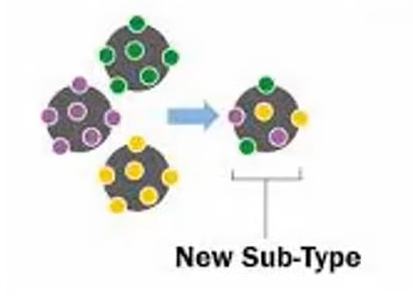
Antigenic shift
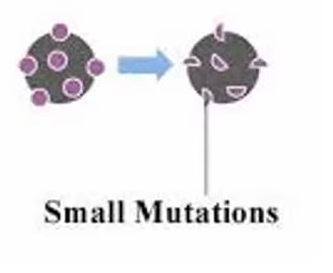
Antigenic drift
High mutation rate for the HA and NA genes of the influenza A that is due to RNA genome. Involves the changing of the shape of HA and NA proteins. These shape changes do NOT change their function.
Antigenic drift