Energy Expenditure
 Call Kai
 Learn
Learn Practice Test
 Spaced Repetition
 Match
Match Flashcards
 Knowt Play
1/17

Earn XP
Description and Tags
Semester 1, week 3
Name | Mastery | Learn | Test | Matching | Spaced | Call with Kai |
|---|
No analytics yet
Send a link to your students to track their progress
18 Terms
Why measure energy expenditure?
Fuel utilisation
Assess metabolic needs
Insight into demands of exercise
Assessment of economy
Nutritional interventions for performance/recovery
Thermic effects of foods
What is a calorie?
The amount of energy required to raise the temeperature of 1g of water by 1C
What is a bomb calorimeter?
A device used to measure the heat combustion of a sample
How can we estimate EE?
Measurement of expired gases using a Douglas Bag (indirect calorimetry)
Measure heat given off to the environment directly (direct calorimetry)
What are the pros and cons of direct calorimetry?
Pros: direct measure of heat, accurate for steady state measures
Cons: expensive, slow to generate results, few in operation, not accurate for exercise
What are the benefits of indirect calorimetry?
Can detect changes during exercise with breath by breath systems
No longer affected by the heat of equipment etc.
Easy to administer etc.
Fairly accurate for aerobic measures
Direct assessment of gas exchange
What are the limitations of indirect calorimetry?
Assumes body's O2 content constant, CO2 exchange in lung is proportional to release from cells aerobic processes
BUT, CO2 released in the lung may not be representative of CO2 released by working cells, and body has O2 stores not directly reflected in pulmonary measures
Assumes little contribution from protein during exercise (non protein RER)
But protein contributed up to 5% of total energy in prolonged exercise
RER values >1 won't provide a valid estimation of energy expenditure
Even values approaching 1 may be inaccurate in assessing energy expenditure
Gluconeogenesis from catabolism of fat and amino acid produces RER <0.7
RER not appropriate for EE estimations outside range of 0.7-1
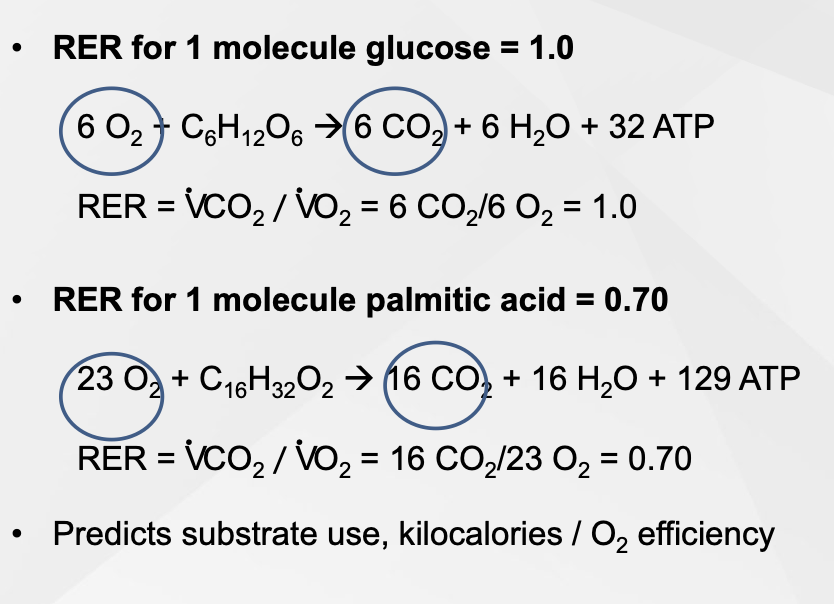
What are the RER values for glucose and palmitic acid?
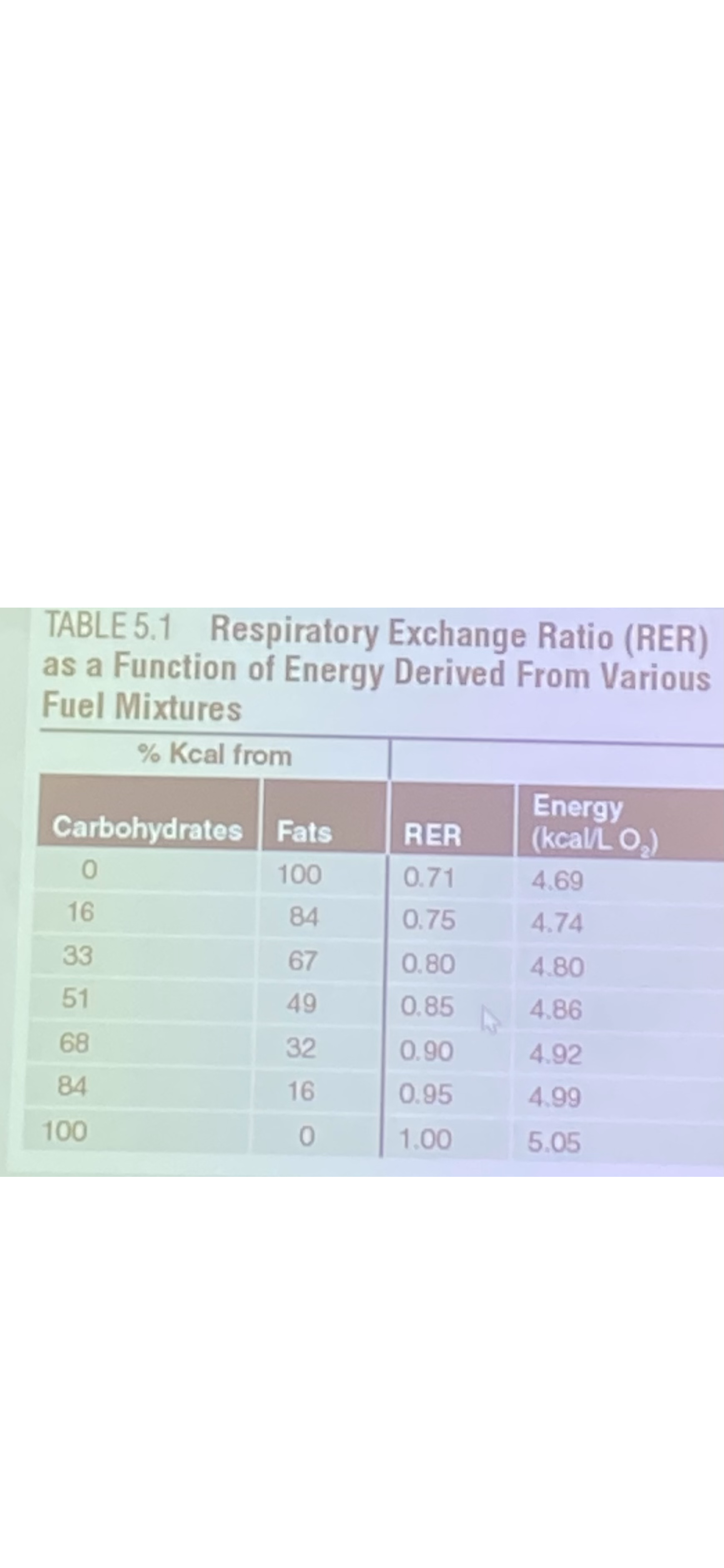
What are the caloric equivalents for oxygen?
Fat is the fuel substrate that gives the most energy per gram
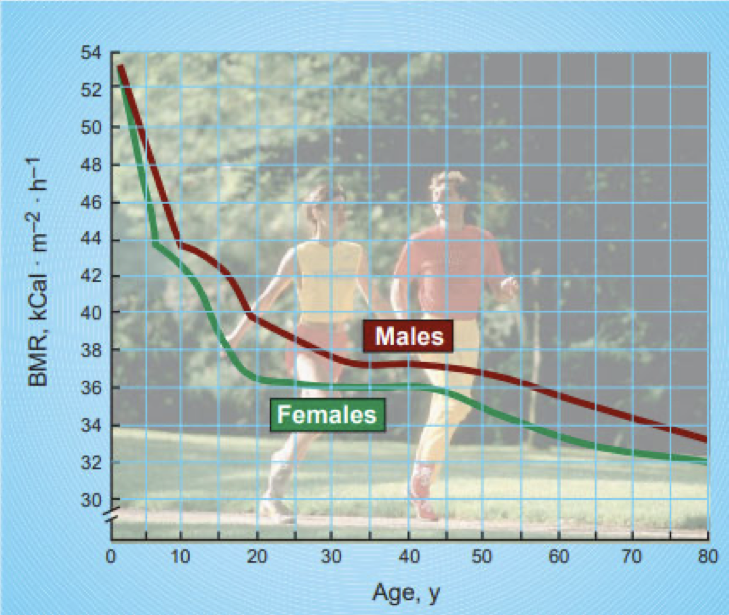
How does BMR change as age increases?
2-3% decrease in metabolic rate per decade
Decrease in fat free mass
Depression of metabolic activity of lean tissues
Altered change in body composition (increase FFM)
Altered by physical activity (independent of change in body composition)
How is resting metabolic rate different to BMR?
Less tightly controlled vs BMR
More accessible/applicable
What is MET?
The MET = multiples of RMR (resting metabolic rate)
1 MET = 3.5ml/kg/min
VO2 ~200ml/min for average sized woman (57kg x 3.5ml/kg/min)
VO2 ~250ml/min for average sized man (71kg x 3.5ml/kg/min)
An activity at 7ml/kg/min would be a 2 MET activity
What is fat max?
Facilitation of fat metabolism important for health and performance
Exercise intensity at which maximal fat oxidation is observed "fatmax"
Explained by: lower availability of plasma FFA, reduced entry of fatty acids into mitochondria
What determines energy expenditure and carbohydrate reliance in marathon performance?
EE for Performance:
Slower recreational runners (3h 45m) run at 60-65% VO2max RER = 0.9 - CHO 68%
Faster athletes (2h 45m) run at 70-75% VO2max RER = 0.95 - CHO 84%
Elite runners run at 80-90% of VO2max for 2.02 to 2.10
Possible that these athletes could compete marathon using only CHO as fuel (RER=1)
What is mechanical efficiency?
= (external work accomplished)/(energy expenditure)
Average value for cycling, running, walking: 20-25%
Eg.
Cycling: 160 Watts: ~2.29 kcal/min
Oxygen uptake at 160 Watts: ~2.0L/min
2.0L/min equivalent to 10kcal/min (as ~5kcal per litre O2)
Mechanical efficiency: 2.29/10=0.229 22.9%
Swimming (more drag): <20%
What is the importance of efficiency?
Relationship between VO2max and performance not evident in homogenous group of runners
But there is a relationship between running economy and performance
Although VO2max similar between elite RE varies up to 30%
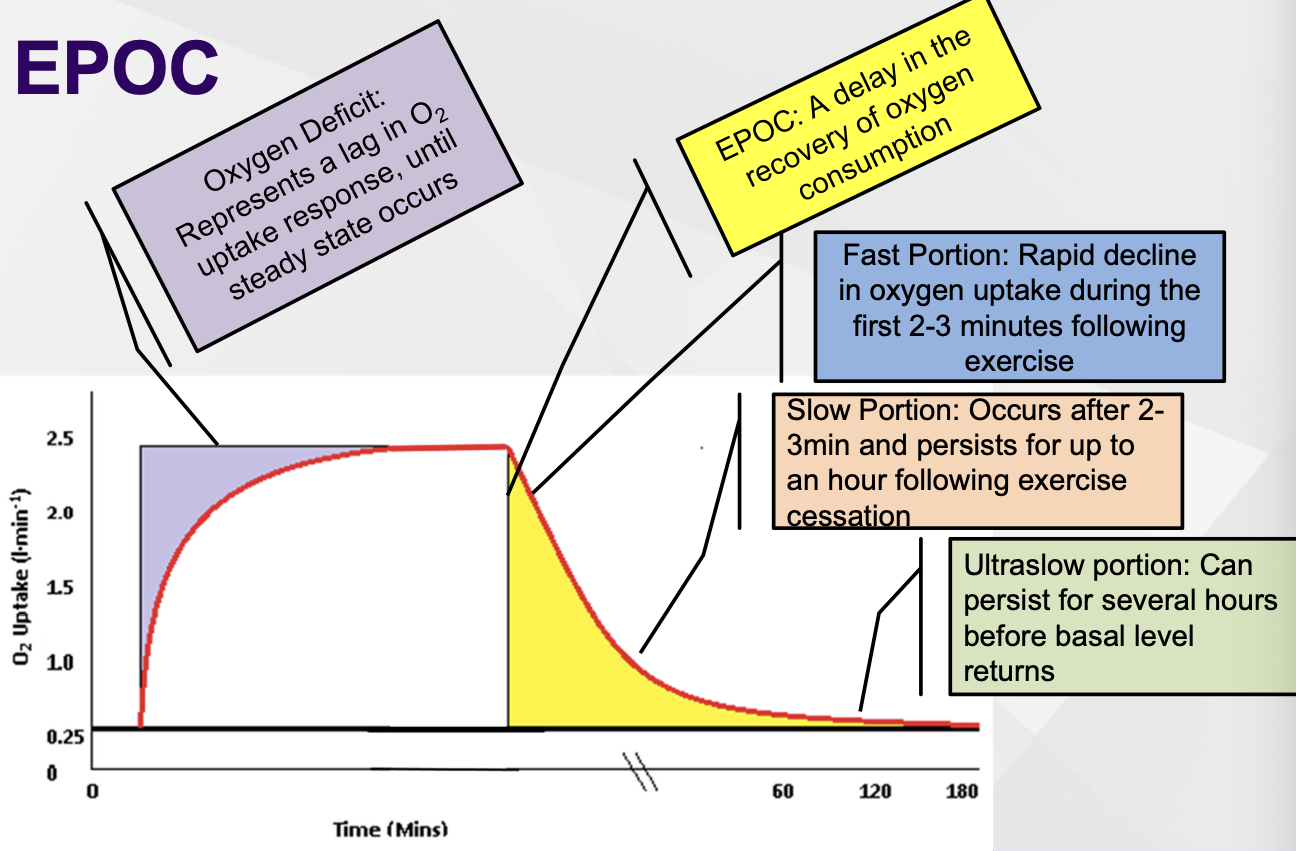
What is EPOC?
= excess post-exercise oxygen consumption
Fast: resynthesis of ATP and PCr
Fast: oxygen levels restored to myoglobin and haemoglobin
Fast: thermogenic effects of hormones
Slow: HR and VE remain elevated for several minutes after exercise
Slow: resynthesis of lactate to glycogen
Slow: thermogenic effects of elevated core temperature
What is a summary of energy expenditure in exercise?
Respiratory exchange ration (RER) describes the ratio between CO2 produced and O2 consumed. This ratio depends on the relative contributions of fat and glucose in total energy production
1 MET describes the energy required to cover resting metabolic rate, and depends on body mass (1 MET = 3.5ml/kg/min), activities can be classed according to METs
Excess post exercise oxygen consumption (EPOC) occurs to refuel the cells (eg. Replenish high-energy phosphates and resynthesise lactate to glycogen). Increased body temperature and hormones can also increase EPOC