Anatomy, Physiology, and Cell Biology: Key Concepts for Students
 Call Kai
 Learn
Learn Practice Test
 Spaced Repetition
 Match
Match Flashcards
 Knowt Play
1/92

There's no tags or description
Looks like no tags are added yet.
Name | Mastery | Learn | Test | Matching | Spaced | Call with Kai |
|---|
No analytics yet
Send a link to your students to track their progress
93 Terms
Anatomy vs. Physiology
Anatomy studies the form and structure of the body, while physiology examines how those parts and the body function.
Traits shared by all living organisms
Organization, metabolism, growth/development, responsiveness, regulation (homeostasis), and reproduction.
Smallest unit of matter
An atom.
Organ system that secretes hormones
The Endocrine system.
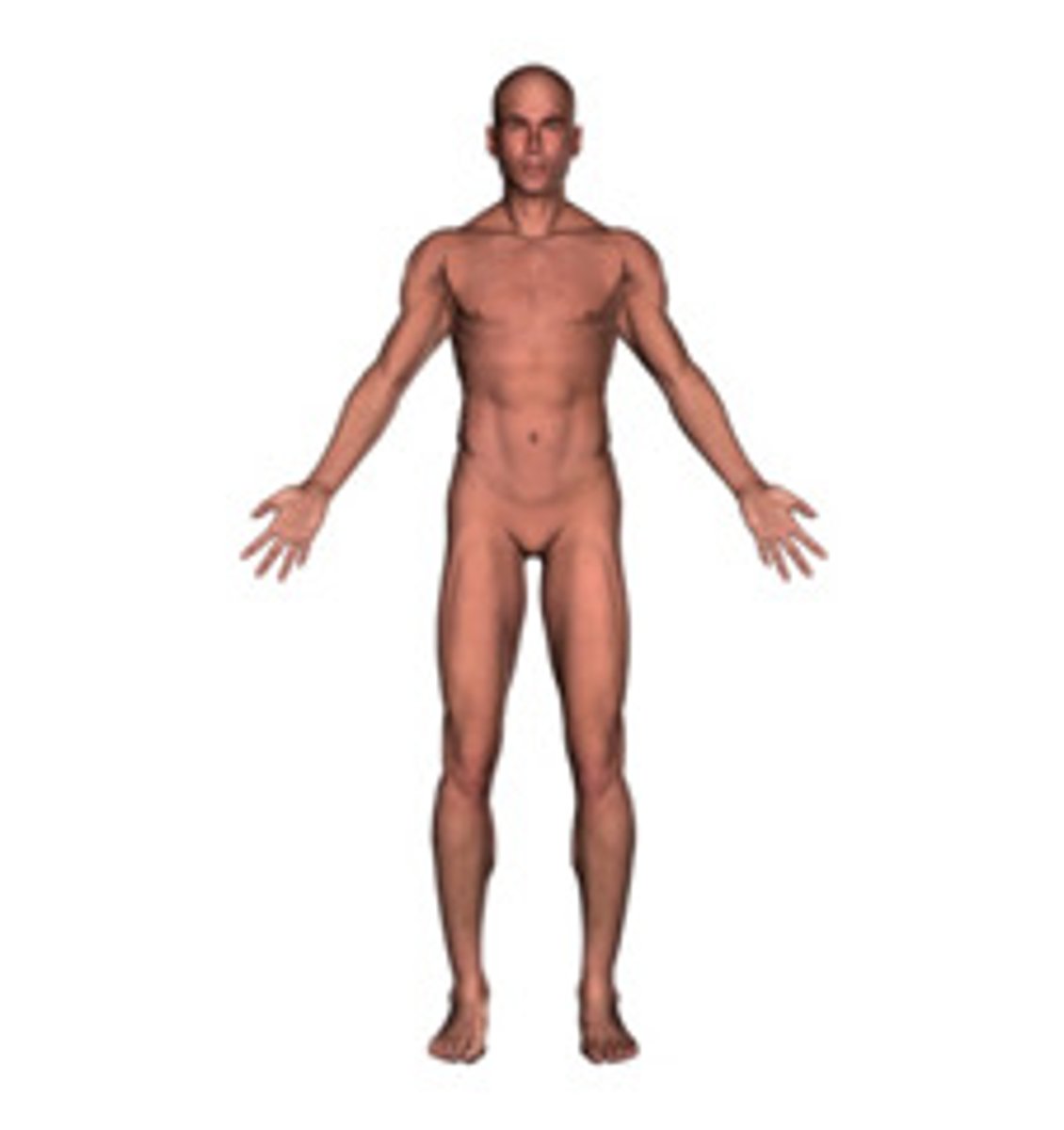
Standard anatomic position
Standing upright, feet parallel and flat on the floor, upper limbs at the sides, palms facing forward (anteriorly), head level, and eyes looking forward.
Body plane dividing the body into front and back halves
Frontal (or Coronal) plane.
Directional term for structures located toward the belly
Ventral (or Anterior).
The foot is _________ to the hip
Distal (further from the point of attachment).
The elbow is _________ to the hand
Proximal (closer to the point of attachment).
Parietal layer
The type of serous membrane located on the inner surface of the body wall.
Body cavity containing the lungs
Pleural cavities (within the thoracic cavity).
Mediastinum
The median space in the thoracic cavity containing the heart, thymus, esophagus, trachea, and major blood vessels.
Positive feedback
The feedback mechanism the body uses less frequently in order to maintain homeostasis (used for rapid, climatic events like childbirth).
Tissue level
The level of organization consisting of groups of similar-looking cells with surrounding material working together to perform a function.
Organ system that removes waste from blood, regulates pH and water balance
The Urinary system.
Differentiation
The process involving unspecialized cells changing into cells with a specialized function.
Homeostasis
The body's ability to maintain itself in a steady, consistent internal state.
Receptor (or sensor)
The component of a feedback loop that senses changes (stimuli) in the body.
Directional term for the antebrachium compared to the brachium
Distal (the forearm is farther from the trunk than the arm).
Oblique section
A cut through a tubular organ (like the small intestine) that produces an oval-shaped piece.
Olecranon (or olecranal)
The anatomical term that refers to the point of the elbow.
Diaphragm
The structure that separates the ventral body cavity into the thoracic and abdominopelvic cavities.
Visceral pericardium (or epicardium)
The specific serous membrane that tightly covers the surface of the heart.
Element required for a substance to be considered organic
Carbon.
Isotope
Atoms of the same element with the same number of protons but different numbers of neutrons (e.g., Iodine-131 used medically for thyroid imaging).
Strongest bond at the atomic level
Covalent bond.
Hydrophilic
"Water-loving"; describes substances (like polar molecules and ions) that dissolve easily in water.
Subatomic particles accounting for most of an atom's mass
Protons and neutrons (found in the nucleus).
Cation vs. Anion
A cation is a positively charged ion (lost electrons); an anion is a negatively charged ion (gained electrons).
Activation Energy
The minimal energy needed to start a chemical reaction.
Catalysts (or Enzymes)
Substances that speed up the rate of a chemical reaction without being changed by that reaction.
Buffer
A substance that functions to prevent drastic changes in pH by absorbing or releasing hydrogen ions.
Glycogen
The polysaccharide used for energy storage in humans (stored in liver and muscle cells).
Acid
A substance that frees Hydrogen ions (H+) in solution and has a pH range from 0 up to 7.
Base
A substance that binds Hydrogen ions (or frees OH-) in solution and has a pH range greater than 7 up to 14.
Suspension
A mixture that does not remain mixed unless in motion and scatters light (e.g., blood cells in plasma).
Colloid
A mixture that remains mixed when not in motion and scatters light (e.g., gelatin or cell cytosol).
Solution
A mixture that remains mixed when not in motion and does not scatter light (e.g., saltwater).
Phospholipids (and cholesterol)
The type of macronutrient/lipid that forms the major components of the cell membrane.
Carbohydrates (Glucose)
The macronutrient providing the best and fastest form of short-term energy for the body.
DNA (Deoxyribonucleic Acid)
The nucleic acid that is double-stranded.
Potential to Kinetic energy rule
True: Potential energy must be converted to kinetic energy before it can do work.
Metabolism
The collective term for all chemical reactions in the body.
Exergonic reaction
A reaction where energy is released; the reactants contain more energy than the products.
ATP (Adenosine Triphosphate)
The body's primary "energy currency" used for nearly all general active functions of the cell.
Enzyme influence on reactions
It speeds up chemical reactions by lowering the activation energy required.
Suffix associated with enzymes
"-ase" (e.g., lactase).
Anaerobic step of cellular respiration
Glycolysis (does not require oxygen).
Electron Transport System / Oxidative Phosphorylation
The step of cellular respiration that nets the most ATP and is the reason we need to breathe in oxygen.
Glycolysis location
The step of cellular respiration that takes place in the cytosol, NOT inside the mitochondrion.
Phospholipids
The molecules that make up the bilayer core found in the cell membrane fluid mosaic model.
Leak channels
Channel proteins that are always open and responsible for the continuous permeability of the plasma membrane to ions.
Substances that diffuse directly through the lipid bilayer
Small, nonpolar (hydrophobic) substances like oxygen, carbon dioxide, and lipids.
Mitochondrion
The organelle responsible for producing large amounts of cellular ATP.
Smooth Endoplasmic Reticulum (Smooth ER)
Cells that synthesize large amounts of lipids would have large amounts of this organelle.
Cell in a Hypotonic solution
Water moves into the cell, causing it to swell and potentially burst (lyse).
Cell in a Hypertonic solution
Water moves out of the cell, causing it to shrink (crenate).
Cell in an Isotonic solution
No net water or solute movement occurs; the cell size stays the same.
Passive transport
A type of transport that does not require cellular energy (e.g., simple diffusion, osmosis).
Organelles containing DNA
The Nucleus and the Mitochondria.
Transcription
The process inside the nucleus where a DNA sequence is copied into a complementary strand of mRNA.
Translation
The process in the cytoplasm where a ribosome reads mRNA to assemble a specific chain of amino acids (protein).
Interphase
The phase of the cell cycle where cells spend the majority of their life cycle performing normal metabolic activities.
Apoptosis
Programmed cell death ("cellular suicide").
Tissue vs. Histology
A tissue is a group of similar cells working together; histology is the microscopic study of tissues.
Four primary tissue types
Epithelial, Connective, Muscle, and Nervous tissue.
Vascularity of Epithelial tissue
False: Epithelial tissue is completely avascular (lacks blood vessels) and relies on diffusion.
Epithelial cell naming features
Differentiated and named by the number of cell layers (Simple vs. Stratified) and the shape of cells at the apical surface.
Shapes of epithelial cells
Squamous (flat), Cuboidal (cube-like), and Columnar (tall/column-like).
Simple vs. Stratified epithelium functions
Simple epithelium is suited for absorption/filtration; Stratified epithelium is suited for protection against friction/wear.
Exocrine vs. Endocrine glands
Exocrine glands secrete products into ducts; Endocrine glands are ductless and secrete hormones directly into the bloodstream.
Simple vs. Compound ducts
Simple ducts are unbranched; Compound ducts have a branched duct system.
Methods of exocrine secretion
Merocrine, Apocrine, and Holocrine. Holocrine secretion uses up and destroys whole cells to release its product.
Three basic components of connective tissue
Cells, protein fibers, and ground substance.
Protein fibers in connective tissue
Collagen fibers (strength), Elastic fibers (flexibility/recoil), and Reticular fibers (structural framework).
Three types of loose connective tissue
Areolar, Adipose (fat), and Reticular connective tissue.
Three types of dense connective tissue
Dense Regular, Dense Irregular, and Elastic dense connective tissue.
Two types of supporting connective tissue
Cartilage and Bone.
Three types of cartilage
Hyaline cartilage, Fibrocartilage, and Elastic cartilage.
Lacunae
The microscopic chambers/spaces that house mature Chondrocytes (cartilage cells) and Osteocytes (bone cells).
Two types of fluid connective tissue
Blood and Lymph.
Three types of muscle tissue and their nuclei
Skeletal muscle (multinucleated, peripheral), Cardiac muscle (1-2 central nuclei), and Smooth muscle (single central nucleus).
Striated muscle tissues
Skeletal muscle and Cardiac muscle.
Voluntary muscle tissue
Skeletal muscle tissue.
Intercalated discs
Specialized cellular junctions unique to Cardiac muscle tissue.
Two types of cells in nervous tissue
Neurons (signal conductors) and Neuroglia/Glial cells (support cells).
Three units of a neuron
Dendrites (receive incoming signals), Cell Body/Soma (processes information), and the Axon (transmits outward signals).
Four types of body membranes
Mucous, Serous, Cutaneous (skin), and Synovial membranes.
Atrophy
Tissue alteration marked by a decrease in cell number and/or size.
Hyperplasia
Tissue alteration marked by an increase in the total number of cells.
Hypertrophy
Tissue alteration marked by an increase in the physical size of individual cells.
Necrosis
Uncontrolled or accidental tissue/cell death.
Neoplasia
Tissue growth that is abnormal and completely beyond cellular control (tumor formation).