P4.3.2 Series and parallel circuits
 Call Kai
 Learn
Learn Practice Test
 Spaced Repetition
 Match
Match Flashcards
 Knowt Play
1/3

There's no tags or description
Looks like no tags are added yet.
Name | Mastery | Learn | Test | Matching | Spaced | Call with Kai |
|---|
No analytics yet
Send a link to your students to track their progress
4 Terms
Describe characteristics of a series circuit
If one lamp blows out, other lamps go out too
Lamps cannot be switched on and off independently
All lamps share the same brightness, but amount of lamps affects the brightness of each lamp (more=dimmer)
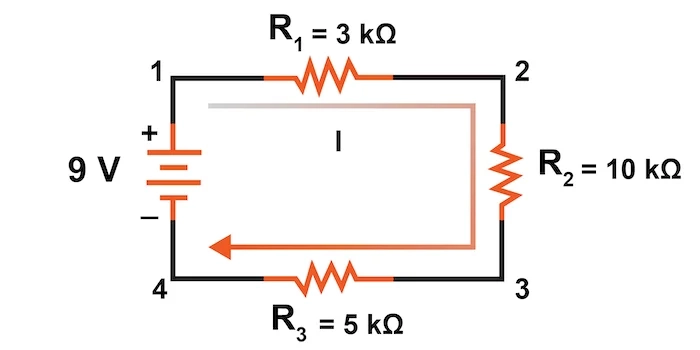
Calculate current, resistance and voltage in a series circuit
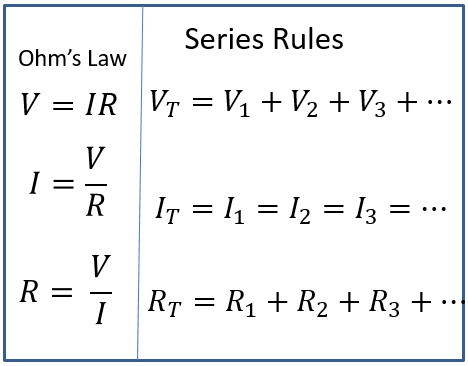
Current: same at every point
Resistance: addition of all resistance
Increases as you add more components
Total voltage (p.d.): addition of each individual voltage (voltage is divided among components)
Describe characteristics of a parallel circuit
If one lamp blows out, other lamps will continue to work
Lamps can be switched on and off independently
All lamps share the same brightness, but amount of lamps does not affect the brightness of each lamp (more=same brightness)
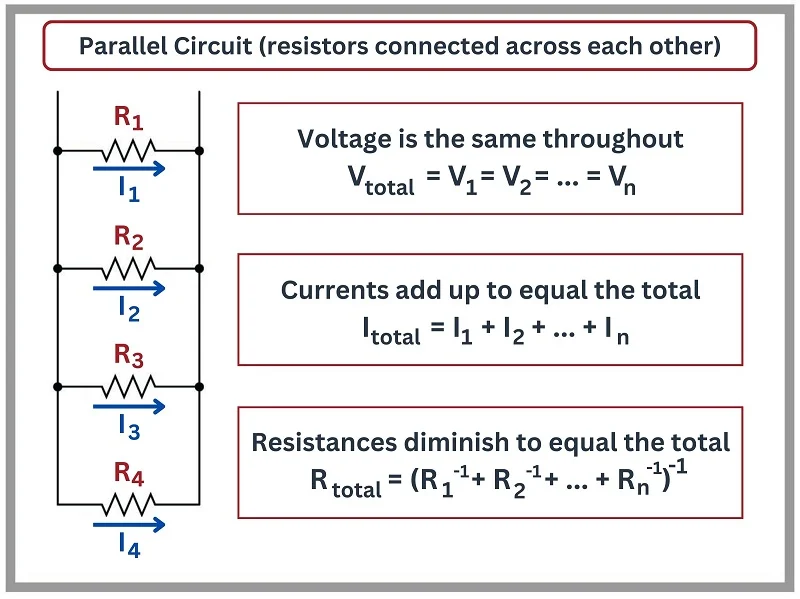
Calculate current, resistance and voltage in a parallel circuit
Total current: add up each individual current (current is divided between each branch)
If ammeter is placed next to the battery, it measures total current
If ammeter is placed on a branch, it only measures the amperes of that specific branch
Resistance: the reciprocal of the sum of the reciprocal of each individual resistance
Decreases as you add more components
Voltage (p.d.): same throughout the circuit