Lecture 5 ADL's Lactate and Depth
 Call Kai
 Learn
Learn Practice Test
 Spaced Repetition
 Match
Match Flashcards
 Knowt Play
1/23

There's no tags or description
Looks like no tags are added yet.
Name | Mastery | Learn | Test | Matching | Spaced | Call with Kai |
|---|
No analytics yet
Send a link to your students to track their progress
24 Terms
ADL
Aerobic Dive Limit
What is ADL?
Length of time an animal can nominally dive using oxygen stores
Animals with a higher metabolic rate underwater will reduce their ADL accordingly
How is ADL calculated?
Calculate O2 stores
Divide by basal metabolic rate
= cADL (calculated)
Calculates a maximum ADL
Basal metabolic rate
Minimum amount of energy needed to expend to stay alive
Why speed important?
If speed is doubled 8 times the amount of oxygen is required, need to spend less time underwater - why most animals travel slow
How often do ADL’s get exceeded (Case Study)?
New Zealand and Australian Sea lion (deep divers): dived for longer than they should
Antarctic fur seal dived within ADL, feeds shallower
The deep dives are benthic foragers, requiring them to exceed or meet their ADL
What happens when an animal exceeds its ADL?
Move into energy production without oxygen (Anaerobic dives)
Overall, produces less energy and creates lactic acid build up
Requires much longer surface recovery time
How to remove lactate?
Oxidise to create energy - requires 17 times the aerobic period, i.e. a long surface period
Reconvert to glucose - requires energy
What is the difference between ADL and cADL?
ADL (Diving Lactate Threshold, DLT) - dive duration after which there is an increase in post-dive concentration of lactate, at ADL there is some usable oxygen remaining
cADL - divides usable oxygen by rate of oxygen consumption during diving, assumes that all of the usable oxygen stores have been consumed (not always true)
Animals go anaerobic before all their oxygen has been consumed
What do animals do to forage efficiently?
Don’t go anaerobic because it takes a longer time to recover
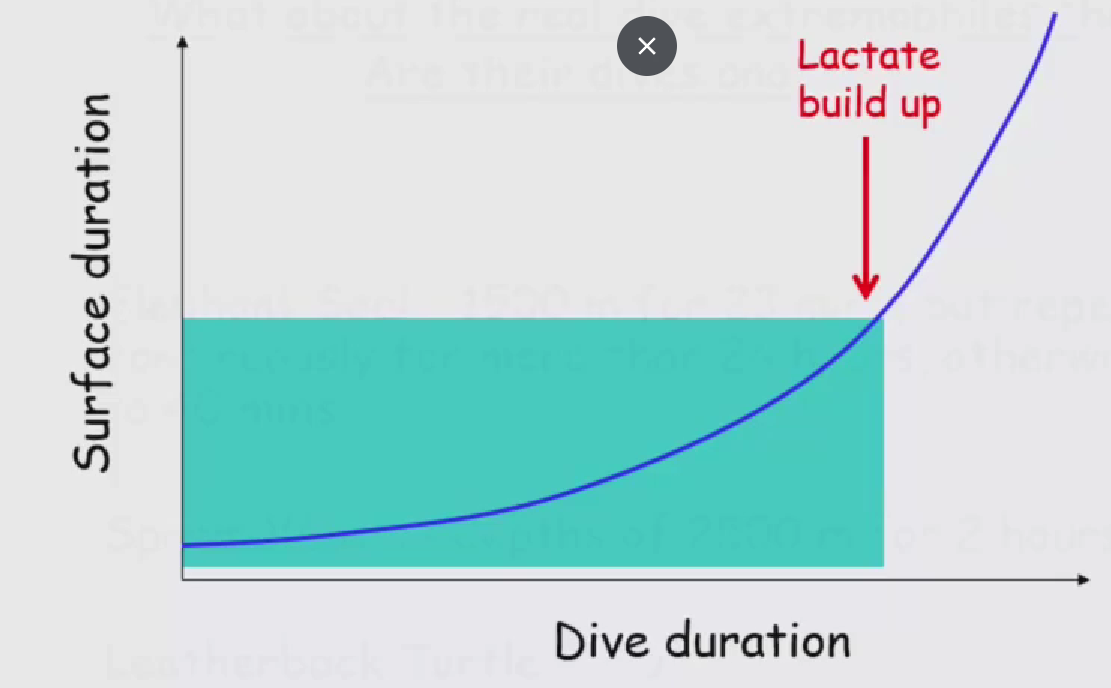
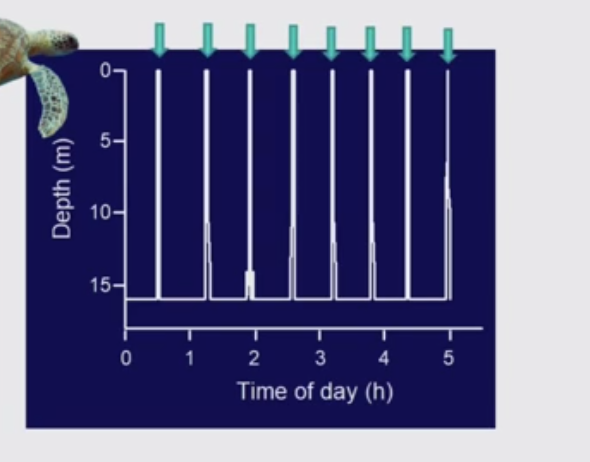
On a depth/time graph how to identfy an aerobic dive?
TDR data shows short surface intervals
How is it possible that a number of diving animals exceed their cADL (without long surface intervals)?
Underestimate oxygen stores
Overestimate metabolic rate
Oxygen stores, what do the best animal divers have?
Expanded blood volume and RBC mass (high hematocrit)
High muscle myoglobin concentrations
Collapsible lungs
Where are oxygen stores?
Blood volume
Blood pigment (haemoglobin)
Muscle pigment (myoglobin)
Lungs
Mass specific metabolic rate explained
Larger animals use oxygen more slowly per unit mass compared to smaller animals, but use more overall
Looks at amount of oxygen used per gram of tissue
Larger animals have a lower mass-specific metabolic rate
Amount of oxygen per kg body mass is not affected by size
Larger animals can spend longer underwater - smaller animals use oxygen faster
Oxygen stores scale linearly with mass
Metabolic rate = total energy used by the whole body
Mass-specific metabolic rate = energy used per unit mass
As body mass increases it gives space to store more oxygen
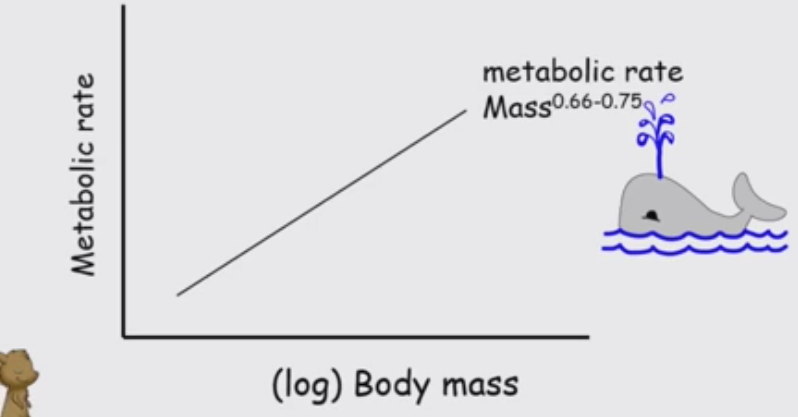
What is the relationship between oxygen stores and mass?
Scale linearly
Amount of oxygen a small animal can store per gram in its body is the same as a large animal
Small animals just use oxygen up faster
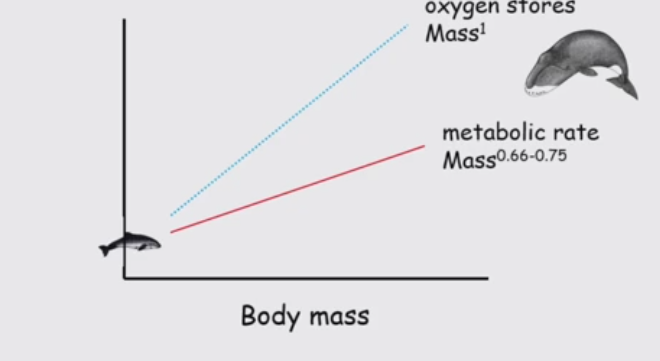
Elephant Shrew curve (Mass Specific Metabolic Rate)
Amount of oxygen used per gram of tissue, shrews use much more than elephants
Why: Per unit mass, small animals use oxygen very fast, large animals use it slowly
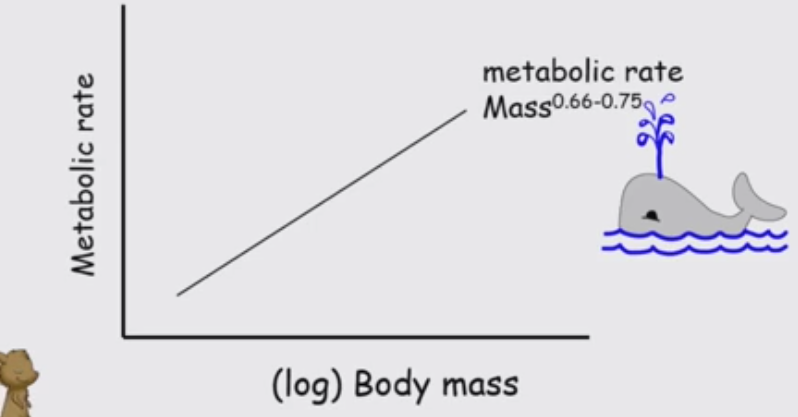
Mass Specific Metabolic Rate definition
How quickly animals use oxygen per kg body mass depends on animal mass
Allometry (oxygen store/usage hypothesis)
Small animals use oxygen faster, so can’t spend as long underwater
If animals store about the same oxygen per gram:
1 kg animal → small total oxygen store
100 kg animal → much larger total oxygen store
So bigger animals have more total oxygen available
Dive duration increases with body mass, as oxygen is not used as fast (reason for animals to be big)
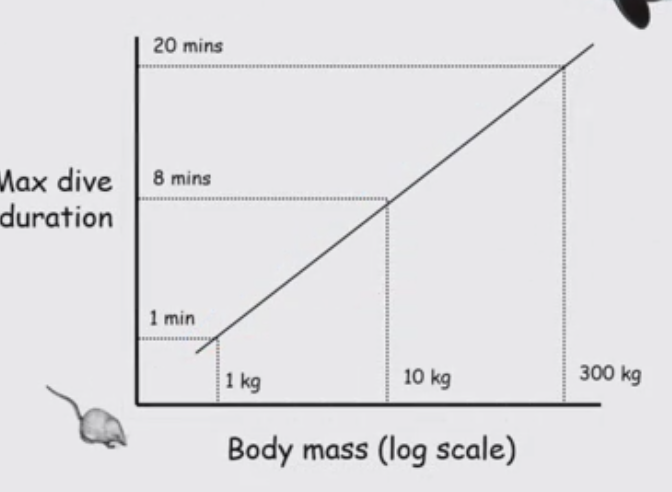
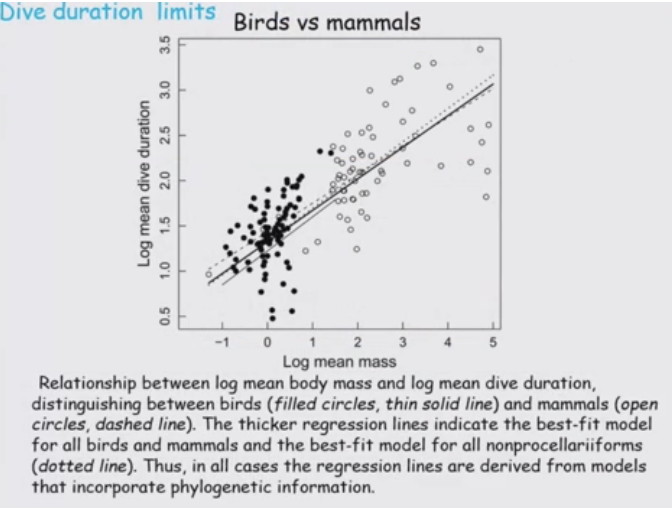
Dive duration limits, paper example
Halsey et al., 2006
Oxygen stores/ usage hypotheisis suggests that larger animals can dive for longer and deeper because oxygen storage scales isometrically (goes up linearly) with body mass
Whereas, oxygen usage scales allometrically with an exponent <1 (uses oxygen less quickly)
True when compared with birds and mammals, but birds tend to dive deeper than mammals of equivalent mass
Time under
Oxygen stores/metabolic rate
Why does body mass not explain everything?
E.g. Sperm whale and Grey whale - same mass, 10x difference in dive duration
Body mass only approximates O2 storage and use, differences in ecology and activity
E.g. Grey whales mainly feed on krill, so don’t need to deep dive
Muscle O2 stores
Muscle mass (kg) x Mb concentration (g Mb kg-1) x 1.34 (ml O2 g Mb-1)
Mb = myoglobin
What’s the difference between endotherms and ectotherms dive duration, paper example?
Wilco et al., 2020
Ectotherms can remain submerged for longer
Mass scaling relationship for dive duration is steeper in endotherms
Explains why the largest extant vertebrate divers are endothermic (not reptiles)