BIO-169-chapter 20: Vessels and circulation
 Call Kai
 Learn
Learn Practice Test
 Spaced Repetition
 Match
Match Flashcards
 Knowt Play
1/114

There's no tags or description
Looks like no tags are added yet.
Name | Mastery | Learn | Test | Matching | Spaced | Call with Kai |
|---|
No analytics yet
Send a link to your students to track their progress
115 Terms
Arteries
____ transport blood away from the heart to the capillaries
Capillaries
____ are microscopic, relatgiely porous blood vessels for the exchange of substances between blood and tissues
Capillaries’ narrow vessel diameter and thin wall are optimal for
exchange of substances between blood and body tissues
Veins
_____ drain blood from the capillaries, transporting it back to the heart
veins are structurally similar to the _______ valves of the heart
semilunar
Tunics
Vessel walls are composed of layers called _____.
Lumen
The tunics surround the _____, or inside space, of the vessel through which blood flows.
tunica intima, tunica media, tunica externa
The three tunics are:
media, externa
An artery has a thicker tunica ____ and a relatively smaller lumen, whereas a veins thickest layer is the tunica ____, and it has a larger lumen
Tunica intima
the innermost layer of a blood vessel
Endothelium
The _____ both provides a smooth surface as the blood moves through the lumen of the blood vessel and releases substances to regulate contraction and relaxation of smooth muscle within the tunica media
Tunica media
The tunica _____ is the middle layer of the vessel wall.
Vasoconstriction
Narrowing of the blood vessel lumen
Vasodilation
Widening of the blood vessel lumen
Tunica externa
The tunica ____ is the outermost layer of the blood vessel wall
Companion vessels
arteries and veins that supply the same body region and tend to lie next to one another are called:
Arteries
_____ progressively branch into smaller vessels as they extend from the heart to the capillaries
capillaries, arteries, veins
Which are major classes of blood vessels?
Arteries
Which class of blood vessel carries blood away from the heart to the body?
Tunics
The walls of arteries and veins have three layers called:
Companion
In the body, _____ blood vessels travel together and supply the same region.
Veins
Which blood vessels become larger and merge as they move toward the heart?
Arterioles
The smallest type of arteries are the:
Capillaries
The smallest blood vessels in the cardiovascular system are the:
Venules
The companion vessels to the arterioles are the:
Muscular arteries
Smaller and medium sized veins typically travel with:
False
True/false: Arteries contain valves to prevent the back flow of blood.
Elastic
____ arteries are the largest arteries, ranging from 2.5 to 1 centimeters. They are also called conducting arteries because they conduct blood from the heart to the smaller muscular arteries
Muscular
_____ arteries typically have diameters ranging from 1 centimeter to 0.3 millimeter. These medium sized arteries are also called distributing arteries because they distribute blood to specific body regions and organs
Atherosclerosis
A progressive disease of the elastic and muscular arteries which leads to thickening of the tunica intima and narrowing of the arterial lumen
Hypercholesterolemia
An increased amount of cholesterol in the blood which tends to run in families
angioplasty
surgical repair of a blood vessel where a physician inserts a balloon tip catheter into an artery and positions it at the site where the lumen is narrowed
Internal elastic, external elastic
The ____ _____ lamina seperates the tunica media from the tunica intima, and the ____ ____ lamina seperates the tunica media from the tunica externa
Aneurysm
ballooning of a weakened portion of an arterial wall which can rupture and cause massive blessing or death
Continuous capillaries, fenestrated capillaries, and sinusoids
Capillaries include three types:
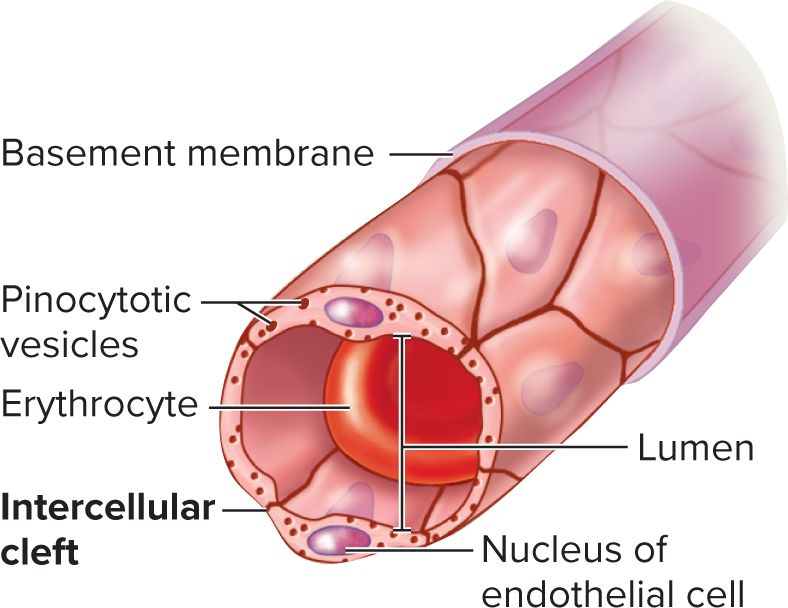
Continuous capillaries
The most common type of capillary least permeable, allowing plasma and small solutes to pass
Fenestrated
____ capillaries are composed of a complete continuous lining of endothelial cells and a basement membrane and are found in the small intestine to absorb nutrients, aqueous humor, choroid plexus, endocrine glands, and the kidneys
Sinusoids
_____ have an incomplete lining of the endothelial cells with large openings, or gaps, and the basement membrane is either discontinuous or absent
Capillary bed
A group of capillaries formed together that works together
Metarteriole
A branch of an arteriole
True capillaries
Vessels called ____ _____ branch from the metatariole and make up the bulk of the capillary bed
precapillary sphincter
At the origin of each true capillary, a smooth muscle ring called the _____ _____ controls blood flow into the true capillaries
Venules
____ are the smallest veins, measuring from 8-100 micrometers in diameter and are companion vessels with arterioles and they marge to form veins
Valves
Most veins contain numerous _____, so as to prevent blood from pooling in the limbs
Sinus
A modified vein that has very thin walls and no smooth muscle is referred to as a:
End arteries
Arteries that provide only one pathway through which blood can reach an organ are referred to as:
anastomosis
An _____ is the joining together of blood vessels
Portal vein
A ____ _____ delivers blood to another organ first, before the blood is sent back to the heart
55%
When a person is at rest, approximately how much blood is being held within the veins, the body's blood reservoirs?
-25%
-75%
-55%
Vein
The simple pathway of blood flow to an organ or body region includes an artery, capillary bed, and a:
Elastic arteries
Which arteries are also called conducting arteries because they conduct blood away from the heart to the smaller muscular arteries?
Elastic artery
Which type of artery has a large proportion of elastic fibers throughout all three tunics, especially the tunica media?
Elastic arteries
The aorta, pulmonary arteries, brachiocephalic arteries, and common iliac arteries are examples of:
Muscular arteries
Which arteries are also known as distributing arteries because they distribute blood to the body organs and tissues?
Decreases
Arteriole vasoconstriction _____ blood flow into the an area
Cross sectional area
The ____ ____ __ of a vessel is the diameter of the vessels lumen
Blood flow velocity
rate of blood transported per unit time and typically measured in centimeters per second
Capillaries
The function of _____ is to allow for the exchange of substances between the blood and the surrounding tissues
Diffusion
Within systemic capillaries, substances such as oxygen, hormones, and nutrients move by _____ from their relatively high concentration in the blood into the interstitial fluid and then into the tissue cells
Vesicular transport
___ ____ occurs when endothelial cells use pinocytosis to form fluid filled vesicles, which are then transported to the other side of the cell and released by exocytosis
Bulk flow
___ _____ refers to the movement of large amounts of fluids and their dissolved substances in one direction down a pressure gradient
Filtration
_____, a process that occurs on the arterial end of a capillary, is the movement of fluid by bulk flow out of the blood through the openings in the capillaries
reabsorption
The movement of fluid by bulk flow in the opposite direction, back into the blood
hydrostatic pressure
The physical force exerted by fluid on a structure
blood hydrostatic pressure
Force exerted per unit area by blood as it presses against the internal surface of the vessel wall
External
The ____ elastic lamina in the walls of muscular arteries seperates the tunica media from the tunica externa
Coronary artery, brachial artery, inferior mesenteric artery
Which are muscular arteries?
-coronary artery
-brachial artery
-pulmonary artery
-inferior mesenteric artery
True
True/false: arterioles have a significant role in regulating systemic blood pressure and blood flow to different areas of the body.
tunica intima
The walls of capillaries contain only the ____ ____ allowing for rapid gas and nutrient exchange between the blood and tissues
Endothelium
Most capillaries consist solely of ________, which is composed of simple squamous epithelium resting on a basement membrane.
Continuous capillaries
Which type of capillaries use simple diffusion or pinocytosis to pass materials through the vessel walls?
-sinusoids
-fenestrated capillaries
-continuous capillaries
Muscle, skin
Where are continuous capillaries found within the body?
fenestrated capillaries
Which type of capillaries have pores within each endothelial cell and a continuous basement membrane?
Fenestrated capillaries
Which type of capillaries are found where a great deal of fluid transport between the blood and interstitial fluid occurs, such as the small intestine, ciliary process of the eye, most endocrine glands, and the kidney?
Sinusoids
Which type of capillaries are found in the bone marrow, spleen, and liver, where larger materials need to enter and exit the blood?
thoroughfare channel
In a capillary bed, the distal part of the metarteriole, called the ___ ____, connects to a post capillary Venule
precapillary sphincter
Relaxation of the ____ ____ allows blood flow into the the capillaries of a capillary bed
Perfusion
The specific amount of blood entering capillaries per unit time per gram of tissue is called:
Tumor angiogenesis
A critical event in development of a cancerous tumor is the formation of blood vessels within the tumor, and process called:
myogenic response
The contraction and relaxation of smooth muscle within blood vessels in response to changes in stretch of the blood vessel wall is the:
Vasodilators
Substances that cause smooth muscle relaxation, which results in both vasodilation of arterioles and opening of precapillary sphincters
vasoconstrictors
Substances that cause smooth muscle contraction
Autoregulation
The process by which a tissue itself regulates or controls its local blood flow in response to its changing metabolic needs
histamine and bradykinin
____ and _____ are inflammatory mediators, which are released in response to a trauma, an allergic reaction, an infection, or even exercise
Prostaglandins and thromboxanes
____ and ___ are local hormones released with tissue injury that can cause vasoconstriction
Blood pressure
___ __ is the force per unit area that blood experts against the inside wall of a vessel
Blood pressure gradient
The change in blood pressure from one end of a blood vessel to its other end
Systolic pressure
The highest blood pressure generated in arteries is during ventricular systole when the artery is maximally stretched; this value is recorded as the:
Diastolic pressure
The lowest pressure is during ventricular diastole when the artery recoils no further; this value is recorded as the:
Pulse pressure
The additional pressure placed on the arteries from when the heart is resting
Pulse
The rhythmic throbbing of an arterial wall as blood is being pumped through the vessel
Thrombus
Another word for blood clot
Varicose
_____ veins are dilated and have many curves and twists and may be a result of aging or some form of stress like standing for long periods of time and can occur anally like hemorrhoids
Resistance
The amount of friction the blood experienced as it is transported through the blood vessels
True capillaries
The bulk of a capillary bed is formed by the:
-metarteriole
-thoroughfare channel
-true capillaries
End arteries
arteries that provide only one pathway through which blood can reach an organ are referred to as:
Anastomosis
An _____ is the site where two or more arteries/veins converge to supply the same body region
Venous
A _____ anastomosis includes two or more veins draining the same body region
Arteriovenous anastomosis
Which would be present in the fingers, toes, palms, and ears to allow these areas to be bypassed if the body is becoming hypothermic?
Baroreceptors
Specialized sensory nerve endings that respond to stretch and sudden short term changes in blood pressure