Introduction to management accounting
 Call Kai
 Learn
Learn Practice Test
 Spaced Repetition
 Match
Match Flashcards
 Knowt Play
1/13

There's no tags or description
Looks like no tags are added yet.
Name | Mastery | Learn | Test | Matching | Spaced | Call with Kai |
|---|
No analytics yet
Send a link to your students to track their progress
14 Terms
Operational budgets: For sales revenue budget what 2 things do you need?
Budget sales, sales price
Operational budgets: What do you add and take away for production budget
budgeted sales - opening inventory + closing inventory
Operational budget: how do you work out material usage?
Budget usage (mats used in budget) - opening inventory + closing inventory
Average time per unit to produce Y units=
no. units x (time to produce first unit x cumulative no. units^leaning index)
Learning index= Log (learning index decimal)/ Log(2)
What is the high low method
Total cost= total fixed cost + variable cost per unit x no. units
BUT variable cost is cost= cost at highest units - cost at lowest units/ high units - low units
Contribution margin=
selling price per unit - variable cost per unit
Ratio= contribution margin per unit / selling price x100
Break even point
Units: total fixed cost/ contribution per unit
Revenue: Fixed cost/ contribution margin ratio
Margin of safety
Units: Budget units- break even units
%: budget sales- break even sales / budget sales x100
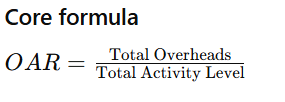
what does the overhead absorption rate show
An overhead absorption rate (OAR) shows how much overhead cost (indirect costs like rent, utilities, supervision) is charged to each unit of activity—for example per labour hour, machine hour, or per unit produced
Discount factor=
1/(1+r)²
Sales volume contribution variance =
(Fixed volume – Flexed volume) x Standard unit contribution
Materials Price Variance=
(Actual Price−Standard Price)×Actual Quantity
Pay back time
start of no. years + difference in cost of initial investment and latest year/ total of year
Like linear interpolation
Internal rate of return
look at 2 different discount values then do linear interpolation