ME Chap 2-9
 Call Kai
 Learn
Learn Practice Test
 Spaced Repetition
 Match
Match Flashcards
 Knowt Play
1/117

There's no tags or description
Looks like no tags are added yet.
Name | Mastery | Learn | Test | Matching | Spaced | Call with Kai |
|---|
No analytics yet
Send a link to your students to track their progress
118 Terms
biddle and hamermesh study on how sleep affects wages
people with higher wages sleep less
if the wage rate increases, labor hours don’t increase but sleeping time is reduced in favor of leisure time
consistent with prior research, men’s supply of work hours is much less sensitive to changes in the wage rate than women’s. The labour supply elasticity is measured as –0.021 for men and 0.191 for women
sleeping time seems to be a normal good: in some economies, a higher GNP is associated with significantly longer sleep duration.
how wage subsidies affect unemployment
reduce voluntary unemployment by increasing the net return to work, shifting labor supply curve right, while lowering gov costs by replacing higher unemployment benefits with lower, targeted subsidies. it increases net wage received and decreases labor costs
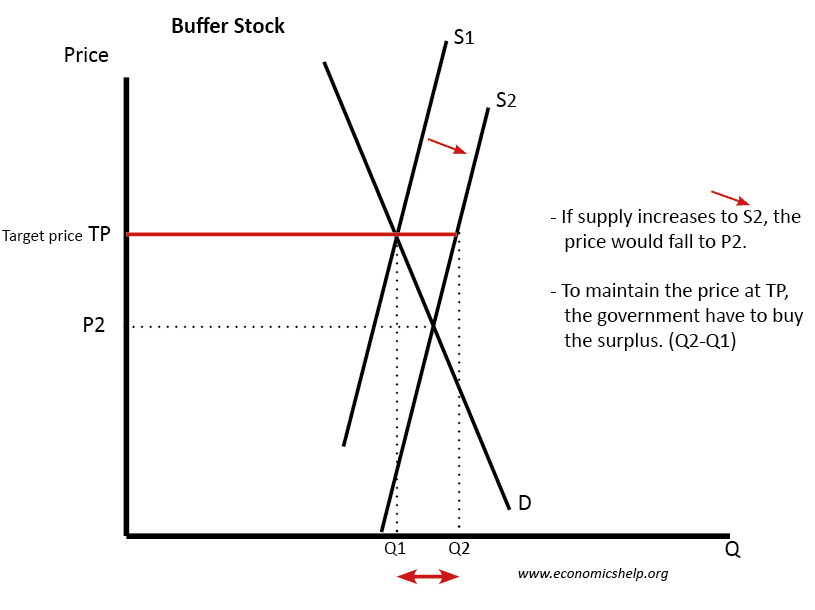
what happens if the government pays a fixed amount in welfare benefits for unemployed workers
creates a negative income effect, reducing the labor supply because individuals can afford more leisure without working. creates no direct substitution effect since the relative price of leisure (the wage rate). increases the reservation wage unemployment duration
reservation wage
the lowest hourly rate an individual will accept to take a job
how the income and substitute effect affects the work to leisure ratio
substitution effect pushes in the direction of more work. income effect has a negative impact on labour supply as it leads to more leisure and less work if you assume that leisure is a normal good.
basic labour supply model
assumes that the worker has a free choice of working hours or length of working week
what makes the budget constraint piecewise linear and concave
progressive income tax
budget constraint
indicates how much consumption is possible for each choice of leisure and its implied choice of work time given a wage rate
backward-bending supply of savings
as the interest rate increases to a high level, savers may reduce their savings
income effect
the change in demand for a good or service caused by a change in a consumer's purchasing power (real income), resulting from either a shift in nominal income or a change in price
substitution effect
change in consumer demand for a good resulting from a change in its relative price, prompting consumers to buy cheaper alternatives when a product becomes more expensive, holding utility constant
how to determine the market interest rate
plotting the total amount of savings and the total amount of borrowing against the interest rate. You read off the equilibrium interest rate where the two curves intersect
what is the optimum bundle of current and future consumption
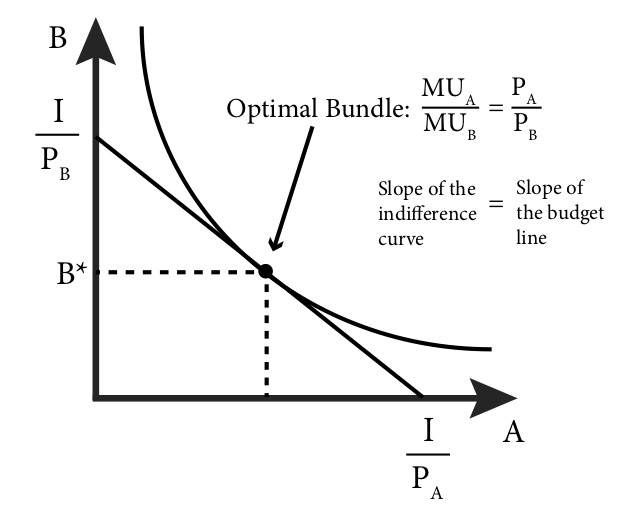
the budget line is tangent to the highest possible indifference curve
what a convexity (lack of linearness) of preferences show
consumers would rather have an average amount of consumption each period rather than a lot today and nothing tomorrow
what does the utility function represents
current and future consumption
piecewise linear
a function composed of multiple straight-line segments defined over different intervals
endowment point
the initial bundle of goods or assets an agent holds before any trade, exchange, or consumption occurs in an economic model
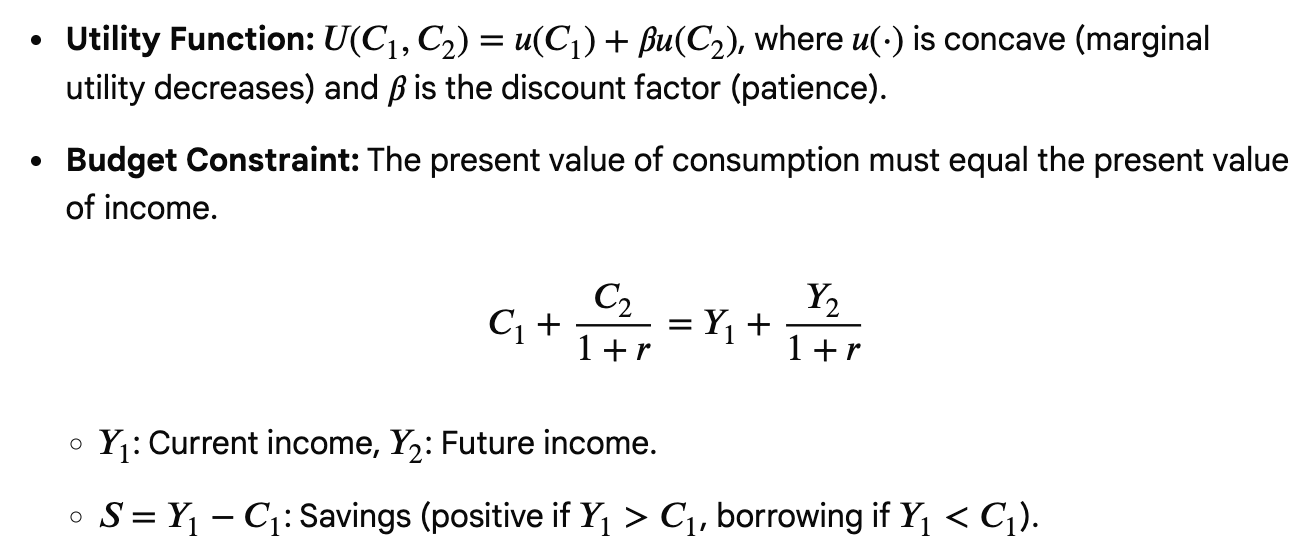
intertemporal consumption choice problem formula
iso-expected income line
represents all combinations of risky outcomes that yield the same expected total income, given specific probabilities. the tangency of an indifference curve and an iso-expected income line occurs at the intersection of the indifference curve with the certainty line
what is the 45 degree / certainty line
income bundles for which income in both states is equal and hence there is no uncertainty
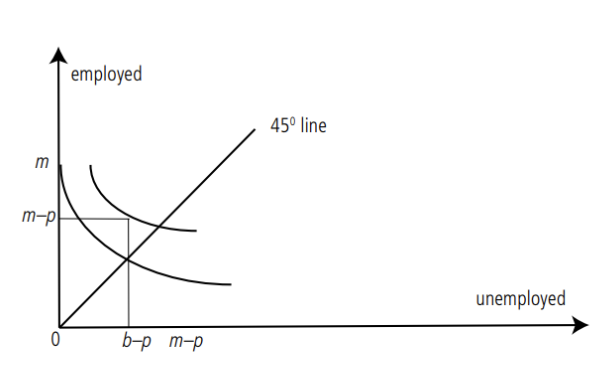
income bundle when you are jobless and don't have unemployment insurance
could be (0, m) indicating a zero income level
state-contingent commodities model
models uncertainty by defining goods based on both physical properties and the "state of nature" in which they are delivered
backward-bending supply of labour
an increase in wages causes individuals to work fewer hours resulting in a backward-bending curve, occurs when after a certain wage level
intertemporal choice
consumers’ choices of consumption over time
indifference curve
shows various combinations of two goods that provide a consumer with the same level of utility (satisfaction), leaving them indifferent between the options
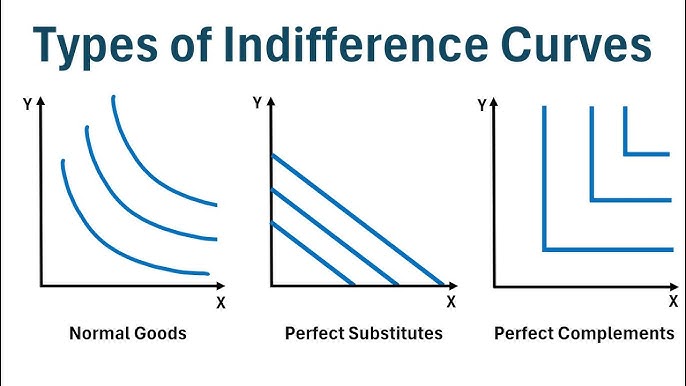
how the optimal bundle is found
MRS must equal the slope of the budget line
demand function
relates consumers’ optimal choice and the quantities demanded to the different values of prices and income

what does market demand consist of,
the horizontal sum of the individual demands, to find market demand add individual demands horizontally
slutsky substitution effect
budget line rotates through the original consumption bundle until it has the same slope as the new budget line. depends on the initial consumption bundle as it tries compare if it can fulfill it and more
hicks substitution effect
budget line rolls under the original optimal indifference curve until it has the same slope as the new budget line so that utility rather than purchasing power is now held constant
slutsky's and hick's approach have in common
both shows the new relative prices after the change in price of one of the goods
difference between slutsky and hicks
slutsky evolves around maintaining the original purchasing power (i.e. old consumption bundle) after a price change, while the Hicks centers on maintaining the original level of utility
why hicks can be useful
cost-benefit analyses of public policy changes as they can help come up with estimates of consumer detriment
public policy
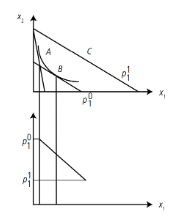
type of tax policy that affects consumer welfare as it can reduce income tax from increasing the tax on commodities
what do the compensating variation and equivalent compensation methods do to see the impact of a price change on consumers
measure the distance between the initial (before the price change) and final (after the price change) indifference curves
compensating variation (CV)
the amount which is needed to compensate for a price increase or could be taken away from the individual after a price decrease to make him as well off as before the price decrease. represents the change in income necessary to restore the consumer to his original indifference curve
equivalent variation
the amount or additional income needed before a price reduction, or how much less income the consumer would need before a price increase, to give the level of utility she would have after the price change. represents the income change that is equivalent to the price change in terms of impact on consumer’s utility
difference between compensating and equivalent variation
CV refers to a change in income which takes you back to the original indifference curve and EV refers to a change in income which brings you to the new indifference curve. CV is the change in income after the price change while EV is the change in income before the price change takes place
when EV, CV and the change in consumer surplus CS are equal
the income effect of a price change is zero
when the EV, CV and the change in consumer surplus CS intersect
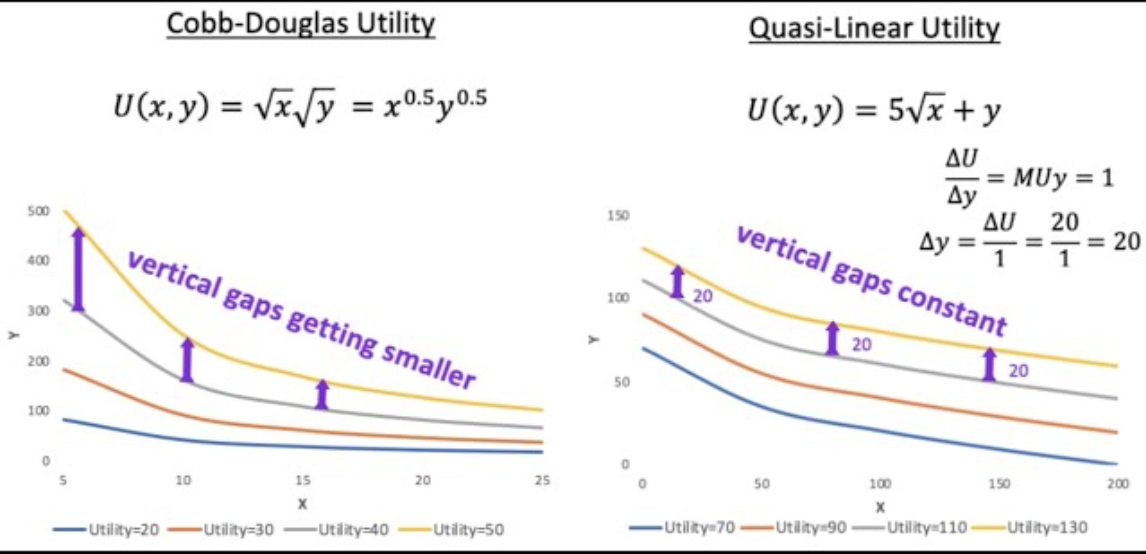
quasilinear utility
factors affecting price elasticity of demand
the number and closeness of substitutes, the period of time over which the response to a price change is assessed and the comparison of luxury and necessity goods
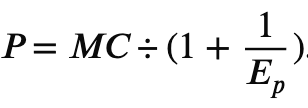
optimal markup over cost
higher demand elasticity (sensitive customers) requires a lower markup, while lower elasticity (loyal customers/unique products) allows for higher markups, often ranging from 50% to over 100% depending on the industry
post contractual opportunism
when one of the parties misbehaves or takes actions that adversely affect the other party after a contract is signed
moral hazards
about incentive problems where one agent cannot observe the actions of the other agent, also known as problems of hidden action
solution of adverse selection
if everyone is insured, the high risk ones will be better off since they pay a lower premium but the low risk ones aren't necessarily better off but they will get the insurance at a lower premium than if the premium was based on only high risk
annuity
a retirement product that converts a certain amount of money (typically a personal pension fund) into a constant income stream for the remainder of the individual’s life
lemons problem
a lemon is a used car of bad quality and a plum is a good quality car. the lemons problem is about the seller will always have hidden information that the buyer won't making the info asymmetrical
adverse selection
occurs when less desirable agents are more likely to voluntarily participate or ‘self-select’ in trade, has to be guessed and so is known as hidden information problems
the 2 scenarios considered for buyers and sellers
(a) where one party knows more about their attributes or the quality of the good, and (b) where one party can take unobservable actions that affect the quality of trade
asymmetrical information
when one party involved in a transaction knows more than the other about relevant variables
expected payoff for putting in effor
expected payoff = p(putting in effort) + (1- p(putting in effort)) - effort cost
incentive mechanism
it is in an agent’s best interest to voluntarily choose the effort level that the principal prefers
marginal disutility of effort
the additional, rising cost or dissatisfaction a worker experiences from providing one more unit of effort
incentive system
used to monitor effort level as it directly is hard to measure, but to have one makes it clear that there is a reason
3 principal agent problem features
agent supplies effort in order to produce some valuable output
agent’s effort level typically is not observed by the principal
principal pays the agent and receives the output
how uninformed parties screen their counterparties
offering a menu of choices or possible contracts to prospective (informed) trading partners who ‘self-select’ one of these offerings
why a signal would be credible
the signalling cost to the good workers is lower than to the low productivity workers
rising wage profile
workers get paid an increasing wage over their careers
difference between screening and signaling
screening is done by the uninformed party while signalling is done by the informed party
screening
when the uninformed party engages in activities to find out the other party’s private information
managers
the ones running the business on a daily basis and may have limited or no ownership whatsoever of the company stock
owners
typically shareholders who are interested in maximizing the firm’s value but are not directly involved in the daily running of the company.
principal agent relationship
when the principal hires the agent to take certain valuable actions
expected payoff
precisely the pay-off you would expect if you were given exact information about what will happen at each probability node
expected value of perfect information (EVPI)
the max amount a decision-maker should pay for additional information to eliminate uncertainty before making a decision
value of perfect information
the increase in expected profit if you can obtain completely accurate information concerning future outcomes
expected utility model
explains how rational decision-makers choose between risky prospects by maximizing the weighted average of potential outcomes
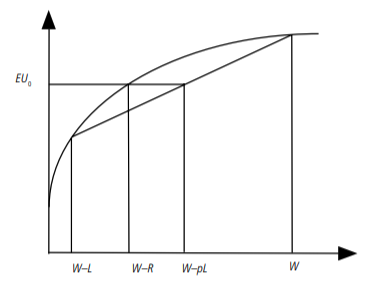
certainty equivalent (CE)
the amount of money that delivers the same level of utility as the lottery, and makes the individual indifferent between it and the risky prospect
rules regarding CE and EMV
risk averse (hating) Certainty Equivalent < Expected Monetary Value, risk neutral if CE = EMV and risk loving if CE > EMV
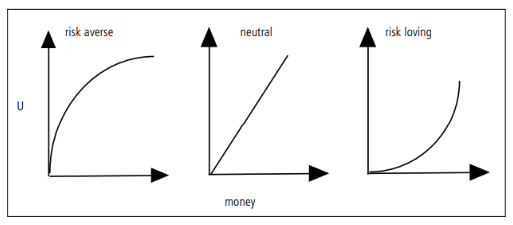
risk aversion regarding the utility function
a risk averse decision-maker has a concave utility function
a risk lover has a convex utility function
a risk neutral decision-maker has a linear utility function
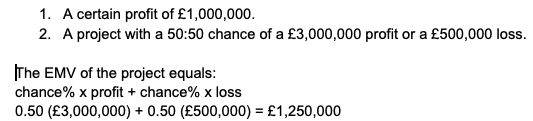
expected monetary value (EMV) criterion
assumed that the decision-maker is interested in maximizing the expected value of profits or minimizing the expected value of costs. bigger EMV makes biggest profits
what bayesian equilibrium requires
strategies should be optimal given players’ beliefs and beliefs should be obtained from strategies, optimal for imperfect or incomplete information games
trigger strategies
cooperate until the other player cheats and then cheat until the horizon is reached
tit for tat strategy
cooperates in the first round and as long as the other player also cooperates until there’s a deviation from cooperation. never initiates cheating, and it is forgiving in that it only punishes for one period, will be in their own interest to always cooperate
duopolists setting the price policy at nash equilibrium
both firms set low prices and hurt themselves by doing so although in equilibrium, it is in neither firm’s interest to deviate
application of the prisoner's dilemma
duopolists deciding on their pricing policy
pure strategies
a stable outcome where players choose a specific action with certainty (100% probability) e.g., always "confess"
prisoner's dilemma
if one confesses and the other doesn't the one who didn't goes to prison for 10 years and vice versa. if both confess both go to prison for 7 years and if neither confess they both serve for 2 years
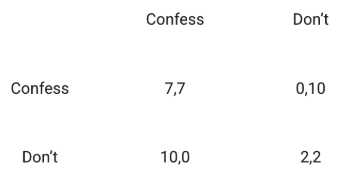
what the presence of nash equilibrium or lack thereof can tell you
any combination of strategies which don’t form a nash equilibrium is inherently unstable. but if there’s more than one nash equilibrium, game theory does not offer a prediction as to which nash equilibrium is more likely to be played
nash equilibrium
the best response to the strategies that a player assumes the other players are using
successive elimination of dominated strategies
when you generate a new pay-off matrix which may contain dominated strategies for the other player which in turn can be deleted and so on
pursuit of rational decision makers
players are assumed to make decisions or choose strategies which will give them the highest possible expected pay-off
game of perfect recall
players remember their own moves and do not forget any information which they obtained in the course of game play. they don’t necessarily learn about other players’ moves
differences between games with complete and incomplete info
in complete info all players know the rules of the game while in incomplete info, at least one player only has probabilistic information about some elements of the game
determinants of a game
the number of players
their possible actions at every point in time
the pay-offs for all possible combinations of moves by the players
the information structure (what players know when they have to make their decisions).
difference between cooperative and non cooperative games
in cooperative, coalitions or groups of players are analysed, players can communicate and make binding agreements while in non-cooperative it’s assumed no binding agreements are allowed and each player chooses her actions, subject to the rules of the game, and is motivated by self-interest.
rubinstein game
features alternating offers between two players over an infinite time horizon. assumes players don’t have all the info about each other and that efficiency is a prediction not an assumption
limitation of alternating offers bargaining game
doesn’t regard how disagreement is common and costly negotiations take place over several weeks or months
why being patient increases bargaining power
a player’s ‘cost’ of rejecting an offer is having to wait until the next period to be able to make a counteroffer. this intrinsic cost of delay decays as the player becomes more patient
alternating offers bargaining game
decide on how to divide an amount of money between them, they alternate in making suggestions about this division and the game ends as soon as an offer is accepted
what the friction in bargaining is modeled as
cost of delay (or cost of haggling)
nash bargaining solution (NBS)
a unique, pareto-efficient, and fair outcome to a cooperative game where two parties bargain over a surplus, maximizing the product of their gains over a disagreement point
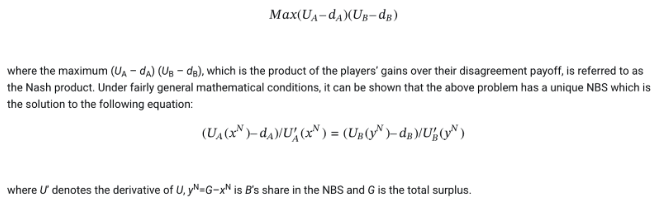
a bargaining solution
when two players have a common interest in cooperating but, at the same time, also have conflicting interests over exactly how to cooperate
bidding insurance’
when a risk averse person bids higher because she is willing to pay more to avoid the zero pay-off associated with losing
phantom bid
an illegal tactic where sellers fabricate non-existent offers to create artificial competition. this tricks potential buyers into increasing their bids, removing conditions, or overpaying for a property
disadvantages of having someone else bid for you
the seller incurs a risk of the high bidder dropping out and one of her agents ‘winning’ the auction
bidders may account for the possibility that they are bidding against an agent and shade their bids accordingly
how to bid in common value auctions
depends on the nature of uncertainty about the value and the information available to the bidders
how to avoid the winner's curse
bid below your estimate
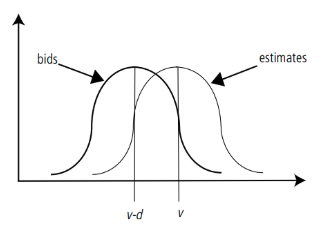
the winner's curse
if you lose you lose but if you win you also lose. if you win the auction, it is probably because you have overestimated the value of the goods being sold
what the dominant strategy is for common value english auctions
no dominant strategy for a common-value English auction and the equilibrium bidding strategy depends on the structure of the information among the bidders