Radiology Concepts I & II
 Call Kai
 Learn
Learn Practice Test
 Spaced Repetition
 Match
Match Flashcards
 Knowt Play
1/72

There's no tags or description
Looks like no tags are added yet.
Name | Mastery | Learn | Test | Matching | Spaced | Call with Kai |
|---|
No analytics yet
Send a link to your students to track their progress
73 Terms
Radiology
study of X rays and radioactive substances and their uses in the diagnosis and treatment of diseases
Radiology Screening
Using radiology to ID risk factors, detect occult disease
Radiology diagnosis
using radiology to establish or exclude disease, early dx, or determine stage / activity of disease
Radiology Disease Management
Using radiology to estimate prognosis, monitor condition, help select therapies
Disadvantages of radiology
cost, risk of discomfort, pain, or morbidity, and incidentalomas
Incidentaloma
refers to a mass lesion involving an organ that is discovered unexpectedly by the use of ultrasound, computed tomography scan, or magnetic resonance imaging and has nothing to do with the patient's symptoms or primary diagnosis
Gold Standard Test
the test with the highest known accuracy of identifying a person as having or not having the disease being assessed
TOC
test of choice
Radiation
energy emitted from unstable atoms (radioactive energy)
Ionizing imaging
Imaging process that uses radiation
Non-ionizing imaging
Imaging process that doesn't use radiation
X-rays
Electromagnetic radiation having a very short wavelength; can penetrate substances such as skin and muscle.
Scatter radiation
A form of secondary radiation that occurs when an x-ray beam has been deflected from its path by interaction with matter
What is required by X-rays used in diagnostic radiology?
A vacuum and a high potential difference between a cathode and an anode
Radiographic Density
the degree of blackness on a radiograph
Radiographic Contrast
The difference between adjacent densities ranging between clear white through various shades of gray to black
Radiolucent
a substance that allows x-rays to pass through and appears black or dark gray on the resulting film
Radiopaque
substance does not allow x-rays to pass through and appears white or light gray on the resulting film
Radiodense
substance does not allow x-rays to pass through and appears white or light gray on the resulting film
Naturally occurring radiographic densities (calcium, adipose, air)
appear as shades of gray to black on a radiograph
Unnaturally occurring radiographic densities (metal, plastic)
appear as white
If an x-ray beam exposed the film entirely, what color would the film be?
black
What happens when a patient stands between the film and the x-ray?
Various structures in the body absorb the x-ray beams
How does the darkness and lightness occur on an x-ray film?
lightness = x-rays are absorbed by structures and do not pass through
darkness = x-rays pass through the object and meet the film
Risk of cell mutation from ionizing energy is higher for what population of people?
younger people
Why is risk of cell mutation higher for younger populations?
They have more cells dividing, more tissues growing, and longer lifespans to develop cancers
Biological effects of radiation
Deterministic (Non-Stochastic)
Stochastic (Probabilistic)
Deterministic effects of radiation
the amount of radiation imparted to a tissue that exceeds a damage threshold value
Stochastic (Probabilistic) effects of radiation
effects can manifest no matter the dose; any procedure with radiation carries some risk
ALARA
As Low As Reasonably Achievable
Ways to decrease radiation exposure
Decrease time of exposure
Increase distance from X-rays
Use shielding
Radiography
process of recording x-rays; produces a static 2D image
In reading X-Rays, what does PA and AP mean?
The way the X-ray beam travels through the body to the film
Posterior Anterior
Anterior Posterior
A provider wants to see a patient's lungs in an x-ray, how should we have the patient stand relative to the film?
Patient should stand facing the film (PA) so the lungs are closer to the film
Why do we want the object of interest in an X-ray to be closer to the film?
The further an object is from the film, the more distorted it becomes
What makes an x-ray film adequate?
Presence of intended anatomy on the image as well as proper exposure / contrasting light and dark to be able to see the structures
A patient has had a rough cough for a few weeks and the provider orders a chest X-ray to rule out infection. The provider receives an X-ray taken at an AP view. Why might the tech have taken that view?
The patient is immobile or too sick to get up. The tech can make it easier for the patient by having them lay down or sit against the film.
Fluoroscopy
visualization of body parts in motion by projecting x-ray images on a luminous fluorescent screen
Why is contrast used for imaging?
It varies the densities of certain tissues to allow them to be distinguished from each other on imaging
What are the two most common contrast agents used in imaging?
Iodine and barium
Computed Tomography (CT)
a scanning technique using multiple X-rays to construct three-dimensional images
How is a patient positioned during a CT scan?
Supine on a table
Hounsfield Unit (HU)
A numeric value in a CT scan representing the density of a certain tissue. Air = -1000 (black), water = 0 (gray), bone = 800-1000 (white)
What are window levels when viewing a CT scan?
Levels used to manipulate the grayscale to focus on certain organ systems (EX adjust levels to view lungs vs soft tissue vs bone)
Which test is faster: CT or MRI?
CT
Which test is better for detecting demyelination: CT or MRI?
MRI
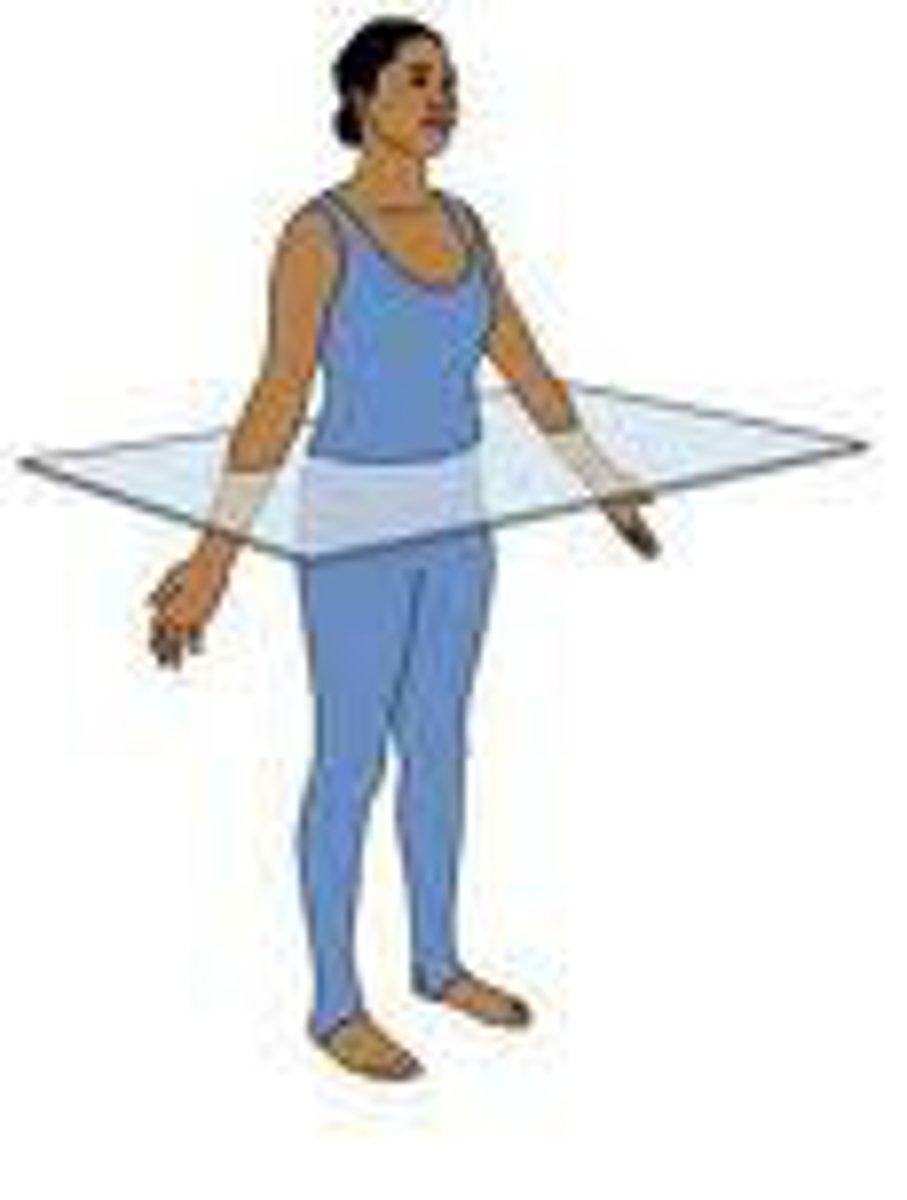
Axial plane
Horizontal plane
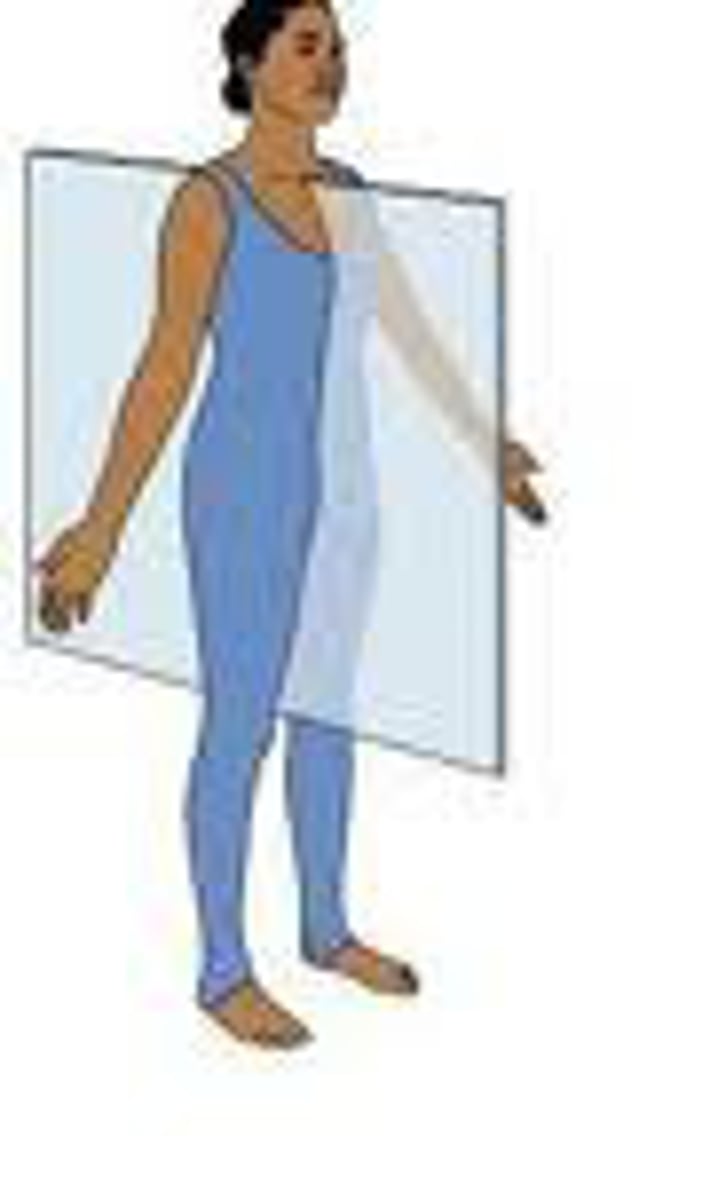
Sagital plane
divides the body into left and right halves
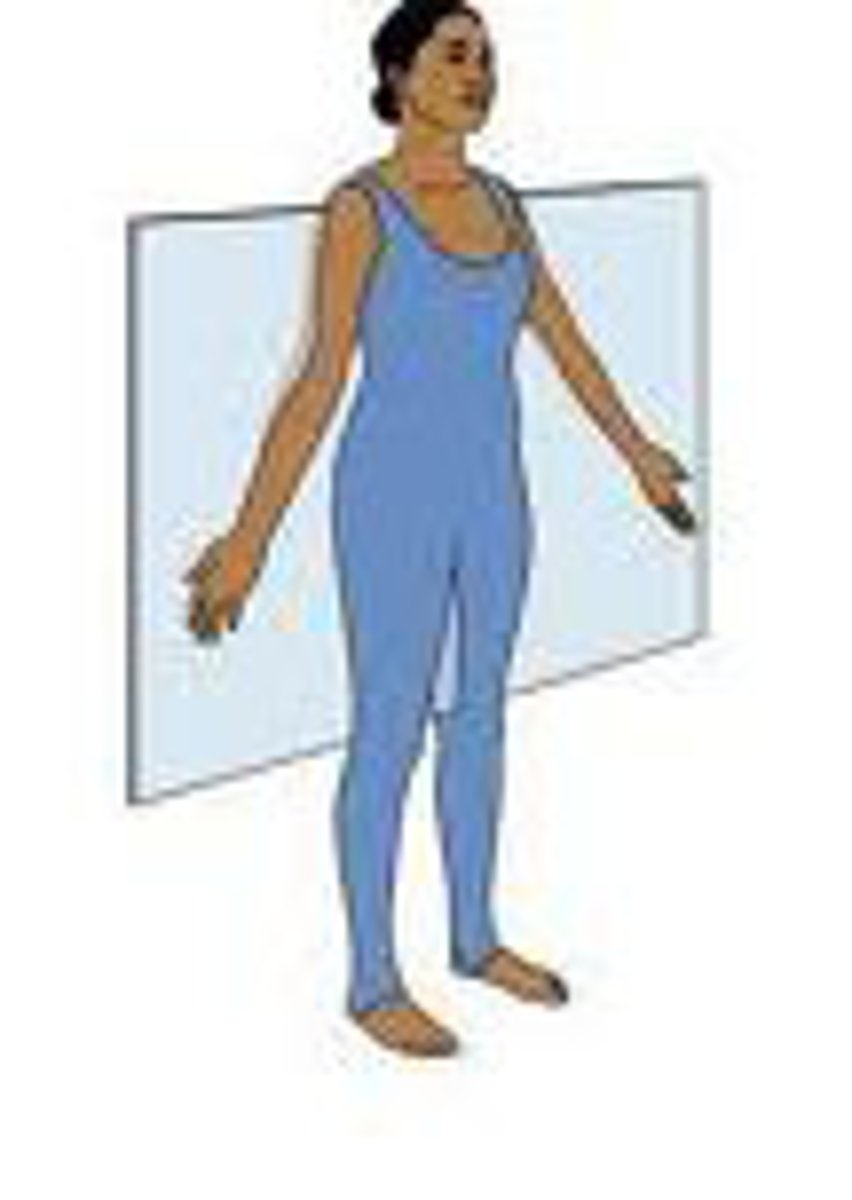
Coronal plane
divides body into front and back
Magnetic Resonance Imaging (MRI)
a technique that uses magnetic fields and radio waves to produce computer-generated images that distinguish among different types of soft tissue; allows us to see structures within the brain
How does MRI work?
Uses a magnet to manipulate hydrogen atoms. Each H atom gives off a radio-frequency that is assigned a grayscale value by the computer, resulting in a highly detailed image
MRI T1
Better resolution and better for anatomy
Fat appears white and water appears dark
MRI T2
Better contrast, especially with water and better for pathology such as tumors
Fat appears dark and blood, edema, and CSF appears white
Hypointense
Areas of low intensity or decreased brightness on the MRI image
Hyperintense
Areas of high intensity or increased brightness on the MRI image
dual energy x-ray absorptiometry (DEXA)
A highly accurate method of measuring body composition and bone mass and density using multiple low-energy X rays.
DEXA T scores
compares bone mineral density to a healthy 35 year old female's.
DEXA Z scores
compares bone mineral density to age/sex-matched control
DEXA T & Z scales
Less than -2.5 = osteoporosis
-2.5 to -1 = osteopenia
Greater than -1 is normal
Nuclear Medicine
Uses radioactive materials either to image a patient's body or to destroy diseased cells
Radiopharmaceuticals
radioactive substance used for diagnostic or treatment purposes
Scintigraphy
diagnostic nuclear medicine test using radiopharmaceuticals and gamma cameras to create images
single photon emission computed tomography (SPECT)
radioactive tracer is injected intravenously and a computer reconstructs a 3D image based on a composite of many views
Positron emission tomography (PET)
a method of imaging that assesses metabolic activity by using a radioactive substance injected into the bloodstream
Ultrasound
Images created via the sending and returning of soundwaves from and to a transducer
Echogenicity
The property of a tissue that allows it to reflect ultrasound waves
hyperechoic
Increased reflection of ultrasound waves
isoechoic
having the same echogenicity
hypoechoic
Low-level echoes within a structure
sonolucent
without echoes, same as anechoic
attenuation
Loss of power in a signal as it travels from the sending device to the receiving device
Doppler shift
the shift to a different wavelength caused by sound passing something moving
Acoustic shadow
the area on the side of the head opposite from the source of a sound in which the loudness of a sound is less because of blocked sound waves