MOLBIO LAB 9
 Call Kai
 Learn
Learn Practice Test
 Spaced Repetition
 Match
Match Flashcards
 Knowt Play
1/52

There's no tags or description
Looks like no tags are added yet.
Name | Mastery | Learn | Test | Matching | Spaced | Call with Kai |
|---|
No analytics yet
Send a link to your students to track their progress
53 Terms
The three separate areas in a molecular biology laboratory
Reagent preparation; Sample preparation; Amplification/ Detection
Frequency of running controls in a PCR laboratory
Every new sample run
Specific sequence of nucleic acid used to ensure the reaction works as expected
Positive Template Control (PTC)
The required way PCR controls must be tested (e.g., number of times)
In duplicates
Room where a Positive Template Control should never be taken
Reagent preparation room
Alternative substance used as NTC if not provided in a kit
Nuclease-free water
Purpose of controls to evaluate if a Medical Technologist performed pipetting correctly
Procedure performance evaluation
Expected visual representation of an NTC on a graph
Never rises above the baseline
Reason why probes are not utilized in a valid NTC
No complementary DNA is present for replication
Control used to distinguish a true negative from an amplification failure
Internal Amplification Control (IAC)
The component added to the Master Mix to act as the IAC
A second set of primers unrelated to the target
Temperature for Reverse Transcription in the provided RT-qPCR protocol
50°C
Process where RNA is converted to complementary DNA
Reverse Transcription
Total number of cycles the RT-qPCR protocol repeats
40 Cycles
Stage where the action of DNA Polymerase occurs
Extension
Temperature for Initial Denaturation in the protocol
95°C
Action where primers bind to specific sequences flanking the target region
Annealing
Non-specific fluorescence in the early cycles of a reaction
Background
Phase where baseline fluorescence is determined
Baseline phase
Cycle number where sample fluorescence rises above the background
Cycle Threshold (Ct) or Crossing Point (Cp)
Phase where there is a theoretical doubling of product at every cycle
Exponential Phase
Phase where fluorescence signal no longer grows exponentially because components are limited
Linear Phase
Phase where all PCR reaction components are exhausted
Plateau Phase
The component that emits the fluorescence signal in Real-Time PCR
Reporter
The level of fluorescence based on background and peak reaction fluorescence
Threshold
Common reporter dye used for the target gene (e.g., ORF1ab)
FAM
Reporter dye often used for the Internal Amplification Control
VIC or HEX
Required shape of an amplification curve for it to be considered valid
Sigmoidal curve
Major cause of PCR contamination
Amplicons from previous testing
Equipment used to capsulize single and double strand breaks in DNA for decontamination
UV Light
Commonly used 10% chemical decontaminant in PCR labs
Bleach (Sodium Hypochlorite)
Enzymatic method used to degrade previous PCR products containing uracil
dUTP-UNG System
Specific pipette tips used to reduce nucleic acid contamination
Aerosol-resistant tips
The workflow direction required to prevent contamination
Unidirectional workflow
Action taken to prevent freeze/thaw cycles of reagents
Aliquoting
Monitoring test used to check work areas for nucleic acid interference
Wipe test
Target gene channel for SARS-CoV-2 in the example provided
FAM
Internal Amplification Control (IAC) channel
VIC/HEX
Interpretation if NTC shows no amplification in both FAM and VIC channels
Pass (Proceed to sample analysis)
Interpretation if PTC shows a sigmoidal curve with Ct < 35 (VIC) and < 37 (FAM)
Pass (Proceed to sample analysis)
Interpretation if NTC shows a sigmoidal curve in either channel
Fail (Repeat run due to contamination)
Interpretation if PTC shows no amplification or Ct above limits
Fail (Repeat run)
Interpretation for a sample: VIC Ct < 35, FAM Ct < 37
Positive for SARS-CoV-2
Interpretation for a sample: VIC Ct < 35, FAM No amplification (or Ct > 37)
Negative for SARS-CoV-2
Interpretation for a sample: VIC No amplification (or Ct > 35), FAM Ct < 37
Invalid test
Interpretation for a sample: VIC No amplification, FAM No amplification
Invalid test
Reason why a sample with FAM No amplification and VIC Sigmoidal is considered valid
The IAC (VIC) proves the reaction worked
Immediate action if a clinical sample result is Invalid
Retest by re-extracting RNA
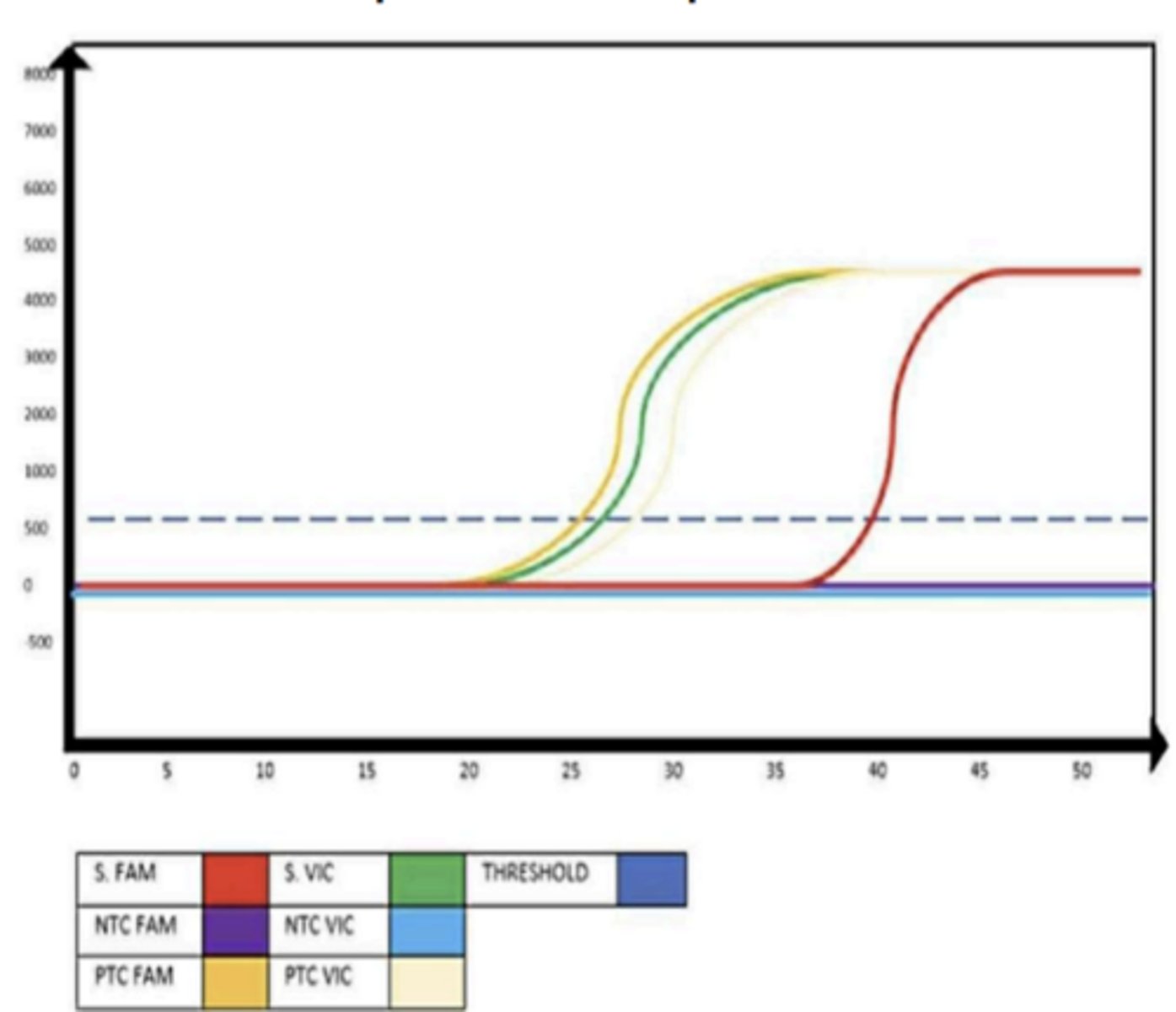
The baseline setting for the auto threshold in the provided protocol
Cycles 3 to 15
VIC/HEX: <35
FAM: <37
Sample interpretation: positive/negative/invalid
QC run interpretation: pass/fail
1. Interpret sample run
2. What phase in PCR is affected by instrument sensitivity?
1. Negative
2. Baseline
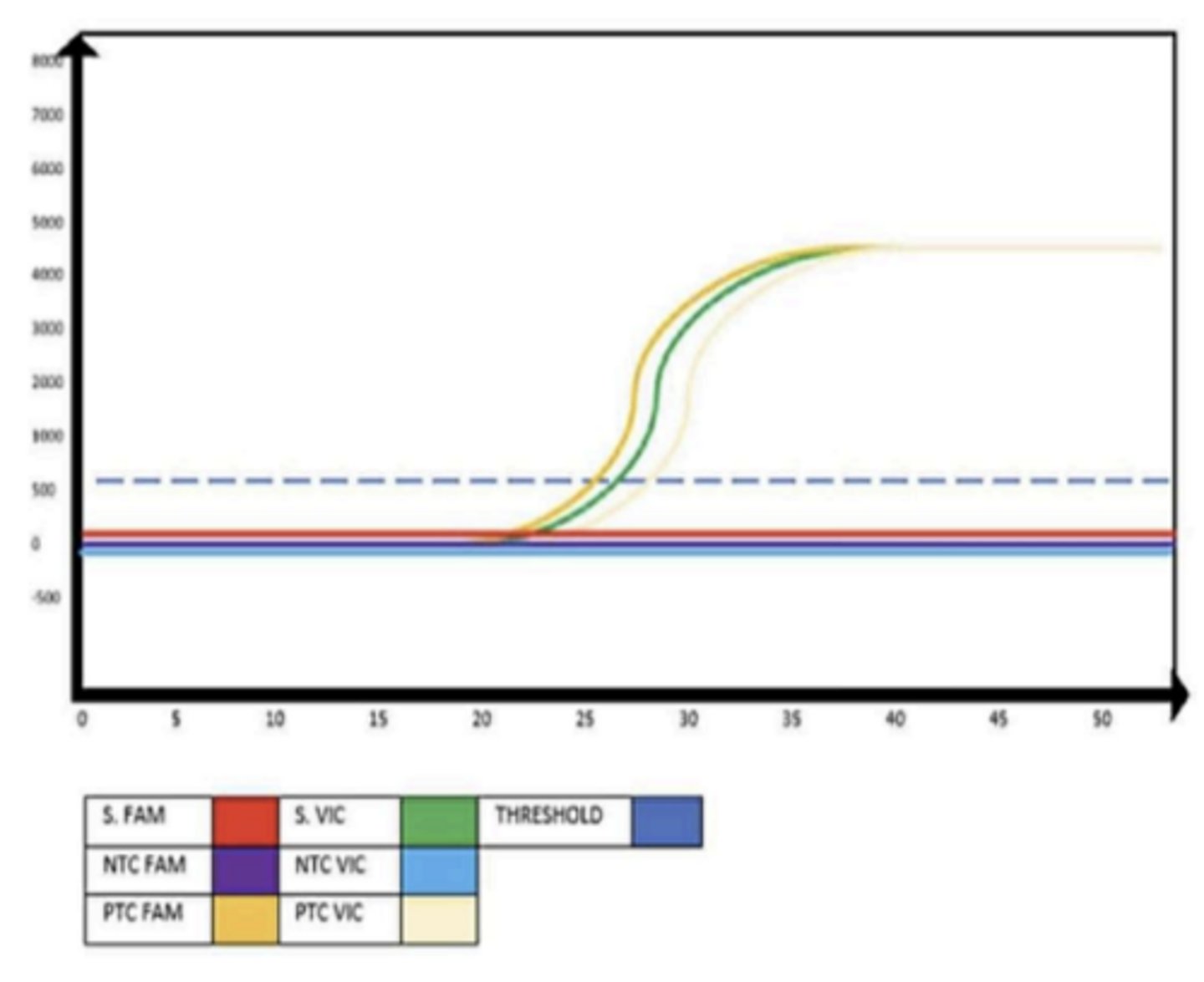
VIC/HEX: <35
FAM: <37
Sample interpretation: positive/negative/invalid
QC run interpretation: pass/fail
1. Identify phase pointed.
2. Interpret QC run
1. Plateau phase
2. Pass
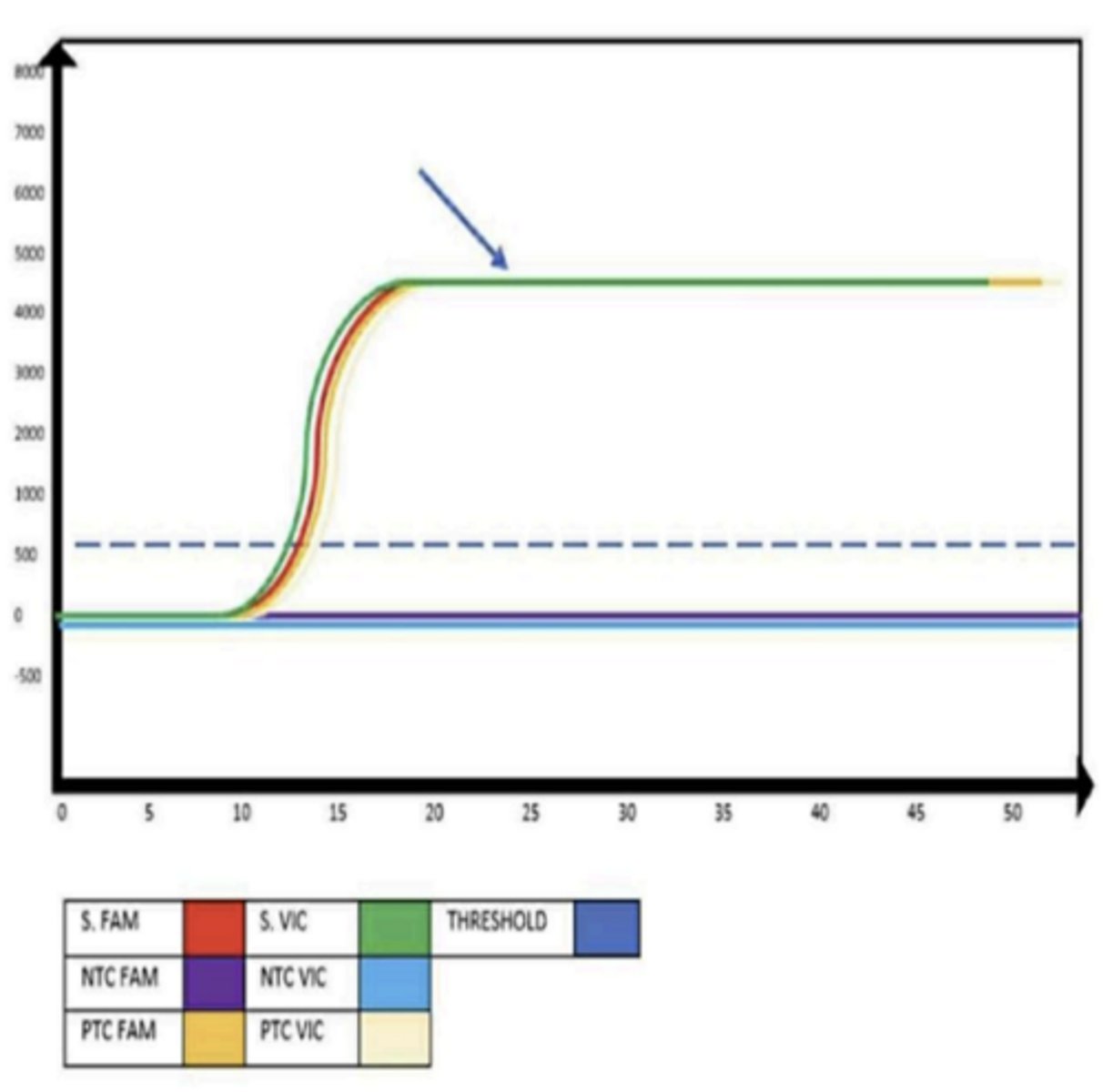
VIC/HEX: <35
FAM: <37
Sample interpretation: positive/negative/invalid
QC run interpretation: pass/fail
1. Interpret sample run
2. Interpret QC run
1. Positive
2. Pass
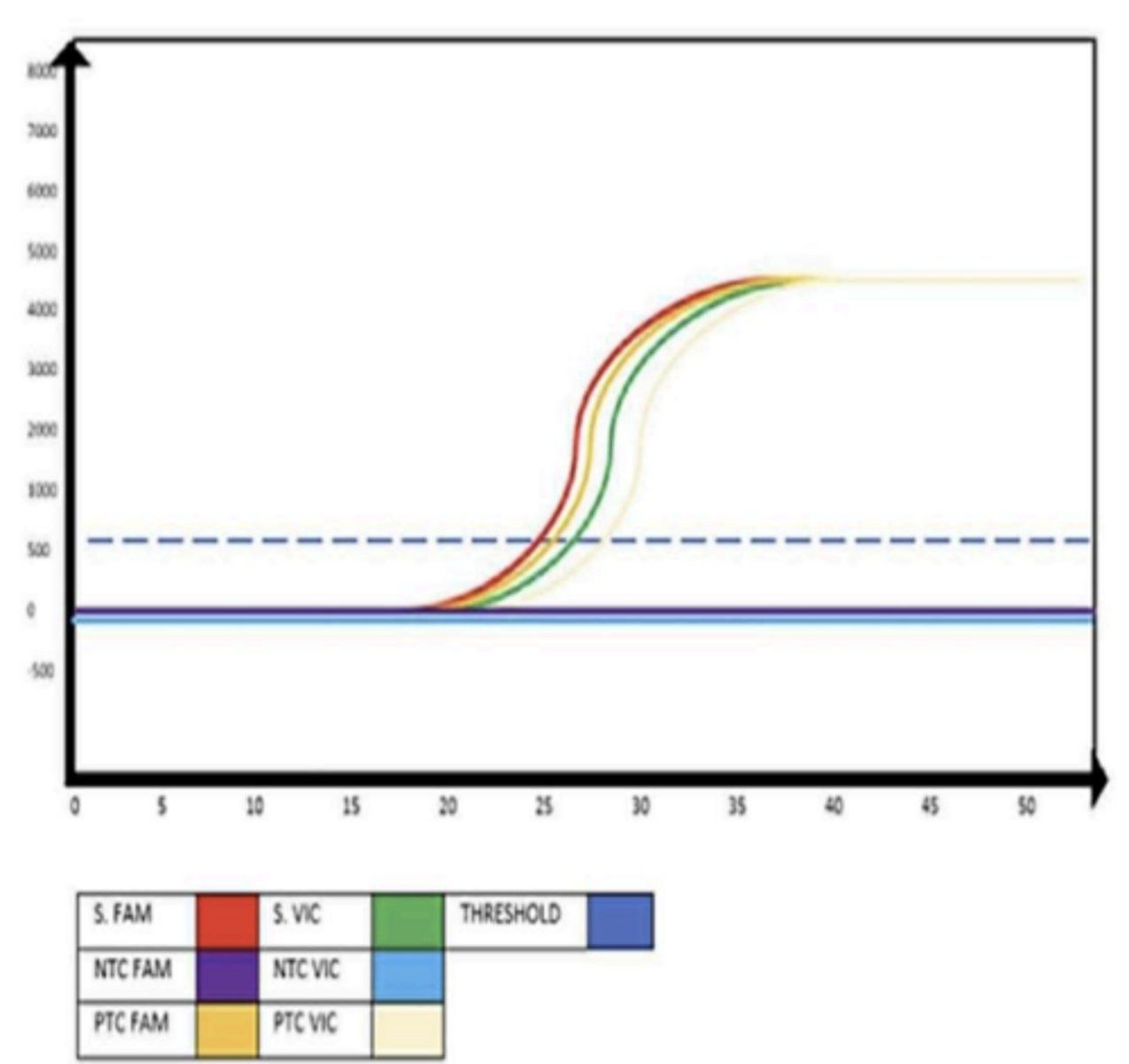
VIC/HEX: <35
FAM: <37
Sample interpretation: positive/negative/invalid
QC run interpretation: pass/fail
1. Interpret sample run
2. What consists of reagents for amplification, probes, primers for virus target and
internal references
1. Negative
2. Master Mix