Electrophysiology of Neurons - 11.3
 Call Kai
 Learn
Learn Practice Test
 Spaced Repetition
 Match
Match Flashcards
 Knowt Play
1/49

Earn XP
Description and Tags
a little bit of a review on electrophysiology from Unit 3 as well
Name | Mastery | Learn | Test | Matching | Spaced | Call with Kai |
|---|
No analytics yet
Send a link to your students to track their progress
50 Terms
Excitability (relative to neurons)
all neurons are responsive in the presence of various stimuli:
chemical signals, local electrical signals, and mechanical deformation
What is conductivity?
stimuli generate electrical changes (action potentials) and are conducted/spread throughout the whole membrane
What are the 2 forms of electrical changes that occur in neurons?
Local Potentials: electrical changes across a neuron’s plasma membrane that travel only short distances
Action Potentials: electrical changes that travel the entire length of an axon
Electrophysiology
the study of electrical changes across the plasma membrane and the accompanying physiological processes
resting membrane potential (RMP)
charge difference across a plasma membrane caused by unequal distributions of ions on either sides of the plasma membrane
(-) inside the membrane
(+) outside the membrane
What is voltage and how is it established?
separation of charges, which forms an electrical gradient
Membrane potential?
the electrical gradient (voltage difference) across the plasma membrane, which is a source of potential energy
What is the resting membrane potential of a neuron?
-70 mV
When is a cell polarized?
when the membrane potential is not at 0 mV. it can either be positive or negative
Ion concentration gradients favor the diffusion of potassium (K+) ions __ of the cell through leak channels and sodium (Na+) ions _ the cell
out, in
potassium is the only one that goes outside of the cell
What are electrochemical gradients and what does it determine?
concentration and electrical gradients collectively
determines direction of diffusion of an ion across the membrane
How is RMP generated?
a cell starts with a negative RMP
there is an unequal distribution of ions across the plasma membrane, Na+, K+, Cl, and Ca, which cause gradients
gradients are also maintained by the Na+/K+ ATPase pump
*big idea: Pumps and the combination of unequal distributions of ions create RMP*
Na+/K+ pump
requires ATP, primary active transport
makes sure more Na+ is outside and more K+ is inside
Local Potentials (graded)
small changes in the membrane potential of a neuron’s plasma membrane that may have caused either depolarization or hyperpolarization
Why are local potentials called graded potentials?
they can vary in size; some produce larger change in MP than others
The degree of the change in MP depends on:
length of stimulation
# of ion channels open
type of ion channels open
What does it mean when local potentials are reversible?
when the stimulus that caused the ion channels to open stops, the neuron quickly returns to its RMP
What does it mean when local potentials are decremental?
local potentials weaken over long distances
changes in MP caused by local potentials are small and lost across the membrane over distance as they travel away from the site of stimulation
Action Potential
uniform, rapid depolarization and repolarization of the membrane potential of a cell
these changes in MP causes a response or action
What can trigger action potentials and local potentials?
AP’s: only axons
LP’s: dendrites and soma
Action Potentials are only generated in trigger zones that include:
axon hillock
node of ranvier (myelin sheath gap)
initial segment of axon
Voltage-gated K+ channels have two possible states:
resting (closed)
activated (open)
Voltage-gated Na+ channels have two gates; an activation gate and an inactivation gate along with three states:
Resting: inactivation gate open, activation gate closed
Activated: BOTH inactivation and activation gates open
Inactivated: inactivation gate closed, activation gate open
Depolarization phase
the membrane potential rises towards 0 and becomes briefly positive
Repolarization phase
the membrane returns to a negative value and approaches RMP, but does not settle at RMP
Hyperpolarization phase
the MP temporarily becomes more negative than the RMP during this phase
What mV is threshold at?
usually at -55 mV
What are the steps for action potential?
A local potential must be able to depolarize the axon to reach threshold (-55 mV)
Once threshold is reached, voltage-gated Na+ channels activate and Na+ ions are able to flow into the axon causing it to depolarize
Na+ ion channels inactivate and voltage-gated K+ ion channels activate. Na+ ions stop flowing into the axon and K+ begins exiting the axon as repolarization begins
The axolemma may hyperpolarize before potassium ion channels return to the resting state; after this, the axolemma returns to its RMP
Big Idea:
*Sodium channels = depolarization*
*Potassium channels = repolarization*
What is the Refractory Period?
period of time, after a neuron has already generated an AP, when the neuron cannot produce another AP, and the membrane cannot be stimulated to fire another one
What are the 2 phases of the refractory period?
Absolute Refractory Period
Relative Refractory Period
What is the absolute refractory period?
no additional stimulus, no matter how strong, can produce another AP
occurs during the period when the voltage-gated Na+ channels are activated and inactivated
cannot occur so long as an AP is in motion
What is the relative refractory period?
only a strong stimulus will produce an action potential
occurs when voltage-gated Na+ channels return to resting state (inactivated gate), despite voltage-gated K+ channels being open
a stronger stimulus is required to stimulate another AP at this point because the MP is hyperpolarized
What is the all-or-none principle?
an event can either happen completely or not at all
when applied to action potentials, if the neuron cannot depolarize the axolemma to a certain threshold, the action potential does not occur
Graded vs Action Potentials
Change
graded - variable change
action - maximum depolarization change to +30 mV
Reversible
graded - reversible; neuron returns to RMP when stimulus ends
action - irreversible; all or nothing principle
Distance Traveled
graded - decremental
action - nondecremental
Propagation
an AP must be conducted or propagated along the entire length of the axon to serve as a long-distance signaling service
Current
a flow of charged particles (ions) created by the propagation of an AP across the axon
An action potential is _ and travels in one direction at a constant speed from the trigger zone to the axon terminals
Self propagating
Events of Propagation down the axon
Depolarizing current from an AP propagates through a section of the axolemma
The depolarizing current triggers adjacent voltage-gated Na+ ions to open, firing another AP. the previously depolarized section of the membrane repolarizes and is refractory
This process repeats as the next section of the axolemma depolarizes to threshold and fires an AP, and the previous section repolarizes
The current propagates down the axon until the axon terminal is reached
Big Idea: AP’s continue to propagate down the axon by the continuous triggering of depolarization down the membrane, generating more AP’s
Why can’t AP’s go in both directions?
because of the refractory period
voltage-gated Na+ ions are activated
Conduction speed
the rate of propagation that is influenced by both the axon diameter and the presence/absence of myelination
Diameter of the axon in conduction speed
larger diameter: faster conduction speed, less resistance to conduction of the current
Presence/Absence of Myelin Sheath relative to conduction speed, what are the 2 types?
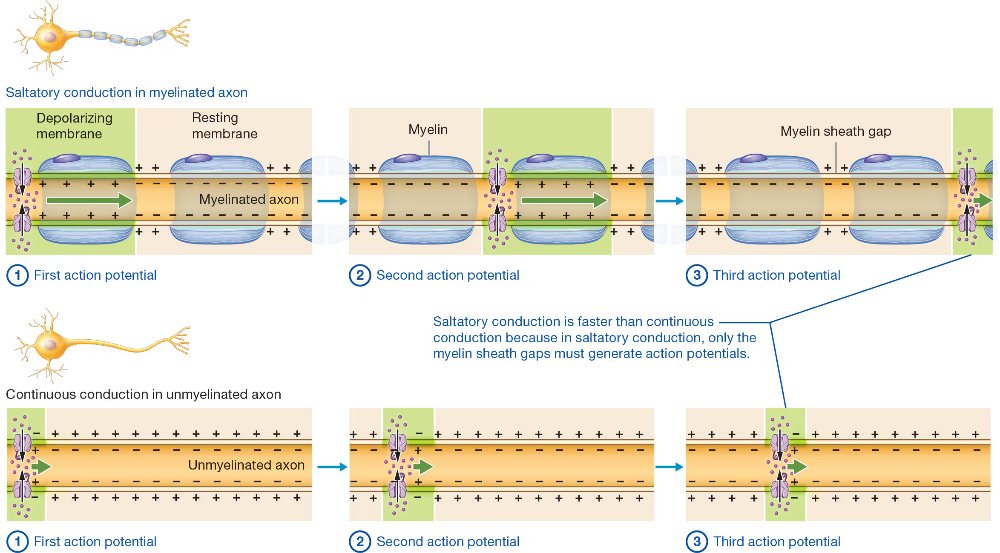
Saltatory Conduction
Continuous Propagation (Conduction)
What is Saltatory Conduction?
Myelin Sheath is present
myelin acts as an insulator of electrical charges, creating a more efficient flow of the current, resulting in faster conduction speeds
myelin being an insulator means that it prevents currents from leaking out through the axolemma
Big idea: myelin present, insulation provided, signal decreases in strength very little because it travels through internodes
What are the steps of Saltatory Conduction?
The myelin sheath gaps are the only unmyelinated segments that must be depolarized to threshold
When the gap is depolarized via voltage-gated Na+ ion channels, an AP is triggered
The AP generates a current that flows passively with little loss of charge through the myelinated segment (internode)
When the current reaches the next myelin sheath gap, another AP is generated
This cycle repeats down the entire axon
The current potential jumps from one gap to the next
What is Continuous Propagation (conduction)
Myelin sheath is absent
each section of the axolemma must be depolarized to threshold
AP’s must be generated in a continuous sequence along the entire axolemma for the current to spread down the axon
the axolemma is very leaky with respect to current, so the current flows easily from the axoplasm out to the ECF
Big Idea: myelin present, continuous firing of AP’s, signal loses strength as it travels through the axon
Big Idea: Saltatory conduction has a more faster and efficient propagation than continuous conduction because it has a myelinated axon and continuous conduction doesn’t have an axon
N/A
How are Axon fibers classified and what are the 3 types?
classified by their diameter and myelin sheath
3 types are:
Type A fibers
Type B fibers
Type C fibers
What are Type A fibers?
largest diameters (5-20 micro meters)
myelinated
fast → ~250mph
found in parts of body where CNS must communicate rapidly: certain sensory axons from joints or fibers, as well as motor axons to skeletal muscles
What are Type B fibers?
intermediate diameter (2-3 micro meters)
myelinated/unmyelinated (mostly myelinated)
~32 mph
includes certain efferent fibers of the autonomic NS and certain sensory axons coming from organs
What are Type C fibers?
smallest diameter (0.5-1.5 micro meters)
slowest fiber - ~1-5 mph
unmyelinated
includes other efferent fibers of the autonomic NS and sensory axons that transmit pain, temp, and certain pressure sensations