Chpt 12: Exercise & Cognition in Children
 Call Kai
 Learn
Learn Practice Test
 Spaced Repetition
 Match
Match Flashcards
 Knowt Play
1/40

There's no tags or description
Looks like no tags are added yet.
Name | Mastery | Learn | Test | Matching | Spaced | Call with Kai |
|---|
No analytics yet
Send a link to your students to track their progress
41 Terms
Chronic effects (fitness)
appear early in processing (~10 yrs old)
Improvements in performance
Changes in ERP (P1, P300, ERN, CNV)
Morphological changes (BG, HC, white matter integrity)
Chronic effects (fitness) - Performance
Oddball task: faster, > accurate (engagement) - P300
Flanker: Nominally faster, > accuracy (< difficulty inhibitiing pre-potent) - P300, ERN
Chronic effects (fitness) - ERP components
> P300 amp: engagement
> ERN + P300: > efficient cog strategies during effortful tasks (> performance)
> P1 amp: early - parietal; V1 activity; modulated by attn (visual)
> CNV amp: better task preparation
Morphological Changes - Basal ganglia
> volume in caudate, putamen (dorsal striatum), globus pallidus
Less interference (< incongruent trial rxn time & accuracy)
Putamen volume - correlated w/ rxn time (> volume, < rxn time - > performance)
Putame: cogntiive control, rxn resolution
Morphological Changes -HC
Item/relational memory (which go together; which were seen)
d’ (sensitivity) = ability to differentiate btwn things that went tg or not
Nominally better performance, > HC volume
For > difficult task (relational mem): HC vol correlate w/ performance
Exercise impacts memory thru HC (volume)
Fractional Anisotropy - White matter integrity
Proportion of hoz H20 diffusion vs vertical (should be hoz)
Occurs in tightly bunded, structurally compact fibres w/ > integrity
Morphological Changes - White matter Integrity
> directionality of H20 diffusion (hoz)
Performance correlated w/ FA (fractional anisotropy)
High FA = > accuracy (> insulative integrity, > connectivity)
High FA = < interference (faster rxn tiime during incongruent)
Effect beyond lab tests
Correlated to results of lab tests (NO-GO - > P300 amp, > academic performance)
> P300 amplitude: > cog demand (WM, attention)
> reading performance, > P300
> arithmetic performance, > P300
Acute effects in children
Larger P300 after exercise
< RT overall, < interference (incogruent rxn time)
Nominal but x sig > improvements in spelling/arithmetic
Sig > in reading comprehension score
Acute effects - Improvement for low performers
More room for improvement
< interference, > accuracy on No-GO task
N2 (rxn Inhibition, error monitoring): Resembled > performance at rest (< amp)
P300 (engagement): > amp (more than > performers)
Neural development - synapses
# synapses > until age 4
Up to 42% synapses eliminated after that
Use it or lose it (active = strong, inactive = pruned)
Neural development - Pruning
Synapse formation: > from gestation → 2 years old
Synapse pruning: 4 years → 6 years & onward
Neural development - Myelination
Spinal cord (24 wk after conception)
Hindbrain
Midbrain
Forebrain (adolescence/early adulthoold) - 25 yrs
Development of cognitive & emotional control
Self-regulation: moving to goal state
Regulation: with conflict (little conflict stops here)
Control
Self-control: HOT EF
Cognitive control: Cool EF
Conflict
Hot EF → conflict = goals
Cool EF - conflict = cognitive/motor processes
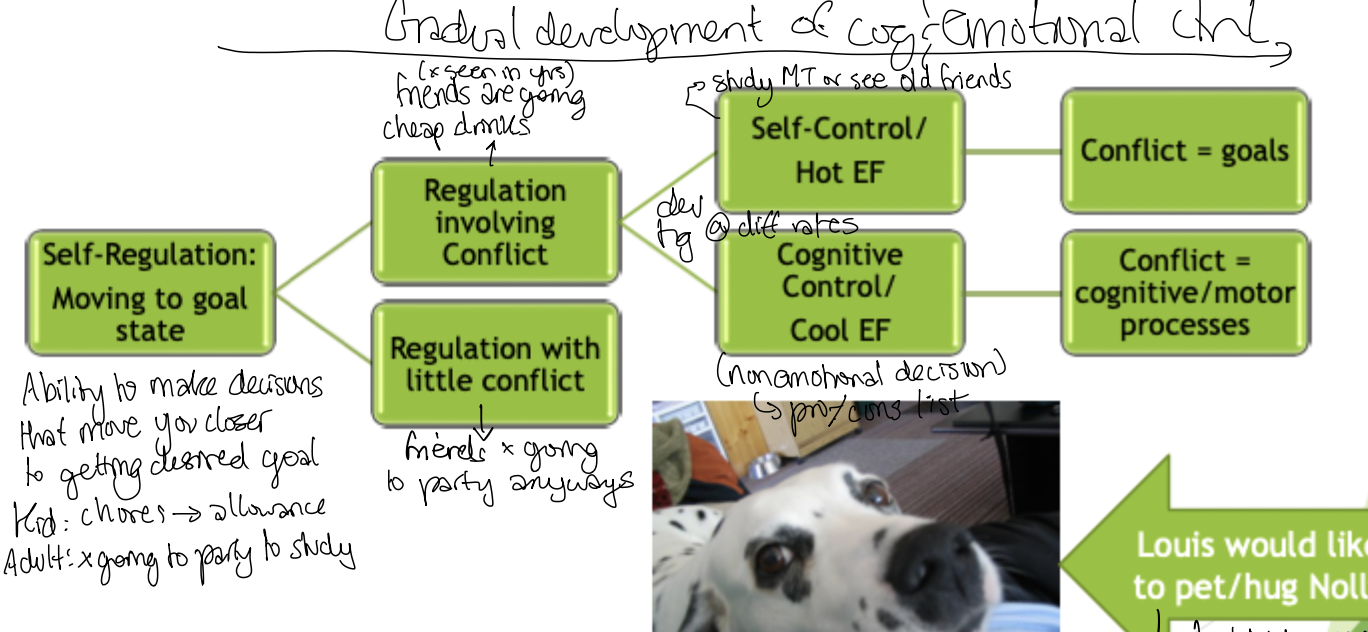
Hot Executive Function
Conflict is motivation/emtion
Knowing how you feel
Representations for rewards/losses over time
Making good decisions (consequences)
Delay for a larger reward (1 cookie now, 2 later)
Cool Executive Function
Conflict is behavioural/thoughts (pros vs cons list)
Working memory
inhibition (stroop, flanker)
Flexibility to changing rules (WCST)
Cerebellum - Inputs
Small powerhouse (10% mass, 50% neurons)
Multiple inputs:
Motor cx (what body is doing)
Brainstem motor nuclei (sent to muscles for movement)
Somatosensory/vestibular sys (where body is in space; balance)
Midbrain
Limbic sys (memory/emotional ctrl)
Dmg causes issues w/ cog/emotional control
Cerebellum - Lobes
Anterior: muscle tone, coordination of skilled movements
Posterior: planning of voluntary activity (EF)
FN lobe: balance, movement ctrl
Cerebellum - Roles
Fine-tuned motor coordination (ctrls force, amplitude, velocity)
General timing mechanism for sensorimotor & cog processes
More active during demanding/novel tasks
Along w/ acitivty in PFC
Cerebellar Cognitive affective syndrome (CCAS) - difficulties
Executive: planning, shifting, WM, abstract reasoning (like frontal lobe dmg)
Spatial: visuo-spatial org, memory
Personality: blunt affect, disinhibition (inappropriate behavi)
Language: agrammatism, aprosodia (rhythm = off)
Exercise & the cerebellum
Increased gray matter
Increased BDNF
Basal Ganglia - Anatomy
Caudete (D1 & D2 DA receptors - signal:noise ratio; receive from SN)
Putamen
Globus pallidus
Basal Ganglia - Function
Control of voluntary movement
Motor learning
Implicit learning
Basal Ganglia - Tracts
Mesolimbic tract: reward/memory
Nigrostriatal tract: movement
Mesocortical tract: organization
Tuberoinfundibular tract: hormone release
BG - Probabalistic Learning
Learning from outcomes of multiple trials
Learn about probabilities (correctly predict outcome)
Relies on striatum
Weather Prediction Study
Probabalistic: Ctr & HC patients are able to learn abt probablities (predict outcome)
BG is intact (Parkinsons didn’t do well)
Declarative: Ctlr & Parkinson’s could report facts abt the task
HC is intact
Engaging the Cerebellum & BG w/ Exercise (coordinated vs cardio)
Coordinated exercise vs cardio exercise (to same %HR)
Coordination > performance more than cardio (d dash & immediate/delayed recall)
> cognitively demanding activity leads to better outcome)
Through recruitment of cerebellum & BG
Engaging the Cerebellum & BG w/ Exercise - Mechanism
Enriched exercise serves as stressor
Coordination exercise engages neural circuitry responsible for motor/cog coordination
Engaging physical activities recruit cogntiive function (theory of mind)
Cortisol
Cortisol receptors in neocortex, cerebellum, HC
Mineralocorticoid: acitivated at moderate intensities
Glucocorticoid: activated at high intensities
Glucocorticoid: < binding affiinity, req > intensity exerice (> [cortisol])
Cortisol (HPA Axis) - Moderate Increase
Supports LTP (new connections, > NT released at synapse)
Impacts cognitive performance (EF, learning/mem, men consolidation)
Mineralocorticoid = activated
Cortisol (HPA Axis) - High Increase
Generates LTD (degrades connections, < NT released at synapse)
Impacts cognitive performance
Glucocorticoid = activated
Hormonal Dev - Cortisol Threshold/Stress rxn
Adults:
Need > intensity exercise (>80% VO2max)
Mod intensity (40-80%) for at least 50 mins
Teens (14-16):
Similar threshold (most have gone thru puberty)
Younger children:
Stress rxn & cortisol threshold differs
Puberty
Chronological age x perfectly align w/ puberty stage
Pubic hair development
Testicular volume)
Generally x pre-pubescent (P1/P2) at 15-16 yr old)
Gradual change
Hormonal Dev - Cortisol
Baseline cortisol lvls correlated w/ chronological age & puberty stage
< baseline for younger children/pre-pub
Cortisol lvl > after exercise
Effect is greater for younger children (> room for improvement)
Cortisol - Fitness & Developmental stage
Cortisol > dep on BOTH fitness & dev stage
Pubescent = increase
Pre-pub = > if high fit
Hormonal Dev - Testosterone
Baseline T lvls correlated w/ age & puberty stage
T > after exercise (greater for younger children)
Testosterone - Fitness
Fit: exercise > T lvls (> active you are, > reactive the body is to a single bout of exercise)
Low-activity: < T w/ exercise
Testosterone - Intensity
> intensity, > lvls of T
Testosterone - Performance
For low performers: sig > WM performance w/ > intensity
High performers: slight improvement w/ mod; decline w/ low/high
Lowest verbal fluency scores had highest T
Suggests an optimal lvl of T for performance
T - Androgen Receptors in cytoplasm
Found in PFC (EF) & HC (memory
T binding to androgen R upregulates mRNA transcription/translation
Improved Cognition - Mechanism
Exercise > testosterone
> T binding to androgen Receptors
Triggers mRNA upregulation
Increases synapses & # dendritic spines
Improves cognition (through improved neural communication)