Bio80H Midterm 2
 Call Kai
 Learn
Learn Practice Test
 Spaced Repetition
 Match
Match Flashcards
 Knowt Play
1/179

There's no tags or description
Looks like no tags are added yet.
Name | Mastery | Learn | Test | Matching | Spaced | Call with Kai |
|---|
No analytics yet
Send a link to your students to track their progress
180 Terms
Evidence of Algal Ancestry in Plants
Multicellular
Eukaryotic
Photosynthesis
Cellulose Walls
Certain chlorophyll
Closest relative: Charophytes (Have circular protein rings that synthesize cellulose)
Sporopollenin
Layer of durable polymer that prevents drying, can be found in plant spores
Pros and Cons of Colonizing Land
Pros:
Unfiltered sunlight
CO2 abundance in the air vs in water
Mineral rich soil
Cons:
Lack of water on surface
Lack of structural support to combat gravity
Unique Plant Traits (Distinguishes from Charophytes)
Alternation of generations
Multicellular, dependent embryos
Walled spores made in sporangia
Apical meristem
Alternation of Generations
A life cycle that alternates between the diploid sporophyte and haploid gametophyte generation. Found in all plants
Gametophyte
Production by mitosis of haploid gametes
Sporophytes
Haploid gametes fuse and mitotically divide
Spores
Haploid, produced by meiosis in a sporophyte from the sporangium, mitotically divides to form a gametophyte
Placental Transfer Cells
Increase transfer rate of nutrients by increasing surface area via ingrowth of walls, found in developing reproductive organs.
Embryophytes
Common name given to plants for their multicellular, dependent embryos
Explain “Walled spores produced in sporangia”
Sporocytes divide via meiosis in the sporangia to produce spores, which are protected by sporopollenin
Apical Meristem
Localized regions of cell division at the tips of roots and shoots
Plant epidermis
Single-tissue layer covering leaves, stems, roots, flowers, etc to protect from sunlight, water, dehydration, and pathogens
Cuticle
Wax and polymer based layer secreted by the epidermis, helps retention of water and protection
Stomata
Pores on plants that help with the exchange of O2 and CO2, helps in photosynthesis and water evaporation
Bryophytes
Nonvascular plants, consists of:
Phylum Heptophyta (Liverworts)
Phylum Bryophyta (Mosses)
Phylum Anthocerophyta (Hornworts)
Seedless Vascular Plants
Phylum Lycophyta (Lycophytes)
Phylum Monilophyta (Monilophytes)
Gymnosperms
Seeds not enclosed in chambers, consists of:
Phylum Ginkophyta (Ginkgo)
Phylum Cycadophyta (Cycads)
Phylum Gnetophyta (Gnetophytes)
Phylum Coniferophyta (Conifers)
Angiosperms
Flowering plants, consists of:
Phylum Anthophyta (Flowering plants)
Vascular tissue
Specialized cells joined into tubes to transport water and nutrients from the roots to various parts of the plant
Bryophyte Life Cycle
Spore becomes a protonema
Protonema grows “buds“ that divide mitotically to form the gametophytes (Antheridia and Archegonia)
After the antheridia releases the flagellated sperm, they travel via chemotaxis to the archegonium in water
Embryo stays inside the archegonia while placental cells bring nutrients
Sporophyte remains attached to the gametophyte as it grows, being feed sugars, amino acids, minerals, and waters (despite plastids)
The peristome opens in dry conditions and closes in wet conditions so the spores discharge gradually through the wind
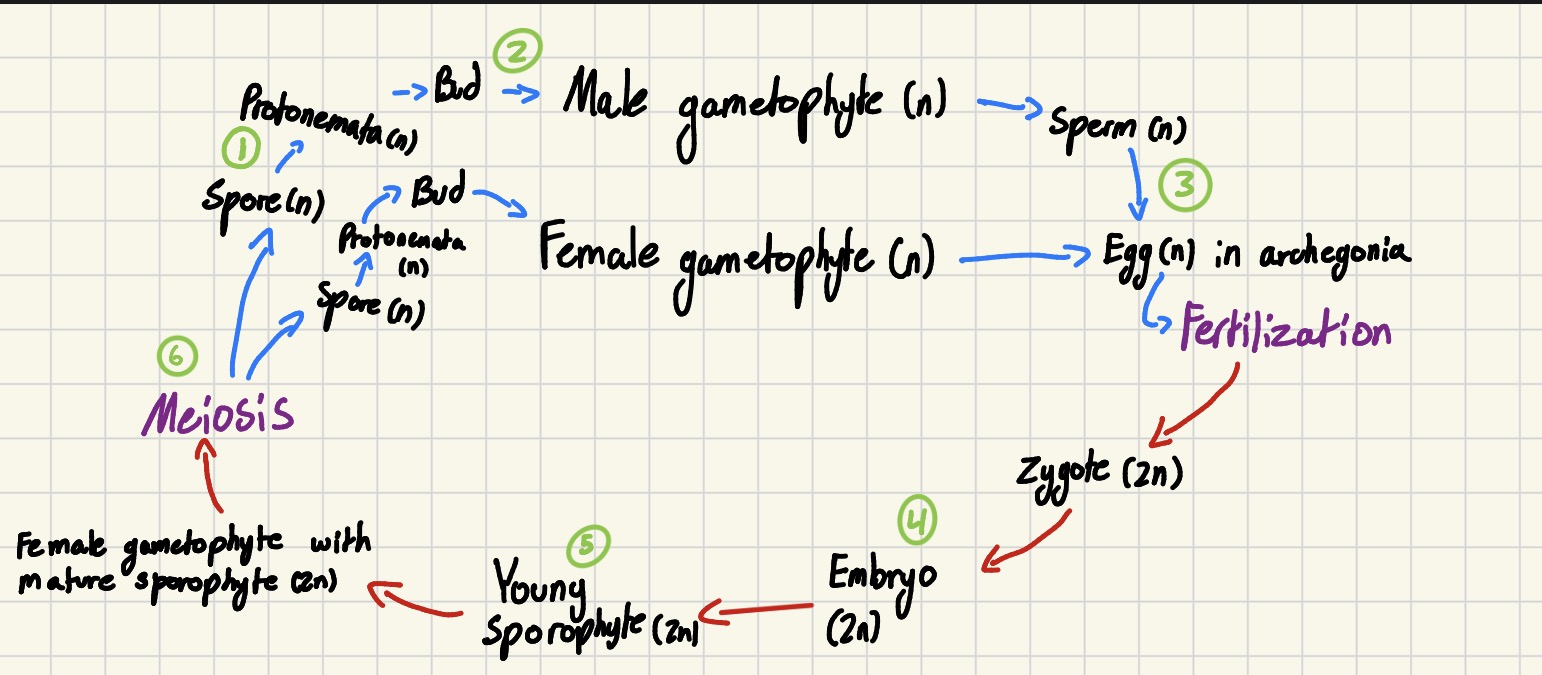
Protonema
One-cell branched thick filament that increases water absorption
Rhizoid
Root-like structures that anchor the gametophytes to the ground, do not absorb water or minerals
Gametangia
Multicellular structures on the gametophyte that produce gametes mitotically
Antheridia
Male gametangia, produces many sperm
Archegonia
Female gametangia, produces one egg
Chemotaxis
Process in which archegonia release chemicals to guide sperm to the egg
Parts of a Sporophyte
Foot
Seta (Stalk)
Capsule (Sporangium)
Peristome
Foot
Absorbs nutrients from gametophyte
Seta (stalk)
Conducts materials to sporangium, can elongate to improve elevation level
Capsule (sporangium)
Produces spores via meiosis
Peristome
Upper part of capsule with interlocked structures
Peat
Decayed matter of sphagnum, slow decaying helps preserve corpses and has low temp, pH, and O2 levels. Used as fuel source or soil conditioner occasionally.
Main characteristics of vascular plants
Dominant Sporophyte
Transport through Xylem and Phloem
Well developed leaves and roots, including sporophylls
Xylem
Conducts water and minerals from roots up
Tracheids
Tube-shaped cells carrying minerals up the roots, xylem of all vascular plants
Lignin
Strengthens cell was via lignification of water-conducting cells (dead at functional maturity)
Phloem
Cells arranged in a tube to distribute amino acids, sugars, and other organic products (alive at functional maturity)
Vascular Seedless Plant Life Cycles
Spore released that will, in most of this group, produce a bisexual photosynthetic gametophyte
Each gametophyte creates antheridia and archegonia structures (Each mature at different times to prevent self-pollination)
Flagellated sperm swim to egg via chemotaxis
Zygotę grows out of archegonium and develops into sporophyte
Sporophyte creates sporophylls, which have sori on the underside, with each sorus have several sporangia
Sporangia undergoes meiosis and produces spores
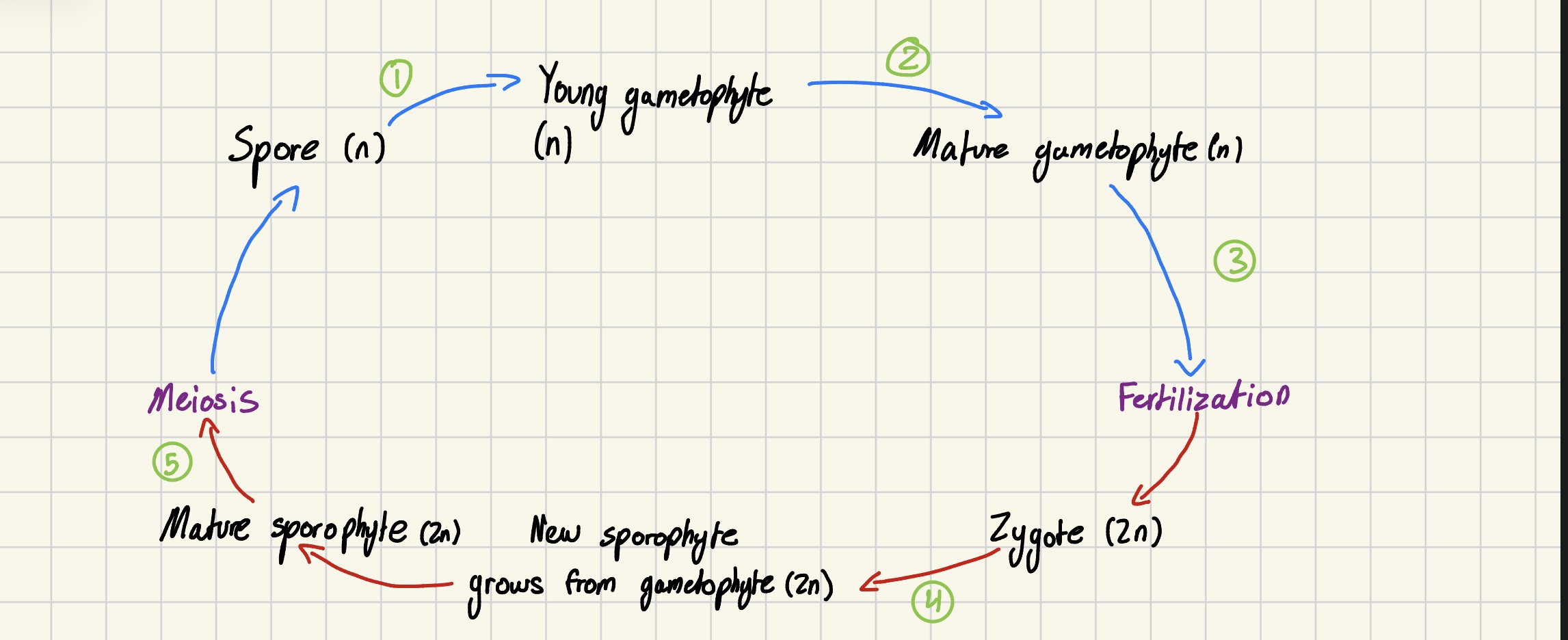
Homosporous
1 type of sporophyll, 1 sporangium, creates a bisexual gametophyte with both sperm and egg
Heterosporous
2 type of sporophyte which create different sporangium, create different gametophytes with one having egg and one having sperm
Megaspore
Spores from heterosporous plants that become female gametophytes from a megasporangium on a megasporophyll
Microspore
Spores from heterosporous plants that become male gametophytes from a microsporangium on a microsporophyll
Sporophylls
Genetically modified leaves for sexual reproduction
Sporangia
Capsule that produces spores via meiosis of sporocytes
Sori
Clusters of sporangia on the underside of sporophylls
Strobili
Clusters of sporophylls forming a cone-like structure
Roots
Organs that absorb water and nutrients from the soil and anchor plants
Microphylls
Small, spine-shaped structure supported by a singular strand of vascular tissue (Lycophytes only)
Megaphyllls
Heavily branched, more photosynthetic product
Epiphytes
Plants that use other plants as substrate but not parasitic (Done by lycophytes)
Seedless vascular plant importance
Early forests lead to large CO2 drops, which are now deposited in the ocean. Also lead to the creation of coal
Seed plant reductions
Gametophyte size
Can now grow in spores, preventing environmental stressors and letting sporophyte feed it
Heterospory
Ovules
Pollen
Lead to better cope with drought, UV, and water-dependency
Integument
Sporophyte produced, protects megasporangium. Eventually transforms into seed coat.
Ovule
Megasporanguim, megaspore, and integument.
Pollen grain
Microspore develops into a gametophyte, which is surrounded by the pollen wall produced by the sporophyte
Pollination
Pollen to ovule

Seed formation process in gymnosperm
The unfertilized ovule is surrounded by fleshy megasporangium and hard integument, with an opening known as the micropyle where the pollen grain enters
Ovule becomes a female gametophyte, by which time the pollen grain has formed a pollen tube to connect the pollen grain and transfer the sperm
Fertilization occurs and zygote is formed, with gametophyte tissue being the nutrient package for the zygote, the spore wall being megasporangium remnant, and the seed coat forming from the integument
Advantages of seeds and pollen
Pollen:
Can spread on dry land
Seeds:
Can remain dormant until favorable conditions are met
Have food to germinate
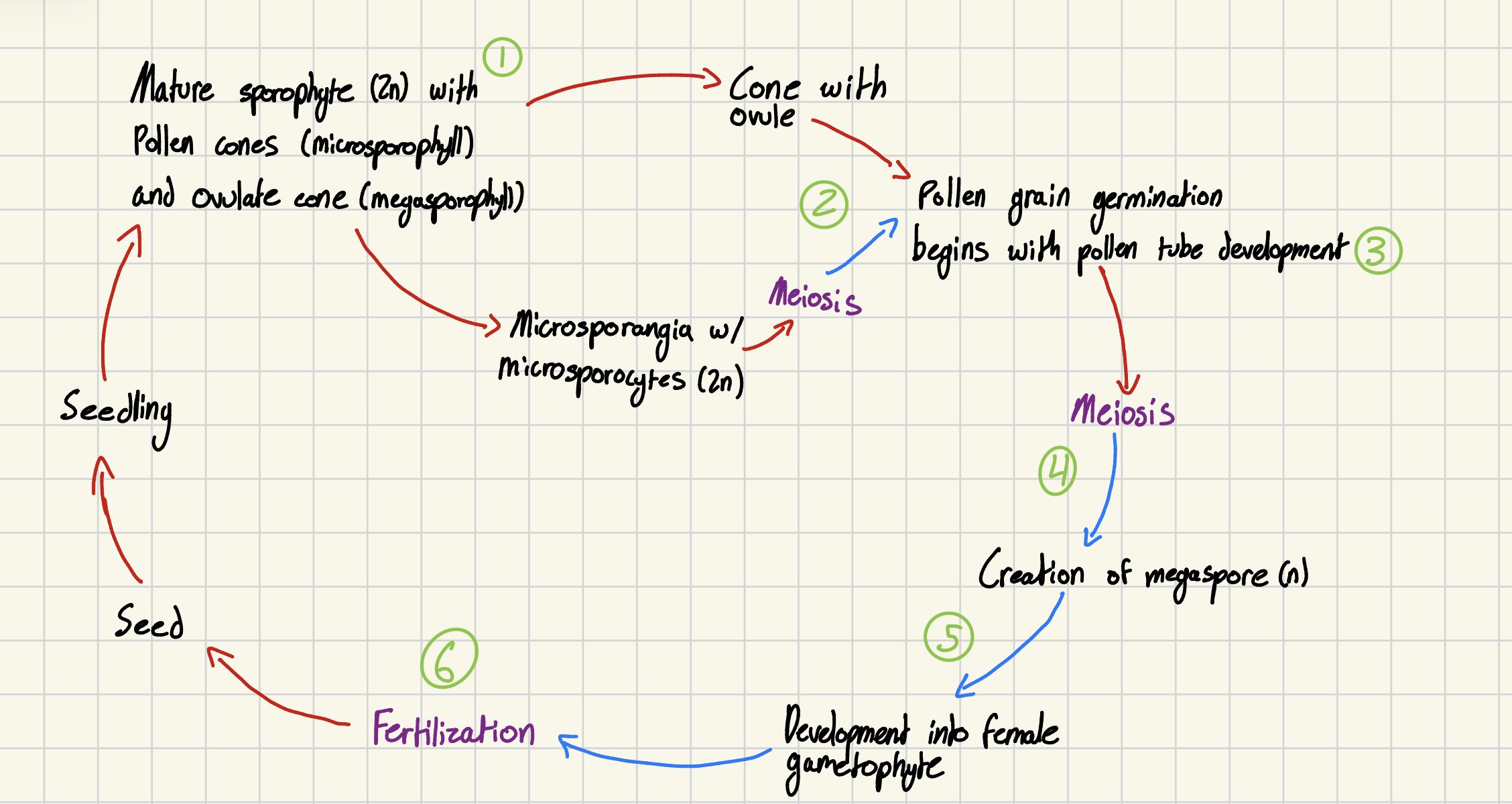
Gymnosperm lifecycle
Conifers (most gymnosperms) are heterosporous, thus producing microsporangium and megasporangium
Microsporocytes in the microsporangium are divided by meiosis to be placed in the pollen grain and released via the wind
Pollen reaches ovule and begins pollen tube development
Megasporocyte undergoes meiosis, 1 of the 4 daughter cells becomes a megaspore
The megaspore produces 2-3 archegonium
Once eggs have matured fertilization occurs, with only one egg turning into a zygote
Conifers
Cone-bearing plants (most gymnosperms)
Gymnosperm rise
As climates dried, lycophytes died and gumnosperms took over, with large SA leaves and thick cuticles
Parts of a flower
Stamen (male sexual reproductive organ (microsporophyll))
Filament: Stalk heightening the anther
Anther: Site of meiosis to produce microspores and pollen
Carpel (female sexual reproductive organ (megasporophyll))
Stigma: Sticky site of landing for pollen
Style: Tube connecting stigma and ovary
Ovary: Site of ovules who become female
Sterile organs
Petals: Used to attract pollinators
Sepal: Protect flower prior to bloom
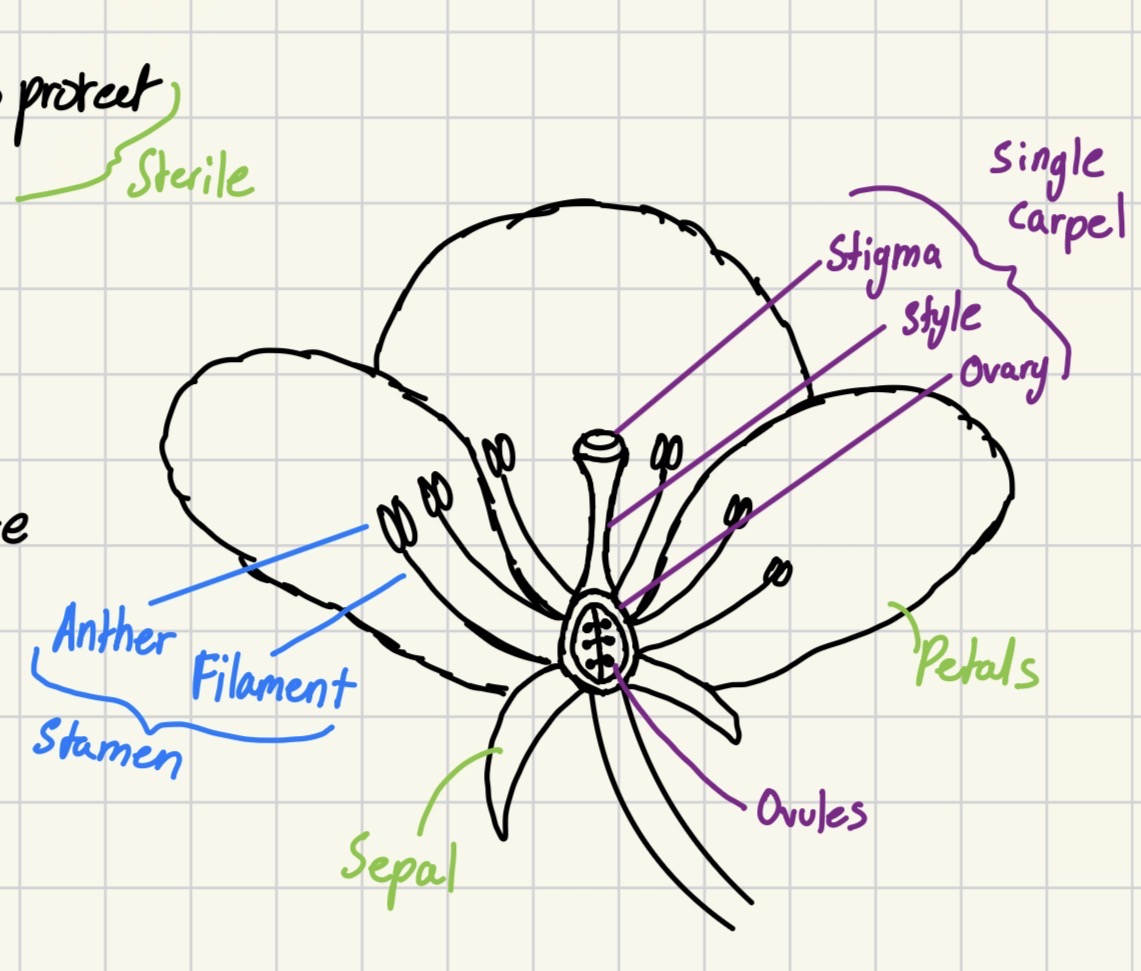
Simple pistol
1 carpel
Compound pistil
2+ fused carpel
Fruit
Ovary wall thickens and matures, creating pericarp protecting the seed(s)
Pericarp
Ripened wall of plant ovary protecting the seed
Methods of Dispersal
Parachutes via wind
Water
Animals (digestible or clings to fur)
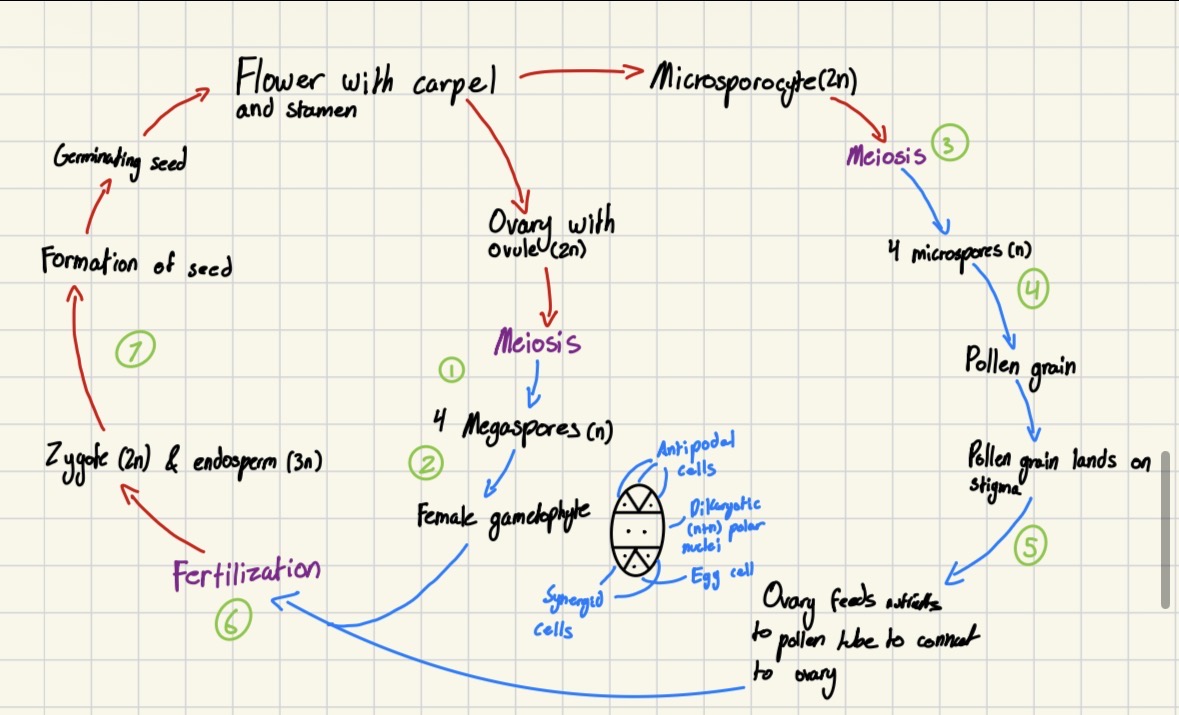
Angiosperm lifecycle
After meiosis in each ovule of the megasporocyte, 1 megaspore will survive
This megaspore will undergo 3 mitotic divisions and be sectioned into 7 parts (3 antipodal cells, 2 synergic cells, 1 egg cell, and 1 dikaryotic polar nuclei) which make up the embryo sac (female gametophyte)
Microsporocyte divides to form 4 microspores
Microspores become pollen grain with gametophytes generative cell breaking into two sperm
Pollen grain connects to stigma,
tube cell then produces pollen tube which is fed by the ovule through the style to ovule where both sperm are discharged at the micropyle
Double fertilization occurs to the central cell (now endosperm) and the egg cell (now a zygote) while the synergid and antipodal cells disintegrate
Egg forms zygote and central cell forms endosperm
Antipodal cells
Provide nourishment for embryo sac
Polar nuclei
Eukaryotic central cell
Synergid cell
Guides pollen tube to the egg
Egg cell
Cell that will be fertilized
Tube cell
Pollen grain produces this to guide sperm to egg
Endosperm
Tissue rich in starch and food to nourish embryo (3n)
Cotyledon
Seed leaves on embryo, has some food and depending on dicot/eudicot will help breakdown endosperm or absorb it
Bilateral symmetry
Symmetry down only one line
Radial Symmetry
Any line drawn through the middle is symmetrical
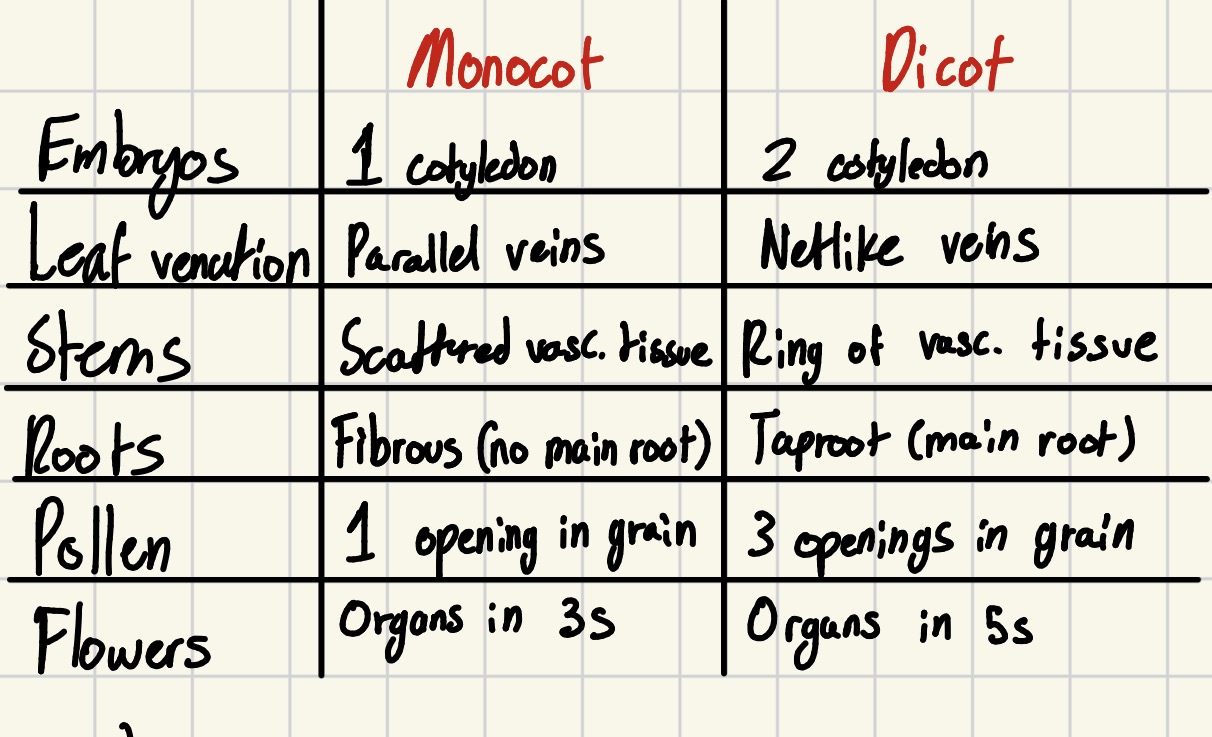
Monocots
Only have 1 cotyledon
Dicots
Have 2 cotyledon, but are a paraphyletic group so they are broken into three groups:
Eudicots: True dicots
Basal angiosperms
Magnolids
Monocot vs Dicot
Tissue
Group of 1 or more cells doing a specialized function
Organ
Several types of tissue that carry out a function
Vascular Plant Organs
Roots, leaves, stems
Basic Plant Structure
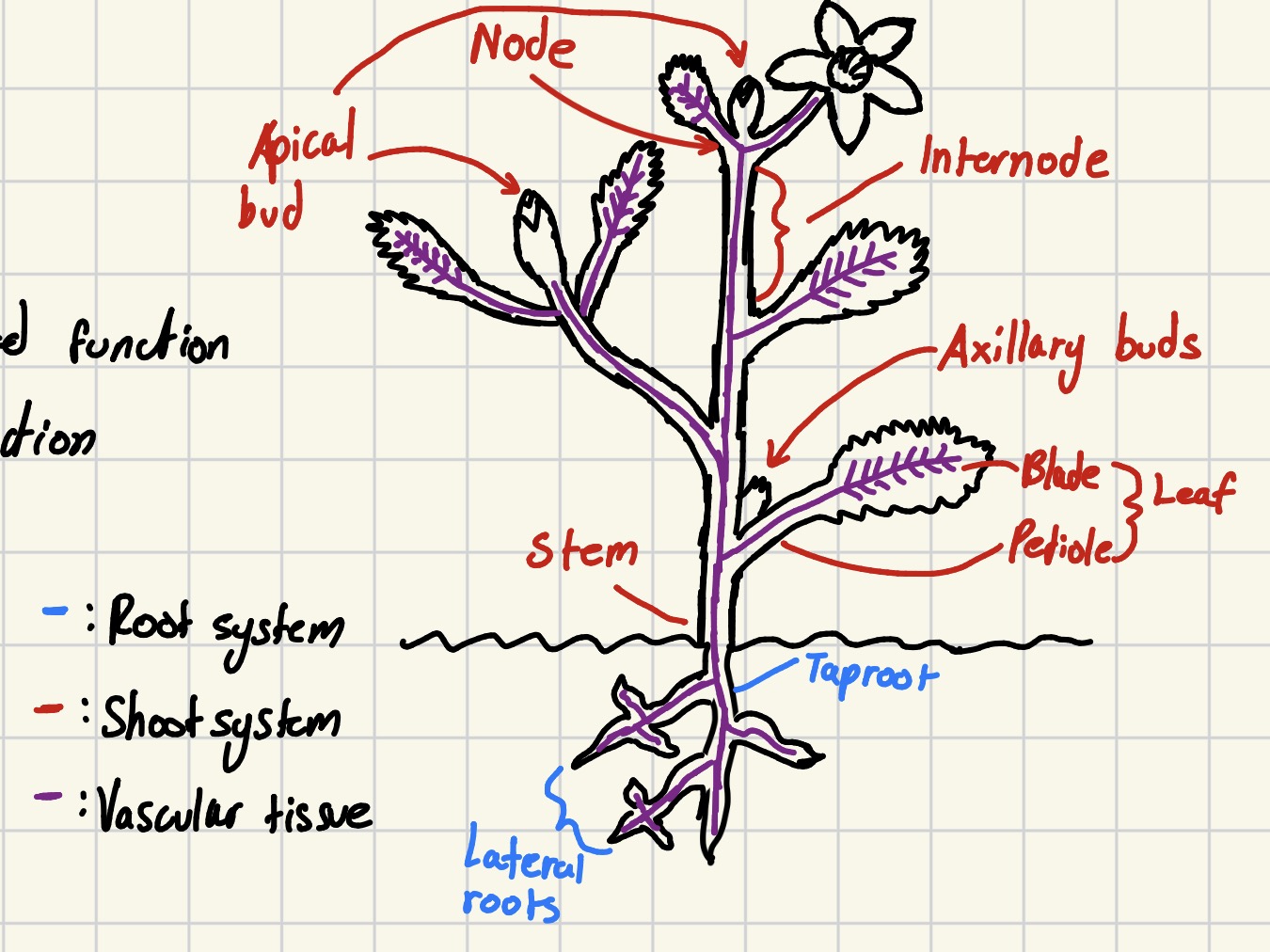
Primary Root
First root to form
Lateral Roots
Branching from primary
Taproot
Main vertical root, common in tall plants, mostly does anchorage while lateral shoots absorb nutrients. Can be used for food storage.
Fibrous Root System
Used by smaller vascular plants to make many roots with the death of primary root. Good at preventing soil erosion
Root hairs
Extensions of epidermal cells that increase surface area for absorption
Types of Specialized Roots
Prop roots: Help tall, top-heavy roots
Storage roots: Store nutrients
Pneumatophores: Projects above low tides to obtain O2 which is unavailable in waterlogged soil
Buttress roots: Large and shallow above ground to help stability
Strangling aerial roots: Grow down to the ground, wrap around host to get it’s nutrients and kill the tree
Stem
Plant organ bearing leaves and buds, elongates and orients to help photosynthesis and elevate reproductive structures
Parts of the Stem
Nodes: Points where leaves are attached
Internodes: Stem between nodes
Apical buds: Growing shoot tip where growth is concentrated
Axillary bud: Grows in the upper nook of the node, can become lateran branch or thorn/flower
Specialized Types of Roots
Rhizomes: Below surface
Stolons: Horizontally across surface, enable asexual reproduction via axillary buds
Tuber: Englargened ends of rhizomes for food storage
Leaves
Main photosynthetic organ in most plants, CO2 exchange, dissipate heat, defense
Flattened Blade
Leaf
Petiole
Joins leaf to stem
Veins
Vascular tissue
Simple leaf
Single undivided leaf
Compound leaf
Multiple leaflets