34-35 - Protozoa
 Call Kai
 Learn
Learn Practice Test
 Spaced Repetition
 Match
Match Flashcards
 Knowt Play
1/35

There's no tags or description
Looks like no tags are added yet.
Name | Mastery | Learn | Test | Matching | Spaced | Call with Kai |
|---|
No analytics yet
Send a link to your students to track their progress
36 Terms
How do protozoan cause disease?
Feed on solid tissues or after liquefying them
Absorb host’s ingested food
Grow inside host cells and destroy them
Produce toxic substances like hemolysins, histolysins, anticoagulants
Reduces host resistance to other diseases/parasites
What are the two major protozoan groups?
Flagellates
Coccidia
What is giardia?
Single cell, flagellate protozoa
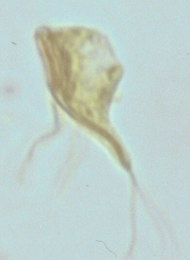
Giardia
Tear-drop shape
What is associated with giardia outbreaks?
Water
Outdoor recreation
What is the lifecycle of giardia?
Trophozoites live free or attach via sucking disk to the SI lumen
Cysts passed in feces after 7-14 days of incubation
How is giardia transmitted?
Fecal-oral
Ingestion of immediately infective cysts
What are the symptoms of giardia?
Asyptomatic or symptomatic
Watery diarrhea (acute phase)
Voluminous, malodorous stools with mushy consistency
Gas, flatulence
Cysts in stools after 7-14 days
Clinical signs don’t subside for 2-6 weeks (immunocompetent animals)
Are giardia trophozoites able to live outside the body?
No, only cyst stage can live in water
Who are most at risk for giardia?
Animals in high-volume facilities (shelters, boarding etc.)
Daycare workers
International travelers
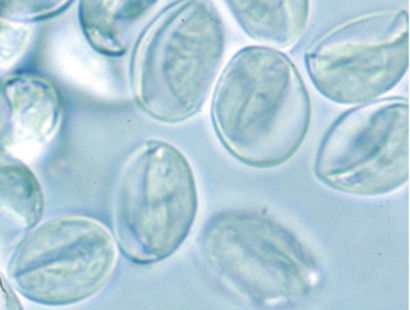
Giardia
Cyst-like
How is giardia treated?
Supportive care → elecrolytes
Panacur
Metronidazole → toxicity if you prolong use!
Bathe pet at beginning and end of treatment to remove immediately infective cysts
Disinfect enviornment with bleach, lysol, ammonia
How is giardia diagnosed?
Fecal float
SNAP test
Direct smear → only with diarrhea
What is Tritrichomonas blagburni?
Flagellate protozoan parasite in the LI of cats
What are the symptoms of Tritrichomonas blagburni?
Chronic diarrhea
Cats otherwise healthy!
Fecal incontinence
Lymphoplasmacytic/neutrophilic colitis
Crypt abscess
Increased mucosus production
Erosion of colonic mucosa
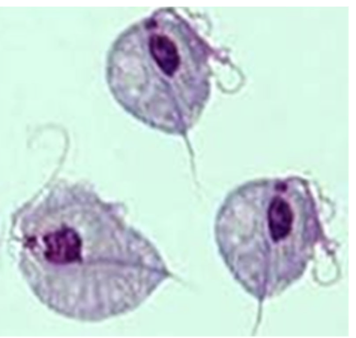
Tritrichomonas blagburni
Large nucleus
Flagella from anterior and posterior
Fusiform body/spindle shape
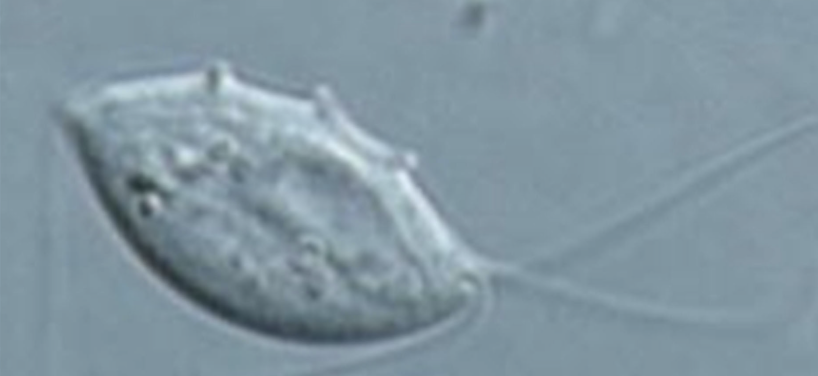
Tritrichomonas blagburni
How can you tell the difference between Tritrichomonas blagburni and Giardia?
Tritrichomonas → more spindle shaped, moves around quickly
Giardia → more tear-drop shape, moves slowly
How is Tritrichomonas blagburni treated and prevented?
No FDA approved therapy
Ronidazole or Metronidazole → can cause neurotoxicity
Segregate infected cats with separate litter boxes
Is Tritrichomonas blagburni zoonotic?
No
Can Tritrichomonas blagburni trophozoites and/or cysts survive the environment?
Trophozoites → yes (water, urine, cat food)
Cysts → yes
What species is indistinguishable from Tritrichomonas blagburni?
Tritrichomonas foetus
What is Tritrichomonas foetus?
Flagellate protozoan in repro tract of cattle
Symptoms of Tritrichomonas foetus
Bovine genital trichomoniasis
Infertility
Spontaneous abortion in 1st trimester
Repro tract infection
Bulls → asymptomatic, typically responsible for herd infections
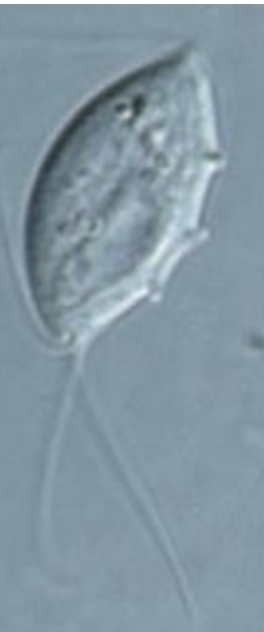
Tritrichomonas foetus
ungulating membrane
What causes African sleeping sickness and Chagas disease?
Trypanosomes (T. cruzi)
What is the flagellate trophozoite stage of Trypanosomes that circulates in blood/lymph? What does it infect?
Trypomastigote
Infective for vertebrate host
Other stages are developmental in arthropod IH
How are Trypanosome of Anterior and Posterior stations different?
Classified by mode of transmission
Anterior → bite of infected teste fly
Posterior → feeding rejuvidae bugs defecate and pass parasites
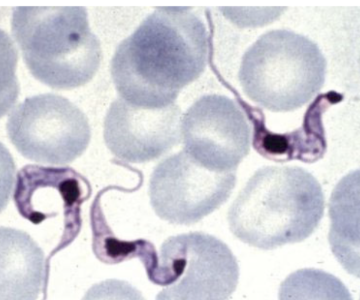
Trypanosome - blood/tissue flagellate
What are Trypanosomes?
Blood-Tissue Flagellate Protozoa
Life cycle of Trypanosome
Arthropods IH infected during blood meal
Epimastigotes divide and multiply in IH
Develop into Trypomastigotes
Transferred to Human/Animal Host
Multiplication in host
What are the symptoms of Trypanosome?
Hyperplasia of bone marrow/spleen
Trypanosome antigens attach to RBCs → erythrophagocytosis → decreased erythropoiesis → anemia
How is Trypanosoma cruzi transmitted?
Vectors
IH defication
Ingestion of IH
Non-Vector
Blood transfusion
Organ/tissue transplantation
Congenital
Lab exposure
Fecal contamination of food
What are the symptoms of Trypanosoma cruzi?
Romona’s sign (edema and inflammation from trypomastigotes fecating on host and rubbed into eye)
Dogs → acute dz
Lymphadenopathy
Myocarditis, tachycardia
Pale MM → anemia!
Splenomegaly
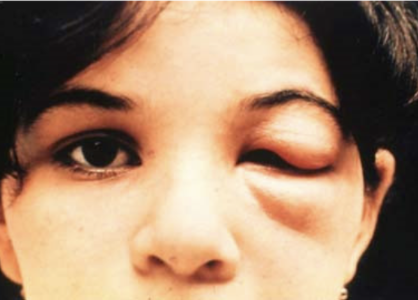
How is Trypanosoma cruzi treated?
No effective intervention!
Pathogenesis of Trypanosoma cruzi?
Trypomastigotes proliferate asexually
Spread via lymphatics enter tissues and continue to proliferate
Acute and can become deadly after 2-4 weeks