Did not know
 Call Kai
 Learn
Learn Practice Test
 Spaced Repetition
 Match
Match Flashcards
 Knowt Play
1/14

There's no tags or description
Looks like no tags are added yet.
Name | Mastery | Learn | Test | Matching | Spaced | Call with Kai |
|---|
No analytics yet
Send a link to your students to track their progress
15 Terms
Which aspects of the food packaging need to be taken into account for LCA?
Less packaging (weight)
Energy savings
Biodegradable
Recyclable
Natural resources
Longer shelf life
Product protections
Prevent food waste
Calculation: equilibrium respiration rates

What is the partial pressure of oxygen in the air?
21% or 0.21
What is the partial pressure of carbon dioxide in the air?
0%
What is the unit for respiration rate
ml/kg*h
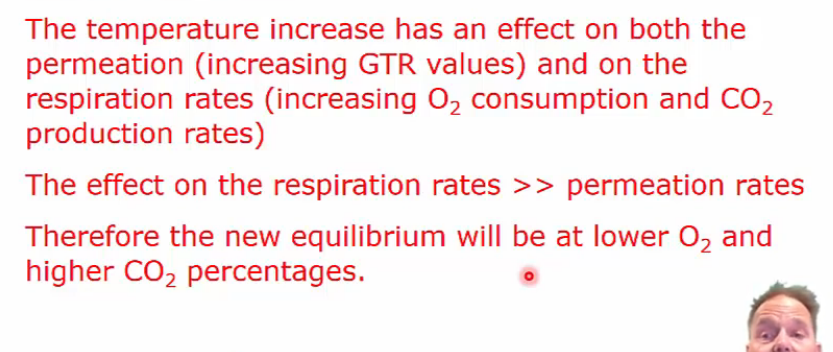
why does an increase in temperature change MAP?
How to calculate new Q10 values?
K can be replaced by respiration rate because K is also a rate
Does permeance (R) become larger or smaller with a larger thickness
Smaller
First moment of truth
The appearance/design of the product.
What is required to verify the "Recycled Content" in plastic packaging?
Food contact approvals and a chain of custody mechanism
What would happen if the TTI (Time-Temperature indicator) has much lower activation energy than the actual food spoilage reaction?
The TTI will react too quickly and underestimate shelf life
If you go to the supermarket to buy a bottle of water, which net quantity statement concerning units would be correct?
Centiliters, Liters, Milliliters
A prepacked salad marketed under a retailer’s private label is produced by a third-party manufacturer. Under Regulation 178/2002 and 1169/2011, who bears primary responsibility for compliance with food information and safety obligations?
B-correct-This option is correct as the retailer is indeed a key FBO for labelling and presentation, the manufacturer must also comply with general food law, ensuring that the products leaving its control are safe and properly documented. If a contamination or mislabelling issue arises from the factory, authorities can and do address enforcement measures to that manufacturer as well. Therefore, the responsibility is overlapping.
Which statement best explains why PET gains improved mechanical and barrier properties after stretch blow molding?
during stretch blow molding, PET is heated above its glass transition temperature and stretched in two directions (bi-orientation). This aligns the polymer chains and increases crystallinity, resulting in improved mechanical strength, rigidity, and barrier properties. The process does not change Tg or make PET fully crystalline.
Does recycled PET have a lower or higher Tg than virgin (pure) PET? Why?
Recycled PET has a lower glassy transition temperature, since, during the recylcing process, PET is subjected to high temperatures and a lot of mechanical shear. This stress causes long plastic polymer chains to break into shorter fragments.