polymorphisms and mutations
 Call Kai
 Learn
Learn Practice Test
 Spaced Repetition
 Match
Match Flashcards
 Knowt Play
1/20

There's no tags or description
Looks like no tags are added yet.
Name | Mastery | Learn | Test | Matching | Spaced | Call with Kai | Chat |
|---|
No analytics yet
Send a link to your students to track their progress
21 Terms
polymorphisms
a genetic variant present in the population in a frequency
the stable co exsitence of more than one variant (allele) of a gene in a population
a non pathogenicc genetic variant (irrespecive of frequency- clinical genetics definition)
single nucleotide polymorphisms
what does each represent
where is it found
what does it act as
most common
each snp represents a difference in a single nucelotid
occur normally throughout a perosns DNA , 1 in 1000 nucleotides
might be unique to a person or common populations
found in DNA between genes and act as markes to locate disease associated genes
snps within a gene or in a regulatory region near a gene may play a more direct role in disease by affecting a genes function
hereditary mutation-
happened in the prev generations and were transmitted down through the germline
must be present in sperm or egg for this to cuur
aquired mutation
changes which occur during the lifetime of the individual
if only present in the somatic cells these will not be passed on.
point mutations
substitution of a single base pair of DNA
missense or nonsense
conservtive or non
insertion or deletion of 1bp are not considered point
what are synonmous changes and where does this usually occur
when a base change occurs in a codon without altering the amino acid
usually happens in the 3rd base of hte codon.
what are non synonymous changes?
if a base change occurs at site 1 or 2 this usually changes the amino acid the codon codes for
non silent changes
missense mutation and 2 types
change a codon - causing a change in aa
conservative if the amino acid sub has similar biochemical properties so little to no effect on protein structure or function
non conservative- diffeent buichemcial properties so major effect on prtein strcture or funciton
properties include positive, negative, non polar, hydrophobic side chains. special cases include cysteine, selenocysteine, glycine, proline
hyperkalemic periodic paralysis
what type
what does it affect
where is it descended from- type of mutation
what is it responsible for
hereditary autosomal dominant
missense
affects horses under stress
undergo a paralytic attack affecting most skeletal muscles
most descended from a single stud (spontaneous germline mutation)
sdeclared the HYPP status of quarter horses
partly responsible for the enhanced muscular tone of this animal
trait was highly desirable for breeder
HYPP how does it work
what is it
what substitution and where
what does this cause
is a sodium channelopathy
single nucleotide change causes phenylalanine to leucine subsitution in a domain of a transmembrane ion channel
prevents complete inactivation of the Na-K channel
channel becomes leaky allowing potassium to escape while Na enters continually enhancing muscle tone
after stressful exercise elevation of extracellular potassium escaping through channels that are working normally. persistent inward sodium current int he aberrant channels
complete depolarisation of the membrane- loss of electrical excitabilith and onset of a paralytic attack
what do nonsense mutation create
truncated protein due to premature stop
citrullinemia
what breed is affected
what type of mutation and which enzyme is affected
which mutation and which aa is afected
what does this lead to
rare genetic disorder in holstein freisians
nonsense mutation causes premature stop codon in arginosuccinate synthetase ASS enzyme
C-T mutation converting arginine 86 to stop
urea cycle is arrested- build up of circulating ammonia
neurological and locomotor fefects - ataxia, blindness, aimless wandering and death
treatment rarely successful- euthanasia
nonsense mediated decay
what does the initial transcript contain
when the introns are spliced out of mrna what proteins remain
normally what does the ribosome do
where are normal stop codons located
what happens in nonsense mediated decay
initial transcript contains exons and introns
introns spliced out of mRNA- proteins known as exon junction complexes remain where exons spliced together
normally ribosome moves along mRNA displacing EJCs untl it hits stop codon at the end of the open reading frame
nromal stop codons are always downstream of the last EJC
if a mutaiton creates a new premature termination codon that stops translation before ribosome reaches the last EJC then NMD is activated: mrna is degratded and little to no protein is produced
examples of nonsense mediated decay
which species is affected
symptoms
signs of a carrier
what is affected
crooked tail syndrome in belgian blue cattle
recessive disorder showing musuclar hypertrophy
scolioiss and tail deviations
carriers have increased muscle mass
mRNA levels reduced in carrier and affected as mutatn mrna with ptc degraded by nmd
reduction in mrc2 prteons indiseased and carrier animals as mrna degraded by nmd
mutations in non coding regulatory regions
where
what does this lead to the disruption of
mutations in which location affect translation, and how does this happen
mutations in the promoter sequence or enhancer regions can affec gene expression- disrupt the binding of transcription factors required to turn genes on or off
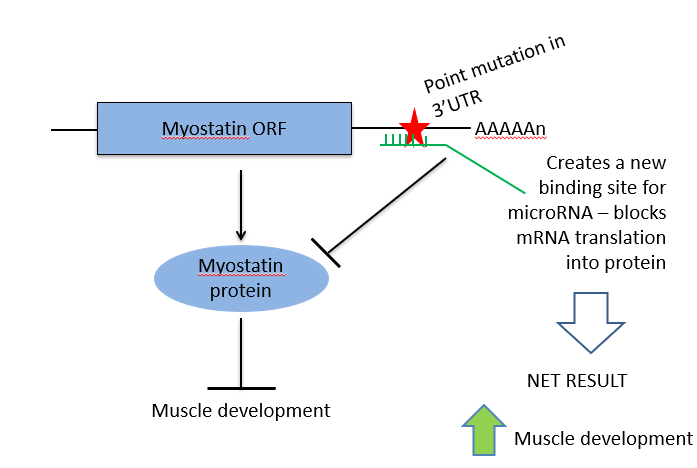
Mutations in 5’UTR or 3’UTR of mRNAs can affect translation.
- destabilise mrna causing it to be degraded before translation can occur
prevent the binding of factors whihc promote/repress translation of mRNA into protein
molecular basis of musculature in texel sheep
what is aneuploidy
chromosome consittution with one or more chromosomes extra or missing from a euploid set
Estimated that ~50% pregnancies are lost before implantation
Most due to chromosome number/structure abnormalities
Trisomy 21 – viable (Down’s syndrome)
Trisomy 13, 18 – most die < 1month after birth
Sex chromosome aneuploidies tolerated
XXY – Klinefelter Syndrome
XYY(n) – XXY Syndrome
XO - Turner Syndrome (only 1 X chromosome)
Not always whole chromosomes – parts can break off and get reattached to other chromosomes
copy number variation
differences between individuals in regions of chromosomes 1-100kb in length
INDEL
what does it caused by
insertion and deletion
polymorphimsm between individuals caused by insertion or deletion of regions of chromosomes
insertions are often caused by 2 classes of transposable elements- DNA elements whihc can copy themselves and insert into other areas in the genome
SINE and LINE
how many base paired long and how many copies per genome
what can insertion of these into coding or regulatory sequences of a gene cause
Short interspersed nuclear elements - <500bp long (106 copies/genome)
Long interspersed nuclear elements - >5000bp long (105 copies/genome)
Insertion of these into the coding or regulatory sequences of a gene can cause insertional mutagenesis if the insertion disrupts gene expression or protein function.
types