3B) Superconducting TMOs (the materials)
 Call Kai
 Learn
Learn Practice Test
 Spaced Repetition
 Match
Match Flashcards
 Knowt Play
1/8

There's no tags or description
Looks like no tags are added yet.
Name | Mastery | Learn | Test | Matching | Spaced | Call with Kai |
|---|
No analytics yet
Send a link to your students to track their progress
9 Terms
Set of chemical rules that may produce a high Tc material
insulating parent phase is an antiferrromagentic insulator; unsual high oxidation states (eg Cu3+); linear B-O-B bonds (ie structures containing CuO2 planes); large amount of covalency in the bonds; high oxidation states due to large (A) positive cations (eg Sr, Ba, La, Y); variable oxygen content
La2CuO4
band theory suggests metal, but is actually a CTI; layered structure of perovskite LaCuO3 and rocksalt LaO; dope La (3+) with Sr(2+) oxidises Cu to 3+ producing holes in the Cu3d/O2p hybrid band giving SC below 23K in the 2D perovskite layers; c axis 3x longer than a axis
How is SC optimised in La2-xSrxCuO4
Sr comp x changes Tc, optimal around x=0.15 give Tc ~38K
What are the two methods of oxidation in LaSrCuO
1) cation sub: replace La3+ with Sr2+ (or Ba, Ca);
2) high pressure synthesis in excess O2 provides extra O for rocksalt layers, formation of O2- ions steals e- from Cu2+ producing Cu3+;
Tc will change at same rate with oxygen content as it will with doped cation content
What is the driving force for redox reactions in La2CuO4
CuO2 planes are under compression; reduction of Cu2+ to 3+ reduces the bond length which is energetically favourable; the RS layers enable charge neutrality (they either provide a hole or absorb an e); optimal bond length between 1.89 and 1.94A otherwise over/underdoped and won’t get SC; the apical O (longer bond ~2.1A) act as links between the RS charge reservoir and the CuO2 sheets
What do the indices m and n mean
m = number of RS unit cells in each layer; n = number of perovskite unit cells in each layer
BiSCCO
BiSrCaCuO series with BiO RS layers; for m=3 and n=1,2,3: Tc increases with n and varies for each compound with δ (excess oxygen); properties are highly anisotropic (c ~20A, a,b~5A but not same)
YBCO
YBa2Cu3O7: O deficient triple perovskite; Ba and Y sit on A sites (normally CN=12) Ba is larger than Y so has large CN (10 vs 8); layered as BaO - CuO chains - BaO - CuO2 SC planes - Y - CuO2 planes - BaO - CuO chains etc; CuO chains act as charge reservoirs (like RS in BiSCCO)
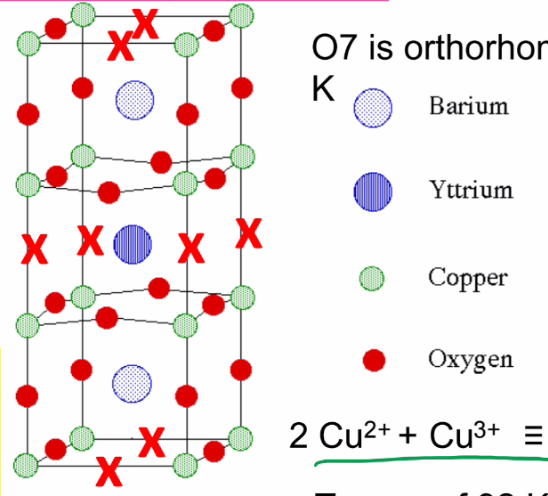
How does oxygen content affect YBCO
lower O content destroys CuO chains reducing SC; Tc drops for O<7; as δ increases transitions from orthorhombic to tetragonal (a=b);
δ=0: orthorhombic super conductor (Tc=92K)
δ=0.5: tetragonal semiconductor
δ=1: tetragonal insulator