37. MANDIBULAR FRACTURES. ORTHOPAEDIC TREATMENT
 Call Kai
 Learn
Learn Practice Test
 Spaced Repetition
 Match
Match Flashcards
 Knowt Play
1/15

There's no tags or description
Looks like no tags are added yet.
Name | Mastery | Learn | Test | Matching | Spaced | Call with Kai |
|---|
No analytics yet
Send a link to your students to track their progress
16 Terms
what are the indications for orthopaedic treatment of mandibular fractures?
there should be teeth available for fixation and immobilisation
there should be small/no dislocation between mobile fragments
what are the contraindications for orthopaedic treatment of mandibular fractures?
old fractures
significant dislocation between fragments
grade 3 mobility of teeth
when can splints be used?
when there are enough stable teeth
when there is minimal dislocation
when we can use inter maxillary fixation
when there are maxillary and mandibular teeth which are stable
what are the types of custom splints we can use?
1. risdon's wiring
2. chavdarov's wiring
3. roy-stout wiring
4. baronov's wiring
5. atanasov's wiring
how is Risdon's wiring splint made?
0.4mm thick, 25cm long wire (2 wires)
loop the wire around most distal mandibular tooth
both ends are twisted together to form a solid buccal base
connect the twisted wires from the left to the right side to make 1 structure in the midline
tie the ligatures in the cervical region of each tooth
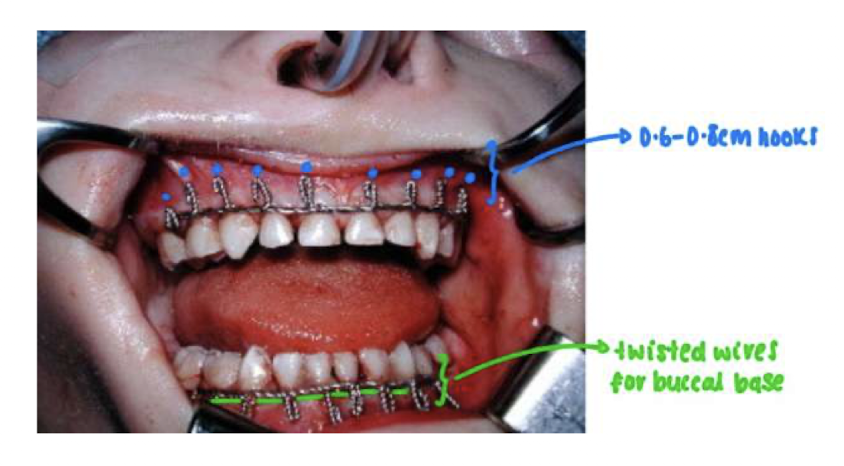
how is Chavdrov's wiring splint made?
0.4mm thick, 45-50cm long wire (1 wire)
same as Risdon's wiring but use 1 piece of wire to create a buccal base via longer wire
what are the standard dental splints?
these are commercially available arch bars
what are standard dental splints used for?
intermaxillary fixation and immobilisation
explain the dimac ligature
Dimac Ligature
- 0.5mm thick, 5-6cm long
the wire has a plastic head with an opening on one end and a screw thread on the other
threaded end goes between the teeth and exits buccally
tighten the ligature by screwing the plastic head with a wrench
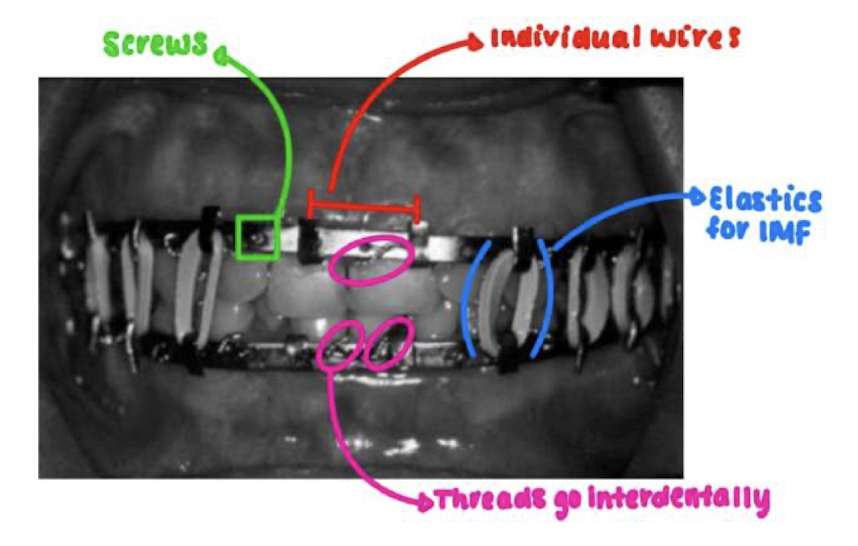
what are the advantages of the Dimac ligature?
easy to fit
good for oral hygiene
what are the disadvantages of the Dimac ligature?
only suitable for fractures with minimal fragmentation
What are some lab made splints?
Gunning port
Weber
Schuchardt
Gunning Port splints are used for what and how?
edentulous patients
impression taken and construction secured with anchor screws
Weber splints are used for what and how?
primary/mixed dentition and edentulous pts
acrylic construction made in lab after inital impression lies on alveolar ridge and around secured via self curing polymer
Weber splint disadavantge
unreliable fixation
Schuchardt splint design
thick piece of wire make base
seats soldered on wire
seatsa are 3-4mm with 2 ends one occlusal surface teeth other intermaxillary fixation
self curing polymer