C9, C10, C11, C12
 Call Kai
 Learn
Learn Practice Test
 Spaced Repetition
 Match
Match Flashcards
 Knowt Play
1/40

Earn XP
Description and Tags
Acids, bases and salts, rates of reaction, energetics and electrolysis
Name | Mastery | Learn | Test | Matching | Spaced | Call with Kai |
|---|
No analytics yet
Send a link to your students to track their progress
41 Terms
C1 - ACIDS BASES AND SALTS
Acid
A substance that forms an aqueous solution with a pH of less than 7
Contains an excess of H+ ions and is an H+ donor
One mole of some acidic substances can donate more than one mole of H+ ions
Mono, di, tri and polyprotic
Base
A substance with a pH of more than 7
Contains an excess of OH- ions
OH- acceptors
Alkali are type of base
Soluble in water
pH scale
More hydrogen, lower pH
Measure of H+ ion concentration

Neutralisation reactions
Positive H+ ions react with negative OH- ions to form water- often exothermic
Acid + base --> salt + water
Acid + metal oxide --> salt + water
Acid + metal hydroxide --> salt + water
Ionic
H+ + OH- --> H2O
Acid + metal carbonate --> salt + water + CO2
Acid + metal --> salt + hydrogen
Oxide reactions
Some oxides of non-metals can react with water to form acidic solutions
Some oxides and hydroxides of metals react with water to form alkaline solutions
Strong acid/base
Ionise COMPLETELY
All acid particles will dissociate
HCl, HNO3
Weak acid/base
Don’t ionise completely
Not all acid particles dissociate
REVERSIBLE
Ethanoic acid, citric acid
Concentration of acid/base
How much acid there is for a certain volume
Strong acid --> lower pH
More H+ ions, which determines pH
C10 - RATES OF REACTION
Factors: concentration
More reactant particles
Are closer together
Frequency of successful collisions increases
Rate increases
Pressure
Reactant particles are closer together
More frequent collisions
Rate of reaction increases
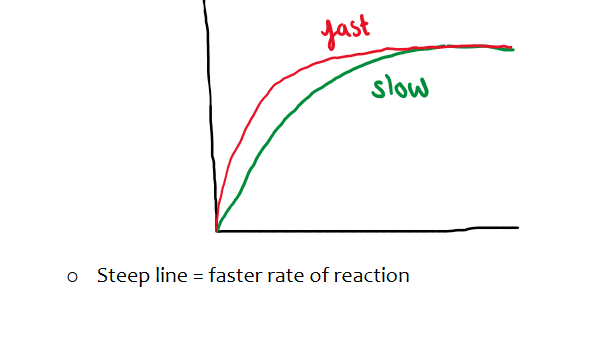
Graph
Steeper line = greater pressure
SA:V
Lumps vs powders
Large lumps have small surface area to volume ratio
If grounded:
Volume stays the same
Area of surface increases
Ratio increases
Large SA:V
More reactant particles are exposed at surface
Frequency of collisions increases
Rate increases
Temperature
Reactant particles move more quickly
Energy of particles increases
Frequency of collisions increases
Rate increases
Catalyst
Substance that
Increases rate of reaction
Does not change chemically or in mass after reaction
Does not alter products
Just produces them at quicker rate
Do not affect the position of the equilibrium
How
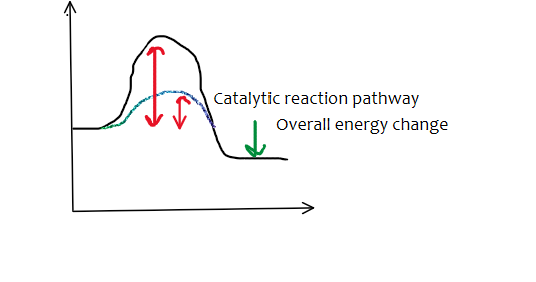
Provide an alternate reaction pathway
Lower activation energy
Does not change frequency of collisions
Changes frequency of successful collisions
More will exceed lower activation energy
Enzyme:
Biological catalyst
Important in cell reactions
Used fermentation of sugars
Measuring rate of reaction
Can be done in two main ways
Measuring loss of a reactant or gain of a product
Measurement of a physical property
When to use
Measuring gain of product:
Gas like CO2
Physical property
Loss/formation of precipitate
X disappears
Collision theory
Conditions of a reaction
Particles must collide
Successful collision (enough energy to react)
Enough energy
Activation energy (min energy for reaction to occur)
Measuring rate again
Depends on reactants and products involved
How long reaction takes
Measuring mass
Change in mass of reactants
Good for CO2 because of high Mr
g/s
Measuring volume
Change in volume of reactant
Gas syringe
cm3/s
Reaction profiles
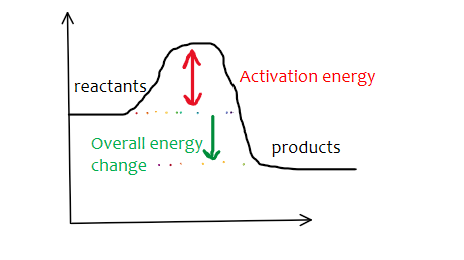
Shows how energy of reactants and products changes
Includes activation energy
The hump which stats at the energy of reactants
C11 - ENERGETICS
Exothermic graph
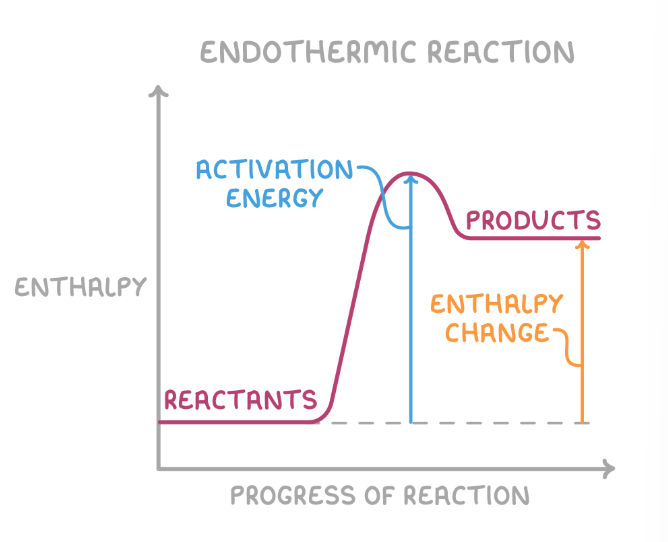
Endothermic graph
Catalyst graph
Enthalpy change
When chemical bonds break or form, energy is often released or absorbed as heat
At constant pressure the energy change is enthalpy change
Exothermic
Release heat energy
Have a negative enthalpy change
Temperature of surroundings increase
Endothermic
Absorb heat energy from surroundings
Have a positive ΔH
Temperature of surroundings decreases
Reversible reactions
If a reversible reaction is exothermic in one direction, it is endothermic in the other direction
Calculating enthalpy change
Q = mcΔT
ΔH = q/n
Breaking and forming bonds
BENDO - MEXO
Overall enthalpy change of a reaction depends on the difference between energy needed to break and form bonds
If more energy is needed to break bonds rather than forming new ones, ΔH is positive
Vice verse means exothermic as ΔH is negative
C12 - ELECTROLYSIS
Molten electrolysis
Done when ion is insoluble
Electrolyte
Ionic compounds molten or dissolved in water
Molten when ionic compound is insoluble
Ions are free to move
Electrolysis
Electrical energy from DC decomposes the electrolyte
Ions are attracted to oppositely charged electrode
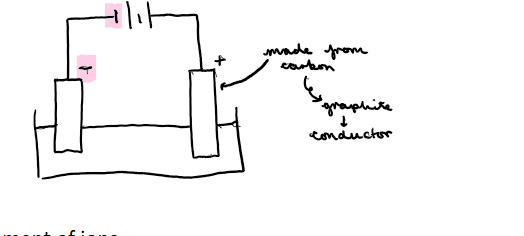
Movement of ions and production in molten electrolysis
Movement of ions
Cations migrate to the cathode (negatively charged electrode)
Anions migrate to the anode (positively charged electrode)
Production at the electrodes
Ions are discharged (lose their charge) and become atoms or molecules of elements
Gain electrons from the inert electrodes so as not to react in the reaction
Lead bromide
Lead will form at the cathode because it has positively charged ions
Bromine gas will form at anode because of the anions that are attracted to it and will be discharged
Reduction and oxidation
OILRIG
Oxidation occurs at anode
Half equation for oxidation
Electrolysis in aqueous solutions
Dissolved in water
Means in the solution there are the ionic compound's ions and H+ and OH-
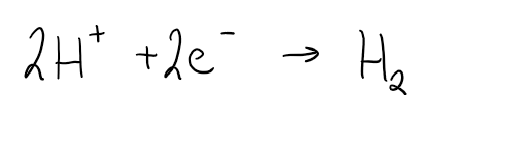
Aqueous electrolysis with cathode
Attracts positive ions
Metal ions + H+ ion
If metal is more reactive than H+ ion, hydrogen will form
If not, metal is formed
Least reactive ion forms
Aqueous anode
Negative ions
Non-metal ion + OH- ion
If halide ion, it will be discharged and be the product
Reason for change in mass

AC vs DC
Ions oscillate back and forth in AC which disrupts the electrochemical reaction needed
DC has a consistent polarity on the electrodes
Electroplating
Involves using electrolysis to put a thin layer of metal on object
Cathode
Iron / steel object
Anode
Plating metal
Electrolyte
Ions of plating metal
Improves corrosion resistance and appearance