Genetics ch 19: Gene mutation and DNA Repair
 Call Kai
 Learn
Learn Practice Test
 Spaced Repetition
 Match
Match Flashcards
 Knowt Play
1/127

There's no tags or description
Looks like no tags are added yet.
Name | Mastery | Learn | Test | Matching | Spaced | Call with Kai | Chat |
|---|
No analytics yet
Send a link to your students to track their progress
128 Terms
mutation
a heritable change in the genetic material
•Provide allelic variations
•Are the foundation for evolutionary change
•Can be detrimental if they result in an allele that functions more poorly than the original
Mutations…
•Provide_______
•Are the foundation for______
•Can be detrimental if…
true!
T/F: Mutations can occur at the chromosomal or gene level
false: usually affect one gene
T/F: gene mutations usually affect several genes
a point mutation is a change in a single base pair and involves a base substitution
a _______ is a change in a single base pair and involves a _______
A transition is a change of a pyrimidine (C, T) to another pyrimidine or a purine (A, G) to another purine
A ______ is a change of a pyrimidine (C, T) to another pyrimidine or a purine (A, G) to another purine
A transversion is a change of a pyrimidine to a purine or vice versa
A _____ is a change of a pyrimidine to a purine or vice versa
false! transtitions are more common than transversions
T/F: transversions are more common than transitions
silent mutation, missense, and nonsense
a base substitution can cause … 1, 2, 3 (types of mutations)
a frameshift
addition and deletion of short DNA sequences causes…
inhibitory (missense neutral or inhibitory)
a frameshift, nonsense, and sometimes a missense mutation have what effect on protein function?
silent
a ___ mutation has no effect on protein function
missense
sickle cell anemia is an example of a ____ mutation becuase eone amino acid substutuion changes blood cell morphology
false!
T/F: gene mutations occuring outside of a coding sequence cannot influence gene expression
promoter
a mutation in the ___ sequence may increase or decrease the rate of transcription
Regulatory element/operator site |
a mutation in the ___ sequence may disrupt the ability of the gene to be properly regulated
5′-UTR/3′-UTR
a mutation in the __ sequence May alter the ability of mRNA to be
translated; may alter mRNA stability
Splice recognition sequence |
a mutation in the ___ sequence May alter the ability of pre-mRNA to be properly spliced
reverse mutation or reversion
a _____ mutation or ___ changes a mutant allele back tot he wild-type
neutral
a ___ mutation does not alter protein function
deleterious mutation / lethal mutation
a ____ mutation lowers the chance of survival and reproduction; extreme ones are called __ and result in death of organism
beneficial
a ___ mutation enhances the survival or reproductive success
true!
Example: Sickle cell allele
•Heterozygotes have increased survival in the presence of malaria
T/F: whether a mutation is beneficial or deleterious can depend on environmental conditions
conditional
•Example: Temperature-sensitive (ts) mutants
•Used by geneticists to study gene function
•Ex: E. coli with a ts mutation may grow in the range 33-38°C but not in the range 40-42°C
A ______ mutation is one that affects the phenotype only under specific conditions
Suppressor
a second mutation that affects the phenotypic expression of a first mutation
suppression occurs in a second site
how is a suppressor different than a reversion?
Intragenic suppressor
– The second mutation is in the same gene as the first
Intergenic suppressor
The second mutation is in a different gene than the first
false! they have effects on both
T/F: intergenic suppressors may have effects on protein-protein interactions between 2 different proteins but not on subunits within the same protein coded by different genes
intergenic suppressor
this suppressor mutation usually involves a change in the expression of one gene that compensates for a loss-of-function mutation affecting another gene
Position effect
when a gene is relocated along a chromosome in a way that alters its gene expression
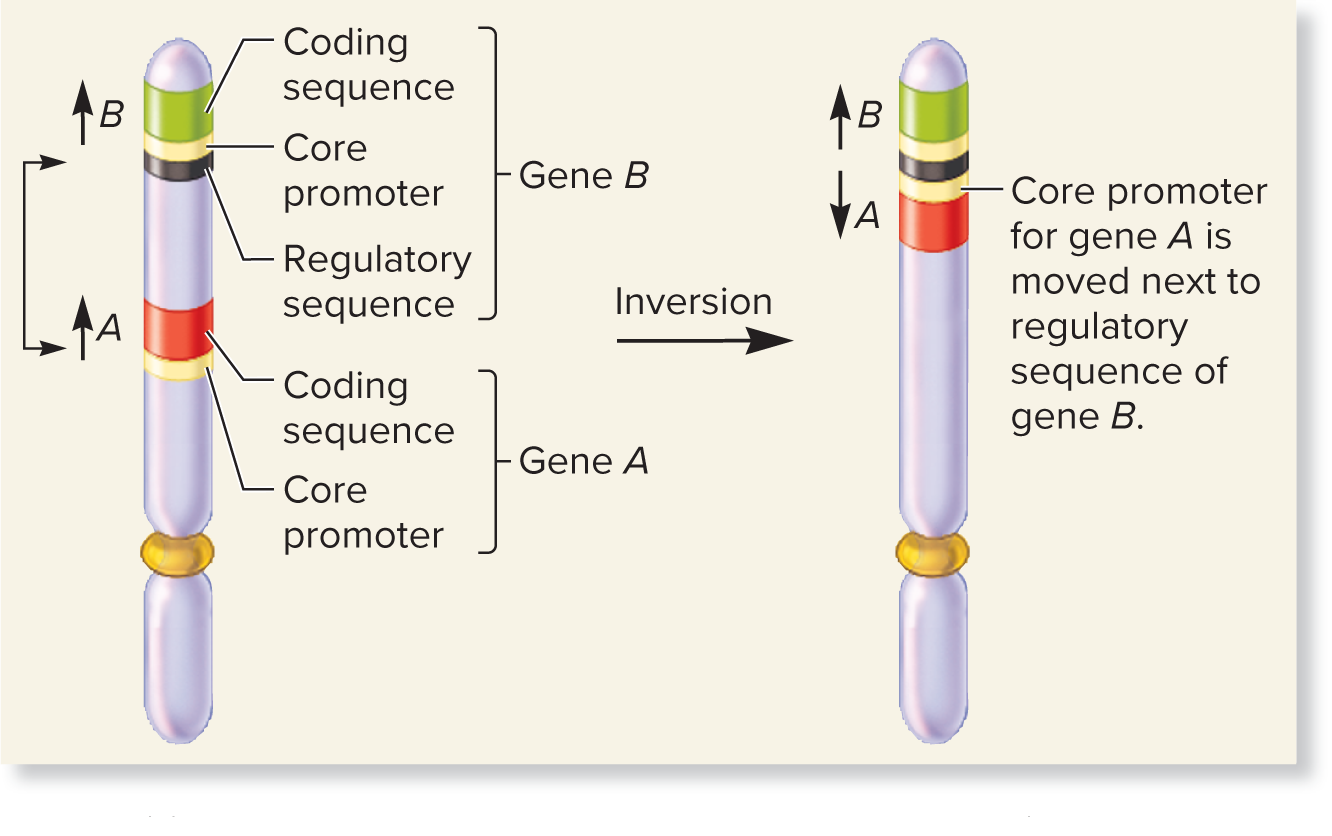
Movement to a position near regulatory sequences for a different gene
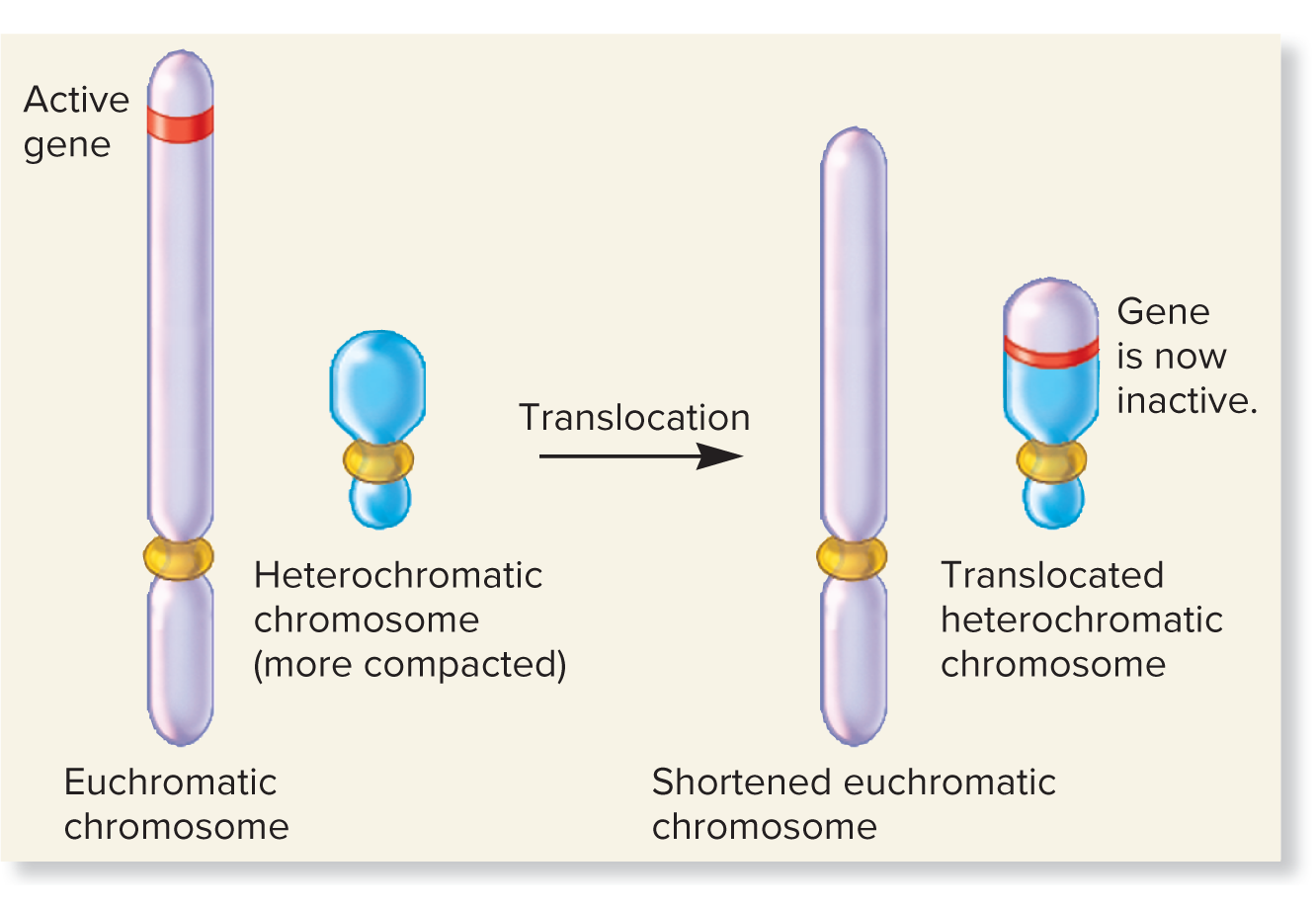
Movement to a heterochromatic region
There are two common reasons for position effects:
Movement to a position near _________
Movement to a ______ region
position effects due to movement of a gene to a position near regulatory sequences for a different gene
what is this?
position effects due to translocation to a heterochromatic chromosome
what is this?
Germ-line mutations
_______ are those that occur directly in a sperm or egg cell, or in one of their precursor cells
Somatic mutations
_______ occur in somatic cells at early or late stages of development
timing in development
Size of the affected region depends on the ______ of the somatic mutation
genetic mosaic
An individual with somatic cells that are genotypically different from each other is called a _______
false! this is true for germ-line mutations
T/F a trait due to somatic mutation is passed from parent to offspring
spontaneous mutation
a change in DNA structure that results from random abnormalities in biological or chemical processes
induced mutation
a mutation caused by environmental agents
induced
chemical substances, UV light, and X-rays changing DNA structure are examples of ___ mutations
Aberrant segregation |
this spontaneous mutation may cause aneuploidy or polyploidy
Aberrant recombination |
Spontaneous mutation described as abnormal crossing over which may cause deletions, duplications, translocations, and inversions
spontaneous
errors in DNA replication like A mistake by DNA polymerase may cause a point mutation which is a ___ mutation
spontaneous
transposable elements can insert themselves into the sequence of a gene and cause a ___ mutation
Depurination
|
Deamination
|
Tautomeric shifts |
Spontaneous mutation described as the products of normal metabolic processes, such as reactive oxygen species, may be chemically reactive agents that can (temporarily) alter the structure of DNA. |
•Depurination
•Deamination
•Tautomeric shift
Spontaneous mutations can arise by three types of chemical changes:
.
.
.
depurination
______ is the most common type of chemical change
apurinic site
if a guanine is removed from a DNA strand what is the name of where the guanine once was?
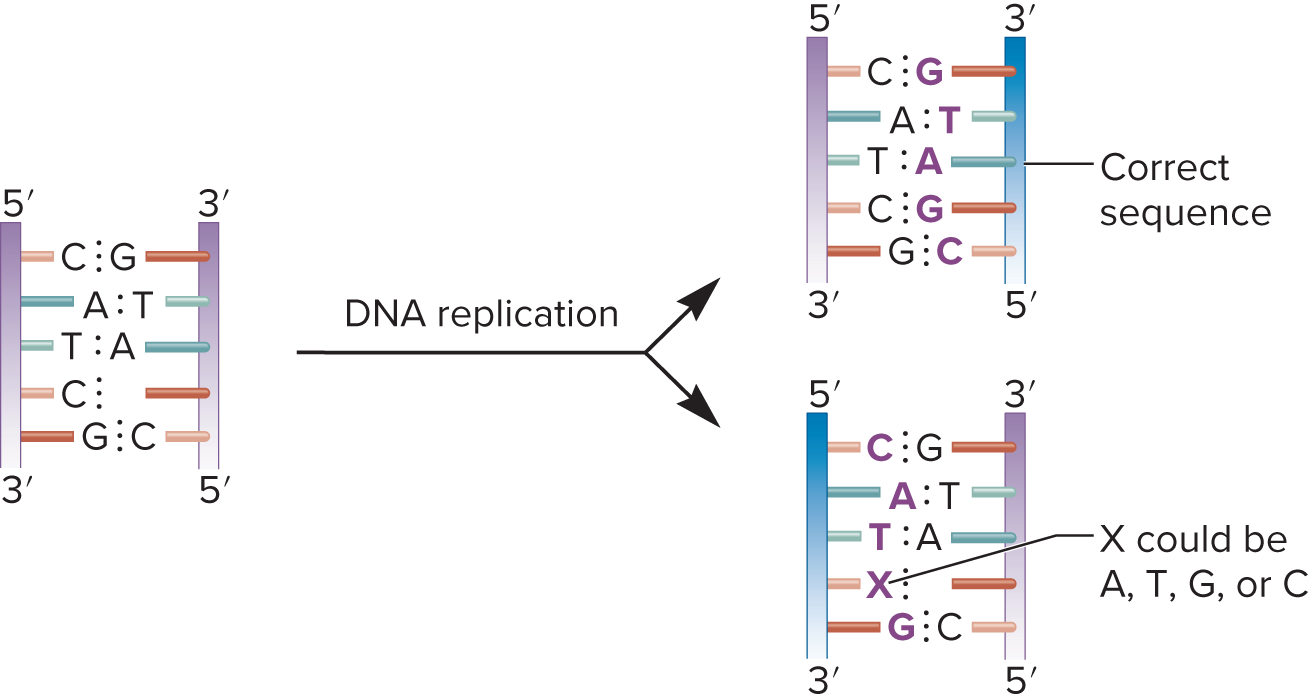
there is no complementary base present to specify the base
if an apurinic site is not repaired, a mutation may result becuase…
75% because 3 out of 4 nucleotides that may be added to the newly made strand opposite the apurinic site are no the correct one
when DNA that has an apurinic site is replicated, what is the probability that a mutation will occur?
deamination
what is it called when C—NH2 becomes C==O so cytosine becomes uracil?
cytosine —> uracil (DNA repair enzymes recognize it as not belonging in DNA)
5-methyl cytosine —> thymine (repair enzymes can’t recognize thymine as not belonging bc its a DNA bp)
For this reason, methylated cytosine bases tend to create hot spots for mutation
deamination of cytosine produces ___ and deamination of 5-methyl cytosine produces ___. What makes this different?
keto form —> enol form
The common, stable form of thymine and guanine is the _____ form
•At a low rate, T and G can interconvert to an ______ form
amino form —> imino form
Amino = Adenine (and cytosine is alphabetically closest)
The common, stable form of adenine and cytosine is the _____
•At a low rate, A and C can interconvert to an ______
•These rare forms promote AC and GT base pairs
immediately prior to DNA replication
To cause a mutation tautomeric shifts must occur…
oxygen
Aerobic organisms use _____ as terminal acceptor in their electron transport chains
Reactive oxygen species (ROS)
molecules generated by normal metabolism, immune responses; Can damage cellular molecules
Oxidative stress is an imbalance between synthesis and destruction of ROS
_______ is an imbalance between synthesis and destruction of ROS
oxidative DNA damage
ROS can cause changes in the DNA structure - called _______
False! eukaryotes and prokaryotes
T/F: methylation of cytosine occurs in only eukaryotes
guanine —-[O]—> 8-oxoguanine (8-oxoG)
___- bases are particularly vulnerable to oxidation which leads to many oxidation products like _____
8oxo-G base-pairs with adenine (instead of cytosine) which causes mutations in which a G-C base pair becomes a T-A base pair aka a transversion mutation
what does 8-oxoG do that is harmful?
False: increase!
T/F Trinucleotide sequences decrease from one generation to the next
trinucleotide repeat expansion (TNRE)
spinal and bulbar muscular atrophy (SBMA), Huntington disease (HD), Fragile X syndrome (FRAXA), spinocerebellar ataxia (SCA1), and myotonic muscular dystrophy are all examples of diseases that arise from ________
trinucleotide repeat expansion (TNRE)
The phenomenon/mutation in which a repeated sequence of 3 nucleotides can readily increase in number from one generation to the next
True
T/F: TRNE’s can occur in non-coding and coding sequences
CAG (glutamine)
Expansion may be within the coding sequence of the gene typically, ____ repeats which code for ____
•Causes the proteins to aggregate with each other
•Aggregation correlated with disease progression
when the are TNRE in coded regions and long tracks of glutamine are in the encoded protein….
anticipation
when the severity of the (TNRE) disease tends to worsen in future generations (doesn’t happen freuquently with TNRE disorders)
Huntington disease, —> father
myotonic muscular —> mother
•In ______ anticipation is more likely to occur if inherited from the father
•In _______, anticipation is more likely to occur if inherited from the mother
a hairpin (or stem-loop) —> Leading to errors in DNA replication
A key aspect of TNRE is that the triplet repeat can form ____ which leads to …
abnormal changes in RNA structure which may produce methylated CpG islands to silence the gene
Expansions located in noncoding regions are hypothesized to cause _______ which may produce …
mutagens
•An enormous array of agents can act as _____ to permanently alter the structure of DNA
mutagens
______ are often involved in the development of human cancers and are usually classified as chemical or physical
nitrous acid
____ deaminates bases (replaces amino groups with keto groups)
nitrogen mustard and ethyl methanesulfate
alkylating agents (2)
proflavine
intercalates within DNA helix (example of intercalating agent)
2-bromouracil and 2-aminopurine
base analogs (2)
x-rays
this physical mutagen causes base deletions, single-strand breaks in the DNA backbone, crosslinking, and chromosomal breaks
UV light
this physical mutagen Promotes formation of pyrimidine dimers, such
as thymine dimers
Base modifiers (alkylating agens)
Intercalating agents
Base analogs
3 types of chemical mutagens
deamination (base modification)
whats going on here?
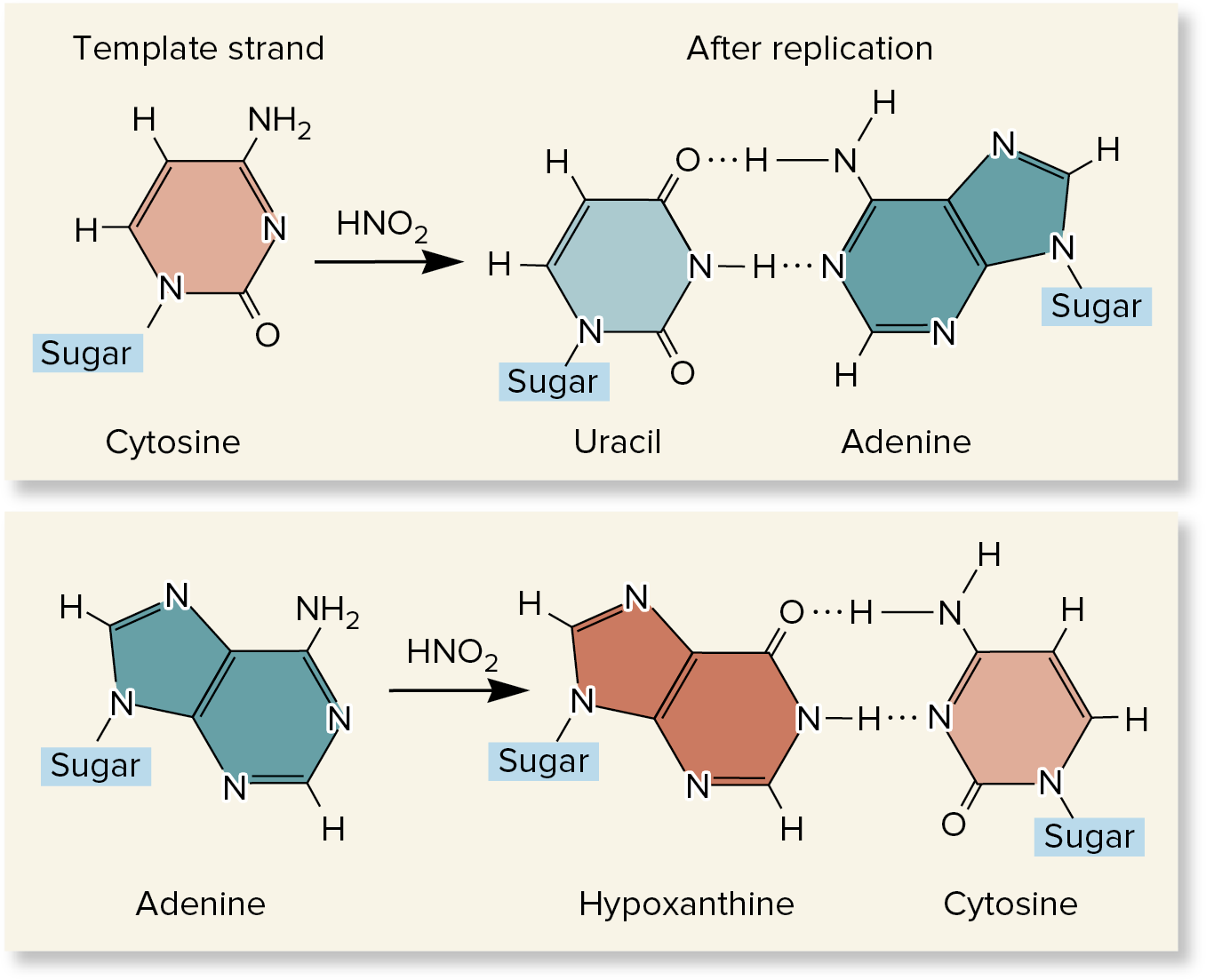
base modification
deamination and alkylation are all examples of _____
These modified bases do not pair with the appropriate nucleotides in the daughter strand during DNA replication
what happens when nitrous acid change scytosine to uracil and adenine to hypoxanthine
alkylation (base modification)
nitrogen mustard and ethyl methanesulfonate (EMS) are involved in ____
Methyl or ethyl groups are covalently attached to the bases and disrupt the appropriate pairing between nucleotides
what happens during alkylation?
Intercalating agents
_______contain flat planar structures that insert themselves into the double helix and distorts helical structure
contain single-nucleotide additions and/or deletions resulting in frameshifts
When DNA containing intercalating agents is replicated, the daughter strands may ….
DNA replication
•Base analogs become incorporated into daughter strands during…
thymine
5-bromouracil is a _____ analogue (It can be incorporated into DNA instead of ___)
5BU undergoes a tautomeric shift and base pairs with G; When this occurs during DNA replication, TA base pair is changed to a 5BU-G base pair (base analog)
when 5-bromouracil incorporated into DNA instead of thymine, what happens?
x-rays and gamma rays —> makes free radicals
Ionizing radiation includes radiation from … and can create …
false! it cannot, only ionizing radiation penetrates deeply
T/F non-ionizing radiation can penetrate deeply into biological molecules material
•Single-strand and double-strand breaks in DNA backbone
•Cross-linking
Oxidized bases
•Base deletions
SCOB
ionizing radiation can cause … (4 things)
UV light
non-ionizing radiation includes _____
cross-linked thymine dimers cause mutations when that DNA strand is replicated
UV light/non-Ionizing radiation causes formation of … which cause…