Chapter 1 : Introduction to Statistic
 Call Kai
 Learn
 Practice Test
 Spaced Repetition
 Match
 Flashcards
 Knowt Play
1/43

Earn XP
44 Terms
What is Statistics
Statistics is the science of collecting, organizing, summarizing, analyzing, presenting, interpreting, and drawing conclusions from data.
Data means any collected values, observations, or measurements.
Why it matters
Collecting and analyzing data is a key part of research.
Researchers need basic statistics knowledge before doing any study that involves data.
Statistics helps analyze surveys and supports scientific research through experiments, estimates, predictions, and quality control.
Why we Need Statistics
Basic knowledge of statistics is required in almost every field of research or study that involves data analysis.
Statistical methods help researchers:
Design valid experiments
Draw reliable conclusions and interpretations from the data they collect and analyze
Knowledge of statistics may help you in:
Describing the relationship between variables.
Making better decision in the face of uncertainty
Population and Sample
Sample (n)
A subset of the population that is observed
Population (N)
A complete collection of measurements, outcomes, objects or individuals under study.

Tangible population
finite and the total number of subjects is fixed and could be listed
→ all computers in a room, all female students in a university, or all electrical components manufactured in a day, etc.
Conceptual (Intangible) population
all values that might possibly have been observed and has an unlimited number of subjects.
→ simulated data from computer or instrument, number of germs on human body, all experimental data such as all measurements of length of metal rod, etc.

Parameter and Statistic

Parameter
A numerical value that represents a certain population characteristic
example : The average of weight of students from a population of students in a university
Statistic
A numerical value that represents a certain sample characteristic
example : The average of weight for a sample of female students selected from all students in a university
Descriptive and Inferential Statistics
Descriptive statistics
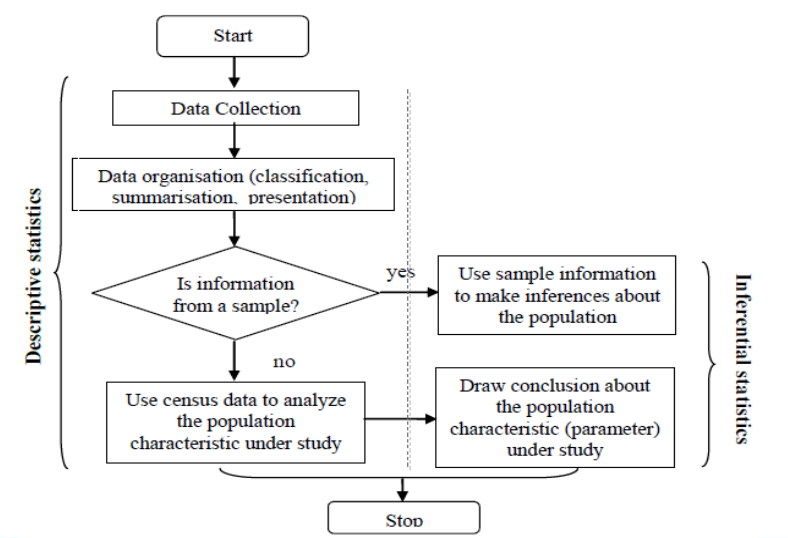
Involves collecting, organising, classifying, summarising, and presenting data from a sample.
Used to describe the characteristics of the sample.
Helps check whether the sample represents the target population by comparing the sample statistic with the population parameter.
Example:
10,000 parents in Malaysia have chosen Takaful Insurance as their trusted life insurance agency.
Inferential statistics
Involves generalisation, estimation, hypothesis testing, prediction, and finding relationships between variables.
Used to describe, infer, estimate, or approximate the characteristics of the target population.
Applied when we want to draw conclusions about the population based on sample data.
Example:
The death rate of lung cancer was 10 times higher for smokers compared to non-smokers.
Overview of descriptive and inferential statistics
STATISTICAL PROBLEM- SOLVING METHODOLOGY
1. Identify the problem or opportunity
2. Decide on the method of data collection
3. Collect the data (sampling techniques)
4. Classify and summarise the data
5. Present and analyse the data
6. Make the decision and conclusion
Characteristics of Sample
Sample
a subset of population
Population
a complete group of people, companies, hospitals, stores, university, students, and etc., that share some set of characteristics.
A census
involves the whole population which possesses a greater likelihood of non-sampling errors.
Sampling error
calculated when the statistical characteristics of a population are estimated from a subset, or sample, of that population. The difference between the sample and population values is considered as a sampling error.
Non-sampling errors
an error that are not due to sampling. As example, in a survey, mistakes may occur in the selection of people.
Characteristics of Sample Size
The larger the sample size, the smaller the magnitude of sampling errors would be.
Deciding on the Method of Data Collection
Data could be obtained in 3 ways:
Data that are made available by others (internal, external, primary or secondary data)
Data resulting from an experiment (experimental study)
Data collected in an observational study (observation, survey, questionnaire)
Observation method
In qualitative research: used to study the behaviours or events and the context that surrounds the behaviours or events and between the behaviour and the event.
In quantitative research: used to collect data regarding the number of occurrences in a specific period of the time, or duration of a very specific behaviour or event.
Interviews method
The purpose of interview in collecting data is to find out what is in or on someone else’s mind.
Interview data can easily become biased and misleading if the interviewed person is aware of the perspective of the interviewer.
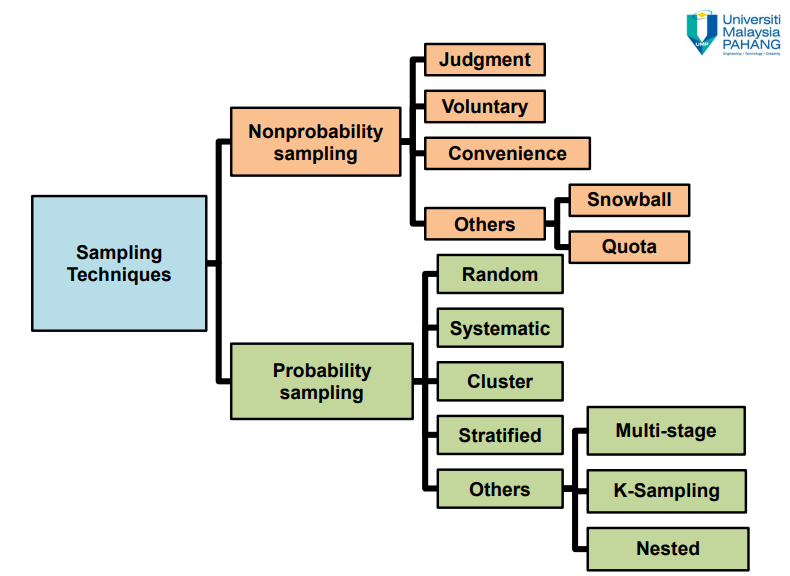
Collecting the Data (Sampling Techniques)
Sampling is a process of selecting few samples from a population to become the basis for estimating or predicting the prevalence of an unknown piece of information, situation or outcome regarding the bigger group.
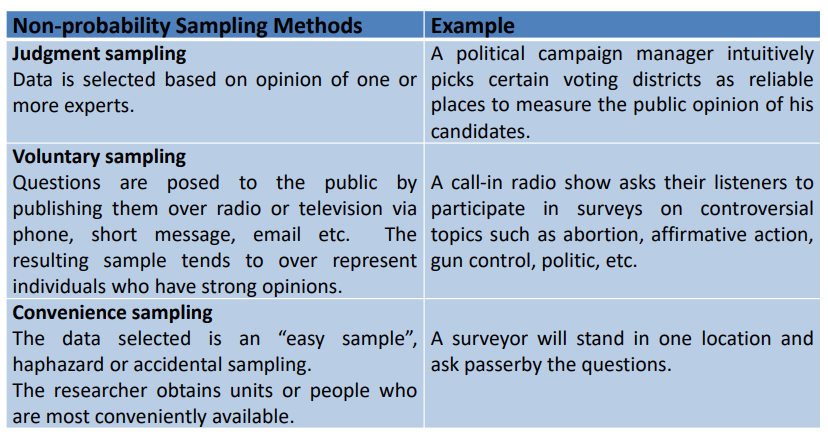
Non-probability sampling (judgment, voluntary, convenience)
Sample collected based on the judgment of the experimenter.
Resulting samples might be biased.

Probability sampling (random, systematic, stratified, cluster)
The chances is known before the sample is picked.
Resulting samples are unbiased.