Cardio Exam 1 (Kaur): HTN
 Call Kai
 Learn
Learn Practice Test
 Spaced Repetition
 Match
Match Flashcards
 Knowt Play
1/58

There's no tags or description
Looks like no tags are added yet.
Name | Mastery | Learn | Test | Matching | Spaced | Call with Kai |
|---|
No analytics yet
Send a link to your students to track their progress
59 Terms
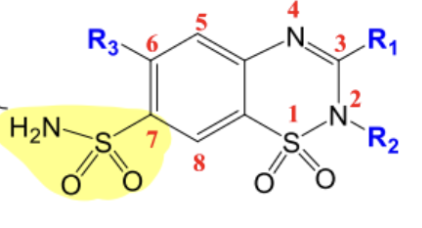
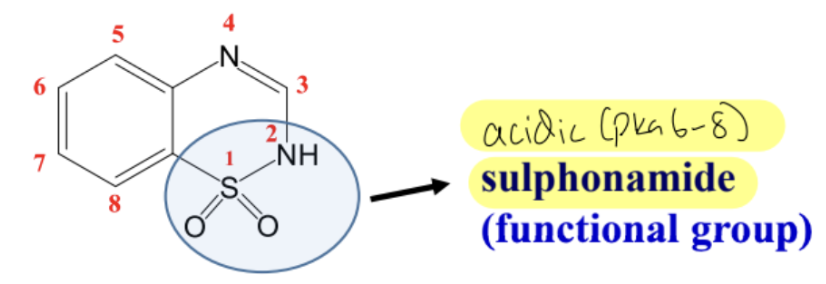
Diuretics: Thiazide or Benzothiadiazine
“Thiazide” or Benzothiadiazine Diuretics Exploration of biological and side effects of sulphonamides (such as _______, _______ diuretic activity) led to the discovery of diuretics.
Originally _______ agents
Structure + Concepts:
Sulphonamide → FG containing -_______- → _______ and pka range of _______
Acidic or basic FGs = _______!
Salt is _______ water-soluble compared to an acid or base
SAR:
Replacement or removal of the sulfonamide group at position __ = little or no diuretic activity
EWG is necessary at position __ → adding _______ are better (H’s are worse)
Saturation of the double bond to give a 3,4-dihydro derivative → _______ active!
Substitution with a lipophilic group at position __ → increases diuretic potency
Haloalkyl, aralkyl, or thioester substitution → increases _______ + longer _______
Alkyl substitution of the __ position → decreases polarity + increases the duration of action
hypoglycemia, high, antibacterial, SO2NH, acidic, 6-8, salt formation, more, 7, 6, halogens, more, 3, lipid solubility, duration of action, 2-N
Diuretics: Thiazide or Benzothiadiazine
Metabolism
Not extensively metabolized + _______
Adverse Effects:
_______ irritation, _______, and _______
excreted unchanged in the urine, gastric, nausea, electrolyte imbalances
Which structure is this?
Benzothiazide
High-Ceiling or Loop: _______
Structure: chlorine + sulfonamide
_______ (pka = ___) is a stronger acid than the thiazide diuretic
Metabolism: excreted primarily _______ and can take place on _______
_______ effective, but may be used parentally when a more prompt diuretic effect is desired
Short duration of action (_______)
Adverse Effects: abnormalities of _______ + _______ balance; _______; hypersensitivity rxns
Furosemide, Furosemide, 3.9, unchanged, furan ring, orally, 6-8 hours, fluid, electrolyte, hypokalemia
High-Ceiling or Loop: Bumetadine
Structure: phenoxy group (EWG/halogen) replaced chloro or trifluoromethyl substitutions
Amine group at position 6 has been moved to position 5
Minor variation led to increase in _______ → 50-fold _______ (KNOW!)
Short duration of activity (_______) (KNOW!)
Adverse effects: similar to furosemide
diuretic potency, more potent, 4 hours
High-Ceiling or Loop: Structure/Concepts
The smaller the pka → _______ the acid
COOH → _______
SO2NH → _______
_______ is more acidic than _______
stronger, 3-5, 6-8, Carboxylic acid, sulfonamide
Potassium-Sparing: Structure/Concepts (_______ → (easier) to make into salt → increases solubility)
_______
Weak organic base
Pteridine derivative
>70% absorbed on _______ administration
Rapid diuretic effect (_______)
t1/2 = _______
_______
Weak organic base → more _______ = more potent
Aminopyrazine derivative
10-fold _______ than triamterene
t1/2 = _______
Amines, Triamterene, oral, 30 mins, 4 hours, Amiloride, basic, more potent, 21 hours
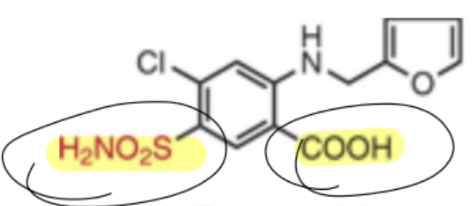
Which structure is this?
Furosemide
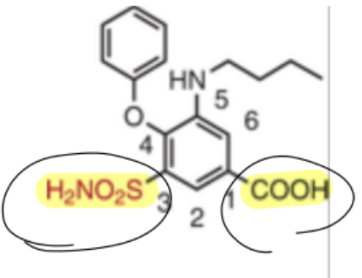
Which structure is this?
Bumetanide
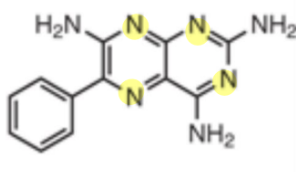
Which structure is this?
Triamterene
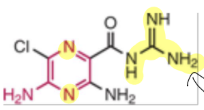
Which structure is this?
Amiloride
Potassium-Sparing: Metabolism
Triamterene
Metabolized to __’-_______ + its _______ conjugate
Amiloride
Mostly _______ (_______)
Adverse Effects
Traimterene
_______
Amiloride
Similar to triamterene
4, hydroxytriamterene, sulfate, excreted unchanged, renal, hyperkalemia
Aldosterone Antagonists (also called potassium-sparing diuretics)
Aldosterone = steroid (_______ fused together)
A substance that _______ the effects of aldosterone could conceivably be a good diuretic drug
Corticosteroids
Glucocorticoids (e.g. _______) → regulate _______, _______, and _______ metabolism
Mineralocorticoids (e.g. _______) → promote _______ and _______ ion _______
4 rings, antagonizes, hydrocortisone, carb, lipid, protein, aldosterone, salt and water retention, potassium and hydrogen, excretion
Aldosterone Antagonists (also called potassium-sparing diuretics)
Eplerdone
Newer drug → _______ group it has lower affinity for _______ receptor than _______
_______ selective aldosterone antagonist with _______ or _______ effects on GR + PR → fewer _______
epoxy, MR, Spironolactone, more, limited, no inhibitory, sexual SEs
Aldosterone Antagonists (also called potassium-sparing diuretics)
Spironolactone
_______ aldosterone binding to the _______ receptor → aldosterone antagonist.
Competitively inhibits, MR
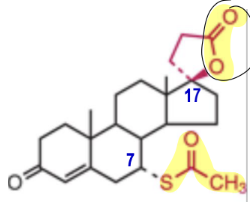
What structure is this?
Spironolactone
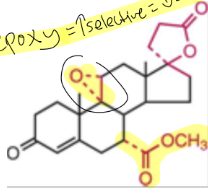
What structure is this?
Eplerenone
Sympatholytics: Beta-Adrenergic Antagonists → Aryloxypropanolamines
Aryl = _______
Structure/Concepts
Zwitterion: A molecule that contains both positively (_______) + negatively (_______) charged FGs
More Lipophilic cleared by _______
More Hydrophilic = cleared by _______
Non-Selective: _______
Highly lipophilic → enters _______
t1/2 = _______
(__) enantiomer = active form → cleared more _______
4-hydroxyl propranolol = _______
Benzene ring, basic, acidic, liver, kidney, Propranolol, CNS better, 3-5 hours, -, slowly, active
Sympatholytics: Beta-Adrenergic Antagonists → Aryloxypropanolamines
Beta-1 Selective: _______ + _______ (KNOW!)
_______ = selective antagonist
_-substituted aryloxypropranolamine
Esmolol t1/2 = _______
Atenolol t1/2 = _______
Esmolol: controls supraventricular tachycardia during surgery (short-acting beta-1 antagonist)
Atenolol, Esmolol, Esmolol, 4, 8 mins, 6-8 hours
Sympatholytics: Beta-Adrenergic Antagonists → Aryloxypropanolamines
Metabolism
Non-Selective: Propranolol
Extensively metabolized by the _______
Beta-1 Selective: Atenolol and Esmolol
Methyl ester of a carboxylic acid → _______ by serum esterases
Acid metabolite is generated by _______ → _______ → excreted as a _______
Adverse Effects
Non-Selective: Propranolol
_______ complicated due to _______ + _______
liver, hydrolysis, hydrolysis, inactive, Zwitterion, clearence, stereospecificity, liver disease
Sympatholytics: Selective Alpha-1-Adrenergic Antagonists: _______, _______, _______
Structure/Concepts
_-amino-_,_-dimethoxyquinazoline attached to a _______ ring
The long half-lives and durations of action for terazosin, doxazosin, tamsulosin, and silodosin permit once-a-day dosing and generally lead to increased patient compliance.
Variations = different t1/2
The Ones She Bolded in Presentation but didn’t talk about:
Terazosin = __ hrs
Doxazosin = __ hrs
Tamsulosin = __ hrs
Silodosin = __ hrs
Metabolism
Reduction of the _______ ring for prazosin to the _______ ring of terazosin increases its duration of action by altering its rate of _______
Prazosin, Terazosin, Doxazosin, 4, 6, 7, piperazine, long, QD, different t1/2, 12, 22, 14-15, 13, furan, tetrahydrofuran, metabollism
Sympatholytics: Combined Alpha/Beta-Adrenergic Antagonists: Labetalol + Carvedilol
Structure/Concepts
Labetalol
2 chiral centers = 4 stereoisomers (2 active + 2 inactive isomers)
4 molecules (R/S or S/R)
_______-blocking is approx. 1.5-fold more than _______-blocking activity (KNOW!)
Beta, alpha-1
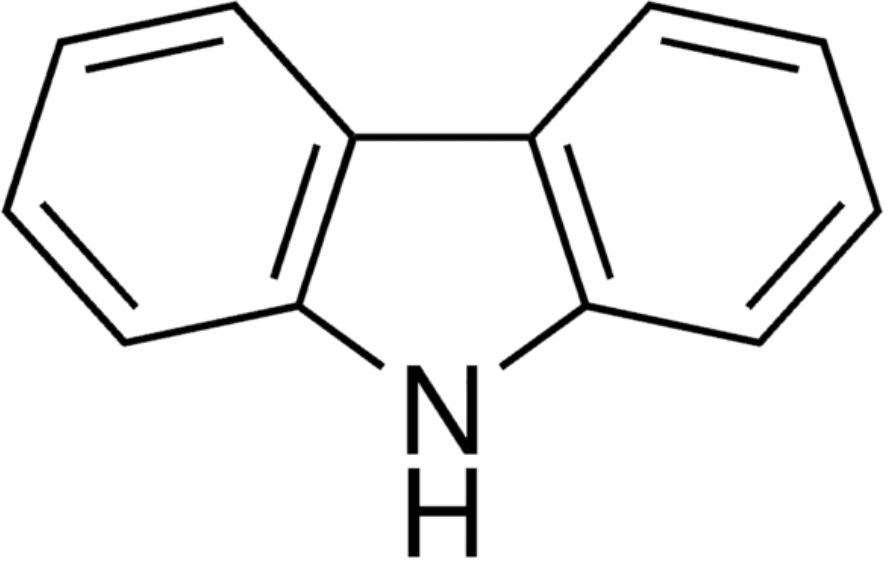
Sympatholytics: Combined Alpha/Beta-Adrenergic Antagonists: Labetalol + Carvedilol
Structure/Concepts
Carvedilol
Beta Blocking activity 10-100-fold more than alpha-1 blocking
_______ portion of the molecule also has _______ properties that provide further protection to the _______ by scavenging _______ (KNOW!)
Carbazole, antioxidant, heart, free radicals
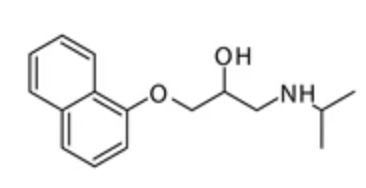
What structure is this?
Propranolol
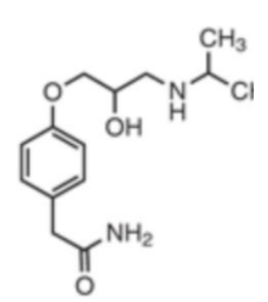
What structure is this?
Atenolol
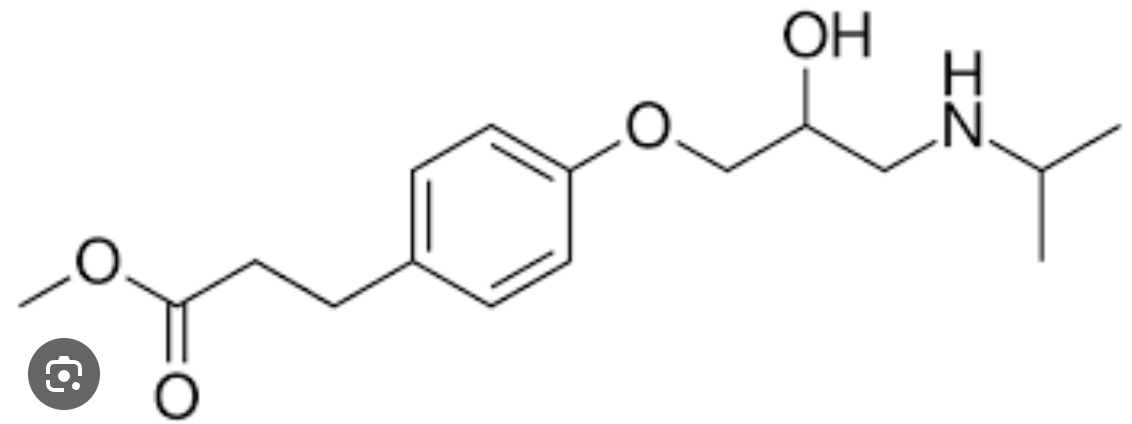
What structure is this?
Esmolol
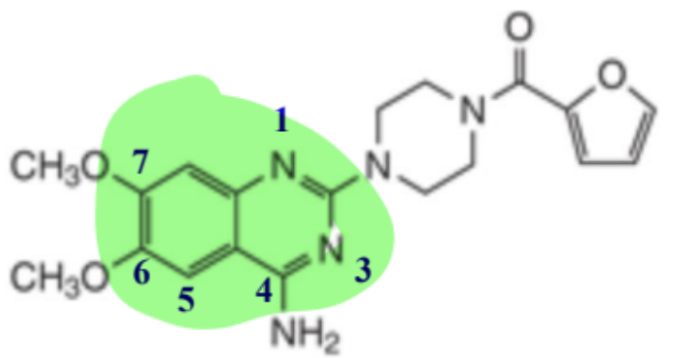
What structure is this?
Prazosin
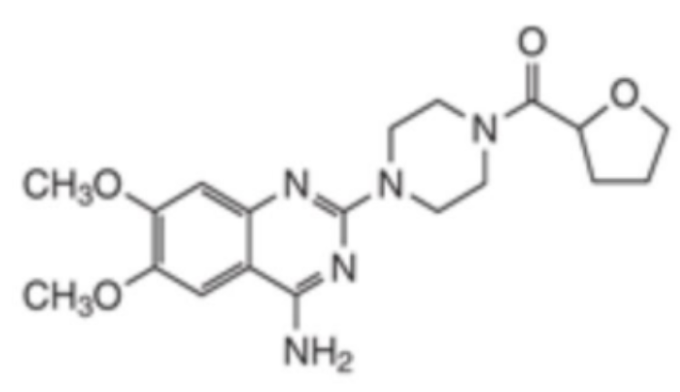
What structure is this?
Terazosin
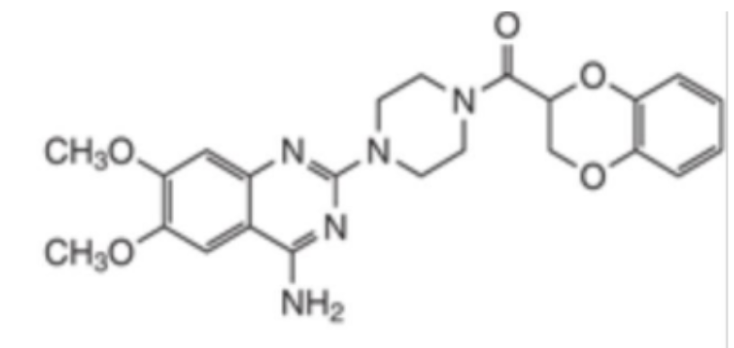
What structure is this?
Doxazosin
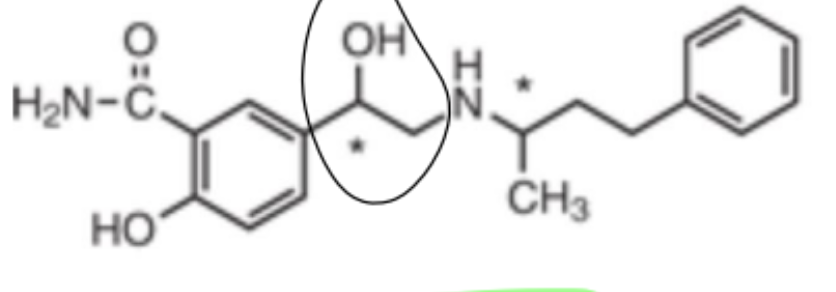
What structure is this?
Labetalol
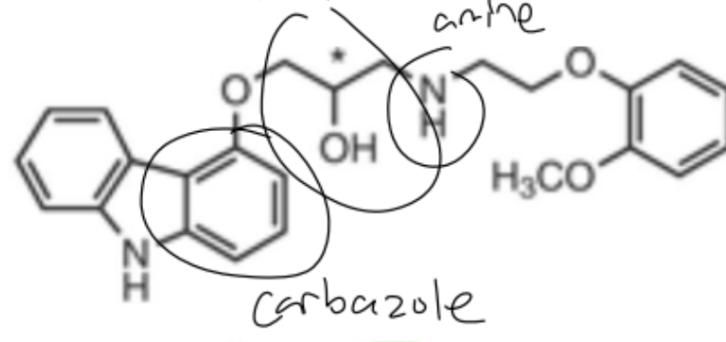
What structure is this?
Carvedilol
CCBs
All CCBs, with the exception of _______, contain at least _______; all marketed as their racemic mixtures (except _______ which is administered as single enantiomer/stereoisomer).
Some enantiomers can be _______ potent than others.
nifedipine, 1 chiral center, Diltiazem, more
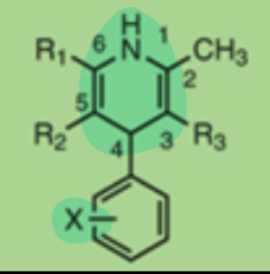
CCBs: Dihydropyridines (DHPs): Nifedipine, Amlodipine, Clevidipine
Structure/Concepts
Ring currents
1,4-DHP (1,4 = where hydrogens are added)
Primarily unionized
_______ is essential for activity. (KNOW!)
Substitution at the _______ position or the use of oxidized (pyridine) or reduced (piperidine) → decreases activity
With exception of amlodipine, all 1,4-DHPs have C2 + C6 methyl groups.
Ester groups at the _______ + _______ positions optimize activity.
A substituted phenyl ring at the _______ position optimizes activity, and _______ substitution with a small nonplanar alkyl or cycloalkyl group decreases activity.
Ortho or meta substitution of Phenyl ring gives optimal activity
All CCBs undergo extensive first-pass metabolism (EXCEPT clevidipine) in the liver and are substrates for CYP3A4. Additionally, several CCBs can inhibit CYP3A4
1,4-DHPs do NOT have tertiary amine + much less basic (electrons are involved in resonance delocalization)
1,4-DHP ring, N1, C3, C5, C4, C4
CCBs: Dihydropyridines (DHPs): Nifedipine, Amlodipine, Clevidipine
Structure/Concepts
Amlodipine Besylate
long t1/2 + infrequent dosing + low cost + SE positive profile
Clevidipine
_______ duration of action (_______) (KNOW!)
ultra-short, 2-4 mins
CCBs: Dihydropyridines (DHPs): Nifedipine, Amlodipine, Clevidipine
Metabolism
1,4-DHPs
1,4-DHPs (EXCEPT Clevidipine) are oxidatively metabolized to a variety of inactive compounds. In many cases, the dihydropyridine ring is initially oxidized to an inactive pyridine analog. These initial metabolites are then further transformed by hydrolysis, conjugation, and additional oxidation pathways.
Clevidipine
_______ to _______ metabolites (KNOW!)
Adverse Effects of 1,4-DHPs
DDIs: _______ → increases systemic concentrations
rapid ester hydrolysis, inactive, grapefruit juice
CCBs: Non-DHPs: _______ + _______
Phenykalkylamine: _______
Contain tertiary amines with pKa values of 8.9 and 7.7
Primarily ionized
Good lipid solubility
Excellent oral absorption
Verapamil, Diltiazem, Verapamil
CCBs: Non-DHPs: _______ + _______
Benzothiazepine: _______
Contain tertiary amines with pKa values of 8.9 and 7.7
Primarily ionized
Administered as single enantiomer/stereoisomer
Verapamil, Diltiazem, Diltiazem
CCBs: Non-DHPs: Verapamil + Diltiazem
Metabolism
_______: Verapamil
Metabolized by CYP3A4 _______ to its principal metabolite, _______, which retains some activity of verapamil, and by _______ (CYP___) into _______ metabolites.
Phenykalkylamine, N-demethylation, norverapamil, O-demethylation, 2D6, inactive
CCBs: Non-DHPs: Verapamil + Diltiazem
Metabolism
Benzothiazepine: Diltiazem
Enzyme hydrolysis
The oral bioavailability of diltiazem and verapamil can be increased with chronic use and increasing dose
Natural AA → _______ stereochemistry (KNOW!)
D-AA → increases _______ (cannot be _______) + _______ (KNOW!)
L, stability, hydrolyzed, duration of action
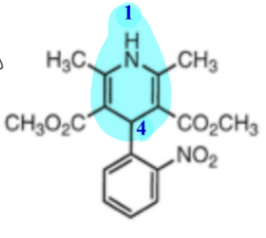
What structure is this?
Nifedipine
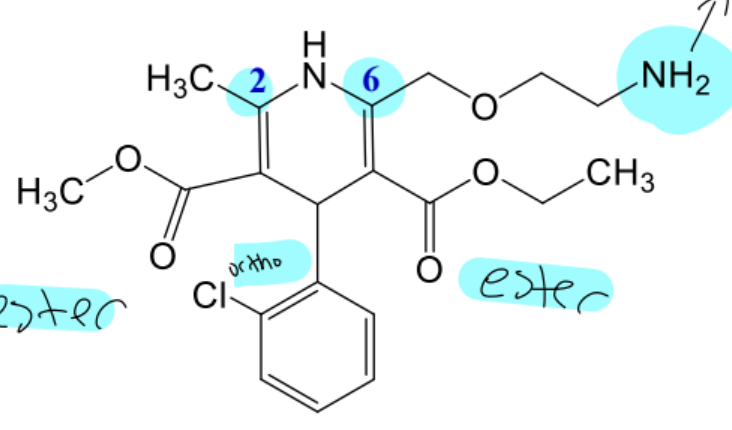
What structure is this?
Amlodipine Besylate
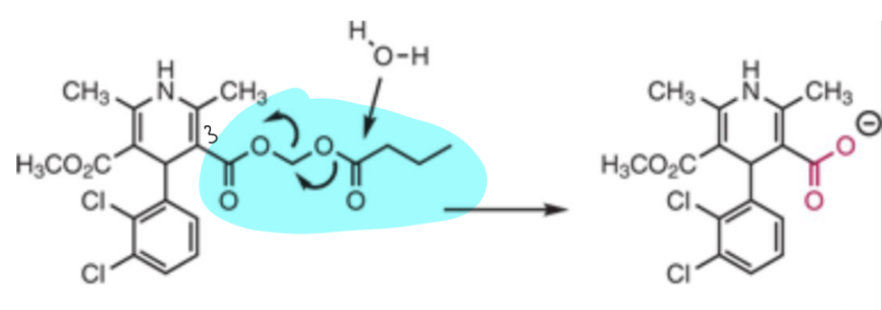
What structure is this? What structure represents the inactive metabolite?
Clevidipine, right structure
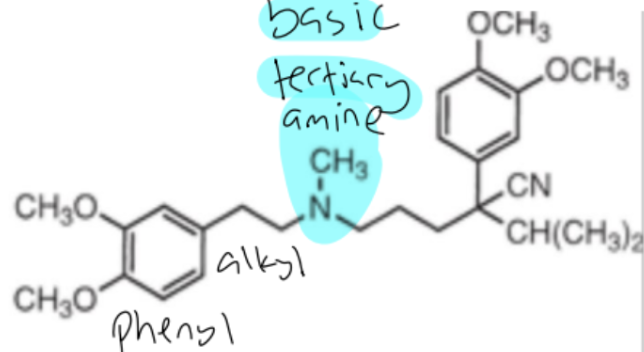
What structure is this?
Verapamil
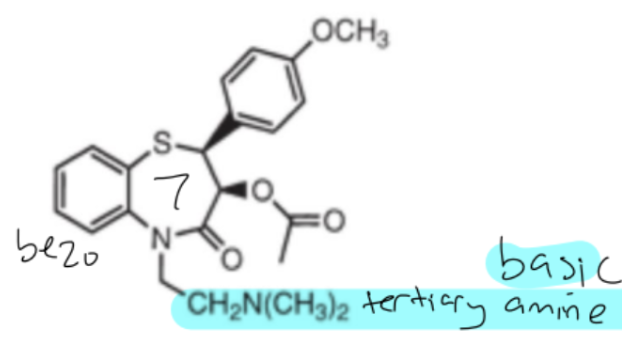
What structure is this?
Diltiazem
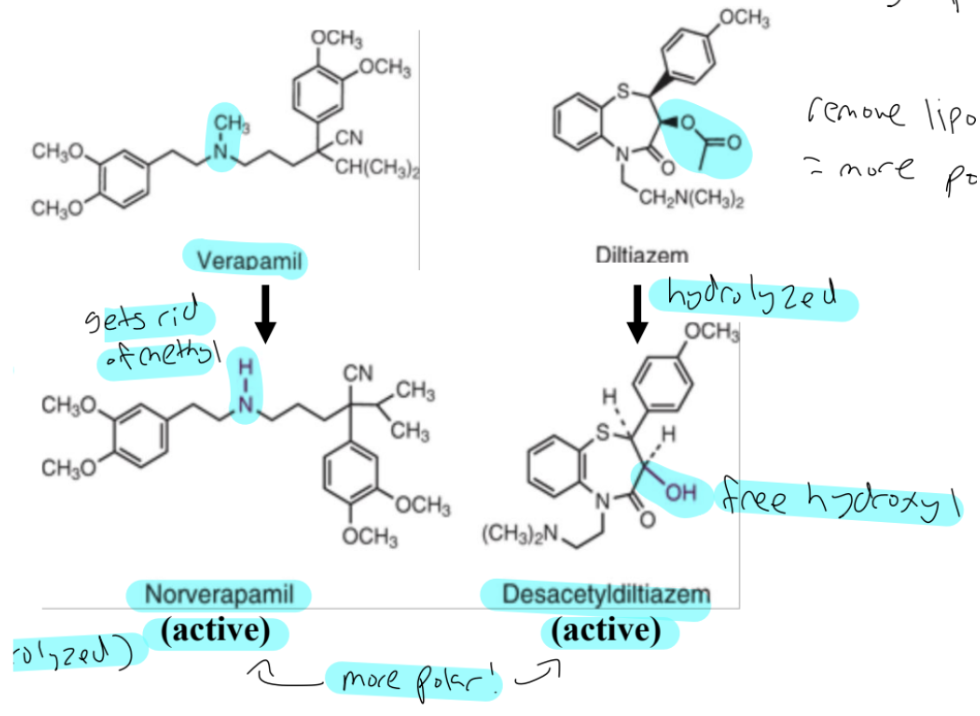
KNOW IMAGE
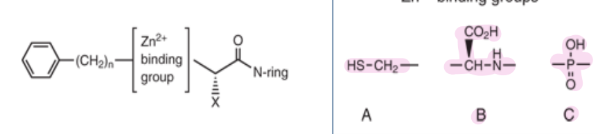
ACE-I: SAR of ACE-I
N-ring must contain a carboxylic acid to mimic the C-terminal carboxylate of ACE substrates.
Large hydrophobic heterocyclic rings (i.e., the N-ring) increase potency + alter pharmacokinetic parameters.
The _______ binding groups can be either a _______ (A), a _______ (B), or a _______ (C). (KNOW!)
Esterification of the carboxylic acid or phosphinic acid produces an orally bioavailable prodrug.
X is usually methyl.
Optimum activity occurs when stereochemistry of the inhibitor is consistent with _______ stereochemistry present in normal substrates. (KNOW!)
zinc, sulfhydryl, carboxylic acid, phosphinic acid, L-AA
ACE-I in General
ACE is a stereoselective drug target. Because currently approved ACE inhibitors act as either di- or tripeptide substrate analogs, they must contain a stereochemistry that is consistent with the L-AA present in the natural substrates.
The oral bioavailability of this class of drugs ranges from 13-95%
Captopril + Fosinopril are acidic drugs, but all other ACE inhibitors are amphoteric (both acidic + basic groups).
Several dicarboxylate-containing inhibitors have been approved.
_______ has a more rapid onset of action (KNOW!); however, it also has a _______ duration (due to formation of disulfides or dimers) and requires a _______ dosing interval
Sulfhydryl or thiol (SH = acidic) group easily gets oxidized to disulfide (S-S).
Captopril, shorter, more frequent
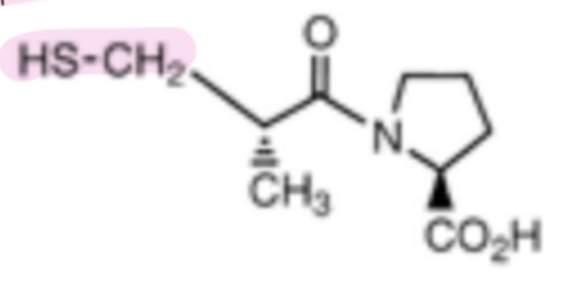
What structure is this?
Captopril
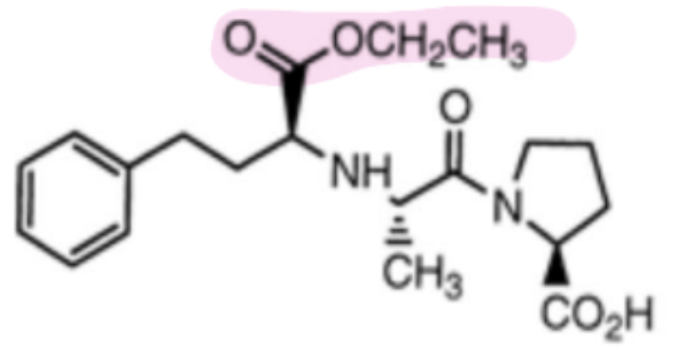
What structure is this?
Enalapril (prodrug)
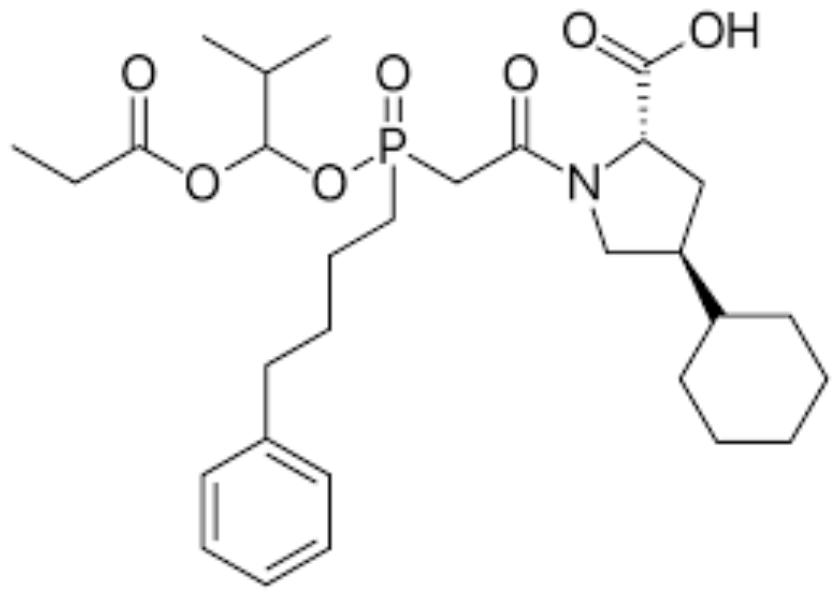
What structure is this?
Fosinopril
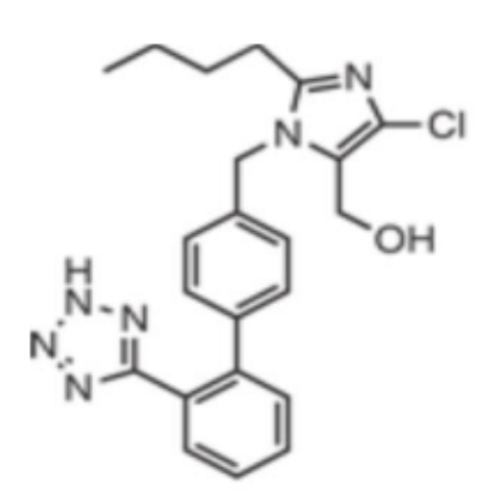
What structure is this?
Losartan
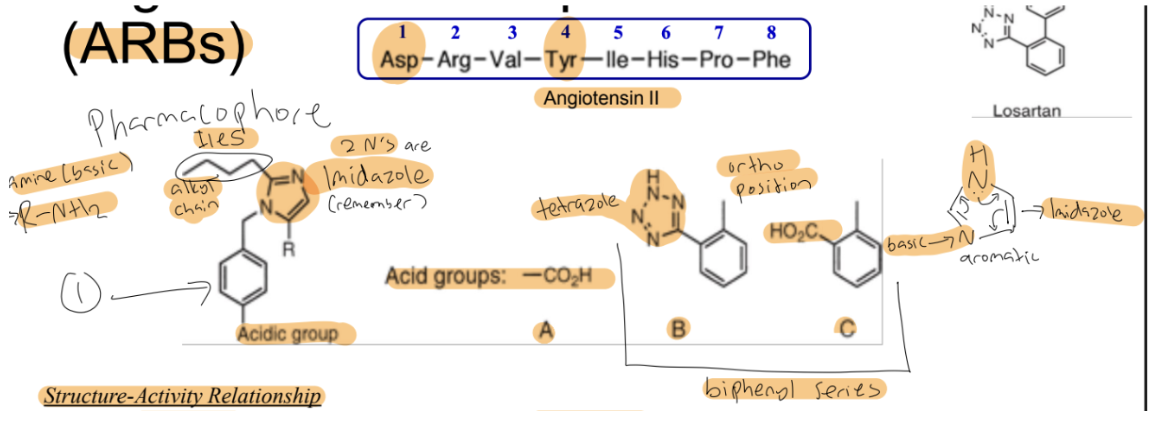
ARBs: Losartan, Valsartan, Irbesartan, Telmisartan, Candesartan Cilexetil (prodrug)
SAR (KNOW!)
The “_______ group” is thought to mimic either the _______ phenol or the _______ carboxylate of _______. Groups capable of such a role include the
carboxylic acid (A)
phenyl _______ or isostere (B)
phenyl _______ (C)
In the biphenyl series, the _______ + _______ groups must be in the _______ position for optimal activity (the _______ group is superior in terms of metabolic stability, lipophilicity, and oral bioavailability)
The _______ group (or an ethyl ether or an n-propyl group) provides hydrophobic binding and, most likely, mimics the side chain of _______ of _______
The _______ ring or an isosteric equivalent is required to mimic the _______ side chain of _______
Substitution can vary at the “_” position
acidic, Tyr4, Asp1, Ang II, tetrazole, carboxylate, tetrazole, carboxylate, ortho, tetrazole, n-butyl, Ile5, Ang II, imidazole, His6, Ang II, R
ARBs: Losartan, Valsartan, Irbesartan, Telmisartan, Candesartan Cilexetil (prodrug)
With the exception of _______ + _______ (high), all of the compounds have low, but adequate, oral bioavailability.
Most of the compounds are _______, the most probable reasons for the low bioavailability = _______ + _______.
Highly _______, have elimination half-lives that allow _______- or _______-daily dosing.
Irbesartan, Temisartan, excreted unchanged, poor lipid solubulity, incomplete absorption, protein bound, once, twice
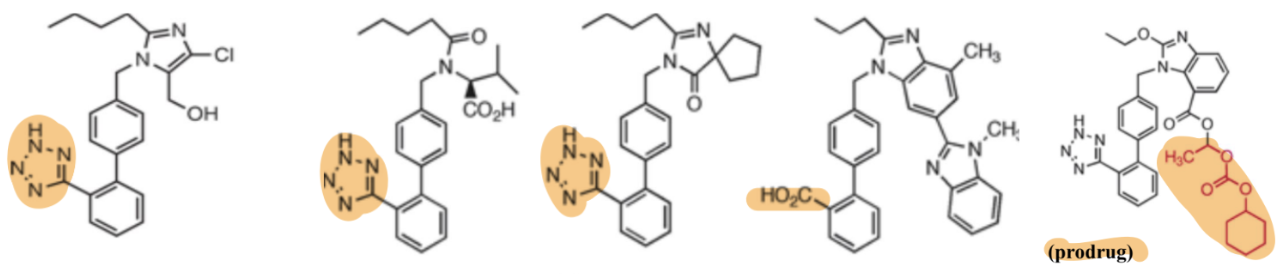
Name these structures from left to right.
Losartan, Valsartan, Irbesartan, Telmisartan, and Candesartan
Stereochemistry
________ + interaction with other ________ + environments (e.g. ________)
Rate of reaction, chiral compounds, receptor of enzymes
Class IA (Sodium CBs)
_______ → _______ = Na+ compound with _______ → brings _______ character
Quinidine, alkaloid, nitrogen, basic
Class IB (Sodium CBs)
Lidocaine → _______ (used _______)
Mexiletine → _______ t1/2 + _______ Metabolism Rate (contributes to good _______ activity)
15-30 mins, IV, 12-16 hours, Slow, oral
Class III Potassium Channel Blockers
Amiodarone → _______
Dronedarone → Noniodinated → iodine groups removed to reduce toxic effects on the _______ → _______
Abutilide → _______ derivative
Dofetilide → Bis-methanesulfonanilide
highly lipophilic, thyroid and other organs, methylsulfonamide, methanesulfonamide
Digoxin (Glycosidic Positive Ionotropic Drug)
PK/Metabolism → Intestinal P-glycoprotein mediated efflux + _______dependent _______
Digoxin-Quinidine Interaction → Quinidine (P-gp substrate) + _______ digoxin’s _______ concentration to TOXIC levels
Digoxin-Verapamil Interaction → Verapamil inhibits intestinal P-gp efflux → _______ digoxin’s _______ levels to TOXIC levels
Rifampin-Digoxin Interaction → rifampin induction of intestinal P-gp expression → _______ digoxin _______ levels to SUBTHERAPEUTIC concentrations
P-gp, renal elimination, increases, plasma, increases, blood, decreases, blood