entire topic 3
 Call Kai
 Learn
Learn Practice Test
 Spaced Repetition
 Match
Match Flashcards
 Knowt Play
1/224

There's no tags or description
Looks like no tags are added yet.
Name | Mastery | Learn | Test | Matching | Spaced | Call with Kai |
|---|
No analytics yet
Send a link to your students to track their progress
225 Terms
How does transpiration affect the pressure in xylem vessels?
It decreases pressure (more negative), increasing the pull on water up the xylem.
In mass flow, what happens to hydrostatic pressure at the source?
It increases because water enters, generating a pressure gradient toward sinks.
What type of evidence would support mass flow: similar speed for different solutes or very different speeds?
Similar speeds for different solutes, because bulk flow carries solutes together.
How can tracer experiments help distinguish xylem transport from phloem transport?
Water tracers move mainly upwards in xylem, while sucrose/organic tracers move in phloem from sources to sinks.
Why does a correlation from tracer distribution not automatically prove causation?
Other factors (e.g. differing tissue uptake or storage) could also affect where the tracer accumulates.
Give one limitation of ringing experiments when evaluating the mass flow hypothesis.
It shows phloem is needed for sugar transport but does not directly measure the pressure gradient or mechanism of movement.
How would blocking the phloem affect tracer movement of labelled sucrose from leaves?
Label would accumulate above the blockage and be reduced/absent below it, showing transport depends on intact phloem.
What is the function of xylem tissue in plants?
Transports water (and mineral ions in solution) through the stem and leaves.
In mass flow, what happens to phloem water potential at the source when sucrose is loaded?
It becomes more negative (decreases), causing water to enter the phloem by osmosis.
In mass flow, what happens at the sink to maintain the pressure gradient?
Sucrose is removed at the sink, increasing phloem water potential so water leaves, lowering hydrostatic pressure.
What is the 'ringing' (girdling) experiment?
Removing a ring of bark/phloem around a stem while leaving xylem intact, then observing effects on transport and growth.
What causal conclusion can be drawn if ringing causes root death after time?
Phloem transport of organic substances to roots is necessary for root respiration and survival.
What key prediction of the mass flow hypothesis can be tested with pressure measurements?
Hydrostatic pressure should be higher at sources and lower at sinks, creating a pressure gradient.
Give one limitation of tracer experiments when evaluating the mass flow hypothesis.
They show the route and destination of transport but may not directly demonstrate that movement is driven by a pressure gradient.
What does the mass flow hypothesis predict about movement direction if a tissue changes from sink to source?
Direction of flow would change because the pressure gradient reverses when sucrose loading/unloading roles switch.
What is the function of phloem tissue in plants?
Transports organic substances (mainly sucrose) around the plant by translocation.
State the cohesion-tension theory in one sentence.
Transpiration creates tension (negative pressure) in leaf xylem that pulls a continuous, cohesive column of water up the plant.
What does 'cohesion' mean in the cohesion-tension theory and why is it important?
Water molecules stick to each other via hydrogen bonding, maintaining an unbroken water column for pulling.
Predict the effect of increased transpiration rate on water movement in xylem.
Increased transpiration increases tension, so water moves up the xylem faster (greater mass flow).
What is translocation?
The transport of organic substances (e.g. sucrose) in the phloem from sources to sinks.
What is a 'sink' in phloem transport?
A region that uses or stores sucrose and imports it from the phloem (e.g. roots, developing fruits).
Why is mass flow described as a 'bulk flow' mechanism?
Sap moves as a mass due to a pressure gradient, rather than by diffusion of individual molecules.
How do tracer experiments provide evidence for translocation in the phloem?
A labelled substance (e.g. radioactive carbon in sucrose) is tracked moving from leaves to other tissues, showing the pathway and direction of transport.
What result in a ringing experiment indicates that phloem transports organic substances?
Swelling above the ring (accumulation of sugars) and poor growth below, showing sugars cannot pass the removed phloem.
How does a ringing experiment provide evidence about the location of phloem in a stem?
Removing the outer ring (bark region) disrupts sugar transport, showing phloem is located near the outside of the stem.
How could tracer timing data be used to support mass flow rather than diffusion?
If movement is rapid over long distances and consistent with bulk flow rates, it supports mass flow over slow diffusion.
How can you use evidence to argue for a causal relationship between transpiration and xylem water transport?
If increasing transpiration increases xylem water flow and reducing transpiration decreases it, this supports transpiration causing xylem flow via tension.
What is meant by the transpiration stream?
The movement of water through the xylem from roots to leaves driven by water loss from leaves.
In cohesion-tension theory, what creates the initial pull on water in the xylem?
Evaporation of water from leaf surfaces (transpiration) lowers leaf water potential, drawing water from xylem.
What does 'tension' mean in the cohesion-tension theory?
A pulling force/negative pressure in the xylem caused by transpiration from leaves.
Why does cohesion-tension theory require a continuous column of water?
A break would stop transmission of the pulling force, preventing upward movement in that vessel.
What is a 'source' in phloem transport?
A region that produces/exports sucrose into the phloem (e.g. photosynthesising leaf).
State the mass flow hypothesis for translocation.
Sucrose loading at sources lowers water potential, water enters by osmosis creating high hydrostatic pressure that drives flow to sinks where sucrose is removed.
In mass flow, what provides the direction of translocation between two points?
A hydrostatic pressure gradient from higher pressure at the source to lower pressure at the sink.
What does a phloem tracer experiment typically show about the direction of movement?
Label moves from a source (often a leaf) to sinks (e.g. roots, fruits), consistent with translocation.
In a ringing experiment, why does the plant often survive initially despite phloem removal?
Xylem remains intact, so water can still be transported to leaves for a time.
What correlation might be observed in tracer studies between sink strength and tracer accumulation?
Greater tracer accumulation in stronger sinks (higher demand), correlating sink demand with translocation to that region.
Give one piece of evidence from ringing experiments that supports the mass flow hypothesis.
Sugars accumulate above the ring, consistent with blocked translocation of sap in phloem.
What is the role of spiracles in insect gas exchange?
Openings that allow air to enter and leave the tracheal system; they can close to reduce water loss.
Describe the structural compromise insects make between efficient gas exchange and limiting water loss.
Spiracles allow gas exchange but increase evaporation; insects reduce water loss by closing spiracles and having a waterproof cuticle.
Explain why counter-current flow results in greater extO2 uptake than concurrent flow.
Blood always meets water with a higher extO2 concentration, so diffusion continues along the full length rather than reaching equilibrium early.
What is the role of stomata in leaf gas exchange?
Pores that allow diffusion of extCO2 into the leaf and extO2 (and water vapour) out.
What is the key conflict between gas exchange and water conservation in terrestrial plants?
Opening stomata increases extCO2 uptake for photosynthesis but also increases water loss by evaporation.
Explain how a reduced number of stomata is a compromise for xerophytes.
It lowers water loss but also limits extCO2 entry, potentially reducing photosynthesis rate.
What would be the expected effect on ventilation if the diaphragm could not contract effectively?
Reduced inspiration, smaller increase in thoracic volume, and decreased ventilation (less air entering per breath).
Data interpretation: If alveolar surface area decreases, what happens to gas exchange and why?
Gas exchange decreases because there is less surface available for diffusion.
Data interpretation: A patient has reduced blood flow through alveolar capillaries. Predict the effect on gas exchange.
Reduced gas exchange because less extCO2 is delivered and less extO2 is removed, reducing the concentration gradient.
A dataset shows higher lung disease incidence in cities than rural areas. Name one confounding variable that could explain this correlation.
Air pollution level (or smoking prevalence) could differ between locations and influence disease incidence.
What two conditions must be met for diffusion to be an effective method of gas exchange?
A large surface area and a steep concentration gradient (maintained by ventilation and/or blood flow).
Explain how surface area to volume ratio changes with organism size and the consequence for gas exchange.
As size increases, surface area to volume ratio decreases, so diffusion across the body surface becomes too slow for gas exchange needs.
What are tracheoles and why are they effective gas exchange surfaces?
Fine, branched tubes delivering air directly to tissues; very large surface area and short diffusion path to cells.
What are gill lamellae and why do they increase gas exchange efficiency?
Lamellae are thin plates on gill filaments; they greatly increase surface area and provide a short diffusion distance to blood.
Name the main leaf structures involved in gas exchange in dicotyledonous plants.
Stomata and mesophyll (especially spongy mesophyll air spaces).
How does mesophyll structure aid gas exchange in leaves?
Spongy mesophyll has many air spaces to increase internal surface area and speed diffusion between stomata and photosynthesising cells.
Give two structural or functional adaptations of xerophytic plants that reduce water loss while allowing gas exchange.
Fewer stomata and/or stomata sunk in pits; thick waxy cuticle to reduce evaporation.
List the gross structures of the human gas exchange system required: from largest airway to gas exchange surface.
Trachea → bronchi → bronchioles → alveoli (within the lungs).
Data interpretation: If alveolar wall thickness increases, predict the effect on gas exchange rate and explain.
Gas exchange rate decreases because diffusion distance increases, slowing diffusion of extO2 and extCO2.
Data interpretation: If ventilation rate falls but blood flow stays constant, what happens to the alveolar concentration gradient?
The gradient decreases because alveolar air is not refreshed as quickly, reducing the difference in extO2 and extCO2 concentrations.
Interpreting incidence data: If lung disease incidence increases with smoking dose, what type of relationship is shown?
A correlation (association) between smoking dose and disease incidence.
Evaluate statutory restrictions: If pollutant emissions were restricted and lung disease incidence later fell, what conclusion is most justified?
The data support the pollutant as a causal risk factor, but alternative explanations (other changes over time) must be considered before claiming proof.
State four general adaptations of gas exchange surfaces in organisms.
Large surface area; thin barrier (short diffusion distance); moist surface; mechanisms to maintain a steep concentration gradient.
Name the three main components of the insect tracheal system involved in gas exchange.
Spiracles, tracheae and tracheoles.
Why does the insect tracheal system reduce the need for transporting extO2 in blood?
extO2 diffuses directly from air in tracheoles to respiring tissues, so bulk transport in blood is less important.
What is meant by the counter-current principle in fish gills?
Water and blood flow in opposite directions, maintaining a concentration gradient for extO2 along the entire lamella.
What is the function of bronchioles in the human respiratory system?
Small airways that conduct air deeper into the lungs and lead to alveoli, allowing distribution of ventilation.
What are the essential features of the alveolar epithelium that make it an effective gas exchange surface?
Single layer of squamous epithelial cells and close association with capillaries, creating a short diffusion distance.
How is a steep concentration gradient maintained across the alveolar surface?
Ventilation refreshes alveolar air and blood flow removes absorbed extO2 and delivers extCO2.
During inspiration, what happens to thoracic volume and pressure?
Thoracic volume increases and pressure in the thorax decreases below atmospheric pressure, so air moves into the lungs.
During expiration, what happens to thoracic volume and pressure?
Thoracic volume decreases and pressure increases above atmospheric pressure, so air moves out of the lungs.
How do pressure changes in the thoracic cavity cause air movement?
Air moves down a pressure gradient: into lungs when thoracic (and alveolar) pressure is lower than atmospheric, and out when higher.
How would you distinguish correlation from causation when interpreting smoking/pollution and lung disease data?
Correlation is an association; causation requires evidence that changing the risk factor changes disease incidence and that other variables have been controlled or accounted for.
Risk-factor analysis: If two risk factors are present together (e.g. smoking and high pollution), what issue must be considered when interpreting disease incidence data?
Confounding and interaction: it may be unclear which factor causes the effect, and combined exposure may change risk compared with each factor alone.
Why is gas exchange across the body surface sufficient for a single-celled organism?
High surface area to volume ratio and short diffusion distances mean diffusion can supply extO2 and remove extCO2 fast enough.
What are tracheae and what supports them?
Large air tubes leading from spiracles; supported by rings of chitin to prevent collapse.
What are fish gill filaments and how do they contribute to gas exchange?
Gill filaments are thin structures projecting from the gill arch; they provide a large surface area for gas exchange.
Identify two features of gills that maintain a steep diffusion gradient.
Continuous ventilation of water over lamellae and continuous blood flow through lamellae.
State two features of alveoli that increase the rate of gas exchange.
Very large surface area (many alveoli) and very thin diffusion barrier.
Why must the alveolar surface be moist?
To allow gases to dissolve before diffusing across the epithelium and capillary wall.
Define ventilation in the context of the lungs.
The movement of air into and out of the lungs to maintain concentration gradients for gas exchange.
State the roles of the diaphragm and external intercostal muscles in inspiration.
Diaphragm contracts and flattens; external intercostals contract to raise ribs, increasing thoracic volume.
Describe the antagonistic action of external and internal intercostal muscles in breathing.
External intercostals contract for inspiration; internal intercostals contract for forced expiration, working in opposition to change thoracic volume.
How can lung disease reduce gas exchange by affecting ventilation and/or diffusion? Give two mechanisms.
It can reduce ventilation (less air reaching alveoli) and/or increase diffusion distance or reduce surface area, lowering diffusion rates.
What feature of experimental or epidemiological data can support a causal link between a pollutant and lung disease?
A consistent dose-response relationship and reduced disease incidence following reduction/removal of the pollutant (with other factors controlled where possible).
what is affinity of haemoglobin for oxygen
the ability of haemoglobin to attract or bind to oxygen
what is saturation of haemoglobin with oxygen
when haemoglobin is holding the maximum amount of oxygen it can bind to (4)
what is loading/association of haemoglobin
the binding of oxygen to haemoglobin
what is partial pressure
measure of how much O2 compared to other gasses
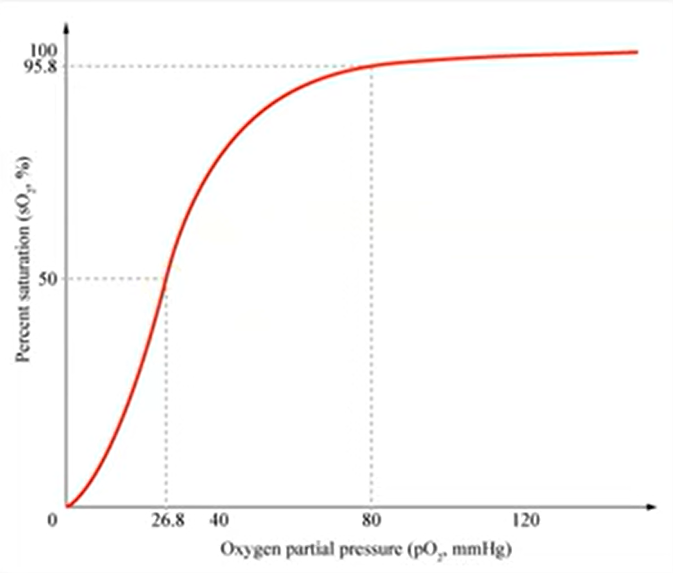
explain oxyhaemoglobin dissociation curve
oxygen is loaded in regions with a high partial pressure of oxygen i.e. alveoli)
unloaded in regions of low partial pressure of oxygen (respiring tissues)
what is the Bohr effect
when a high carbon dioxide concentration causes the oxyhaemoglobin curve to shift to the right
affinity for oxygen decreases because the acidic carbon dioxide changes the shape of haemoglobin slightly
explain haemoglobin molecule
4 polypeptide chains (quaternary)
each polypeptide chain has a prosthetic haem group
what is haem group
-iron ion (Fe2+)
-diatomic (has to be 2 of them i.e. O2)
-associate with 1 molecule of O2
what do higher and lower affinity of haemoglobin mean
higher - associates with oxygen easily but releases oxygen less readily
lower - associates with oxygen less easily but releases oxygen more readily
equation to form oxyhaemoglobin
Hb. + 4O2 >< Hb(O2)4
where from and where to does absorption of lipids happen
from the lumen of the small intestine to the lacteal and blood stream
when do micelles break down in absorption of lipids
when they come in contact with epithelial cells
why do micelles break down when they come in contact with epithelial cell
monoglycerides & fatty acids are non-polar & small
so they can diffuse through the surface membrane of epithelial cells
what do monoglycerides & fatty acids form when transported to endoplasmic reticulum
triglycerides
what forms when golgi apparatus combines triglycerides with cholesterol & lipoproteins
chylomicrons
how are chylomicrons formed
golgi apparatus combines triglycerides with cholesterol & lipoproteins
what are chylomicrons
particles adapted to carry triglycerides
lipoprotein particles that consist of triglycerides, phospholipids, cholesterol and proteins(1-2%)