Unit 1: Structure & Properties of Matter
 Call Kai
 Learn
Learn Practice Test
 Spaced Repetition
 Match
Match Flashcards
 Knowt Play
1/61

Earn XP
Description and Tags
Lesson 1 - Early Atomic Theories, Lesson 2 - Quantum Theory and Quantum Numbers, Lesson 3/4 - Electron Configuration, Lesson 5 - Lewis Structure, Lesson 6 - VSEPR, Lesson 7 - Structure and Properties of Solids, Lesson 8 - Electronegativity + Polarity, Lesson 9 - Molecule Polarity and Intermolecular Forces
Name | Mastery | Learn | Test | Matching | Spaced | Call with Kai |
|---|
No analytics yet
Send a link to your students to track their progress
62 Terms
Democritus (2)
Democritus was the first to speculate that all matter is composed of tiny, elementary particles he called Atoms.
This concept came from intuition and reason
John Dalton (3)
Modern Atomic Theory John Dalton
Elements consist of atoms that cannot be created, destroyed, or divided.
Atoms of a specific element are identical in size, mass, and other properties
J.J Thomson (3)
Discovery of the Electron
using the Cathode Ray Experiment
“blueberry muffin model” or the “plum pudding model” which stated that an atom is a cloud of positive charge with electrons randomly scattered within it.
Ernest Rutherford + Limitations (4)
The Nuclear Model: Ernest Rutherford Nucleus and Protons.
Gold foil experiment: positively charged alpha particles (Helium Nuclei), at a thin sheet of gold foil. alpha particles should have went straight through since the atom was merely gas cloud, but some particles scattered in various angles upon striking the gold foil. (meaning there was sum in the middle that was small and dense + postive charge) atom was still mostly made up of empty space
Limitations: thought electrons should orbit the nucleus like planets —> incorrect
The rutherford model was based on classical physics, which suggested that electrons should orbit the nucleus like planets. However this would imply that every atom would be losing energy constantly, leading to an instant collapse of the universe, which hasn’t happened. (yet)
Niels Bohr (4)
Bohr used the emission spectrum of hydrogen to develop a quantum model for the hydrogen atom.
Bohr discovered that electrons orbit the nucleus in specific energy levels, rather than just floating anywhere.
He assigned each orbit to a particular discrete energy level claiming that electrons could move only in the specific orbits.
When an electron gains more energy (becomes excited), it could move into an orbit farther away from the nucleus
Transition
The movement of an electron from one energy level to another
Ground State
the lowest energy state for an atom
Quantum Mechanics
The application of quantum theory to explain the properties of matter, particularly electrons in atoms
Schrodinger
Schrodinger hypothesized that electrons move in a wave function
In circular standing waves, wavelengths are always multiples of whole numbers.
Orbital
A region around the nucleus where there is a high probability of finding an electron
Heisenberg’s uncertainty principle:
The idea that it is impossible to know the exact position and speed of an electron at a given time.
Atomic Theory, order of scientists, what they discovered.
Democritus (Atom)
John Dalton (Atomic thoery)
JJ. Thomspon (Electron)
Ernest Rutherford (Protons & Nucelus)
Niels Bohr (Electrons orbit & Energy levels)
Shrodinger (Wave function) + Hesienberg (Location & Time)
Wave Function
mathematical equation that describes the wave behaviour of an electron. used to determine electron probability distribution
Electron Probability Distribution
The probability of finding an electron at a given location. Derived from wave equations and used to determine the shapes of orbitals
Quantum Mechanical Model: (3)
A model for the atom based on quantum theory and the calculation of probabilities for the location of electrons.
Electrons can be found in any of these orbitals depending on their energy
Each of these types of orbitals has a set of four numbers called Quantum numbers which describe various properties of the orbital.
The Principal Quantum number (n) (4)
The quantum number that describes the size and energy of an atomic orbital
electron shell/energylevel
As “n” increases energy the energy required for an electron to occupy that orbital increases
This also means that electrons with higher energy are less tightly bound to the nucleus.
Draw the Aufbau Principal
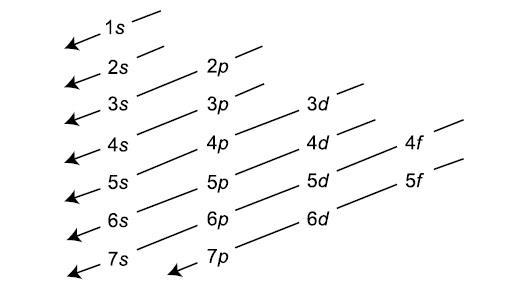
electron shell
An atom’s main energy level, where the shell number is given by the principal quantum number, n= 1, 2, 3 etc
Secondary Quantum Number (l)
The quantum number that describes the shape and energy of an atomic orbital, with whole-number values from 0 to n-1 for each value of n
Subshells: Orbitals of different shapes and energies often referred to as p, d, and f
Subshells
Orbitals of different shapes and energies often referred to as s, p, d, and f
Name the subshells for each Secondary Quantum Number
l = 0 → s (sharp)
l = 1 → p (principal)
l = 2 → d (diffuse)
l = 3 → f (fundamental)
The Magnetic Quantum Number (Ml ): (3)
Describes the orientation of an atomic orbital in space within whole number values between +l and -l (including zero)
The number of different values that ml can have equals the number of orbitals that are possible (ml values are based on l values)
ie. l = 1 (p) -1, 0, 1 (3 orientations)
The Spin Quantum Number (ms) (2)
The quantum number that relates to the spin of the electron; limited to +½ or -½
The electron can spin in only one of two directions
Pauli Exclusion Principle: (2)
In a given atom, no two electrons can have the same set of four quantum numbers. n, l, ml , ms
Because there are only two sets of spin, each orbital can only hold two electrons.
Aufbau principle:
The theory that an atom is “built up” by the addition of electrons, which fill up orbitals starting at the lowest energy orbital before filling higher energy orbitals.
write the electron config to 7s.
1s2 2s2 2p6 3s2 3p6 4s2 3d10 4p6 5s2 4d10 5p6 6s2 4f14 5d10 6p6 7s2
Hund’s Rule (3)
Don't Double Up: Electrons prefer to occupy their own empty "seat" (orbital) first.
Parallel Spins: When they are sitting alone in their own orbitals, they all spin in the same direction (usually represented as arrows pointing up).
Wait Your Turn: They only start pairing up and sharing an orbital once every available spot in that subshell has at least one electron
Order of Lowest to Highest energy Level
s < p < d < f
Transition metals are more stable with a d orbital than a __ s orbital
half full, full
Ionic Bonds (7)
A chemical bond between oppositely charged ions.
Metal + non-metal
Form Crystals lattices
Hard and Brittle
High melting/boiling points
Don’t conduct electricity as solids (but do conduct electricity when dissolved in water)
Can be soluble or insoluble (according to the solubility table)
Molecular Bonds (6)
Molecular (Covalent) Bonds are a chemical bond in which atoms share the bonding electron
(Non metal + Non Metal)
Low melting and boiling points
Do not conduct electricity
Most are insoluble in water
Soft and Pliable
Bonding electron pair:
an electron pair that is involved in bonding, found in the space between 2 atoms
Bonding Capacity
How many e- it would take on in an ionic compound
what does VSEPR stand for
Valence Shell Electron-Pair Repulsion
VSEPR Theory:
A method to determine the geometry of a molecules based on the idea that electron pairs are as far apart as possible.
Electron Pair Repulsion:
The repulsive force that occurs between electron pairs, causing them to be positioned as far apart as possible in a molecule
bonding capacity (2)
highest ← lowest (non-metals)
how many e- it would take on in an ionic compound is its bonding capacity usually
Octet Rule Exception (4)
B-6
Be-4
P-10
S-12
Composite Materials: (3 properties + deff)
A composite material is made of two or more distinct materials that remain separate from each other in the solid phase.
Composite materials:
Have a high strength-to-weight ratio
Are resistant to corrosion
Resist heat and chemicals
What’s a crystal? (2)
A crystal is a solid where atoms, ions, or molecules are arranged in a regular, repeating 3D pattern.
Molecules are individual units, crystals are big repeating structure.
The four major types of crystalline solids are:
Ionic crystals
Metallic crystals
Molecular crystals
Covalent network crystals
Ionic Crystal: (4)
Ionic crystals form when a metal reacts with a non-metal, producing oppositely charged ionic crystals.
In NaCl (s), the ions arrange in a crystal lattice structure w alternating positive and negative ions
High melting points
Not good conductors solid, but good dissolved in water
Metallic Crystals
A metallic crystal consists of closely packed atoms surrounded by a “sea of delocalized electrons” that can move freely.
Electron Sea Theory: Valence electrons are mobile, while the positively charged nuclei are fixed in place.
Metals conduct electricity because their valence electrons can move freely when connected to a battery.
Electrical conductivity
highish mp
Iron (Fe)
Aluminum (Al)
Gold (Au)
Silver (Ag)
Molecular Crystals (4)
Molecular crystals form when individual molecules arrange into a crystal lattice.
Low melting points
Poor electrical conductivity
ie. Iodine, sulfur, carbon dioxide and water
Covalent Network Crystals (4)
A covalent network crystal is a solid where atoms are bonded in a continuous network of covalent bonds.
Diamond is an example; each carbon bonds to four other carbons in a tetrahedral arrangement.
Extremely high melting points
Very hard
Unlike metals, these crystals do not conduct electricity because electrons are held in covalent bonds and cannot move freely.
Carbon Structures (3)
Graphite (slippery, layered structure)
Buckyball (soccer-ball-shaped cage of 60 carbons)
Carbon nanotubes (cylindrical carbon structures)
Doping?
Adding a small amount of another element to modify conductivity. This process allows engineers to create semiconductors with specific conductive properties
Non-Polar Covalent Bond:
A covalent bond in which the electrons are shared equally between atoms:
Polar covalent bonds:
A covalent bond in which the electrons are not shared equally because 1 atom attracts them more strongly than the other.
Electronegativity: (2)
The ability of an atom in a molecule to attract shared electrons to itself.
noble gasses don’t have an electronegativity value
Dipole:
A separation of positive negative charges in a region in space
EN diff meaning
< 0.5 → non polar covalent
0.5 - 0.7 → polar covalent
> 1.7 → ionic
Intramolecular Forces:
The forces that hold together a molecule (Occurs within Molecules)
Intermolecular Forces:
A force that causes one molecule to interact with other molecules (Occurs between molecules)
London Dispersion Force
The only intermolecular force in non-polar molecules. Thought to arise from temporary dipoles (partial charges) due to electron motion.
Small non-polar molecules have few dispersion forces. Large non-polar molecules have many dispersion forces. As molar mass increases melting and boiling points increase.
Dipole-Dipole Force
Attraction between oppositely charged ends of polar molecules
Hydrogen Bonds (not a bond
An attraction between a slightly positive hydrogen (bonded to O, F or N) to the O, F or N atoms on another molecule. A molecule must contain an O-H, F-H or N-H bond, to form a hydrogen bond
What do Intermolecular forces do? (3)
Intermolecular forces affect the physical properties of molecules
stronger IMF → higher boiling point
When compared two samples with similar intermolecular forces, the samples with higher molar masses have higher boiling points.
Quantum Technologies + 3 examples
Quantum technologies are used in devices such as DVD players, cellphones, MRI machines.
BEC (3)
Bose and Einstein predicted a new state of matter in the 1920s (decade).
A Bose-Einstein condensate forms only at temperatures extremely close to 0 K, also known as -278.15 °C.
In a BEC, atoms all collapse into the same lowest quantum energy state.
Laser Technology (8)
A laser stands for "light amplification by stimulated emission of radiation."
Einstein laid the theoretical foundation for lasers in 1917 (year).
The first working visible-light laser was demonstrated by Theodore Maiman in 1960.
A laser produces intense light of a single wavelength (colour).
Laser light waves are described as coherent, meaning they vibrate in the same direction at the same time.
Class 1 lasers are generally safe, while Class 4 lasers can be powerful enough to cut through metal.
In a ruby laser, electrons absorb energy from the flash tube and jump to higher energy levels.
When these electrons fall back, they release photons that trigger other atoms to do the same, a process called photon amplification.
MRI and Quantum Analysis (6)
MRI stands for magnetic resonance imaging.
MRI uses a strong magnetic field to align the hydrogen atoms in the body.
A radio transmitter then applies varying radio waves that cause atoms’ magnetic fields to flip in the opposite direction.
When the radio pulse stops, atoms return to their original spin and release energy, which detectors convert into an image.
MRI is especially useful for scanning tissues such as the brain, internal organs, and muscles.
An advantage of MRI over X-rays or CT scans is that MRI does not use ionizing radiation.