Chapter 3 - Design of Products and Services
 Call Kai
 Learn
Learn Practice Test
 Spaced Repetition
 Match
Match Flashcards
 Knowt Play
1/10

There's no tags or description
Looks like no tags are added yet.
Name | Mastery | Learn | Test | Matching | Spaced | Call with Kai |
|---|
No analytics yet
Send a link to your students to track their progress
11 Terms
Six Phases of the Generic Product Development Process
Phase 0: Planning
Phase 1: Concept Development
Phase 2: System-level design
Phase 3: Design Detail
Phase 4: Testing and refinement
Phase 5: Production ramp-up
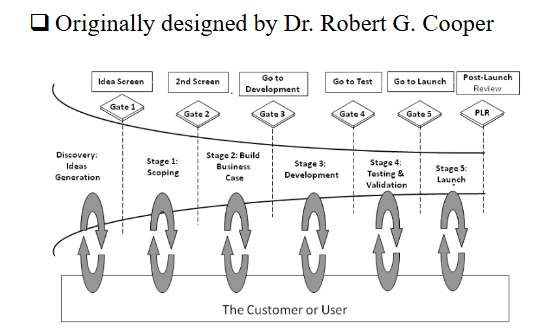
The Stage-Gate Model
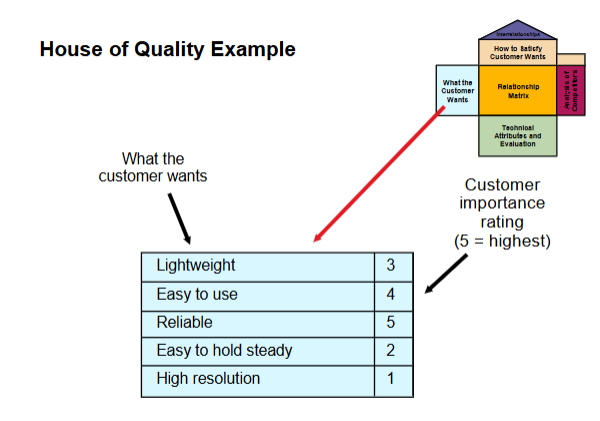
Quality Function Deployment
Designing for aesthetics and the user is generally termed industrial design
Uses interfunctional teams from marketing, design, engineering, and manufacturing (using market research)
Converts expectations and demands into clear objectives and specifications
Customer requirements form the basis for the house of quality
QFD House of Quality
Value Analysis/Engineering (VA / VE)
Purpose is to simplify products and processes, objective is to achieve better performance at a lower cost while maintaining all functional requirements
Does the item have any design features that are not necessary?
Can two or more parts be combined into one?
How can we cut down the weight?
Are there nonstandard parts that can be eliminated
Ecodesign
Incorporation of environmental considerations in the design and development of products or services
The whole life cycle is considered
The product is considered as a system
A multi-criteria approach is used
Designing Service Products
Direct customer involvement introduces significant variability in the process. Questions to address:
How will this variability be addressed?
What are the implications for operation cost and the customer service experience?
Complexity
the number of steps involved in a service and the possible actions that can be taken at each step
Can help determine different resource requirements such as worker skills, layout, and process controls
Divergence
the number of ways a customer/service provider interaction can vary at each step according to the needs and abilities of each.
Can help determine different resource requirements such as worker skills, layout, and process controls
Sensitivity Analysis to Understand Project Trade-Offs
Longer product development time
Higher/lower sales volume
Higher/lower sales price
Higher/lower development costs
Typical Measures of Product Development Success
Time to market
The frequency of new product introductions and the time from initial concept to market introduction
Productivity
Such measures as the number of engineering hours, the cost of materials, and tooling costs are used in these measures
Quality
Measures that relate to the reliability of the product in use, the product’s performance features compared to customer expectations and the ability of a factory or service process to produce the product