Week 16 - Evolution and diversity of plants 1
 Call Kai
 Learn
Learn Practice Test
 Spaced Repetition
 Match
Match Flashcards
 Knowt Play
1/106

There's no tags or description
Looks like no tags are added yet.
Name | Mastery | Learn | Test | Matching | Spaced | Call with Kai |
|---|
No analytics yet
Send a link to your students to track their progress
107 Terms
How long ago did the Byrophytes appear?
Approx. 450 Mya
How long ago did the Vascular plants appear?
Approx. 420 Mya
How long ago did the Gymnosperms appear?
Approx. 360 Mya
How long ago did the Angiosperms appear?
Approx. 140 Mya
How long ago did the grasses appear?
Approx. 70 Mya
What are large swings in global climate driven by?
Solar Forcing: Changes in the sun's energy output (e.g., the "Faint Young Sun" hypothesis).
Atmospheric Composition: Specifically Greenhouse Gases (GHGs) like C02.
Plate Tectonics: Shifting continents change ocean currents, climates, sea levels and early plant evolution. Tectonic activity reshapes earths continents
Earth’s Biota: Life (especially plants) actively removes CO2.
What is the current CO2 concentration?
Approx. 425 ppm
How did volcanic activity effect CO2 concentrations? What was the effect?
It caused mass CO2 outgoings, warming the planet.
Without these mass CO2 outgoings from volcanoes, earth would be a giant snowball planet.
Why despite the high concentrations of CO2, was the Earth not as warm as expected?
In the past, CO₂ levels were high, which would normally increase temperature.
However, the Sun was weaker, producing less solar radiation.
As a result, temperatures were not as high as expected despite high CO₂.
Describe the geological carbon cycle (4 steps).
Step 1: Volcanic CO2 outgassing releases CO2 in the atmosphere. CO2 dissolves in rainwater to form Carbonic Acid (H2CO3).
Step 2: Acidic rain hits silicate rocks, causing Chemical Weathering.
Step 3: Dissolved minerals (calcium/magnesium) wash into rivers and then oceans.
Step 4: Carbon is buried as carbonate minerals in the seafloor for millions of years.
How did byrophytes chemically help accelerate the carbon cycle?
They secreted organic acids to dissolve minerals in rocks.
How did byrophytes physically help accelerate the carbon cycle?
Roots/rhizoids penetrated rock cracks. Expansion and concentration aid physical weathering of rocks.
Where is the effect of byrophytes on the carbon cycle seen?
Mesocosm experiments have shown >5x more weathering of calcium & magnesium silicates due to Bryophytes.
What is the effect of weathering on oceans, subsequently then the carbon cycle?
Increased weathering of rocks releases more phosphorus into the oceans (possibly doubling it).
More phosphorus → stimulates marine productivity (e.g. algae growth).
Increased productivity → more organic carbon is buried in sediments.
When did plants begin to evolve into trees?
Between ~400–300 million years ago (mid-Devonian to end-Carboniferous), plants evolved from small vascular and non-vascular forms into large trees over 35 m tall.
What enabled the evolution of tall plants/trees in drier habitats (on land)?
Lignified vascular system (tracheophytes) enabled increased size & colonization of drier habitats
Which feature/innovation enabled plants/trees to better compete/survive on land?
The evolution of branching allowed plants to grow more complex structures. This helped them compete more effectively for light in dense forests.
What did Pangea form from?
Pangaea formed from the collision of Gondwana and Laurasia.
What is the effect of Pangea formation on the global atmosphere and environment?
This collision caused extensive uplift (mountain building) → increased weathering of rocks.
Increased weathering → greater removal of CO₂ from the atmosphere.
Enhanced equatorial precipitation further accelerated CO₂ drawdown.
Reduced CO₂ levels contributed to global cooling and ice buildup.
What are the 2 advantages of vascularised plants, that enabled them to subsequently colonise new environments?
Higher photosynthetic rates → increased growth potential
Greater resistance to water stress → able to survive in drier conditions
How did the evolution of lignin in vascular plants affect decomposition and soils?
Lignin made plant litter more resistant to decay. This:
Slowed decomposition by microbes
Led to accumulation of organic matter in soils
What did the expansion of vascular land plants with deep roots lead to?
Higher photosynthetic rates
Increased colonisation of land
How did vascular land plants contribute to a drop in atmospheric CO₂ and global cooling?
Produced resistant organic matter → increased carbon burial
Accelerated silicate weathering
Both processes removed CO₂ from the atmosphere
Resulted in global cooling and glaciation
How did cooling create a negative climate feedback on CO₂ levels?
Cooling caused:
Reduced chemical weathering
Reduced biological activity
This slowed CO₂ removal from the atmosphere
Result: negative feedback that stabilised climate
How did coal deposits, used in the industrial revolution, developed?
Through Carbon Sequestration (Coal Formation).
During this period, large amounts of plant material were buried and not fully decomposed. Over time, this led to the formation of massive coal deposits, that were later used in the industrial revolution.
What was the result of pangea movement on the global climate?
It caused decreased precipitation in the continental interior, causing large scale drying.
How does coal form in wet climates?
Forms from the accumulation of peat in wet climates.
In which period were coal deposits abundant in the tropics?
During the Carboniferous (350-299 Ma)
An area of little coal deposition indicates what?
Areas lacking coal deposit provide evidence of a warmer, drier climate, implying reduced rainfall.
How long ago (and in what climate) did major seeds evolve?
In the backdrop of a warmer, drier climate that the evolotion of major seed plants takes place approx. 248-206 Ma.
What were temperatures like during the Cretaceous period?
Temperatures were >10°C higher than today
However, they were gradually decreasing over time
What were global conditions at ~50 million years ago (Ma)?
Ice-free Earth → warm climate
Forested poles
CO₂ levels > 600 ppm
Only ~5 biomes (compared to 9 today) → indicates a more even, less variable climate
How did continental shifts contribute to the formation of arid climates?
Movement of continental plates caused mountain uplift
Mountains altered wind patterns and blocked moisture-bearing winds
At the same time, more water became locked in polar ice caps
This reduced available moisture → increased aridity
Result: formation of deserts and arid biomes
How did mountain formation lead to a long-term decline in atmospheric CO₂?
Increased erosion exposed calcium silicate rocks
Enhanced chemical weathering → removes CO₂
Forms carbonate minerals that are buried in ocean sediments
Result: long-term CO₂ decline (as low as ~180 ppm)
How long ago did cellular life evolve?
Cellular life evolved more than 3,000 Million years ago (Mya)
When are the earliest eukaryotic fossils dated to?
Earliest eukaryotic fossils ~1,600Mya.
When are the earliest cyanobacteria fossils dated to?
Earliest cyanobacteria fossils ~1,900Mya.
What event gave rise to the green lineage of algae?
An endosymbiotic event in which a eukaryotic cell engulfed a photosynthesizing cyanobacteria
What are the key characteristics of green algae?
Contain chlorophyll a and b for photosynthesis
Can be unicellular, colonial, or multicellular
Mostly aquatic (freshwater and marine)
Some form symbiotic relationships
Which life cycle does the green algae follow?
A simple haplontic life cycle.
Describe the simple haplontic life cycle.
The main life stage is haploid (n).
The organism spends most of its life as a haploid individual.
Gametes are produced by mitosis (not meiosis).
Fertilisation forms a diploid zygote (2n).
The zygote immediately undergoes meiosis to produce haploid cells.
What are the 2 major groups of green algae?
Chlorophyta
Charophyta
What is the closest living sister lineage to land plants? How was this relationship identified?
The Zygnematophyceae (a group of charophyte algae). Identified based on shared traits with land plants.
What is Viridiplantae (Chloroplastida)?
Includes all green plants
Composed of green algae + land plants
What is Streptophyta?
A subgroup of Viridiplantae
Includes charophyte algae + land plants
Compare haplontic, diplontic and haplodiplontic life cycles.
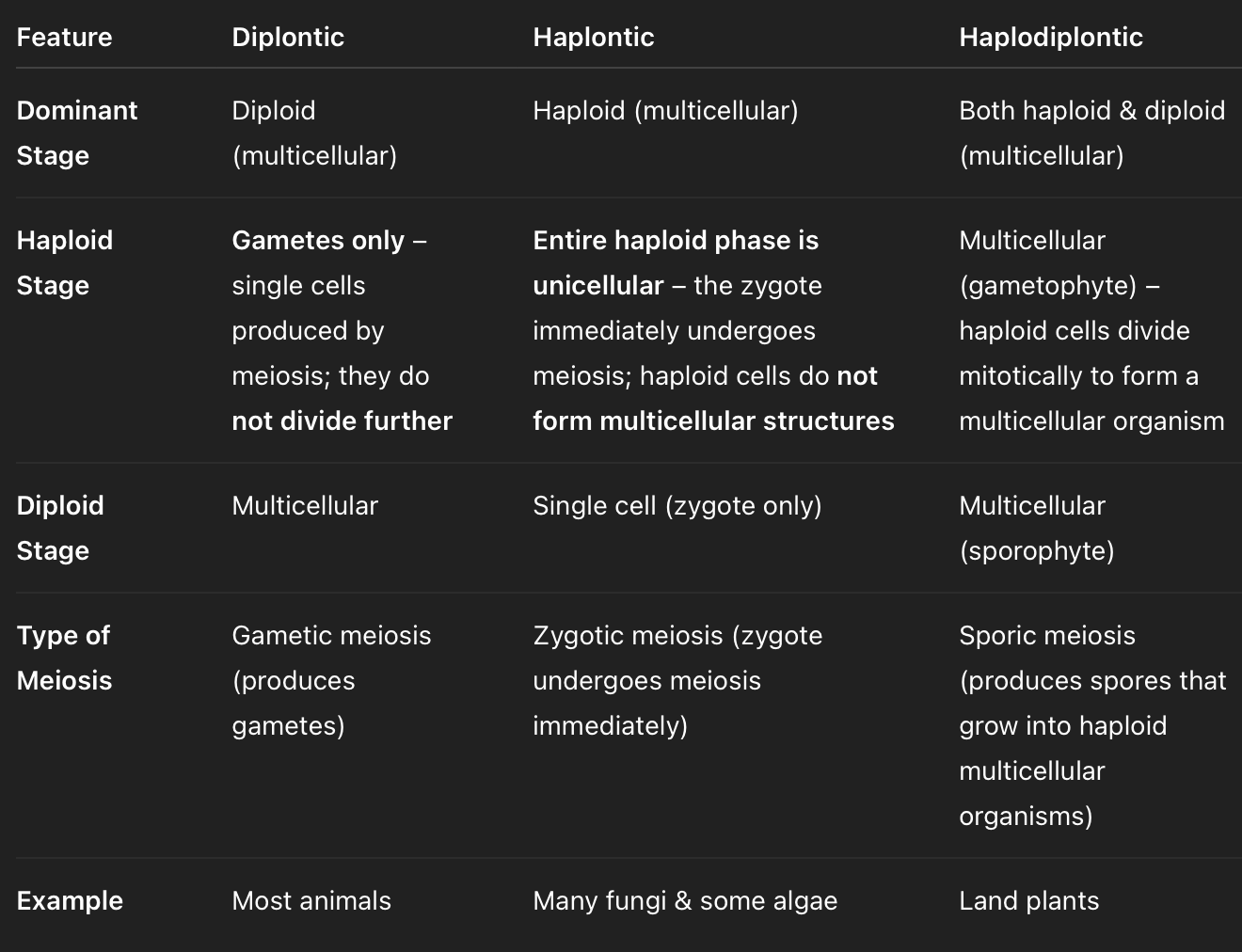
What is zygotic meiosis?
Where the zygote undergoes meiosis immediately after gamete fusion.
Describe the haplontic life cycle of Chara.
Reproductive structures in the haploid thallus
undergo mitosis to produce the haploid
gametes.Gametes fuse during fertilization to produce a
diploid zygote.The zygote undergoes meiosis before
germination to produce the haploid thallus.
Why is Chara important for understanding plant evolution?
Chara is a freshwater green alga and one of the closest living relatives of land plants, and studying its biology and life cycle helps provide insights into how land plants evolved.
In which organisms are diplontic life cycles seen?
In most animals
In which organisms are haplontic life cycles seen?
In green algae and fungi.
In which organisms are haplodiplontic life cycles seen?
Land plants
What structure produces female gametes in Chara?
The oogonium (singular) or oogonia (plural) produces egg cells.
What structure produces male gametes in Chara?
The antheridium (singular) or antheridia (plural) produces sperm cells.
What are rhizoids and what is their function (early adaptations of plants to land)?
Root-like structures that anchor the plant and help absorb water.
What are primitive water-conducting tissues (early adaptations of plants to land)?
Simple tissues that transport water through the plant but are not lignified (less efficient than vascular tissue).
What is the function of the waxy cuticle (early adaptations of plants to land)?
A waterproof layer that reduces water loss from the plant surface.
What is sporopollenin and why is it important (early adaptations of plants to land)?
A tough substance in spores that protects against drying out and UV radiation.
Which adaptations help plants obtain water?
Rhizoids and primitive water-conducting tissues.
Which adaptations help prevent water loss and UV damage?
Waxy cuticle and sporopollenin.
What are the 3 extant (still existing) groups of byrophytes?
Hornwort
Liverwort
Moss
What are the key features of hornwort morphology?
Gametophyte: thallus with rhizoids; antheridia and archegonia develop in chambers within the thallus
Sporophyte: photosynthetic with cuticle and stomata
Example: Anthoceros
What are the key features of liverwort morphology?
Gametophyte: thallus, thin cuticle, simple water-conducting cells, rhizoids, pores
Asexual reproduction: gemmae
Sporophyte: very reduced, no stomata
Example: Marchantia
What are the key features of moss morphology?
Gametophyte: leafy with rhizoids
Sporophyte: non-photosynthetic, stomata on capsule
Conducting cells present in both generations
Example: Physcomitrium
What are hydroids and what is their function in moss?
Hydroids are dead cells that conduct water and are similar to xylem in higher plants.
What are leptoids and what is their function in moss?
Leptoids are living cells that conduct photosynthate (sugars) and are similar to phloem in higher plants.
What are the key steps in the moss life cycle?
Haploid gametophyte produces gametes by mitosis; female gametes formed in the archegonium
Fertilization produces a diploid zygote
Zygote undergoes mitosis and develops within the archegonium into a multicellular diploid sporophyte
Sporophyte produces haploid spores by meiosis in the sporangium
Spores undergo mitosis and germinate to form a new haploid gametophyte
What are the key reproductive innovations of early land plants?
Haplodiplontic life cycle with alternation of generations (both haploid and diploid stages multicellular)
Sporic meiosis produces spores that develop into gametophytes
Multicellular sporophyte with sporangia for spore production
Multicellular archegonia that produce and protect the female gamete
Retention of the zygote and embryo within the gametophyte for protection and nourishment
What is an antheridium?
An antheridium is a male structure that produces sperm and is also called a microgametangium.
What is an archegonium?
An archegonium is a female structure that produces the egg and protects the zygote, and is also called a megagametangium.
What is a sporangium?
A sporangium is a structure with no gender that produces spores via meiosis.
What are the limitations of Bryophytes?
Water Dependency: Still require a film of water for flagellated sperm to swim to the egg.
Size: Limited by the lack of a complex vascular system.
Dominance: The Gametophyte (n) is the dominant, visible generation; the sporophyte is dependent on it.
What is the first complete fossil of a land plant?
The first complete fossil of a land plant is Cooksonia.
What are the key features of Cooksonia?
Cooksonia had a simple branching system and is considered a possible intermediate between bryophytes and tracheophytes.
When did Cooksonia live?
Cooksonia lived around 428 million years ago during the late Silurian period to the early Devonian.
What defines vascular plants (tracheophytes)?
Vascular plants are defined by the presence of tracheids/xylem, which are specialized water-conducting cells.
What is the name for vascular plants?
Tracheophytes.
What are the 2 extant groups of tracheophytes (vascular plants)?
Lycophytes:
→ club mosses.
Euphyllophytes:
→ ferns, horsetails and whisk ferns.
→ seed plants.
What is a tracheid?
Tracheids are elongated, dead cells with lignified (strengthened) cell walls that provide support and allow water transport. They have pits in their walls that enable water to move between adjacent cells. The evolution of tracheids was a key innovation that gave rise to vascular plants.
What is a stele?
The stele is the central region of a stem (or root) that contains the vascular tissues—xylem and phloem - responsible for transporting water, nutrients, and sugars throughout the plant.
How did sporophyte structure evolve from bryophytes to vascular plants?
Bryophytes: single axis sporophytes (no branching) that terminate in sporangia
Early extinct vascular plants: simple branching sporophytes that still terminate in sporangia
Vascular plants: simple to highly branched sporophytes with indeterminate growth and lateral sporangia
What is dichotomous branching (Cooksania)?
Dichotomous branching is equal splitting of the sporophyte into two branches, as seen in Cooksonia, and represents a simple form of branching to increase spore production.
What is pseudo-monopodial branching (Selaginella)?
Pseudo-monopodial branching is unequal splitting where one branch becomes dominant, as seen in Selaginella, representing an intermediate stage of increasing complexity.
What is monopodial branching (Seed plants)?
Monopodial branching involves one main trunk with lateral branches, as seen in seed plants, representing a more complex form that increases spore production.
What are rhizomes?
Rhizomes are underground stems that grow horizontally and produce roots and shoots (leaves) at different points along their length.
What is the difference between leaves in lycophytes and euphyllophytes?
Lycophytes have microphylls, which are small, simple leaves with a single vein, while euphyllophytes have true leaves (megaphylls) that are larger, more complex, and have branching veins.
What are the key characteristics of lycophytes?
Life cycle: Dominant sporophyte with a small, free-living gametophyte
Growth form: Branching sporophyte (often pseudomonopodial in some species like Selaginella)
Reproduction: Can be
Homosporous (one type of spore, e.g. Lycopodium)
Heterosporous (two types of spores, e.g. Selaginella)
Reproductive structures: Spores are produced in strobili (cone-like structures)
Examples:
Lycopodium (club moss)
Selaginella (spike moss)
What are the key characteristics of ferns (Euphyllophytes)?
Life cycle: Dominant sporophyte with a small, free-living gametophyte.
Leaves (fronds): Young leaves show circinate vernation (coiled “fiddlehead” that unrolls as it grows).
Reproduction: Most are homosporous (produce one type of spore).
Reproductive structures:
Sporangia are grouped into clusters called sori (singular: sorus), usually found on the underside of fronds.
Key feature: Young fronds are called fiddleheads due to their coiled shape.
What are the key characteristics of horsetails (Euphyllophytes)?
Life cycle: Dominant sporophyte with a small, free-living gametophyte
Growth form: Jointed (segmented) stems with reduced leaves arranged in whorls; stems often contain silica
Growth habit: Grow from rhizomes (underground stems)
Reproduction: Usually homosporous (one type of spore)
Reproductive structures:
Spores are produced in strobili (cone-like structures) at the tips of stems
What are the key characteristics of ferns (Euphyllophytes)?
Life cycle: Dominant sporophyte with a small, free-living gametophyte
Growth form: Dichotomously branching sporophyte
Reproduction: Homosporous (one type of spore)
Reproductive structures: Sporangia are borne on lateral branches
Describe the stages of the fern (A euphyllophyte) life cycle.
The sporophyte is a free-living plant and is the dominant stage.
The sporophyte produces sporangia, which contain clusters of spores.
The spores germinate into a small, free-living gametophyte.
The gametophyte produces gametes: sperm and eggs.
The sperm swim through water to reach the egg (fertilization requires water).
Fertilization restores the diploid stage, producing a new sporophyte.
The cycle repeats.
What is sporophyte dominance in ferns (A euphyllophyte)?
The sporophyte is the large, dominant, and long-lived phase, while the gametophyte is small, short-lived, and reduced.
What are the reproductive innovations of vascular plants?
Dominant sporophyte – Large, long-lived, main plant.
Reduced gametophyte – Small, short-lived, often independent.
Heterospory (in some groups) – Two types of spores: microspores and megaspores.
How did the process of sporophyte generation in plants evolve?
Across time there was a shift from: The sporophyte being dependent on the gametophyte → The gametophyte being dependent on the sporophyte.
What key innovations first appeared in the sporophyte of plants?
Stomata – Pores for gas exchange.
Vascular tissues – Transport water and nutrients (xylem & phloem).
True leaves – Increase photosynthesis.
Pollen – Male gametes travel without water.
Seeds – Protect, nourish, and disperse embryos.
Flowers – Specialized reproductive organs for pollination.
Fruits – Help with seed dispersal.
What is the difference between homospory and heterospory?
Homospory:
Produces one type of spore (all identical)
Spores typically develop into bisexual gametophytes
No differentiation into male and female gametophytes
Heterospory:
Produces two types of spores:
Megaspores → develop into female gametophytes
Microspores → develop into male gametophytes
In heterospory, what do megaspores develop into?
Into female gametophytes.
In heterospory, what do microspores develop into?
Into male gametophytes.
Which organism displays heterospory?
Selaginella.
What is special about the female gametophyte (megagametophyte) in Selaginella?
The megagametophyte (female gametophyte) is very small and reduced
It develops inside the megaspore → called endosporic development
It has two main functions:
Produces archegonia (structures that make eggs)
Provides nutrient tissue to support development