Biology 30 AP - DNA & Protein Synthesis
 Call Kai
 Learn
Learn Practice Test
 Spaced Repetition
 Match
Match Flashcards
 Knowt Play
1/60

There's no tags or description
Looks like no tags are added yet.
Name | Mastery | Learn | Test | Matching | Spaced | Call with Kai |
|---|
No analytics yet
Send a link to your students to track their progress
61 Terms
History of DNA
1952 - Rosalind Franklin → X-ray diffraction shows helical structure of DNA
1953 - Watson & Crick → publish paper on complete double helix structure of DNA
used Franklin’s photograph (Photograph 51) of DNA and claimed it as their own
Where is DNA found in plants?
nucleus
chloroplast
mitochondrion
What is unique about the way mitochondrial DNA is passed down?
only inherited from the mother (thousands in the egg compared to the sperm)
DNA structure
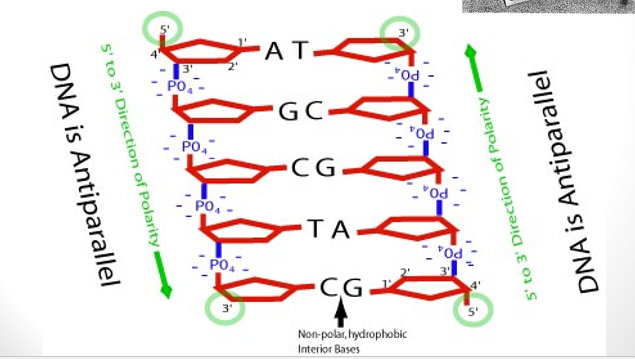
double helix (twisted ladder)
each unit made of sugar (deoxyribose) and phosphate backbone with nitrogen base (“rungs”) held together with covalent bond (a.k.a. nucleotide)
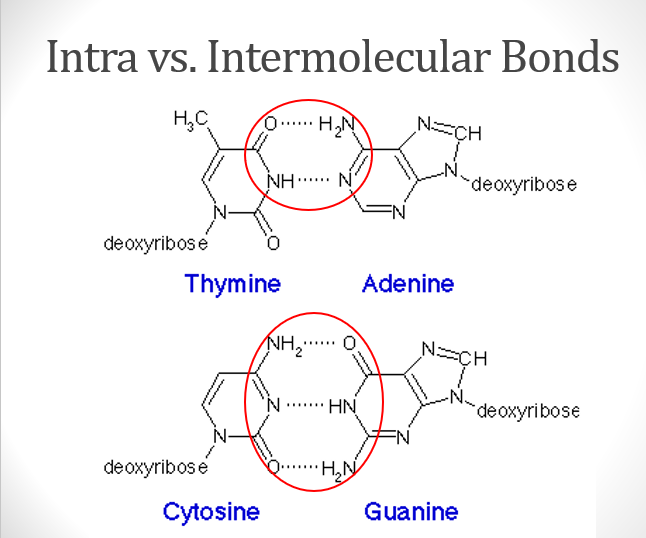
nitrogen bases from one backbone connects to complementary nitrogen base on another backbone via hydrogen bonds
strands are put together anti-parallel → one strand is “upside-down” compared to other
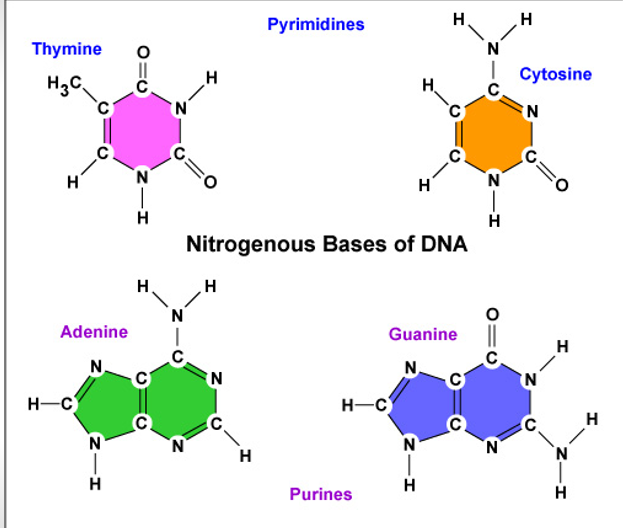
Four nitrogen bases
adenine (A)
guanine (G)
thymine (T)
cytosine (C)
Two types of bases
purines (double ring structure) - A & G
pyrimidines (single ring structure) - T & C
How do the bases pair with one another?
adenine always forms bonds with thymine (A—T): 2 HB
guanine with cytosine (G—C): 3 HB
purines pair with pyrimidines
Strongest intramolecular bonds
within a nucleotide
covalent bonds
Strongest intermolecular bonds
between bases
hydrogen bonds
Chargaff’s Rule
amount of A=T
amount of C=G
DNA replication
DNA must be replicated for growth and reproduction
cells must have nucleotides available → from food
semi-conservative → new double helices each contain one original (parent) strand and one new (daughter) strand
number of enzymes required
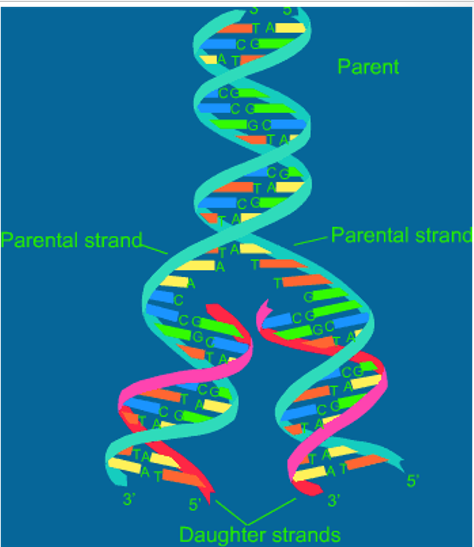
Unwinding enzymes/helicase
unzip double helix
Primase
initiate replication site by adding primers
Polymerase
add new nucleotides
remove primer
checks for mistakes
Ligase
glues fragments together when synthesis complete
Mutations
unrepaired mistakes
rate increases with exposure to mutagens (toxic chemicals, radiation)
germ cells (eggs/sperm) mutation → passed on to every cell of offspring
mutations may cause cancer and produce more viable offspring (increased variation)
Steps of DNA replication
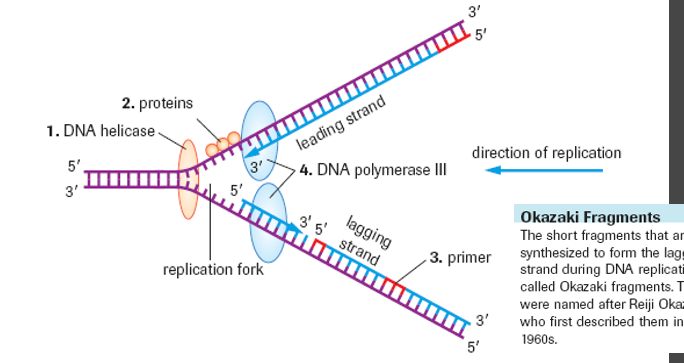
Helicase unwinds/unzips DNA
Binding proteins keeps DNA unzipped
Primase adds RNA primers
Polymerase III adds bases in 5’ to 3’ direction starting at primer
leading strand → continuously towards replication fork
lagging strand → Okazaki fragments away from replication fork
Polymerase I removes RNA primer and replaces with DNA nucleotides
Ligase glues new DNA
Polymerase III fixes mistakes
Gene
functional sub-unit of DNA that directs production of one or more polypeptides (protein molecules)
not spaced regularly among chromosomes
information converted into a specific characteristic/trait through polypeptide production
order of the base pairs in a DNA molecule makes up the genetic code of an organism
Genome
sum of all DNA that is carried in each cell of an organism
includes genes and regions of non-coding DNA
What is there no set relationship between?
number of genes in an organism and total size of its genome
Polypeptides
made up of amino acids → 20 amino acids → proteins made up of polypeptides
one gene → one protein → up to 50 000 amino acids = gene expression = protein synthesis
How many bases are needed to code for all 20 amino acids?
if 1 - only 4 amino acids could be coded (A,C,T,G)
if 2 - only 16 amino acids could be coded (4×4)
if 3 - up to 64 amino acids can be coded (4×4×4)
Codon
group of 3 bases
Central dogma
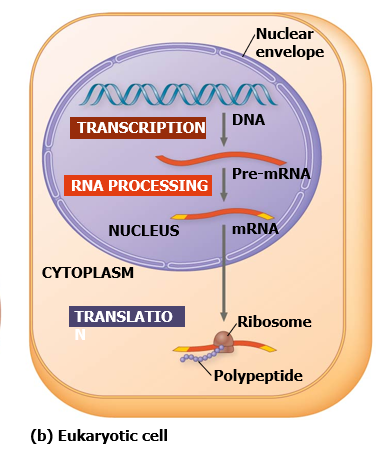
eukaryotic cells
DNA → mRNA → protein
transcription → translation
DNA vs. RNA
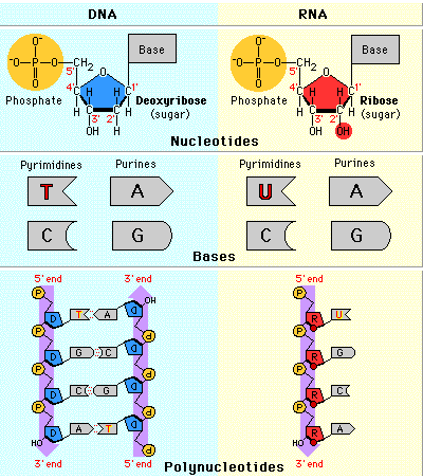
copy of gene required to synthesize specific protein is made in nucleus → mRNA (messenger RNA)
one strand of the DNA is copied into RNA → similar to DNA synthesis except:
much shorter strand
single-stranded
no thymine → uracil pairs with adenine (AUGC)
sugar backbone made from riboseRNA polymerase is used to make mRNA
Transcription
promoter and terminator sequences (before and after gene) tell RNA polymerase where to start and stop
once mRNA is made, it is processed
introns (non-coding regions) removed (“incised”)
leaves only exons (“expressed”) as template
mRNA moves to cytoplasm → protein synthesis occurs at ribosomes
Coding sense strand
5’ to 3’
carries the translatable genetic code and has the same sequences as the mRNA
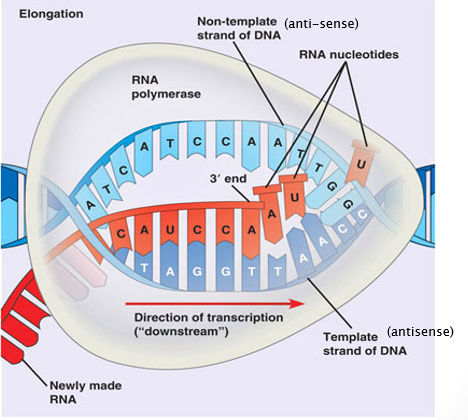
Non-coding/template anti-sense strand
3’ to 5’
template for producing mRNA which directs the synthesis of a protein
complementary to the RNA and acts as a guide
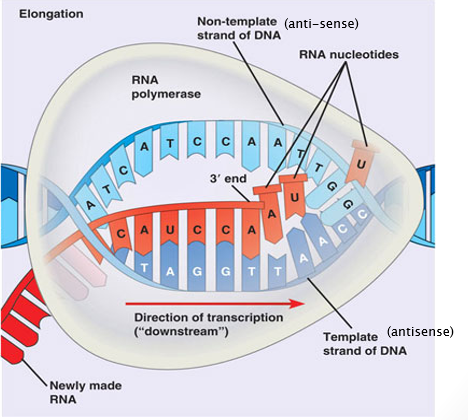
How does RNA polymerase work?
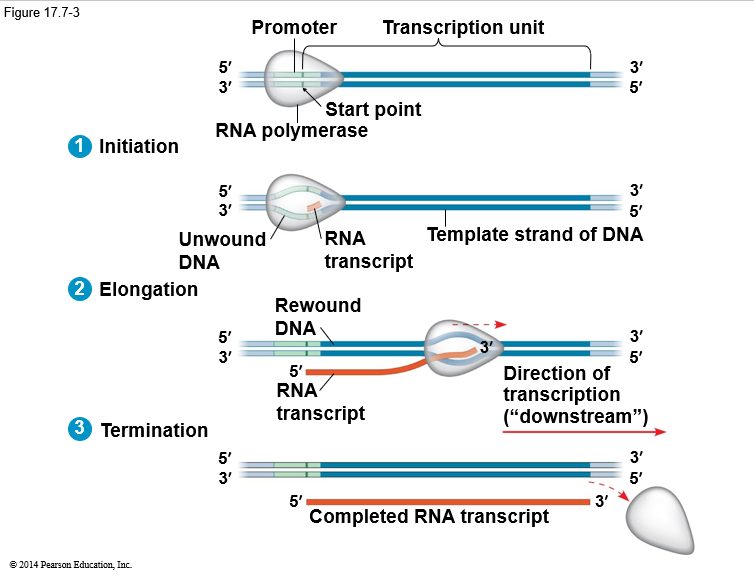
Binds to promoter on template strand (promoter sequence comes before the gene and tells the RNA polymerase where to start)
Section of double helix opens (initiation)
RNA Polymerase II moves along DNA and completes a strand of mRNA complementary to DNA (elongation)
Copies the DNA in 5’ to 3’ direction
Adds one nucleotide at a time (uracil - U - instead of thymine - T)
Reaches a terminator sequence that signals transcription to stop (termination)
mRNA released and travels to cytoplasm
DNA recoils
Summary of genetic code
redundant → multiple codons can code for the same amino acid
continuous → no spaces between codon = mistakes can compromise entire protein
(nearly) universal → almost all organisms build proteins with same codons & aa combos
Translation
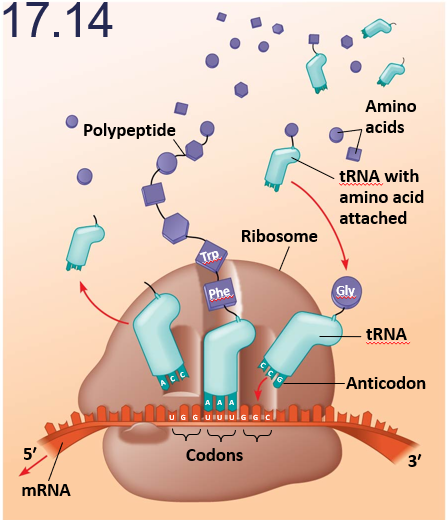
interpretation of mRNA to make protein takes place on ribosomes (protein/RNA complex) in cytoplasm
mRNA attaches to ribosome → tRNA (transfer RNA) brings amino acids to complex → polypeptide chain assembled
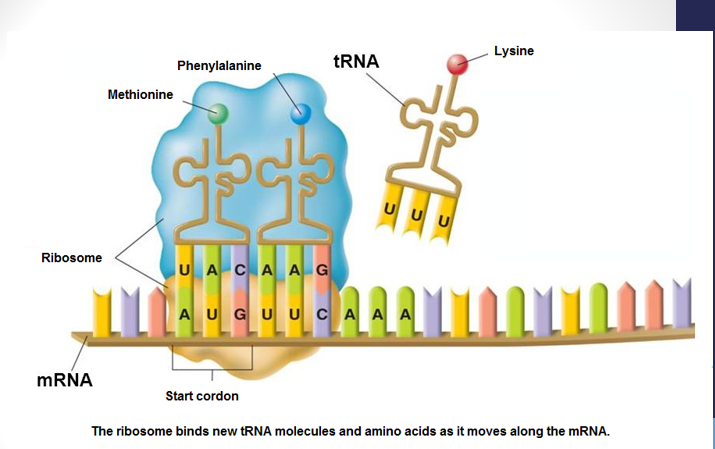
tRNA (transfer RNA)
two specific ends
one that reads the mRNA triplet (anticodon)
one that attaches to a specific amino acid
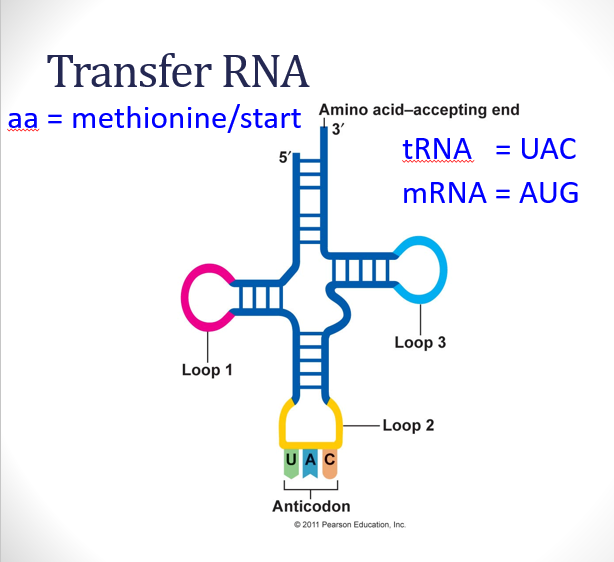
Anticodon
complementary to mRNA codon
Ribosomes
small organelles made mainly of rRNA (and some proteins)
made of a large and small subunit
match tRNA with the corresponding mRNA
brings in enzymes to form bonds between amino acids
free ribosomes → synthesize proteins for use in the cell
RER → synthesize proteins for excretion
Initiator/start codon
all proteins start with it
AUG → always methionine
Terminator codon
all proteins end with it
UAA, AUG, or UGA (stop codons)
Steps of translation
mRNA binds to ribosome so that two codons are exposed
tRNA with methionine is first to bind
second tRNA (to match second codon) brings in second amino acid
enzyme catalyzes peptide bond formation
ribosome moves one codon along chain and process repeats
continues until stop codon reached
at stop codon, chain is released and ribosome complex disassembles
Mutation
permanent change in genetic material of an organism
can occur in somatic or germ cells
Somatic cells
mutations in non-sex cells that are not passed on to next generation → can lead to cancer
Germ cells
mutations in reproductive/sex cells → passed on from one generation to the next
Point mutation
affects one or few nucleotides
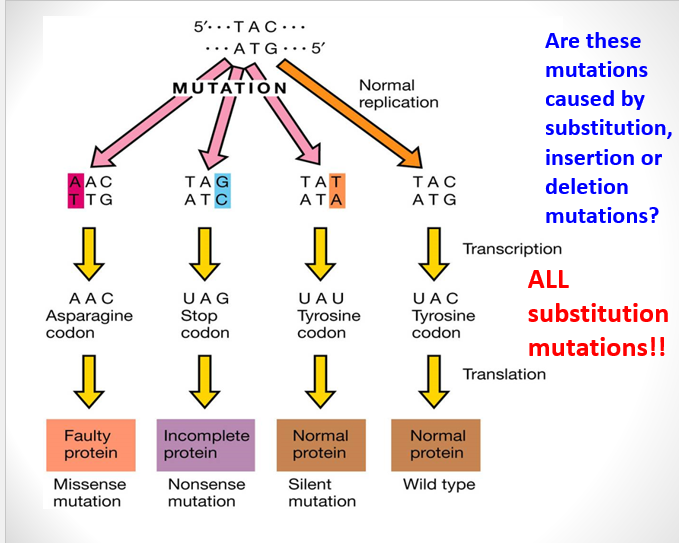
Substitution
one nucleotide for another
3 types: missense, silent, and nonsense
Frameshift mutations
insertions (additions): an extra base is slipped in
deletions: a base is missing
not multiples of three
Missense mutation
results in an altered protein (e.g. sickle cell anemia)
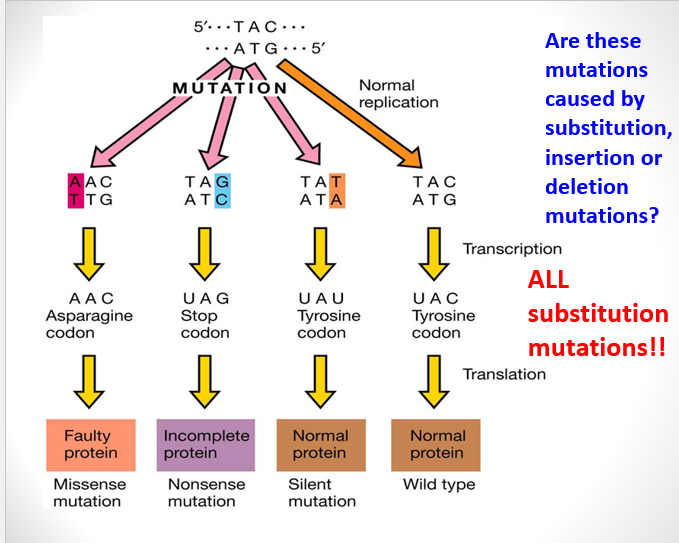
Silent mutation
has no effect on a cell’s metabolism
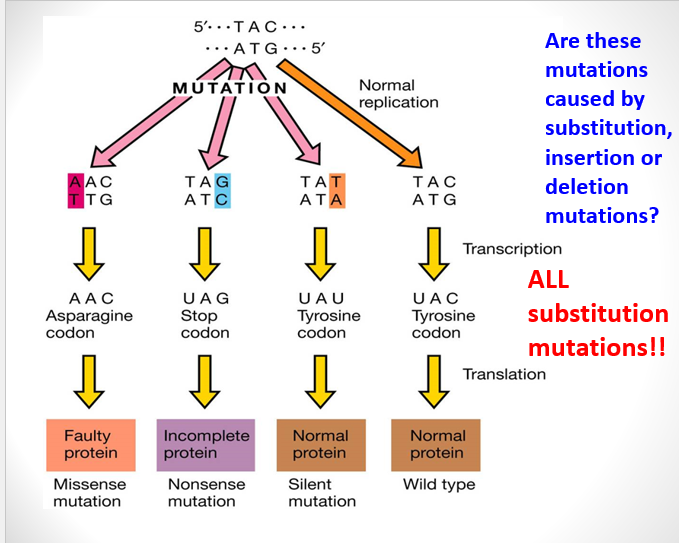
Nonsense mutation
renders gene unable to code for a functional polypeptide
Causes of mutations
spontaneous → DNA polymerase incorrectly pairing nucleotides
induced by a mutagen
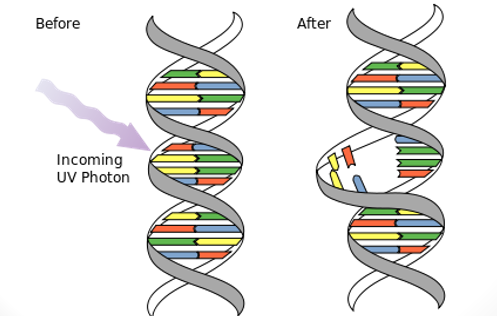
3 types of mutagens
most are carcinogenic (cancer-causing)
physical: forcibly break a nucleotide sequence, causing random changes (e.g. X-rays, UV radiation)
chemical: enters cell nucleus and causes permanent change in genetic material by reacting chemically with DNA (nitrites)
infectious: bacterial or viral pathogen
Is mutation always bad?
frameshift mutations can result in whole new protein → rarely good for an organism
can sometimes generate new, beneficial trait (genetic variability)
Genetic engineering
science of manipulating genes that carry hereditary information
Recombinant DNA Technique
Use a restriction enzyme to cut a piece of DNA from selected organism to isolate the desired gene
Use the same restriction enzyme to cut vector DNA
Insert DNA (gene) into vector genome
Glue pieces together with ligase. Allow recombination
Have hope the cells take up the DNA
Vector will replicate, transcribe, and translate inserted gene along with rest of organism’s genome
Use a selection technique to determine if DNA has recombined the way you want it to in vector
Selection technique
include a gene for antibiotic resistance beside the gene you really want
try to grow the vector/bacteria in that medium → only those bacteria that have incorporated the DNA you want will be able to grow
clone the bacteria
Vectors
provide a means to get genes where you want them → viruses, bacteria, plasmids (circular and self-replicating)
Restriction enzymes
recognize specific sequences and cut DNA into pieces with uneven ends → “sticky ends”
Ligase
used to rejoin sticky ends of DNA cut with restriction enzymes
Targeted gene expression
insert human genes into other organism’s genome that cause some human traits to be expressed (e.g. HGH, insulin)
Gene therapy
providing “fixed” genes to people with faulty genes (must use a vector)
Biological warfare
insert harmful genes into harmless bacteria → transfer to food/water → mass infections with resistant bacteria
3 goals of the Human Genome Project (1990-2003)
determine the location of all of the genes in the human genome
sequence the bases in the human genome
determine the function of the genes
DNA fingerprinting
copied (by polymerase chain reaction - PCR) and cut DNA is separated using gel electrophoresis
Gel electrophoresis
electric current run through gel
negatively charged DNA attracted to positive cathode
larger strands move slowest
branding pattern appears