Biology - DNA Technology and Genomics
0.0(0)
Studied by 14 people Call Kai
 Learn
Learn Practice Test
 Spaced Repetition
 Match
Match Flashcards
 Knowt Play
Card Sorting
1/54

Last updated 4:35 PM on 6/6/26
Name | Mastery | Learn | Test | Matching | Spaced | Call with Kai |
|---|
No analytics yet
Send a link to your students to track their progress
55 Terms
1
New cards
on average, ___% of DNA between humans is the same:
99\.9
2
New cards
what are three kinds of noncoding DNA?
promoters, enhancers, introns, telomeres
3
New cards
name the 4 steps in DNA identification:
PCR method, restriction enzymes, gel electrophoresis, DNA fingerprinting
4
New cards
This machine is used the PCR method:
thermocycler
5
New cards
The PCR method is used to ______ DNA sequences:
amplify
6
New cards
describe the PCR method:
the DNA sample is mixed with DNA polymerase, nucleotides, and primers. This solution goes through cycles of heating and cooling, which replicates the DNA.
7
New cards
restriction enzymes:
cut DNA at specific sequences
8
New cards
what do restriction enzymes naturally do?
cut up foreign DNA in bacteria
9
New cards
what do the restriction enzymes produce?
restriction fragments
10
New cards
single-strand overhanging ends on restriction fragments:
sticky ends
11
New cards
sticky ends are the key to:
joining DNA restriction fragments originating from different sources
12
New cards
how can you add a piece of DNA from another source with restriction enzymes?
cut both sources with the same restriction enzyme so they have the same sticky ends
13
New cards
gel electrophoresis seperates nucleic acids or proteins on the basis of what?
size or electrical charge
14
New cards
describe gel electrophoresis:
the DNA mixtures are placed in a well at one end of the gel slab, a negative electrode is attached near the DNA-containing end and a positive electrode is attached on the other side, DNA molecules travel towards the positive side, after 1/2 hour, the shorter molecules have moved further than the longer ones, separating them by length
15
New cards
the difference in restriction fragments:
restriction fragment length polymorphisms
16
New cards
what is the purpose of DNA fingerprinting?
permanently preserves the sorted DNA fragments
17
New cards
describe the DNA fingerprinting process:
a positively charged nylon membrane is pressed over the gel, attracting the DNA fragments.
18
New cards
what are probes?
small fragments of minisatellite DNA tagged with radioactive phosphorous
19
New cards
what are probes used for?
used to find a gene in a mass of DNA
20
New cards
the number of repeated units in minisatellites are called:
VNTRs
21
New cards
how many VNTR loci does DNA fingerprinting compare?
5-13
22
New cards
combining genes from different sources produces:
recombinant DNA
23
New cards
plasmids:
small, circular DNA molecules that are separate from the bacterial chromosome
24
New cards
what do plasmids do?
they cause bacterium to cause diseases or protect themselves against antibiotics
25
New cards
this enzyme pastes DNA fragments together:
DNA ligase
26
New cards
how do different DNA fragments bond?
they hydrogen bond
27
New cards
a bacterial cell takes up the recombinant plasmid through:
transformation
28
New cards
the recombinant bacteria then reproduces to form:
a clone of cells
29
New cards
how are cloned bacteria cells used?
directly or to produce protein
30
New cards
vector:
short piece of DNA that are used to copy genes and used in cloning
31
New cards
vectors can be:
plasmids or phages
32
New cards
genomic library:
the entire collection of all the cloned DNA fragments from a genome
33
New cards
name 2 ways that scientists can identify a clone with a desired gene:
test for the protein product and use nucleic acid probes to test
34
New cards
True or False: There is RNA processing in bacterium:
False
35
New cards
which enzyme is responsible for cDNA?
reverse transcriptase
36
New cards
where do scientists get reverse transcriptase?
retrovirus
37
New cards
cDNA stands for:
complementary DNA
38
New cards
cDNA do not have _____, making it shorter than usual DNA
introns
39
New cards
what does the Human Genome Project do?
mapped out the entire human genome
40
New cards
according to the Human Genome Project, how many genes do we have?
around 25,000 genes
41
New cards
what is the most common bacterium used for genetic engineering?
agrobacterium tumefaciens
42
New cards
what is the plasmid of agrobacterium tumefaciens?
ti plasmid
43
New cards
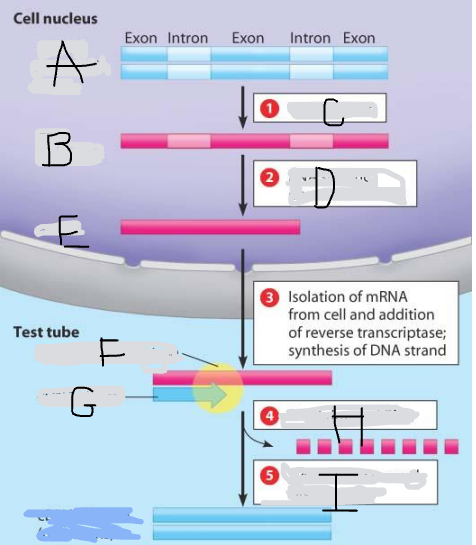
A:
DNA of eukaryotic gene
44
New cards
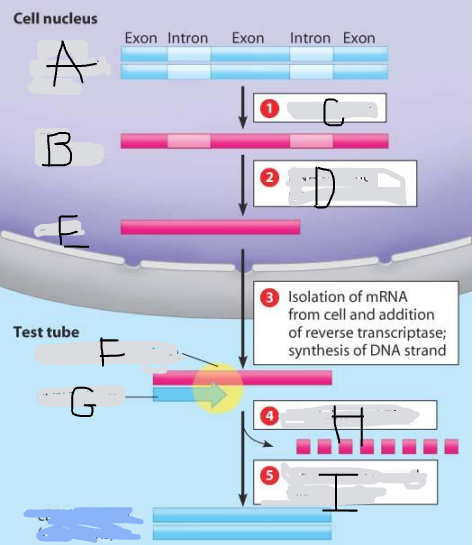
B:
RNA transcript
45
New cards
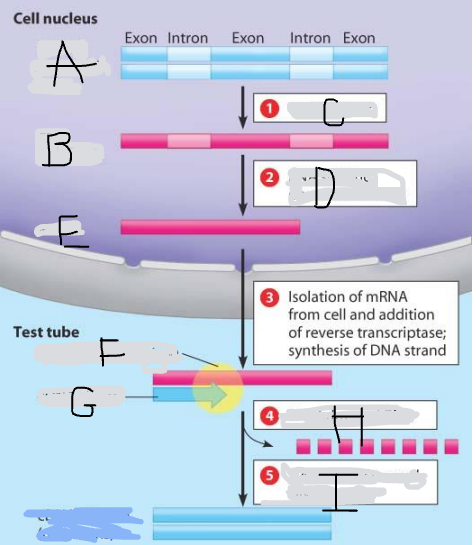
C:
transcription
46
New cards
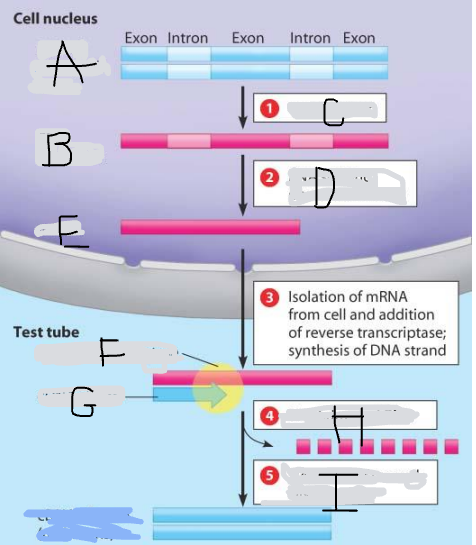
D:
RNA splicing
47
New cards
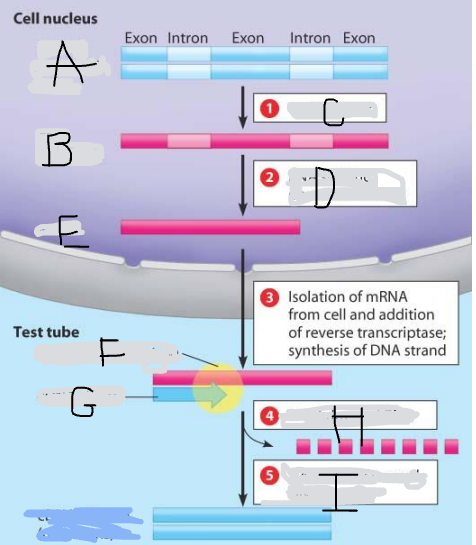
E:
mRNA
48
New cards
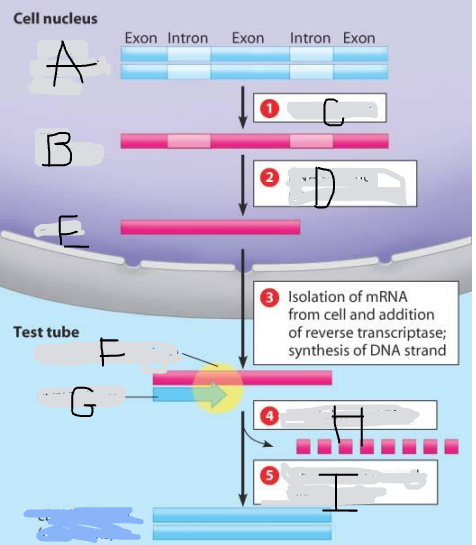
F:
reverse transcriptase
49
New cards
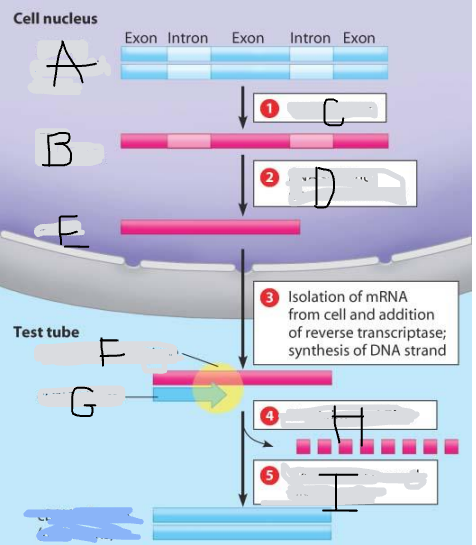
G:
cDNA
50
New cards
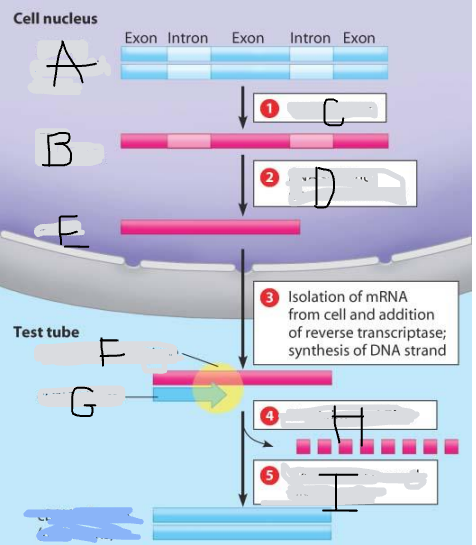
H:
RNA breakdown
51
New cards
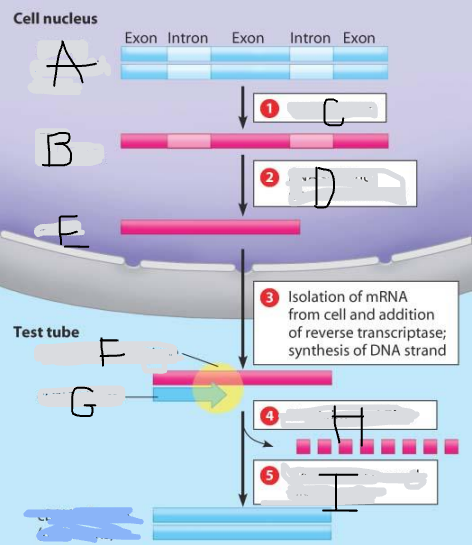
I
synthesis of second DNA strand
52
New cards
give 4 examples of uses of gene cloning:
pest resistance gene in plants, bacterium can clean up waste, protein makes snow form at higher temperatures, proteins that dissolve blood clots in heart attack therapy
53
New cards
what products do E. coli produce?
insulin, growth hormone, interleukin-2, cellulase, taxol, interferons
54
New cards
what products do S. cerevisiae produce?
interferons and hepatitis B vaccine
55
New cards
what products do mammalian cells produce?
erythropoietin, factor VIII, tissue plasminogen activator