Hand
 Call Kai
 Learn
Learn Practice Test
 Spaced Repetition
 Match
Match Flashcards
 Knowt Play
1/61

There's no tags or description
Looks like no tags are added yet.
Name | Mastery | Learn | Test | Matching | Spaced | Call with Kai |
|---|
No analytics yet
Send a link to your students to track their progress
62 Terms
what is the palmar surface of the hand also called?
volar surface
what does a ray describe?
decribes on metacaral bone and its associated phalanges
how many bones are in the hand?
The hand consists of 27 bones, including the carpals (8), metacarpals (5), and phalanges (14).
how is the thumb labeled in its anatomical position?
the dorsal surface (where the thumbnail reisdes) faces laterally, the palmar surface faces medially, the radial surface faces anteriorly, and the ulnar surface posteriorly
which arches support the natural concavity of the hand?
three arches- the proximal and distal arches. and the longitudinal arch
what forms the proximal transverse arch of the hand?
the distal row of carpal bones, is static and rigid and forms the carpal tunnel, the keystone is the capitate
what forms the distal transverse arch?
the distal ends of the MCP joints, the distal arch is mobile compared to the proximal end, keystone is the MCP joints of the central metacarpals (2-3)
what forms the longitudinal arch?
follows the general shape of the second and third rays, the keystone is the 2nd and 3rd MCP joints
what is the function of the CMC joints?
to allow the concavity of the palm to fit around many objects
which digits form the most stable and fixed central pillar in the hand?
the second and third digits
which is the most mobile CMC joint?
the thumb CMC joint, followed by the fifth, then the fourth, allowing them to “fold” around the hand’s central pillar
what kind of joints are the CMC joints of the second and third digits?
planar to complex saddle joints with interlocking surfaces that create the central pillar of the hand
what motions create the “cupping” motion of the CMC joints of the 4th and 5th digit?
flexion and “internal” rotation of the ulnar metacarpals toward the middle digit to deepen the palmar concavity
how many degrees of flexion and extension do the 4th and 5th CMC joint have when the other is constrained?
approx 20 degrees
how many degrees of flexion/extension does the fifth digit have when the fourth is unconstrained?
about 44
what does the mobility of the fourth and fifth CMC joint provide while clenching a fist?
improves the effectiveness of a grasp, enhances interaction with thumb
which is the most complex CMC joint?
the thumb- its saddle shape allows thumb opposition which allows the encircling of objects help within the thumb, as well as greatly enhances the dexterity of human precision
what is the shape of the longitudinal diameter of the proximal articular surface of the thumb metacarpal?
convex (allowing rolling and sliding in opposite directions during abduction and adduction)
what is the shape of the tranverse diameter of the the proximal articular surface of the thumb metacarpal?
concave (allowing rolling and sliding in the same direction during flexion and extension)
what plane does abduction/adduction of the CMC joint of the thumb occur in?
sagittal plane around a medial lateral axis
what plane does flexion and extension of the CMC joint of the thumb occur in?
frontal plane around an anteroposterior axis
what are the phases of opposition of the thumb?
first phase is abduction, next is the flexion and medial rotation, and reposition involves adduction adn extension-lateral rotation
is the capsule of the CMC joint of the thumb loose or tight?
loose to accommodate a large and circular ROM
what is the function of the ligaments of the CMC joint of the thumb?
help control extent and direction of joint motion, maintain alignment and stability, and dissipate forces produced by activated muscles
what motions do the anterior (palmar) oblique ligament resist (and which are they slack in?)
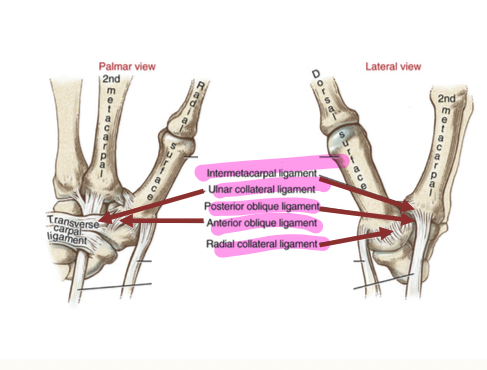
a thin and weak ligament, is slack and opposition, flexion, and abduction, taut in full extension
ulnar collateral ligament (of thumb)
part of the transverse carpal ligament, is taut in abduction and extension
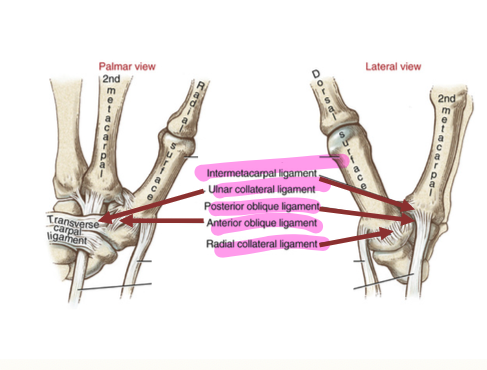
which motions are the intermetacarpal ligament of the thumb taut in?
taut in opposition, flexion, and extension
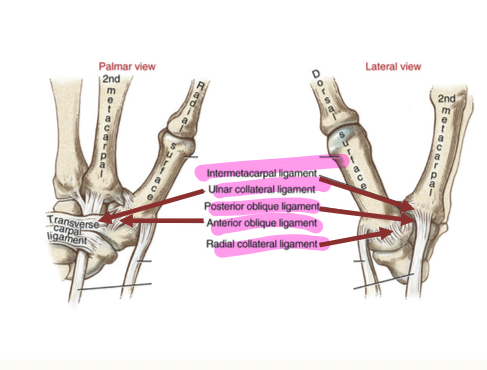
radial collateral and posterior oblique
relatively thick and strong, densley populated with sensory fibers, taut in opposition, flexion, and abduction
what are the ligaments within the capsule of each MCP joint that provide stability?
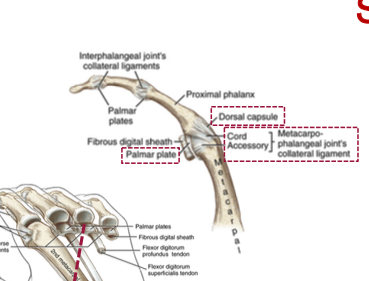
radial and ulnar collateral ligaments, palmar (volar) plate which is a dense and thick fibrocartilage
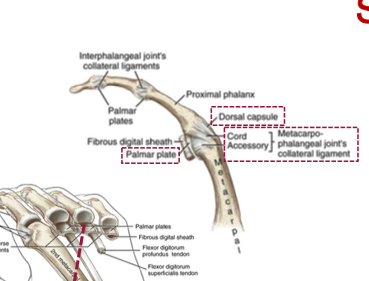
what is the primary function of the palmar plates?
to strengthen the strucutre of the MCP joints and limit the extremes of extension
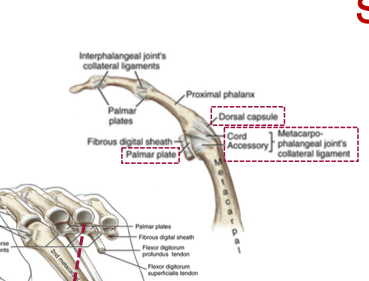
how many degrees of freedom are there in the MCP joints?
2- flexion/extension and abduction/adduction
accessory motions of the MCP joints
are motions that occur passively (passive mobility), include distraction-compression, translation, and axial rotation which allows the fingers to better conform to shapes of held objects and increase control of grasp
how many degrees of freedom are there in the MCP of the thumb?
just one- allows flexion/extension in the frontal plane around an anterior-lateral axis of rotation, abduction/adduction is super limited and considered accessory motion
how many degrees of freedom do the PIP and DIPs have?
1- allows flexion/extnesion
what is the approximate ROM of the PIP?
flexion of 100-120, minimal extension with flexion greater in ulnar digits
what is the approx ROM of the DIPS
flexion of 70-90, extension 0-30
what is the appoximate ROM of the IP of the thumb?
active flexion: 70, passive extension: beyond neutral to 20 degrees
how can contractures be limited if immobilization is necessary>?
position the wrist and hand into a position of function- 20-30 degrees of extension with slight ulnar deviation, 35-45 of MCP flexion, 15-30 of PIP and DIP flexion, and 35-45 of thumb abduction
what position does the position of function create?
a slightly opened and cupped hand, with the wirst in the position to maintain optial length of the finger flexor muscles
what are the extrinsic flexor muscles of the digits?
flexor digitorum superficialis, flexor pollicis longus, and flexor digitorum profundus
what do the distal attachments of the extrinsic finger flexor muscles travel through on their way to their distal attachment?
fibrous digital sheaths aka the protective fibro-osseus tunnels
what are the structures found within the digital sheaths that prevent bowstringing of the tendons called?
flexor pulleys
how are the major pulleys classified compared to the minor pulleys
major (A2 and A4) attach to the shafts of the proximal and distal phalanx, and minor (A1, A3, A5) attach to the palmar plate at each of the three joints within a finger
which ligaments of the thumb act as pulleys for the passage of the tendon of the flexor pollicis longus?
annular and oblique ligaments
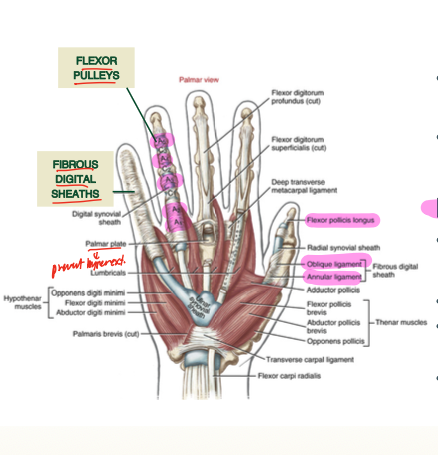
how can extrinsic digital flexors isolate flexion at one joint despite crossing muscle joints?
other muscles contract synergistically with the digital flexors to prevent flexion across all the joitns
what is tenodesis action?
refers to the passive flexion of the fingers and thumb that occurs as the wrist is extended, occurs due to stretch on the extrinsic digital flexors
what are the extrinsic extensors of the fingers?
extensor digitorum, extensor indicis, extensor digiti minimi
what is the function of the extensor mechanism (extensor expansion) of the fingers?
transfers extensor force distally throughout the entire finger
how does the extensor mechanism form?
the extensor digitorum’s tendon splits into three parts, creating a hood-like structure over the proximal phalanx (the central band), which attaches to the dorsal base of teh middle phalanx and diverges into two lateral bands that run to the distal phalanx.
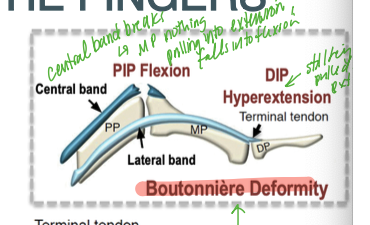
what occurs when the central band of the extensor mechanism ruptures?
boutonniere deformity as the PIP is no longer held into extension and falls into flexion, with the lateral band intact and pulling the DIP into hyperextension
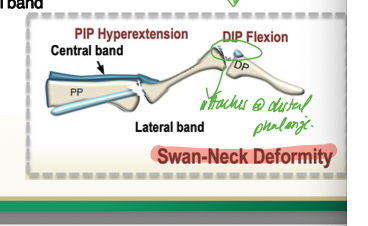
what occurs when the lateral band of the extensor mechanism ruptures?
swan neck deformity as the DIP falls into flexion as the lateral band is slackened, and the central band intact continues to pull the PIP into hyperextension
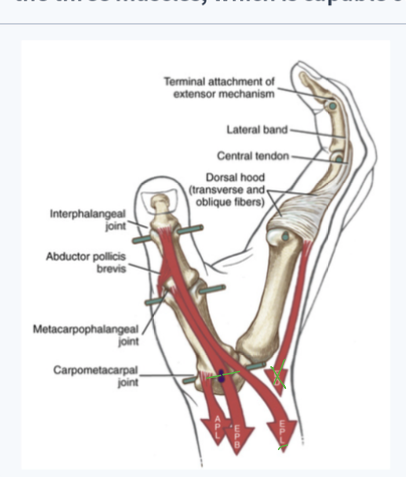
based on the figure, which muscle is capable of adduction?
extensor pollicis longus
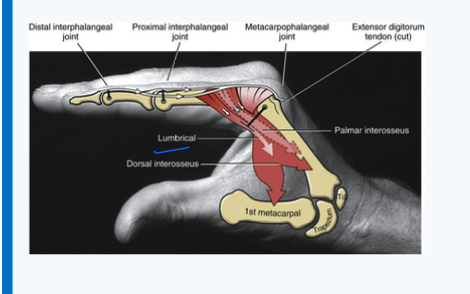
based on the figure, which muscle has the greatest moment arm for flexion of the MCP joint of the index finger?
lumbrical
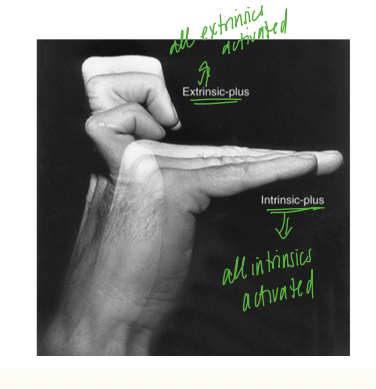
what is the extrinsic plus position?
with the MCP extended and the PIP and DIP flexed- all the extrinsic muscles are activated (ED, FDS, FDP)
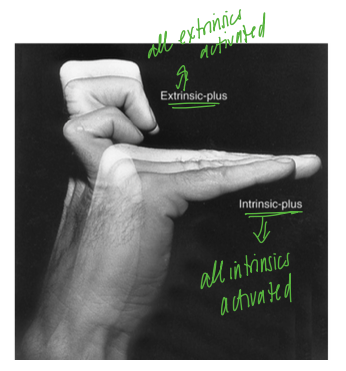
what is teh intrinsic plus position?
with the MCP flexed and the DIP and PIP extended- all instrinsics are activated (lumbricals adn interossei)
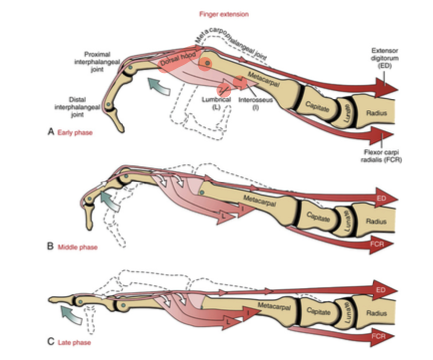
how does finger extension progress (phases)?
early phase: extensor digitorum extend MCP joint, middle phase: intrinsic muscles assist ED with extension of PIP and DIP joints. late phase: muscle activation continues through full finger extension
how does finger flexion progress (phases)?
early phase: flexor muscles activley flex the joints of finger, late phase: muscle activation continues (ED helps to decelerate flexion of the MCP joint)
which muscles are activated when flexing the fingers against resistance or at relatively high speed?
FDP , FDS, and interosseus muscles to some extent
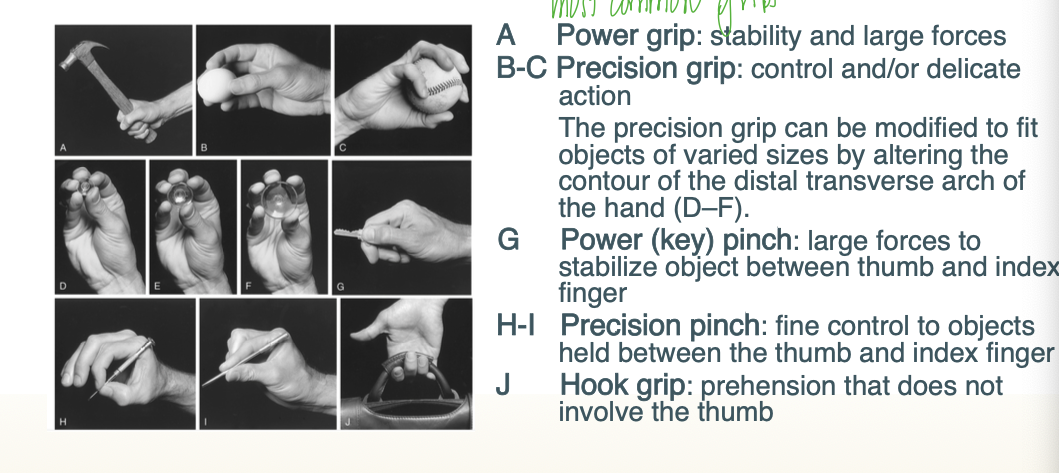
types of grip
includes teh power grip, the precision grip, teh power (key) pinch, the precision pinch, and the hook grip
what are the primary extensors of the fingers?
the extensor digitorum and intrinsic muscles (lumbricals and interossei)
what is the arthrokinematics of the CMC joints?
the irregular surfaces of the CMC joints prohibit standard roll adn slide arthrokinematic descriptions
what do the MTP joints serve as in terms of the mobile arches of the hand?
serve as keystones