2.1 Demand Theory
 Call Kai
 Learn
Learn Practice Test
 Spaced Repetition
 Match
Match Flashcards
 Knowt Play
1/16

There's no tags or description
Looks like no tags are added yet.
Name | Mastery | Learn | Test | Matching | Spaced | Call with Kai |
|---|
No analytics yet
Send a link to your students to track their progress
17 Terms
demand
willingness and ability of a consumer to pay a certain amount for a good or service at a specified price and a prticular point in time
law of demand
as the price of a good or service rises, the quantity demanded falls, and as the price of a good falls, the quantity demanded rises (ceteris paribus)
negative relationship between quantity demanded and price
what are the three assumptions underlying the law of demand?
real income effect
substitution effect
law of diminishing marginal utility
real income effect
when a change in the price of a good affects consumers’ purchasing power
e.g. a lower price increases a consumer’s purchasing power since with the same amount of money they can afford to buy more of that good
substitution effect
change in the quantity demanded of a good when its price changes, making it more or less expensive relative to other goods
-consumers will substitute away from more expensive goods in favour of cheaper alternatives
-as the price of a good falls, the quantity demanded increases partly because the good offers greater satisfaction to the consumer per unit of money spent compared to its substitutes
law of diminishing marginal utility
as more of a good is consumed, the additional satisfaction (marginal utility) gained from each extra unit consumed decreases, and so consumers will only buy more of the good if its price falls
utility
satisfaction that a consumer derives from consuming a good or a service
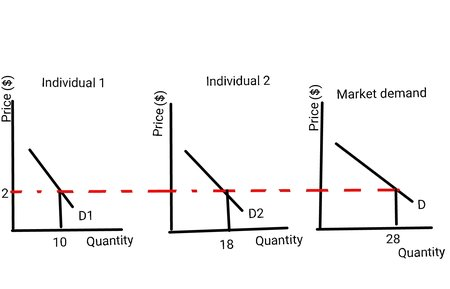
individual demand
quantity of a good or service that a single consumer is willing and able to purchase at various prices over a given period of time, specific to that consumer’s tastes and preferences
market demand
total quantity of a good or service that all consumers in a market are willing and able to purchase at various prices over a given period of time
how to figure out market demand given individual demand curves
5 non-price determinants of demand
income
tastes and preferences
future price expectations
price of related goods (substitutes and complements)
number of consumers
normal goods
positive relationship between consumer income and demand
e.g. fresh food, new cars
inferior goods
negative relationship between consumer income and demand
e.g. instant noodles, public transport
necessity goods
as household incomes rise, the demand for necessity goods will rise but at a less than proportionate rate relative to the rise in income
type of normal good
e.g. bread, housing, electricity
luxury goods
as household income rise the demand for the luxury goods will rise but at a greater than proportionate rate relative to the rise in income
strong positive correlation between income and demand
e.g. holidays, branded clothing
what causes a movement along the demand curve
change in the price of a good or a service itself
what causes a shift in the demand curve
a change in any of the non-price determinants altering the quantity demanded at every point