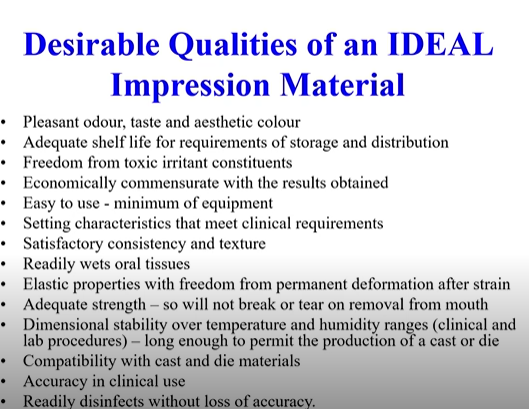
Impression materials for fixed prosthodontics
 Call Kai
 Learn
Learn Practice Test
 Spaced Repetition
 Match
Match Flashcards
 Knowt Play
1/36

There's no tags or description
Looks like no tags are added yet.
Name | Mastery | Learn | Test | Matching | Spaced | Call with Kai |
|---|
No analytics yet
Send a link to your students to track their progress
37 Terms
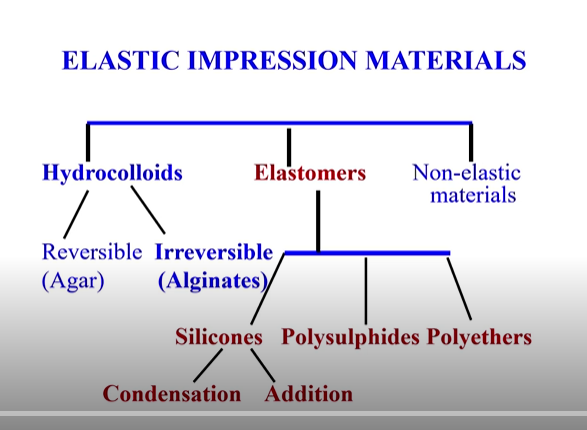
Elastic impression materials can be used for (5)
Partial dentures
overdentures
Implants
Crowns
bridge work
All of the impression materials
Impression materials
Should be easy to mix otherwise? (4)
Affects setting time
May not set evenly throughout
Affect tear strength and elongation at break
take up both clinical and patient time
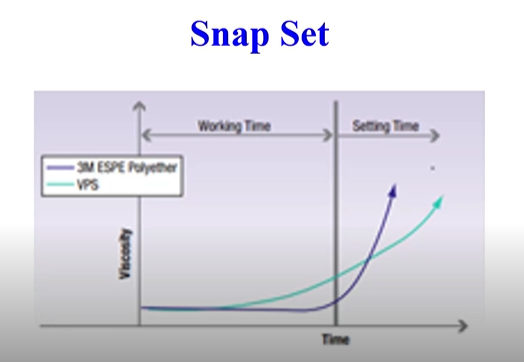
Impression materials should have what about the working time and setting time?
Long working time: enough to mix, place in the tray, and position tray correctly in the mouth
Quick setting time: the tray should remain in the mouth for a short time otherwise it becomes very uncomfortable for the patient
Overall 2 main properties prior to impression taking?
Easy to mix
Long working time and short setting time
Intra-oral, during impression making
the material should be? (5)
Hydrophilic: so does not shy away from moist oral structures to record fine details
Flow: Ability to flow around the preparation without slumping, otherwise certain details will not be recorded
Capture good detail
Good taste and odour
Snap set: Rapid transition from the unset to the set state, in rheological terms: plastic to elastic state, should not start setting before the the working time ends, and when working time does end it should set immediately
While removing from the mouth:
the set material should be: (3)
Easy to remove: the tray should not get stuck so that it needs to be cut away together with the impression material (depends on the rigidity of the material)
High tear strength: So that it does not tear during removal leaving bits of material in the mouth
Good recovery from deformation: When the material is being removed from the mouth it is elongated, after elongation it should bounce back to its original state as rapidly as possible (don’t want any permanent deformation when removing from undercuts)
After removal from the mouth, the material should have what? (2)
Dimensional stability - in air it should not shrink
Can be disinfected without loss of accuracy: must not swell/shrink in disinfection solutions, water or moist humid environments
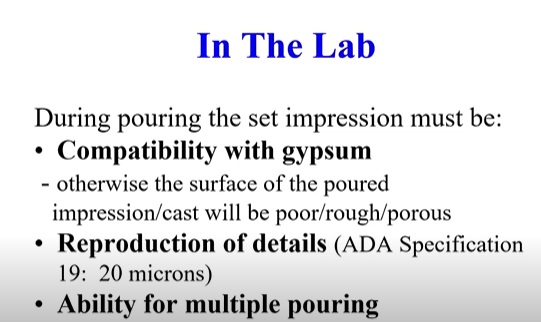
In the lab, during pouring, the impression must be? (3)
Compatible with gypsum
Reproduction of details
Ability for multiple pouring (to make a study cast and cast to make the actual prosthesis on)
Why are elastomers used over alginate and agar?(3)
what can they be used for?
cost?
Strength and dimensional stability
They produce an accurate replica of teeth and supporting tissues
Crowns, bridges and inlays/onlays
More expensive than alginates/agar
Elastomers vs hydrocolloids (1 property)
Alginates can be accurate if what?
Elastomers include?
More accurate
Alginates can be accurate if poured immediately after setting
Condensation/addition silicones, PE, PS
Elastomeric materials are available in a range of ()
viscosities
The viscosity of the elastomeric impression materials is dependent on? (2)
Filler content and molecular weight of the polymer
What are the different viscosities? (5)
Putty, heavy, medium, light and wash
light/wash - least amount of filler
2 pastes can be dispensed as? (5)
two separate tubes
Two tubs of putty
or tub of putty and tube
Double barrel cartridge (dispensing gun)
Pouches for Pentamix
Advantages of double barrel cartridges and pouches for Pentamix? (2)
Avoid incomplete mixing
Prevent introduction of air bubbles
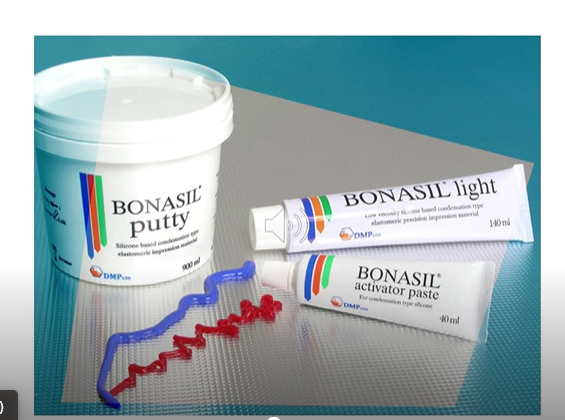
Monophase technique using medium viscosity disadvantages? (3)
Monophase technique - using on viscosity to take an impression
Compared to the light body: Reduced ability to flow into intra coronal and gingival crevice and surface reproduction may not be as good as the light bod material
Greater amount of polymerisation shrinkage compared to heavy body (as it has less filler in comparison)
Why can the light-bodied/wash material not be used by itself?
Due to containing little filler, it does not have the strength and body, so it will tear easily when removing the tray/impression from the mouth
Therefore you have to use a range of viscosities
Therefore the light bodies material should be used with what?
wash used with?
used in combination with a high viscosity paste
Wash is used with a putty in a stock tray
what is the role of the lighter and heavier bodies?
Light-bodied/wash material records the fine detail
Heavy-bodied/putty material acts as a base to support the light material
Describe the Putty and Wash twin mix/One stage technique?
The wash material is syringed around the teeth/the prepared tooth/teeth
The putty is loaded into the tray and inserted immediately after syringing the wash material
Disadvantage of this technique? (heavier and lightwash?
)
Difficult to control thickness of wash material
As higher viscosity putty displaces the wash material - critical areas captures in putty rather than the light body and so detail capture is compromised
What is the putty and wash two step/stage technique
and the two types within this?
The putty is used to take an impression before starting the preparation
After preparing the teeth, the wash material is syringed on the prepared teeth - can also be placed in tray over the putty
and the tray with putty material is reinserted over the wash
spacer or no spacer (polythene sheet over the teeth)
Disadvantages of twostep/stage technique? (2)
Difficulty to reposition the tray correctly after the first putty impression
Time - takes longer
What is the dual viscosity technique? and the role of the different viscosities?
Heavy and light-bodied pastes are used in combination
Heavy/medium-bodied material is extruded in the tray
Light-bodied is syringed around the teeth of interest and can also be placed on heavy/medium material in the tray
Tray then seated in the mouth and the material is allowed to set prior to removal
Light body paste can flow into undercuts and record fine detail
They heavy bodied material will force the light body material into the gingival sulcus and reparation detail
Heavy-bodied material is more rigid so acts as a support for the light-bodied material
Which viscosity will take longer to set?
The light bodied material will take longer to set
after extruding some of it, leave some on the side to assess set
Advantages of these techniques?
Fine detail recorded
Dis of one stage and 2 stage technique?
One stage : both pastes have to be mixed simultaneously
Two stage: time taken for two impressions and difficulty in repositioning the tray after the first impression
General setting reaction (2 possible types), to form what?
What does the reaction type affect?
When both pastes are mixed together, via a condensation or addition reaction they form a 3D network of cross-liked molecules
The two reactions affect the dimensional stability of the set material
Addition - no by-products
Condensation - elimination of a small molecule resulting in shrinkage of the set material
Condensation silicone:
what type of phobic?
Dis?
Hydrophobic
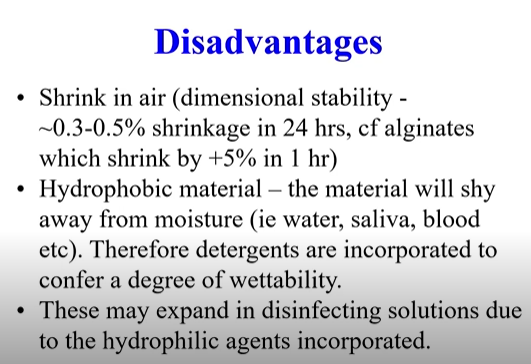
Shrink in air (dimensional stability)
Hydrophobic - shy away from moisture, detergents incorporated to confer a degree of wettability
Disinfection: detergents may expand in disinfection solutions due to hydrophilic agents incorporated
The mouth still needs to be fairly dry
Erratic setting behaviour when a liquid catalyst is used
Limited shelf life, mainly with liquid catalyst
Addition silicones:
phobic?
Hydrophobic, manufacturers incorporate surfactant to confer a degree of wettability
Disadvantages of addition silicones?
2 (adv)
Free water in plaster reacts with unreacted Si-H groups - releasing Hydrogen and giving porous models - recommended to pour the impression 30 minutes after taking (so that all the Si-H groups are consumed)
Setting can be seriously impaired when handled with natural rubber gloves (S poisons Pt catalyst)
Hydrophobic material - shy away from moisture (water/blood/saliva) - so detergents added to confer a degree of wettability
the mouth still needs to be fairly dry
Hydrophobic additions may expand during disinfection
% elongation and tear strength are adequate
Best elastic recovery (bounce back to original shape)
Polyether (IMPERGUM)
phobic?
setting reaction?
Hydrophilic material
Set via cationic addition reactions
Disadvantages of Impregum/PE?
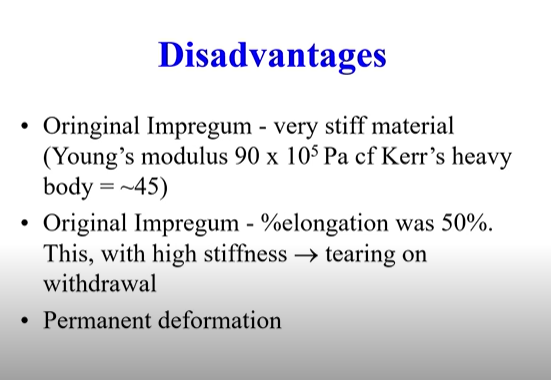
Original: very stiff and low elongation at break - tearing on withdrawal
Permanent deformation
Hydrophilic: Dimensional stability on prolonged contact with water - material swells so do not wrap in a damp napkin - disinfection also a problem
Polysulphides
setting reaction?
CONDESNATION REACTION
Disadvantages of PS? (4)
Dimensional stability - shrinks
Slow setting
Dirty to handle and unpleasant smell
Elastic recovery not as goof as silicones and PE - permanent set (although it has good elongations at break)
Overall the desirable qualities of an ideal impression material