Lecture 18 - Salmonella
 Call Kai
 Learn
Learn Practice Test
 Spaced Repetition
 Match
Match Flashcards
 Knowt Play
1/54

There's no tags or description
Looks like no tags are added yet.
Name | Mastery | Learn | Test | Matching | Spaced | Call with Kai |
|---|
No analytics yet
Send a link to your students to track their progress
55 Terms
What does Salmonella look like under a microscope?
Gram-neg rods
Motile
Oxygen requirements of salmonella
Facultative anaerobe
Salmonella do not ferment ________ and produce ______
lactose; H2S
Where does non-typhoidal salmonella (S. enterica) live?
Animals and humans
GI tract
What diseases can S. enterica (NTS) cause?
Bacteremia in immunocompromised hosts
Gastroenteritis
Where does S. enterica (Typhi) mainly live?
Humans only
What exposure caused gastroenteritis in humans?
Reptile exposure
Salmonella — acid resistant or acid labile?
Acid labile (sensitive to acid)
Does freezing kill Salmonella?
No. Not readily killed by freezing.
Must be properly cooked to eliminate.
Salmonella — resistant to desiccation?
Yes. Can survive drying → explains outbreaks in dried foods/spices.
Salmonella — intracellular or extracellular?
Facultatively intracellular.
Can survive inside macrophages (SPI-2).
What is the function of Salmonella SPI-1?
Encodes a Type III Secretion System (T3SS) that allows invasion of intestinal epithelial cells.
What is a Type III Secretion System?
A nano-scale needle complex that injects bacterial effector proteins into host cells.
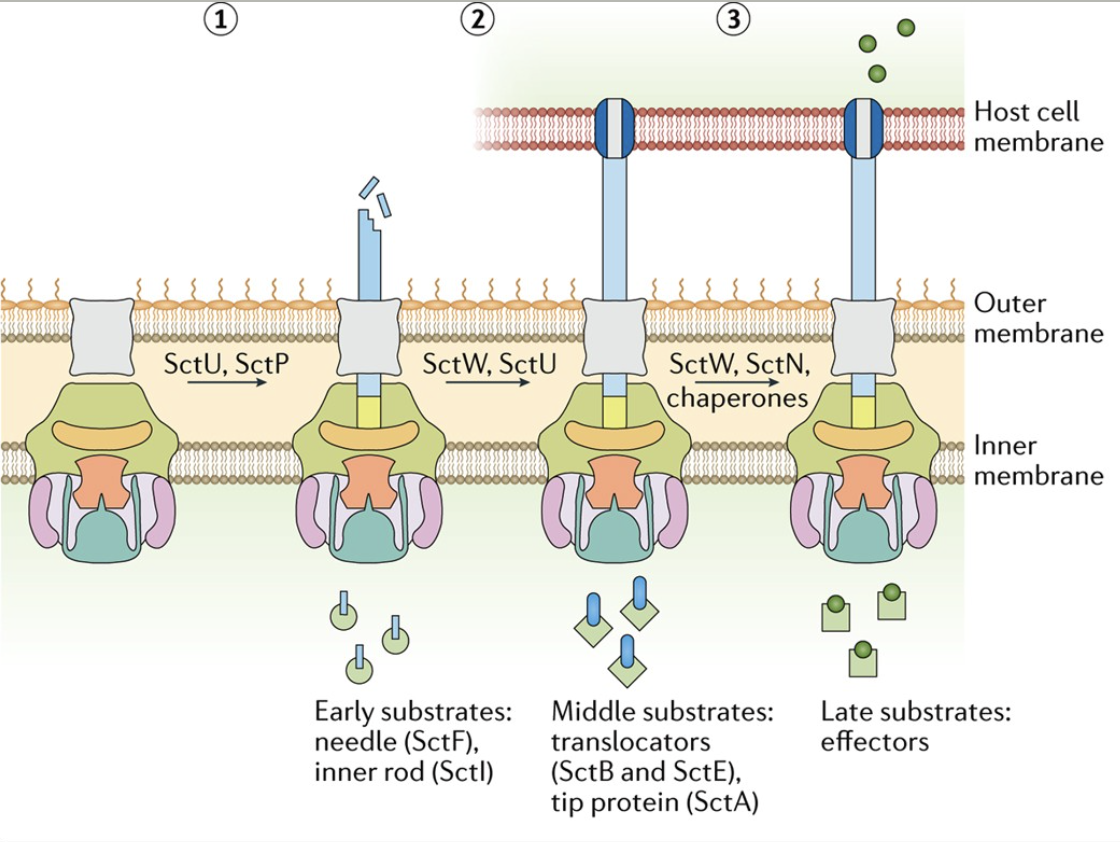
How does Salmonella invade the intestinal mucosa and cause diarrhea?
Uses SPI-1–encoded Type III Secretion System (T3SS)
Nano-needle injects effectors into M cells
Membrane ruffling + invasion
Spreads to Peyer’s patches
Triggers pyroptosis → inflammation → diarrhea.
What does SPI-1 do and what is the clinical consequence?
SPI-1 encodes a T3SS that mediates epithelial invasion and induces pyroptosis → inflammatory diarrhea.
What is the function of SPI-2 in Salmonella?
SPI-2 enables survival inside macrophages by modifying the phagolysosome, preventing maturation, and blocking oxidative killing.
Mutants that cannot survive in macrophages are avirulent.
Compare SPI-1 and SPI-2 in Salmonella pathogenesis.
SPI-1 → intestinal invasion + inflammation → diarrhea
SPI-2 → macrophage survival → systemic spread
What is the role of Salmonella flagella and how are they recognized by the immune system?
Flagella provide motility and chemotaxis, aiding colonization and environmental fitness.
They are recognized by:
Innate immunity: TLR5 (GI mucosa), NLRC4 inflammasome → pyroptosis
Adaptive immunity: B cells and T cells
How does the innate immune system detect Salmonella flagella?
TLR5 recognizes extracellular flagellin.
NLRC4 inflammasome detects intracellular flagellin → triggers pyroptosis and IL-1β release.
What is pyroptosis and why is it important in Salmonella infection?
Pyroptosis is inflammatory programmed cell death triggered by inflammasome activation.
How does pyroptosis help defend against Salmonella?
Infected macrophage undergoes pyroptosis →
Cell bursts → bacteria released →
Neutrophils take up and kill bacteria →
Limits intracellular survival.
Why does pyroptosis contribute to diarrhea in Salmonella infection?
Pyroptosis releases:
IL-1β → fever + inflammation
Intracellular contents
HMGB-1 → activates macrophages
Inflammation → fluid secretion → diarrhea.
Is pyroptosis beneficial or harmful in Salmonella infection?
Both.
Beneficial → Host defense mechanism.
Harmful → Causes intense inflammation and diarrhea.
What is the Vi antigen in Salmonella?
A polysaccharide capsule expressed by Salmonella enterica serovar Typhi that enhances virulence and immune evasion.
How does the Vi capsule increase virulence?
Limits immune recognition
Reduces TLR activation
Decreases inflammation
Increases intracellular survival
Vi-negative strains are less infectious and less virulent.
What is the relationship between the Vi capsule and flagella in Typhi?
They are reciprocally regulated.
When Vi capsule expression is high → flagellar expression is reduced.
This helps Typhi avoid immune detection (since flagella trigger TLR5).
Which Salmonella strains express the Vi capsule?
Typhi (and some Paratyphi).
Non-typhoidal Salmonella (NTS) do NOT express the Vi capsule.
Where is NTS found and what is the usual source of infection?
Lives in animals (poultry, cattle, reptiles)
Contaminated food: undercooked poultry, eggs, dairy, other contaminated ingredients
Can spread human-to-human in rare outbreaks
How does NTS infect the host?
Invades intestinal epithelium via SPI-1 T3SS → M cells → Peyer’s patches
Triggers inflammation and diarrhea
Which of the following is NOT true about Non-Typhoidal Salmonella (NTS) infection?
A. Diarrhea may be bloody, accompanied by fever and stomach cramps
B. Incubation period is typically 6 hours to 6 days
C. Infection usually requires antibiotics to resolve
D. Complications like bacteremia or osteomyelitis mainly occur in immunocompromised patients
E. Infectious dose is relatively high (~10⁵–10⁶ bacteria)
C. Infection usually requires antibiotics to resolve
Does Salmonella NTS and Typhi both use SPI-1 and SPI-2?
Yes
Why does Salmonella Typhi have less intestinal inflammation than Salmonella NTS?
Vi capsule hides flagella → limits TLR5 detection
Lower inflammation
Which of the following is NOT true about typhoid fever (S. Typhi infection)?
A. Humans are the only natural reservoir
B. The Vi capsule helps S. Typhi evade immune detection
C. Most infections are acquired from undercooked poultry or reptile exposure
D. Chronic carriers can shed bacteria in stool or urine for months to years
E. Severe complications can include intestinal perforation, GI hemorrhage, and encephalopathy
C. Most infections are acquired from undercooked poultry or reptile exposure
Typhoid fever is human-adapted
Which of the following is NOT true about typhoid fever (S. Typhi)?
A. The term “typhus” comes from Greek meaning “smoky,” describing delirium in patients
B. Pierre Louis introduced the term “typhoid fever” in 1829 after identifying infected abdominal lymph nodes
C. Karl Ebert identified S. Typhi in 1880
D. In the pre-antibiotic era, typhoid fever had a mortality of less than 1%
E. Worldwide, there are >20 million cases per year, with >200,000 deaths
D. In the pre-antibiotic era, typhoid fever had a mortality of less than 1%
~15%
Which of the following is NOT true about Salmonella Typhi infection?
A. Humans are the only known reservoir for S. Typhi
B. In the U.S., typhoid fever is rare and usually linked to travel
C. The infectious dose is extremely high (~1011 bacteria)
D. Common early symptoms include gradually rising fever, headache, malaise, and lethargy
E. Severe cases can involve bacteremia, sepsis, shock, and meningitis
C. The infectious dose is extremely high (~1011 bacteria)
103-106
Which Salmonella strain is associated with a maculopapular rash known as “rose spots” on the chest/abdomen?
Salmonella Typhi
What is the chronic carrier state in typhoid fever?
Bacterial persistence in the gallbladder without symptoms; excretion in stool/urine for >12 months
Which S. Typhi virulence factor helps it evade immune detection and suppress gut inflammation?
Vi polysaccharide capsule
Name two shared virulence factors between NTS and Typhi.
SPI-1 and SPI-2 Type III secretion systems
Flagella
Which of the following is NOT true about diagnosing Salmonella infections?
A. NTS is usually diagnosed by stool culture; blood culture is used if systemic symptoms or immune compromise are present
B. Stool culture for Typhoid fever is positive in 30–40% of cases
C. Blood culture for Typhoid fever is positive in 40–80% of cases
D. Bone marrow culture is rarely useful and usually negative after starting antibiotics
E. H2S production on Hektoen agar helps identify Salmonella species
D. Bone marrow culture is rarely useful and usually negative after starting antibiotics
What should Salmonella colonies look like on Hektoen agar?
Black colonies
Which of the following agar types is commonly used to identify Salmonella species by H2S production?
A. MacConkey agar
B. Hektoen agar
C. Blood agar
D. Chocolate agar
E. Mannitol salt agar
B. Hektoen agar
Which of the following is NOT typically used to diagnose Non-Typhoidal Salmonella (NTS)?
A. Stool culture
B. Blood culture
C. Bone marrow culture
D. Hektoen enteric agar
E. MacConkey agar
C. Bone marrow culture
Which of the following is NOT typically used to diagnose Typhoid fever (S. Typhi)?
A. Stool culture
B. Blood culture
C. Bone marrow culture
D. MacConkey agar
E. Hektoen enteric agar
D. MacConkey agar
Which of the following is NOT a recommended preventive measure for Salmonella infections?
A. Adequate cooking of food
B. Proper handling of cooked food
C. Avoiding unpeeled fruits and vegetables in endemic regions
D. Regular antibiotic prophylaxis in healthy individuals
E. Sanitation, including pet care
D. Regular antibiotic prophylaxis in healthy individuals
The oral live attenuated Ty21a typhoid vaccine:
A. Is given as a single dose for children ≥2 years
B. Requires 4 doses for individuals ≥6 years
C. Provides lifelong immunity after 1 course
D. Can be taken safely with antibiotics
E. Is an injectable vaccine
B. Requires 4 doses for individuals ≥ 6 years
It’s a live oral vaccine, short-lived, and boosters are required every 5 years. Antibiotics should not be taken concurrently.
Which of the following is NOT true about the treatment of Non-Typhoidal Salmonella (NTS) gastroenteritis?
A. Supportive care with correction of dehydration and electrolytes is essential
B. Antibiotics are generally not recommended for uncomplicated localized NTS
C. Uncomplicated NTS usually resolves in 4–7 days
D. Antibiotics should always be given to all patients to prevent spread
E. Infants under 3 months or immunocompromised patients may need special consideration
D. Antibiotics should always be given to all patients to prevent spread
Which of the following statements about treatment of Non-Typhoidal Salmonella (NTS) is NOT true?
A. Supportive care with correction of dehydration and electrolytes is the mainstay of treatment for uncomplicated cases
B. Antibiotics should be used for all cases of NTS gastroenteritis
C. Infants under 3 months or immunocompromised patients may need special consideration
D. Blood cultures should be obtained in diagnosed cases to evaluate systemic spread
E. Disseminated disease (bacteremia, meningitis, or osteomyelitis) may require extended antibiotic therapy
B. Antibiotics should be used for all cases of NTS gastroenteritis
Which of the following statements about the treatment of Typhoid fever is NOT true?
A. Fluoroquinolones are the drug of choice for Typhoid fever
B. Third-generation cephalosporins or azithromycin may be used if resistance emerges
C. Severe cases with delirium or shock may benefit from corticosteroids
D. Chronic carriers require only 7–10 days of antibiotics
E. Cholecystectomy may be considered for treatment failures
D. Chronic carriers require only 7–10 days of antibiotics
Requires 4 weeks of antibiotics
Which of the following is the main drug of choice for treating Typhoid fever (S. Typhi)?
A. Azithromycin
B. Third-generation cephalosporins
C. Fluoroquinolones
D. Corticosteroids
E. Amoxicillin
C. Fluoroquinolones
Which of the following are reasons antibiotics are generally NOT used for uncomplicated Non-Typhoidal Salmonella (NTS) gastroenteritis? (Select all that apply)
A. Antibiotics can prolong the duration of diarrhea
B. Antibiotics prevent dehydration
C. Antibiotics may promote antibiotic resistance
D. Most healthy individuals recover without antibiotics
E. Antibiotics prevent all transmission of bacteria
A. Antibiotics can prolong the duration of diarrhea
C. Antibiotics may promote antibiotic resistance
D. Most healthy individuals recover without antibiotics
Which type of Salmonella is associated with systemic disease?
Salmonella Typhi
A chronic carrier of Salmonella enterica serovar Typhi: Choose one
typically carries Salmonella in the back of their throat.
is likely to have antibodies against the Vi antigen.
typically feels sick and is aware they are a carrier.
is likely to have antibodies against the Vi antigen.
Why is the Vi antigen of Typhi upregulated when bacteria is inside the host cell?
To mask LPS, reduce immune recognition and inflammation, and promote systemic survival.
The flagella of Salmonella play an important role in colonization of the ______________.
intestinal epithelium