Radiographic Technique for Digital Imaging
 Call Kai
 Learn
Learn Practice Test
 Spaced Repetition
 Match
Match Flashcards
 Knowt Play
1/149

There's no tags or description
Looks like no tags are added yet.
Name | Mastery | Learn | Test | Matching | Spaced | Call with Kai |
|---|
No analytics yet
Send a link to your students to track their progress
150 Terms
In film, technique...
mattered significantly for final image production
in film, kVp =
contrast
less kVp typically indicated higher contrast
in film, mAs =
density
darker meant more mAs
lighter meant less mAs
In digital; brightness, contrast, noise, sharpness, and magnification have all been
tampered with by the time the technologist sees the final image
What is the new king in digital when it comes to technique?
IR exposure
What is techniques primary role?
To ensure that adequate signal reaches the detector system such that computer algorithms can be successful in making corrections and refinements to the image
Tecniques primary role necessitates
high signal to noise ratio
does kVp still control image contrast?
yes but to a degree
kVp still controls he
subject contrast of the remnant beam signal that reaches the detector
subject contrast
The degree of differential absorption resulting from the differing absorption characteristics of the tissues in the body
the percentage penetration of the X-ray beam is
a critical part of ensuring an adequate signal
final digital image qualities are still primarily the
result of the computer operations on the acquired data
no amount of mAs can compensate for
insufficient kVp
what modifies the contrast of the incoming data set?
rescaling
What makes the greatest impact on the contrast displayed in the final image?
LUT applied during gradation processing
The biggest manipulator of image contrast
LUT applied during gradation processing
As long as we have sufficient kVp
Contrast may be further altered after LUT application by
windowing after the initial image is displayed
Primary role of kVp in DR
to provide sufficient penetration to ensure adequate signal reaches detector
Primary controlling factor for grayscale/contrast in DR
LUTs
Primary controlling factor for grayscale/contrast in film-screen
kVp
Primary controlling factor for brightness/density in DR
Rescaling
Primary controlling factor for brightness/density in film-screen
mAs
Primary controller of sharpness for DR
Pixel size
Primary controller of sharpness for film-screen
Focal spot size
Primary controller of magnification for DR
Matrix size
Primary controller of magnification for film-screen
Distancess (SID/SOD) ratio
Primary controller of shape distortion for both DR and film-screen
Alignment
Beam penetration
percentage or ratio of remaining/remnant x-ray photon quantity compared to starting/original X-ray photon quantity
If you had 100 photons to start, and 10 remaining, what is the percentage of penetration
10%
If you have 50 photons of a higher kVp, and 10 remaining, what is the percentage of penetration?
20%
The total exposure at the detector is based on
mAs and kVp
Detector only cares about getting sufficient
quantity to create the image
BUT THIS COMBO OF BOTH STARTING QUANTITY AND PENETRATION
It is extremely important to visualize
subject contrast
What is the percentage of the subject contrast difference between tissues in film?
10% or greater difference in contrast was discernable
What is the percentage of the subject contrast difference between tissues in digital?
It can be as low as 1%
What is the percentage of the subject contrast difference between tissues in CT?
Objects with 0.5% contrast variation
Effects of higher kVp values on production of scatter were previously
over-emphasized
Primary causes of scatter
Patient Size
Collimation
The effects of kVp when compared to tissue volume on scatter are
secondary
Digital equipment is remarkably resilient to the
effects of scatter radiation caused during an exposure
Consider latitude in choosing
exposure factors, including high kVp levels
Research shows that increasing kVp levels by 15% across the board for technique charts has not caused
substantial generation of scatter radiation
and allows for all mAs values to be cut in half
While the impact of increasing kVp by a single 15% step does marginally impact scatter, the impact on contrast of the final displayed image is so
slight as to be generally negligible, and often discernible
Recent research indicates that many radiologists immediately
window images they examine
increasing/decreasing contrast according to the anatomy or particular condition being ruled out
A 15% kVp increase that marginally decreases contrast is
practically irrelevant when the radiologists immediately window contrast to personal preference
How much percentage of magnification should you use for evaluation of mottle?
200%
Mottle is best evaluated by examining a
relatively homogenous tissue, or "smooth" tissue density area
What are some good examples of where you can evaluate mottle the best?
Joint spaces of AP knee
Soft tissue area between transverse process of L5 and scaral ala on AP abdomen
When decreasing mAs and increasing kVp, reviewing images for mottle is not a case of is there mottle, but rather
is there an increase in mottle between images
Recommendation for reducing patient exposure
apply the 15% rule to film techniques for conversion to digital uses
which this is practically already done in DR
By applying the 15% rule to film technique for the conversion to digital uses, the
-surface exposure can be reduced by 1/3
-absorbed dose to the patient can be reduced even more (due to increased penetration)
Exposure latitude (under and over exposure) is defined as
the margin of error in setting technique that a system will allow
Film-screen had a latitude from
-30% to +50% (of ideal exposure)
CR and DR have a latitude margin from
-50% to more than +400%
Underexposure limits are
easy to discern since mottle becomes quickly apparent
Saturation requires how much to be visible
8-10x the normal exposure
a practical upper limit eludes us
Due to the hair-trigger nature for underexposure and the excessive latitude with overexposure limits, what has become the new norm?
Dose creep
Repeat rates have dropped from 5% to
3%
Although repeat rates have dropped, an increase of radiation delivered per exam has been documented at approx
40-50%
What are the 4 factors related to an increase in patient exposure?
1. Popular selection of the 200 speed class on CR/DR systems rather than 300 or 400 that are readily available
2. The irrational resistance to using higher kVps across the board within a department
3. The legitimate fear of image mottle resulting from underexposure
4. The amazing inherent ability of CR and DR to "correct" for overexposure
Myths of CR and DR for kVp
Never use less than 70 kVp
Never use more than 80 kVp
Myths of CR and DR for mAs
This system is mAs driven, adjust mAs only
This system is kVp driven, adjust kVp only
True or false: you cant collimate with CR
false
unless less than 30% of the field is in it
True or false: you cant use grids with CR or DR
false
There is no longer a what in DR for which techniques need to be adjusted
extremity cassette
All procedures in DR are processed at the same speed of
200 or more
Similar thicknesses and tissue densities can share
similar technique
What is an example of anatomy that are similar to one another, that could use similar technique?
Lateral skull
AP C spine
AP shoulder
All 1/2 of a PA skull technique
Skills learned from manual techniques are
essential
For ever 4cm for part thickness
mAs should be doubled
15% rule still
applies
Distance rule of thumb are still
valuable to memorize
When CR was first installed to a location with film, what recalibration was required?
AEC calibration
If AEC is calibrated correctly for CR/DR system, it will work with
reasonable consistency
If mottle is still apparent, the main culprit is likely
continued use of low kVp
high kVp is necessary to assure adequate penetration of the X-ray beam to the AEC detectors
What should you avoid adjusting?
The density setting to +2 or +3
Why should we avoid adjusting the density to +2 or +3?
It will increase mAs unnecessarily
If image mottle is a problem, kVp should be
increased until sufficient signal is reaching the detectors AEC cells
What may be no longer needed as much?
Grids
Why are grids not necessarily needed anymore?
Digital processing can compensate for the effects of scatter, supplanting the traditional purpose of grids
Digital processing is taking over
grids
Virtual grid software literally eliminates need for grid use except for in
the most extreme circumstances
What is the revision of grids in the digital age?
By reducing scatter radiation, grids comprise one method of reducing the overall amount of noise the computer must deal with
In digital, grids reduce
overall amount of noise the computer must deal with
What is moire artifact?
An interference pattern; false presentation of artifactual lines
Aliasing may be also known as
Moire effect
Grid errors are seen more with
CR
Moire: grid error
where grid lines are parallel or near parallel to the scan direction
Short dimension grids
Have grid lines running crosswise rather than lengthwise
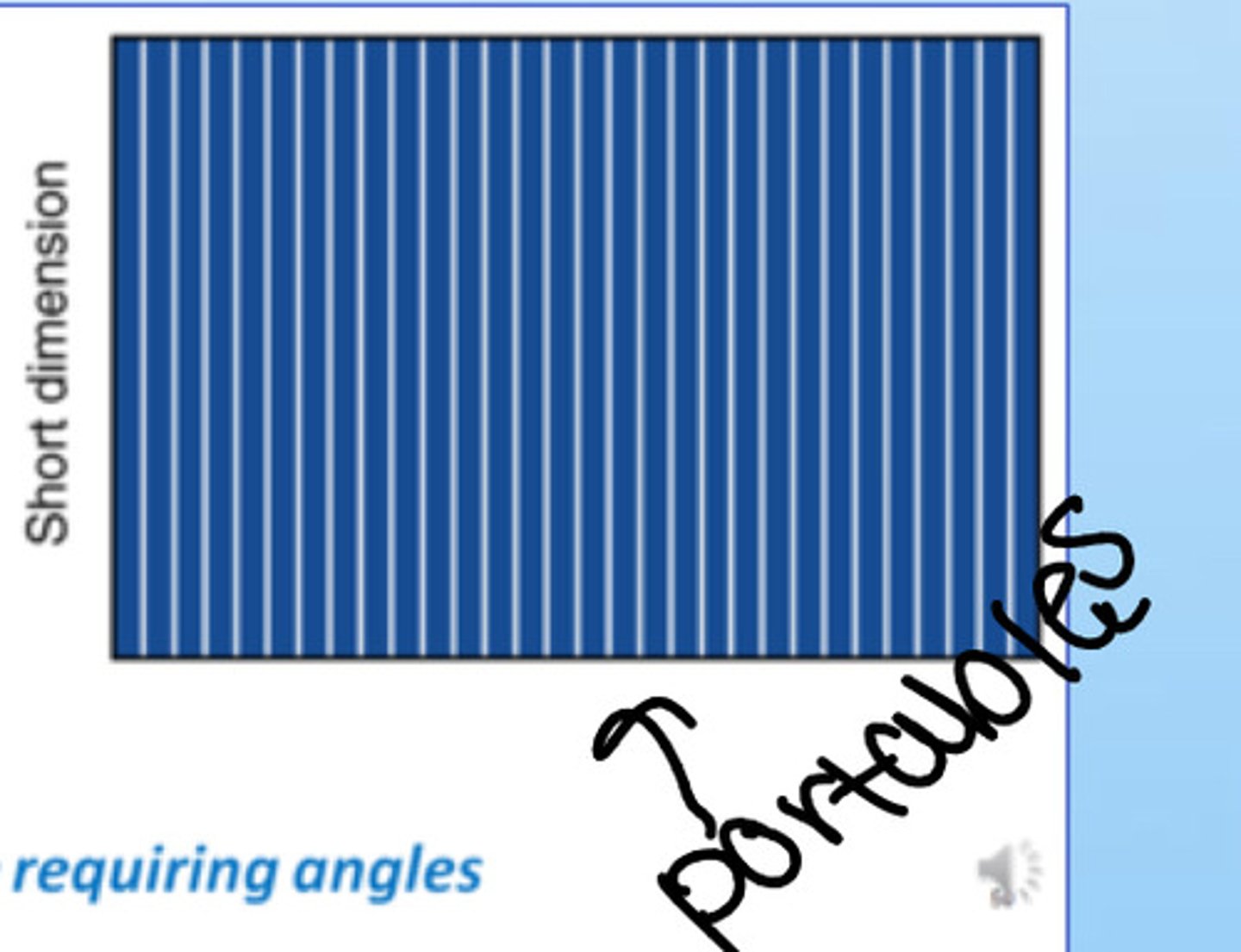
What are short dimension grids beneficial for?
Portables (chest)
The grid lines often run in the same direction as the
scan direction
Aliasing is most significant when
lines are near parallel
Grid/scan direction best orientation
90 degrees
Extraordinary exposure latitude of DR allows for more flexibility in choosing
not to use a grid for anatomic regions somewhat thicker than traditional 10 cm (4'') film-screen threshold
Best practice for grid use with DR
1. Any pediatric procedure for anatomy 13cm (5.1'') or less should be performed non grid
2. Aerated thorax images (chest, t-spine, sternum, ribs, etc.) contain considerable amounts of gaseous air that does not produce significant amounts of scatter; therefore, for routine patient habituses, non-grid techniques may be beneficial (dose savings without degradation of image quality)
3. Use lower grid ratios whenever possible
4. For all mobile procedures, 6:1 ratio grid use is generally recommended
What is the part thickness in which a pediatric procedure should be performed non-grid
13 cm (5.1'') or less
Skull/torso procedures in film-screen needed 10:1-12:1 grids, what grids would you use in DR?
6:1-8:1
For all mobile procedures, what grid ratio is recommended?
6:1
Virtual grid software may
overtake the grid practice in coming years
Which is more acceptable, mottle or scatter?
Scatter