Lecture 11 - Bone pathology
 Call Kai
 Learn
Learn Practice Test
 Spaced Repetition
 Match
Match Flashcards
 Knowt Play
1/82

There's no tags or description
Looks like no tags are added yet.
Name | Mastery | Learn | Test | Matching | Spaced | Call with Kai |
|---|
No analytics yet
Send a link to your students to track their progress
83 Terms
What is the function of osteoblasts? How is it measured?
-Line bone surfaces
-Make osteoid and initiate mineralization
-Measured indirectly through ALP
What is the function of osteocytes? Where are they found?
-Mature osteoblasts surrounded by mineralized bone
-Found in lacunae
What are osteoclasts?
-Cause bone resorption
What is the bone matrix composed of?
Osteoid and bone mineral (hydroxyapatite crystals)
What is osteoid composed of?
Type I collagen and ground substance
What are the two types of bone?
-Cortical bone (dense and strong, surrounds spongy bone)
-Trabecular/spongy bone (found in marrow cavity)
What is Wolff’s law?
-Bone is deposited in sites where it’s needed and resorbed where it’s not
-Allows for remodeling based on mechanical demands
What is the weakest part of bone in young/growing animals?
Growth plate (distal radial physis most commonly affected)
What is a slipped epiphysis/epiphysiolysis?
Complete separation of the growth plate
What causes angular limb deformities?
Growth plate damage is only on one side, other side continues growing
What is a valgus deformity?
Lateral deviation of the limb distal to affected growth plate
What is a varus deformity?
Medial deviation of the limb
What is codman’s triangle? What diseases is it found with?
-Pyramid shaped region of new bone formation
-Osteosarcoma and osteomyelitis
What is exostoses?
Localized outgrowth of new bone beneath periosteum
What are the two main types of bone fractures?
Traumatic - normal bone broken by excessive force
Pathological - abnormal bone broken by minimum trauma
What is a salter harris fracture? What are the 5 types? Which ones heal with few to no complications?
-Fracture of the growth plate
-Type I: through growth plate (heal w/ no complications)
S (Separated)
-Type II: through growth plate and metaphysis (heal w/ few complications)
A (Above GP)
-Type III: through growth plate and epiphysis
L (beLow GP)
-Type IV: through growth plate, metaphysis and epiphysis
T (Through GP)
-Type V: crushed growth plate
ER (ERasure of GP)
What is a comminuted fracture?
Bone shattered into multiple small fragments
What is an avulsed fracture?
Fracture caused by traction of a ligament at point of insertion onto bone
What is a greenstick fracture?
One side of the cortex is broken, no separation or displacement
What is a transverse/spiral/oblique fracture?
Orientation of fracture line
What is a compression/impaction fracture?
Bone fragments are pressed together
What is a displacement fracture?
Orientation of distal fracture compared to rest of bone
What are the four processes of fracture repair? How long does each last?
Inflammation (days)
Soft callus (weeks)
Hard callus (months)
Remodeling (months to years)
What is a soft callus?
-Growth factors stimulate mesenchymal cells to form granulation tissue and cartilage
-Anchors fractured bone ends
What is a hard callus?
Disorganized meshwork of woven bone forming from a soft callus
What is sequestrum?
Fragment of bone becomes separated from blood supply and dies but body is unable to remove
What is pseudoarthrosis? What is this a result of?
Formation of false joint caused from bone healing with fibrous tissue
What is osteomyelitis?
Infection of the bone
What is osteopetrosis? What does it cause?
-Increased bone density due to failure of bone resorption by osteoclasts
-Causes increased amount of trabecular bone and reduced cortical bone causing pathological fractures
-Insufficient bone marrow space causes reduced hematopoiesis
What causes osteogenesis imperfect? What does it cause?
-Mutations in collagen 1 formation (major collagen type)
-Causes increased bone fragility (including teeth), joint laxity, and blue sclera
What causes chondrodysplasia? What does it usually result in?
-Abnormality in growth cartilage
-disproportionate dwarfism (short legged with normal sized heads)
What is spider lamb syndrome? What species?
Condrodysplasia in sheep
What causes spider lamb syndrome? What does it lead to?
-Point mutation in fibroblast growth factor receptor 3
-Causes uninhibited chondrocyte growth and unusually long legs
What are the four main metabolic bone diseases?
Ricketts
Osteomalacia
Fibrous osteodystrophy
Osteopenia/osteoporosis
What is osteoporosis? What are potential causes?
-Decreased bone thickness (normal quality, reduced quantity)
-Calcium deficiency, starvation/malnutrition, physical inactivity, hypogonadism, hyperadrenocorticism, age
What does osteoporosis look like grossly? What may be the first evidence of osteoporosis?
-Grossly: decreased cancellous bone and formation of reinforcement trabeculae
-First sign is usually bone fracture without excessive trauma
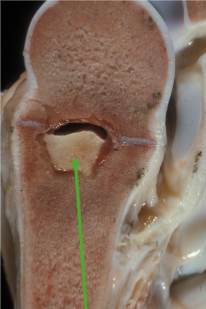
What is the green arrow pointing to?
Sequestrum
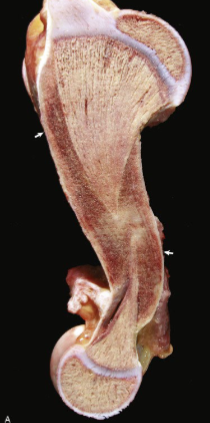
What is this bone showing?
Osteopetrosis
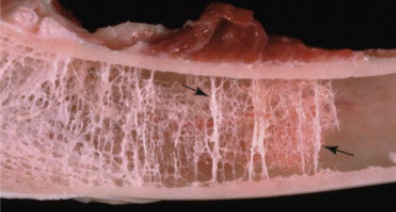
What is wrong with this bone? What are the arrows pointing to?
-Osteoporosis
-Reinforcement trabeculae
What is the difference between rickets and osteomalacia?
Rickets usually occurs in young animals while osteomalacia occurs in adults
What are rickets/osteomalacia?
Abnormal endochondral ossification causing defective bone formation
What is the pathogenesis of rickets/osteomalacia?
-Dietary Vit D/Phos deficiency causing failure of mineralization
-Chronic renal disease, GI malabsorption, hereditary
What are the clinical signs of rickets/osteomalacia?
Pain, pathologic fractures, stiff and lame, reluctance to stand
What are the gross lesions found with rickets?
-Most common in sites of rapid growth (metaphyseal and epiphyseal regions, CCJ)
-Rachitic rosary - abnormally enlarged CCJ
What are the gross lesions found with osteomalacia?
Weak bones, increased fragility
What is fibrous osteodystrophy (rubber jaw)?
-Extensive bone resorption and proliferation of fibrous tissue causing poorly mineralized and immature bone
-Will see weak, flexible bones
What are the main causes of fibrous osteodystrophy?
-Primary hyperparathyroidism (excessive PTH → increased bone resorption)
-Secondary hyperparathyroidism - renal (renal failure) or nutritional (Ca or Vit D deficiency, excess phosphorus)
-Pseudohyperparathyroidism (neoplasms producing PTH)
What are common signs of fibrous osteodystrophy?
-Pliable jaw with protruding tongue
-Bilateral and symmetrical maxillary/facial swelling
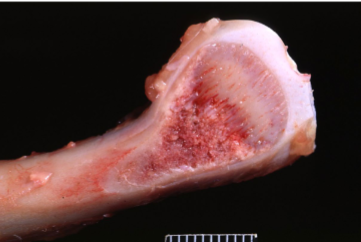
What is this picture showing?
Rickets
What is legg-calve-perthes disease? What species is it common in?
-Avascular necrosis of femoral head
-Small breed dogs
What causes legg-calve-perthes disease? What is the pathogenesis?
-Autosomal recessive
-Idiopathic disruption of capital epiphysis leading to ischemic necrosis
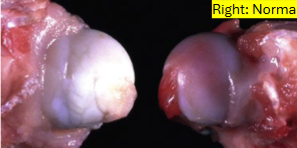
What is this picture showing?
Legg-Calve-Perthes disease
What is osteitis/osteomyelitis?
Inflammation of the bone and medullary cavity
What is periostitis?
Inflammation of the periosteum and bone
What is physitis?
Inflammation at the physis of the bone
What is diskopondylitis?
Inflammation of the vertebral discs and adjacent vertebrae
What are three routes of infection of bacterial osteomyelitis? Which one is common in young animals?
Hematogenous (young animals, especially horses and ruminants)
Local extension
Implantation
Where is a major location for bacterial osteomyelitis in young animals?
Physis
How does bacterial osteomyelitis occur with local extension?
Overlying inflammation extends into bone
How does implantation lead to bacterial osteomyelitis?
Penetrating wound into bone
What is the lesion seen with bacterial osteomyelitis?
Suppurative to necrosuppurative inflammation
What bacteria causes lumpy jaw? What animals?
-Actinomyces bovis
-Cattle
What bone lesions are seen with coccidioides immitis? Where is the predilection site?
-Often subclinical but may see pyogranulomatous inflammation
-Distal diaphysis of long bones
What is the route of infection of cryptococcus? What does this present as?
-Nasal, nasal cavity, lungs
-Swelling on the bridge of the nose (roman nose)
What is the route of infection of blastomyces dermatitidis? What is the most common presentation? What other organs can also be affected?
-Respiratory (inhalation)
-Pneumonia is most common
-Bone, eyes, lymph nodes, skin
What is metaphyseal osteopathy (hypertrophic osteodystrophy)? What animals is it commonly seen in?
-Aseptic osteomyelitis in young, large breed dogs
-Commonly resolves on its own
What are the clinical signs seen with metaphyseal osteopathy? What are the common sites?
-Fever, anorexia, malaise, lameness, swelling and pain
-Loves distal radius and ulna
What will you see on rads with metaphyseal osteopathy (hypertrophic osteodystrophy)? Grossly? On histo?
-Rads: Early lesions with alternating radiodense and radiolucent zones
-Gross: Infractions within medullary bone, bilaterally symmetrical swelling
-Histo: Intratrabecular suppurative inflammation with necrosis
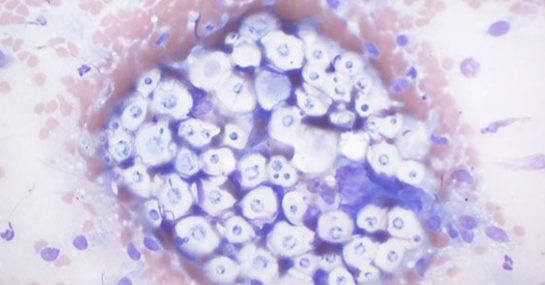
What organism is this slide showing?
Cryptococcus (soap bubble appearance)
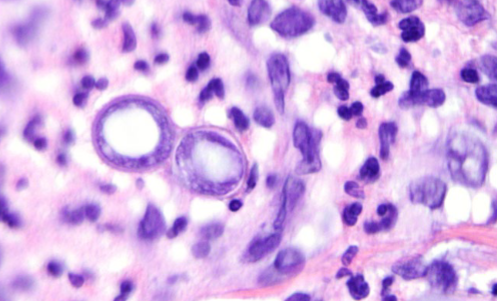
What organism is this slide showing?
Blastomyces dermatitidis (broad, blue based budding)
What are clinical signs seen with canine panosteitis? What kind of dogs does it usually affect?
-Mild to severe lameness, usually resolve after several months
-Usually affects young large and giant breed dogs
What lesions are found on radiographs with canine panosteitis?
Diaphyses of one or more long bones will have increased density in nutrient foramen
What species is hypertrophic osteopathy common in? What is the common lesion found? What is it usually found secondary to?
-Dogs
-Progressive, bilateral new bone formation in diaphyseal and metaphyseal regions
-Usually occurs secondary to space occupying lesion
Where is a bone cyst found? What is found on rads?
-Subchondral, simple, or aneurysmal
-Rads: well-demarcated lucent areas without evidence of aggressive growth
What are 7 primary neoplastic bone lesions? Which is most common?
Ossifying fibroma
Fibrosarcoma
Hemangiosarcoma
Chondroma
Chondrosarcoma
Osteoma
Osteosarcoma (most common)
What are three secondary neoplastic lesions found in bone?
Carcinomas
Sarcomas
Round cell tumors
What are three benign neoplastic lesions commonly found in bone?
Ossifying fibroma
Chondroma
Osteoma
What are 4 malignant neoplastic lesions of bone?
Osteosarcoma
Fibrosarcoma
Chondrosarcoma
Metastatic tumors
What is the site predilection of osteosarcoma in dogs?
-Away from the elbow: proximal humerus and distal radius
-Towards the knee: distal femur and proximal tibia
How do you diagnose osteosarcoma?
-Based on production of osteoid by neoplastic cells
-Do not cross joints
What is a fibrosarcoma? What is a common characteristic?
-Malignant neoplasma of fibroblasts
-No cartilage or osteoid production
What is a chondroma?
Benign term for cartilage lesions
What are the characteristics of a chondrosarcoma? What species is it most common in? What bones does it usually affect?
-Malignant mesenchymal tumors producing cartilaginous or fibrillar matrix (not osteoid)
-Most common in dogs
-Involves flat bones