18. Communication
 Call Kai
 Learn
Learn Practice Test
 Spaced Repetition
 Match
Match Flashcards
 Knowt Play
1/9

There's no tags or description
Looks like no tags are added yet.
Name | Mastery | Learn | Test | Matching | Spaced | Call with Kai |
|---|
No analytics yet
Send a link to your students to track their progress
10 Terms
What produced complex songs?
sexual selection
Syrinx
structure that produces song
Syrinx in sub-oscine passerines
have a tracheal syrinx with few muscles – includes flycatchers, antbirds, woodcreepers
Syrinx in more recently evolved Oscine passerines
(crows, warblers, thrushes, sparrows) have the syrinx at the junction of the trachea and bronchi (B)
• Oscines can produce sound on both sides, and have a complex set of muscles controlling the syrinx
Sequence lateralization in Cardinals
sing frequencies below about 3.5 kHz with left side of their syrinx and higher frequencies with right side
Birds make this switch with such precise coordination that it is not detectable.
phonation switches from the right to left side of the syrinx during the downsweep
Cowbird sequence lateralization
• very rapid 2 or 3 note clusters
• By alternating sides, can adjust silent side of the syrinx to get ready to start that side’s next note without a frequency slur between notes
• A final high-pitched whistle is always sung on the right side
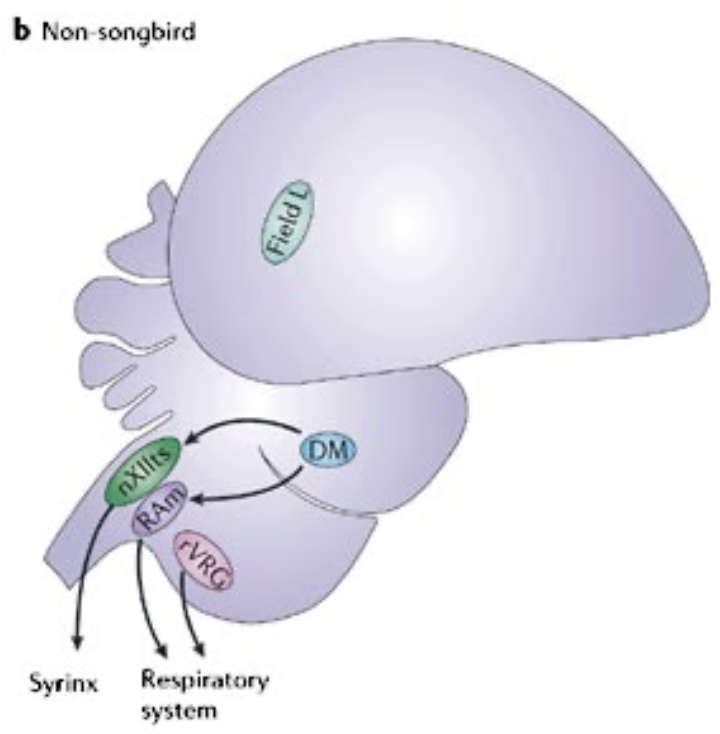
Non-oscine brain wiring
DM (dorsomedial nucleus) controls the syrinx and respiratory system with respect to song
In the forebrain Field L, for auditory input, is not wired to song production (the DM) and there is no song learning
Oscine brain wiring
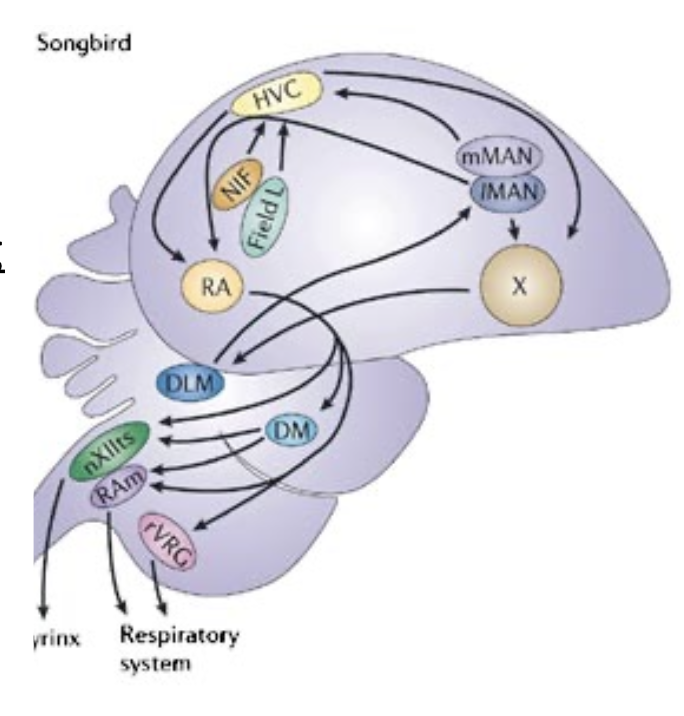
Two critical pathways: song production and song learning
HVC (high vocal center) is central to both pathways
HVC to RA (robust nucleus of arcopallium) to DM wiring triggers song production
Field L (auditory input), is wired to HVC so birds can adjust their song production according to what they hear (song learning)
Crystallization
• Young songbirds learn songs by first listening to adult “models”
• They practice singing (listening to themselves, and comparing that sound to the model stored in their head)
• in some species adults cannot continue to learn songs after crystallization
Savannah Sparrow experiment
put speakers in wild that simulated vocal tutors, young savannah sparrows heard and learned these, then taught them to offspring
birds more likely to learn when songs were played in summer AND spring rather than just summer or just spring